
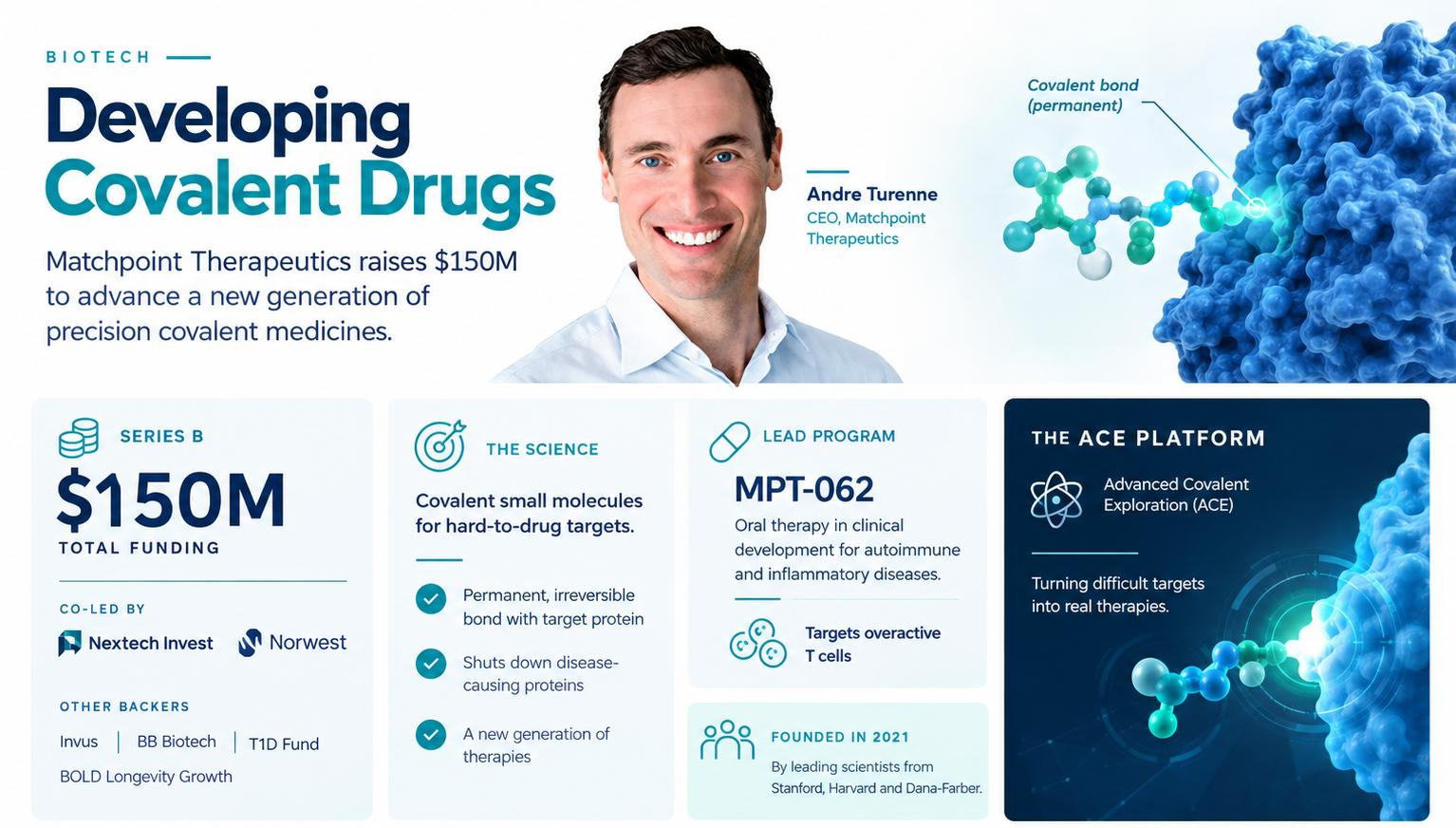
Matchpoint Therapeutics
Precision covalent oral small molecules for autoimmune and inflammatory disease — privately held, Watertown, Massachusetts
Matchpoint is a venture-created biotech incubated by Atlas Venture and Access Biotechnology. It closed a $30 million seed round in November 2021 and emerged from stealth on October 14, 2022. Per company disclosure, the scientific founders are chemical biology, proteomics and computational researchers from Stanford University and Harvard Medical School / Dana-Farber Cancer Institute. The company is headquartered in Watertown, Massachusetts; the 2022 launch release listed Cambridge.
Professor of Chemical and Systems Biology at Stanford University (per the 2022 launch disclosure). Publicly stated that the platform is suited to covalent inhibitors as well as covalent degraders and molecular glues. In our assessment, he anchors the scientific case for modality extensibility.
Associate Professor of Cell Biology at Harvard Medical School and Dana-Farber Cancer Institute (2022 disclosure). The company states that its proprietary chemoproteomics, combined with AI, reaches portions of the proteome that standard methods have not observed.
Dr. Che is affiliated with Dana-Farber Cancer Institute and Dr. Zhang with Stanford University (2022 disclosure). Their specific roles and current positions at the company are not available in public sources, so we describe them at the institutional-affiliation level only.
Per BioPharma Dive, a former Sanofi executive and former CEO of gene therapy developer Voyager Therapeutics. In our assessment, he supplies the commercial and governance depth that an academically rooted founding group typically lacks. He is quoted directly in the Series B release on the clinical entry strategy.
At the October 2022 launch, the board comprised Bruce Booth (Atlas Venture, Chair), Daniel Becker (Access Biotechnology), Jason Hafler (Sanofi Ventures) and CEO Turenne. With the Series B, Kanishka Pothula, Ph.D. (Nextech Invest) and Brian Matesic, M.D. (Norwest) join the board. The full current board roster is not confirmed in public sources.
• Founder titles and affiliations reflect the October 2022 launch release; subsequent changes in roles or advisory arrangements are unverified.
• A third-party database (BounceWatch) lists 32 employees, but the as-of date is unclear and there is no company disclosure to reconcile it against post-Series B headcount. We have not relied on it.
• Senior R&D leadership beyond the CEO (e.g., CSO, CMO) is not named in the Series B release.
Matchpoint is a preclinical, privately held biotech with no marketed products and no disclosed product revenue. Per company disclosure, the operating model has three legs: (i) a proprietary discovery engine, the Advanced Covalent Exploration (ACE) platform; (ii) an internally held lead program, MPT-062; and (iii) option-and-license collaborations with global pharma. Note that the subject was originally framed as a technology company; the business is in substance AI-enabled drug discovery (biotech), and we classify it accordingly.
Per company disclosure, three components: (1) chemoproteomics that identifies novel covalent binders, including to low-abundance proteins, in native cellular environments with proteome-wide selectivity assessment; (2) machine learning to prioritize targets and predict privileged scaffolds; and (3) proprietary covalent compound libraries that evolve with predictive algorithms.
Described as an oral, first-in-class T cell modulator. Series B proceeds are earmarked to reach clinical proof-of-concept and to advance the broader pipeline. Clinical start is planned for 2027; the specific target, mechanism and indication have not been disclosed.
On July 24, 2025, Matchpoint signed an exclusive option and license agreement with Novartis for oral covalent inhibitors directed at a transcription factor linked to inflammatory diseases. Matchpoint leads research through development candidate selection; if Novartis exercises its option, it takes global development and commercialization rights.
Novartis deal structure: Matchpoint is eligible for up to $60 million in upfront payment and research funding and up to $1 billion in total payments (including option exercise fee and development and commercial milestones), plus tiered royalties on product sales, per company disclosure. The program continues alongside the Series B-funded pipeline. The $1 billion is a maximum contingent on option exercise and development success and should not be read as committed revenue.
• The target, mechanism detail, indication priority and any preclinical efficacy or safety data for MPT-062 are absent from the release. The statement that it addresses “disease-causing overactivation of T cells” is an investor quote (Nextech) and is not independently verified.
• BioCentury reported in July 2025 that the company had not named a development candidate or described its pipeline in detail. The timing of candidate nomination and how MPT-062 became the lead asset roughly 15 months later are not disclosed.
• The amount of the “up to $60 million” actually received, and its payment schedule, are not public.
Capital has come from three venture equity rounds (seed, Series A, Series B) plus Novartis collaboration funding. Disclosed seed and Series A proceeds total $100 million; adding the $150 million Series B implies roughly $250 million of equity raised (our simple sum, not a company-reported figure). Novartis upfront and research funding of up to $60 million is non-dilutive and separate. The investor base is characterized by founding-investor and strategic follow-on participation, plus new institutional entrants in the Series B.
The two founding investors co-led the seed round. Atlas’s Bruce Booth serves as board Chair.
Led by Sanofi Ventures with Vertex Ventures HC, Digitalis Ventures, Alexandria Venture Investments and all existing investors. Cumulative funding of $100 million was disclosed at launch, directed to platform advancement and a covalent small-molecule pipeline focused on immunology.
Oral covalent inhibitors against an undisclosed transcription factor. BioCentury noted at the time that no new financing round had been announced since October 2022; in our assessment, this deal was the key funding and validation event between Series A and Series B.
New investors Invus, BB Biotech, T1D Fund and BOLD Longevity Growth joined. Founding investors Access Biotechnology and Atlas Venture, Series A lead Sanofi Ventures, Digitalis Ventures and all other existing investors participated. Proceeds support MPT-062 through clinical proof-of-concept and pipeline expansion, with the clinical start planned for 2027.
• Size: $150,000,000 (closed; announced October 7, 2026)
• Co-leads: Nextech Invest, Norwest
• New investors: Invus, BB Biotech, T1D Fund, BOLD Longevity Growth
• Existing investors: Access Biotechnology, Atlas Venture, Sanofi Ventures, Digitalis Ventures and all other existing investors
• Board changes: Kanishka Pothula, Ph.D. (Nextech) and Brian Matesic, M.D. (Norwest) join the board
• Use of proceeds: MPT-062 clinical proof-of-concept, broader pipeline advancement, and continued progress on the Novartis-funded program
• Valuation not disclosed: Pre- and post-money valuation and dilution for the Series B are not provided in the release or in any secondary source we reviewed. We do not offer an estimate.
• No allocation by investor: The split between the two co-leads and the new and existing investors is not disclosed. A high insider share would, in our assessment, limit the price-discovery signal of the round.
• Cumulative funding tallies differ: Our approximately $250 million equity figure is a simple sum of disclosed rounds (seed $30M + Series A $70M + Series B $150M), not a company-reported total. Caplight lists total funding of $130 million as of July 2025, versus $100 million of disclosed equity at that date; its basis (for example, whether Novartis funding is included) is unclear.
• Headquarters labeling: The 2022 launch release cites Cambridge, Massachusetts; 2025 and later releases cite Watertown. A relocation is not confirmed, and we follow the latest disclosure.
Matchpoint’s differentiation rests on a discovery engine that integrates chemoproteomics, machine learning and covalent libraries; relationships with two large pharma-linked counterparties (Sanofi Ventures and Novartis); and an oral-dosing positioning in immune-mediated disease. Because the company is preclinical, the assessment below addresses the structural strengths of the platform; clinical differentiation has not been demonstrated.
The central concern with covalent drugs is off-target liability from irreversible binding. The company states that ACE assesses selectivity across the proteome in native cellular environments early in discovery (self-reported). Whether this translates into clinical safety is unproven, but applying a selectivity filter at the candidate-selection stage is, in our assessment, a sound design principle.
The company says it can detect novel covalent binders at active, allosteric and cryptic sites on targets that have eluded drug discovery. The Novartis collaboration targets a transcription factor, a class generally regarded as difficult for small molecules; success here would, in our assessment, materially raise the value of the platform.
Novartis committed up to $60 million in upfront and research funding, with up to $1 billion in total potential payments, on a preclinical program, and Sanofi Ventures led the Series A and followed on in the Series B. These are external validation signals, though option exercise remains at Novartis’s discretion and should be distinguished from commercial certainty.
Autoimmune and inflammatory disease has been dominated by injectable biologics, so an oral small-molecule alternative offers a convenience differentiator (company and 2022 BioWorld framing). The Series B added specialist healthcare investors (Nextech, Norwest, Invus, BB Biotech), and full existing-investor follow-on suggests funding visibility through clinical entry.
Governance implications: The structure pairs a Stanford and Harvard/Dana-Farber academic founding group with a CEO who has Sanofi and Voyager experience, and a board anchored by Atlas, Access and Sanofi Ventures. This combines scientific credibility with commercialization oversight. However, the founders’ day-to-day involvement is unconfirmed, so execution capability likely depends heavily on the management team.
For a preclinical biotech, value is driven largely by clinical proof-of-concept and partner option decisions. The following reflects our assessment based on public information.
- No clinical data: The lead asset, MPT-062, is slated to enter the clinic in 2027; there is no human safety or efficacy evidence.
- Covalent safety uncertainty: Irreversible binding has historically raised off-target and immunogenicity concerns; the company’s selectivity claims are self-reported.
- Non-committed Novartis option: Option exercise and milestones depend on Novartis’s discretion and development success; $1 billion is a ceiling, not a forecast.
- Valuation opacity: Absent pricing information, return expectations at a later round, IPO or M&A are difficult to frame.
- Competitive intensity: Oral immunology small molecules attract many competitors, and undisclosed target and mechanism limit our ability to assess differentiation.
- Clinical PoC re-rating: Early clinical data after 2027 is likely the largest near-term value inflection.
- Novartis option cash flows: Option exercise fee, development and commercial milestones and tiered royalties could provide non-dilutive funding over the medium term.
- Platform extensibility: If the company’s claim of applicability to degraders and molecular glues is borne out, additional partnering opportunities widen.
- Funding runway: The $150 million raise alongside Novartis funding reduces financing risk through proof-of-concept, in our assessment.
- Strategic interest: Existing relationships with Sanofi and Novartis could form a basis for future partnering or M&A discussions (our inference; nothing has been disclosed).