
Simple Energy
Bengaluru-based electric scooter OEM — pivoting from a long-range, vertically integrated premium niche toward mass-market volume and a large-scale capacity build-out
Simple Energy (legal entity: Simpleenergy Private Limited) was founded in Bengaluru in 2019. Per company accounts, the idea originated when the founder was shopping for a two-wheeler for his family and his father said he did not trust electric vehicles on long trips. In our assessment, management framed range anxiety as the unaddressed gap in the Indian E2W market and built the product roadmap around long-range capability from the outset.
First-generation entrepreneur from Bengaluru; graduated in architecture from Siddaganga Institute of Technology in 2013. He has said he built technical capability through self-directed learning rather than a formal automotive background. Reporting on his prior ventures is inconsistent (multiple prior startups per one outlet; a robotics startup per another). He was reported in March 2026 to lead a team of more than 450.
Civil engineering graduate (BBDNIIT, Lucknow). Reportedly skeptical of the idea at first before investing and joining as co-founder. Early reporting indicates the two founders funded roughly 70% of the initial capital themselves, with an early investor covering the balance. Named to Forbes Asia 30 Under 30 (2025).
Joined as a later co-founder and leads finance. Disclosed as an equity participant in both the June 2026 Series B and the September 2026 Series C; per Inc42, the CEO and CFO each committed ₹13.5 Cr in the Series B.
Poojary is listed as Founding Partner and CTO and, alongside Mishra, appeared on the Forbes Asia 30 Under 30 (2025) list. Inc42 Datalabs lists Sable as Chief Product Officer and Founding Partner. Some databases count five founders, so the definition of “founder” is not applied consistently across sources.
Analyst view: The leadership team leans on product conviction and in-house engineering rather than conventional automotive pedigree. The CFO’s status as both co-founder and round participant is a positive for alignment. We would, however, watch for the addition of external executives with OEM mass-production experience as volumes scale.
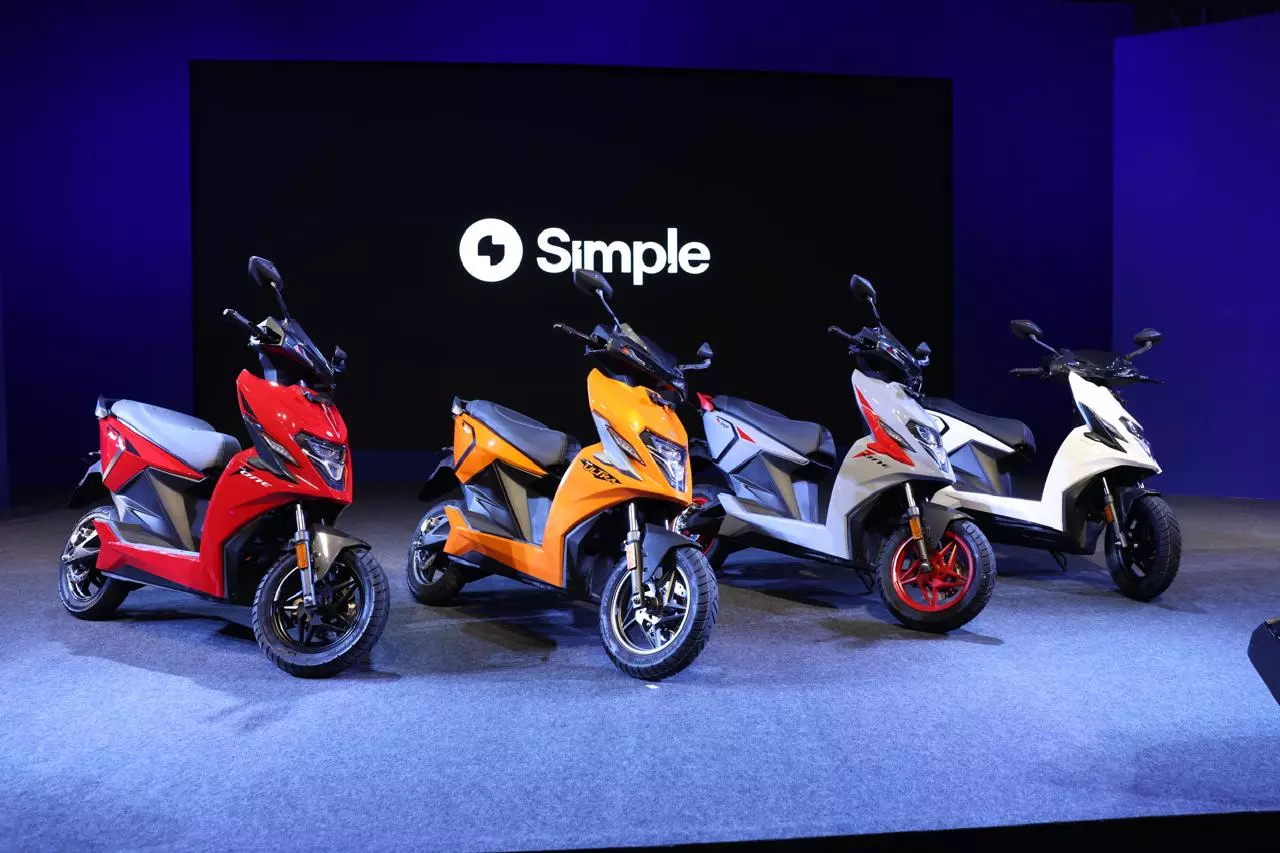
We characterize Simple Energy as a small OEM expanding from a high-performance, long-range premium position into the family scooter segment. Following the Simple One’s customer rollout in 2023, the lineup has grown to four lines — One, OneS, Ultra and Wave. Per available reporting, the company entered the monthly top-10 electric two-wheeler OEM ranking in February 2026, having ranked 13th in CY2025.
One Gen 2 is rated at 236–265 km IDC and OneS Gen 2 at 190 km. The Ultra, launched in April 2026, pairs a 6.5 kWh dual-pack battery (5 + 1.5 kWh) with a claimed 400 km at ₹2.35 lakh ex-showroom (Bengaluru). Direct competitors include the Ola S1 Pro, Ather 450 Apex and TVS iQube ST.
Launched on September 2, 2026 from ₹1.10 lakh across six configurations (2.2–5 kWh, 110–243 km IDC), with deliveries slated from September 25. It targets the largest sub-segment in E2W and competes head-on with the TVS iQube, Bajaj Chetak, Hero Vida and Ather.
The Hosur (Shoolagiri), Tamil Nadu plant is operating. The retail network is targeted to roughly double from 80 outlets to 160–170 by March 2027. Per the CEO, Series C priorities are a new manufacturing facility, higher output, expanded distribution and service, and next-generation products.
Financial and volume momentum: Per the founder, FY26 revenue was approximately ₹170–171 Cr versus ₹40–44 Cr in FY25, roughly a fourfold increase. Autocar India tallies 10,429 units sold in January–August 2026 (18,556 since sales began in 2023), with a monthly peak of 1,780 units in March 2026. August volumes of 1,508 units indicate a plateau-to-softer trend; whether revenue growth converts into sustained monthly volumes is, in our view, the key variable to monitor.
• Capacity: The June 2026 Series B announcement cited 3,000 units/month (utilization of ~35% per Dealroom); the September 2026 Series C coverage cites 10,000 units/month; September 2025 coverage cited 150,000 units/year at Hosur; and the 2021 plan referenced 1 million units/year. Against monthly sales near 1,500, a demand-versus-capacity gap is evident. The company said a battery-line expansion would begin to show from August 2026.
• Revenue: FY26 revenue is founder-stated and unaudited as far as we can verify. The CEO previously projected FY24 revenue of ₹1,600 Cr, whereas Inc42 Datalabs records FY24 revenue of ₹9.7 Cr+. At the 2024 Series A, the company also targeted ₹150 Cr in FY25 top line versus the ₹40–44 Cr now reported. We apply a conservative discount to management guidance given this track record.
• Self-reported claims: 90%+ in-house components, the first Indian OEM to commercially produce heavy rare-earth-free motors, and a lifetime motor-and-battery warranty rest on company statements or secondary sources. Some outlets cite a 5-year/50,000 km warranty for the Ultra.
Simple Energy’s capital structure has relied heavily on patient family-office and HNI capital rather than conventional institutional VC. The family office of Thyrocare founder Dr. Arokiaswamy Velumani has led essentially every round since 2024. The $180M Series C announced on September 30, 2026 closed roughly three months after the prior round and is the largest in the company’s history.
The company was founded in January 2019 with the two founders contributing roughly 70% of initial funding. A seed round in November 2021 is recorded in databases, with Dealroom listing Manish Bharti and Raghunath Subramanian among seed investors.
Participants included the Haran, Velumani, Vasavi and Desai (Apar Industries promoter group) family offices, among others. Proceeds were earmarked for Simple One and Dot One production and national distribution. Per EVreporter, sales in the first half of 2024 were just 524 units, all in Karnataka.
Led by the Velumani family office, with Balamurugan Arumugam and the Haran family office participating. Cumulative funding at the time was stated at $51M, and Inc42 reported an IPO target of roughly $350M in FY27.
Led by the Velumani family office with CEO and CFO equity participation. Of the total, ₹123 Cr was debt from HDFC Bank, Capitar Ventures and NBFCs, implying equity of roughly ₹127 Cr. Approximately 70% of proceeds were directed to working capital and production ramp-up and 30% to marketing, sales and R&D. Dealroom noted the absence of a marquee VC and a reliance on founder capital and debt.
Led by the Velumani family office, with the Haran family office, angel investor Amit Mishra, founder Rajkumar and CFO Gupta participating. The company puts cumulative equity raised at $264M (₹2,530 Cr). Proceeds are allocated to a new manufacturing facility, higher production, distribution and service expansion, next-generation products, and marketing, supply chain, R&D and hiring.
• Round size: $180M (₹1,750 Cr, per Inc42)
• Lead investor: Dr. Arokiaswamy Velumani Family Office (led the prior three rounds as well)
• Cumulative equity raised: $264M (₹2,530 Cr, company figure)
• Use of proceeds: New manufacturing facility, higher output, distribution and service network, next-gen products, marketing, supply chain, R&D, hiring
• Valuation: Not disclosed
• Series C amount conflict: The Dealroom summary text cites US$237.7M (roughly $182M), which is inconsistent with its own headline ($180M) and with Inc42 (₹1,750 Cr). We adopt Inc42’s $180M (₹1,750 Cr) as the base figure and flag a possible conversion error.
• Cumulative funding: The company-stated $264M compares with $343.6M in Dealroom’s text. Because the Series B included ₹123 Cr of debt, the definition of “total equity raised” (whether debt is included) is unclear. The Series B dollar equivalent also varies: $26.3M (Inc42), roughly $29M, and $34M (Dealroom’s Series C article).
• Undisclosed: Pre-/post-money valuation, primary versus secondary mix, instrument type, dilution, and prior-round labeling (PitchBook records a separate Series A in March 2022). A $200M valuation figure for November 2021 comes from a single database and is unverified.
We summarize Simple Energy’s moat as “technical differentiation present, scale economies not yet secured.” With the top four incumbents (TVS, Bajaj, Ather and Hero Vida) reported to have crossed one million combined E2W unit sales in 2026, a company selling roughly 1,500 units a month must defend share on product merit as a challenger.
In-house development of the motor, controller, BMS, battery pack and software is the central differentiator, and the company claims 90%+ in-house content. Reduced external dependence supports cost and quality control in principle, but the figure is not independently verified.
Claimed IDC ranges of 400 km (Ultra), 265 km (One) and 243 km (Wave+) sit at the top of their respective segments, with 0–80% fast charging in about 2 hours 15 minutes. IDC figures can diverge from real-world range, so customer-experience validation is required.
The company asserts it is the first Indian OEM to commercially manufacture heavy rare-earth-free motors. With rare-earth magnet import dependence and geopolitical supply risk in focus, we see medium-term optionality on cost and sourcing stability if the claim holds.
Repeat follow-on funding from the Velumani family office and founder/CFO equity participation improve funding continuity. The Wave extends the price ladder from ₹1.10 lakh to ₹2.35 lakh. The flip side is limited external validation from institutional VCs.
Investment view: Upside drivers are (1) rapid revenue growth, (2) entry into the family segment and (3) the potential for cost improvement from new capacity. Risks are (1) a plateau in monthly volumes and the gap between capacity and utilization, (2) a record of missed management guidance, (3) price competition from better-capitalized rivals (e.g., Ather Konarc at ₹99,999) and (4) leverage from the blended debt-equity funding structure. We would anchor on three to six months of monthly sales and utilization data following the Wave delivery start (September 25, 2026).