
GMI Cloud
An NVIDIA reference-platform GPU cloud and inference operator — a capital-intensive neocloud that repurposed Bitcoin-mining data center assets for AI workloads
GMI Cloud is a GPU cloud operator founded in 2021 by Alex Yeh. For roughly its first two years it operated U.S.-based data centers hosting Bitcoin mining nodes. Per company and founder accounts, management recognized the surge in GPU compute demand in 2023 and pivoted to AI cloud infrastructure within about 30 days. In our assessment, this is best read as a redeployment of power- and cooling-ready data center operating capability toward AI workloads.
Prior roles reported across Credit Suisse, CDIB (managing a portfolio of roughly $200M tied to a China Life private equity fund), Realtek Family Office (investment director) and Infinity Ventures Crypto, a Headline Group affiliate (partner). Self-described as having launched Taiwan’s largest crypto fund at age 25. Johns Hopkins alumnus. We read the profile as an investor-turned-operator rather than an engineering founder, which is consistent with the company’s capital-raising execution.
The company states its AI and HPC specialists come from Google X, Alibaba Cloud and Supermicro and that the team holds more than 30 AI-related patents. Individual executive rosters and the patent list could not be independently confirmed.
Headline Asia (founding partner Akio Tanaka) led the 2024 Series A alongside Banpu’s venture arm, a Thai energy group reported to supply power to GMI’s operations. Energy and manufacturing value chains are thus embedded in the early shareholder base.
Taiwanese electronics manufacturer Wistron is both a Series A investor and a reported product co-development partner. CTBC is the lead bank on the new credit facility. Together they underpin the founder’s argument for proximity to Taiwan’s server supply chain.
• Founder career history rests on company-provided profiles, conference bios and secondary databases; tenures and titles are not independently verified.
• On the “U.S. company” framing: the press release lists Mountain View, California (earlier materials cite Santa Clara and San Jose), yet many outlets describe GMI as Taiwan-based, and its assets, lenders and operating center of gravity sit in Taiwan. We frame it as a U.S.-domiciled entity with Taiwan-centered operations.
• Founding year is reported variously as 2021 (company, most outlets) and 2022 or 2023 (some outlets, apparently conflating the AI pivot date).
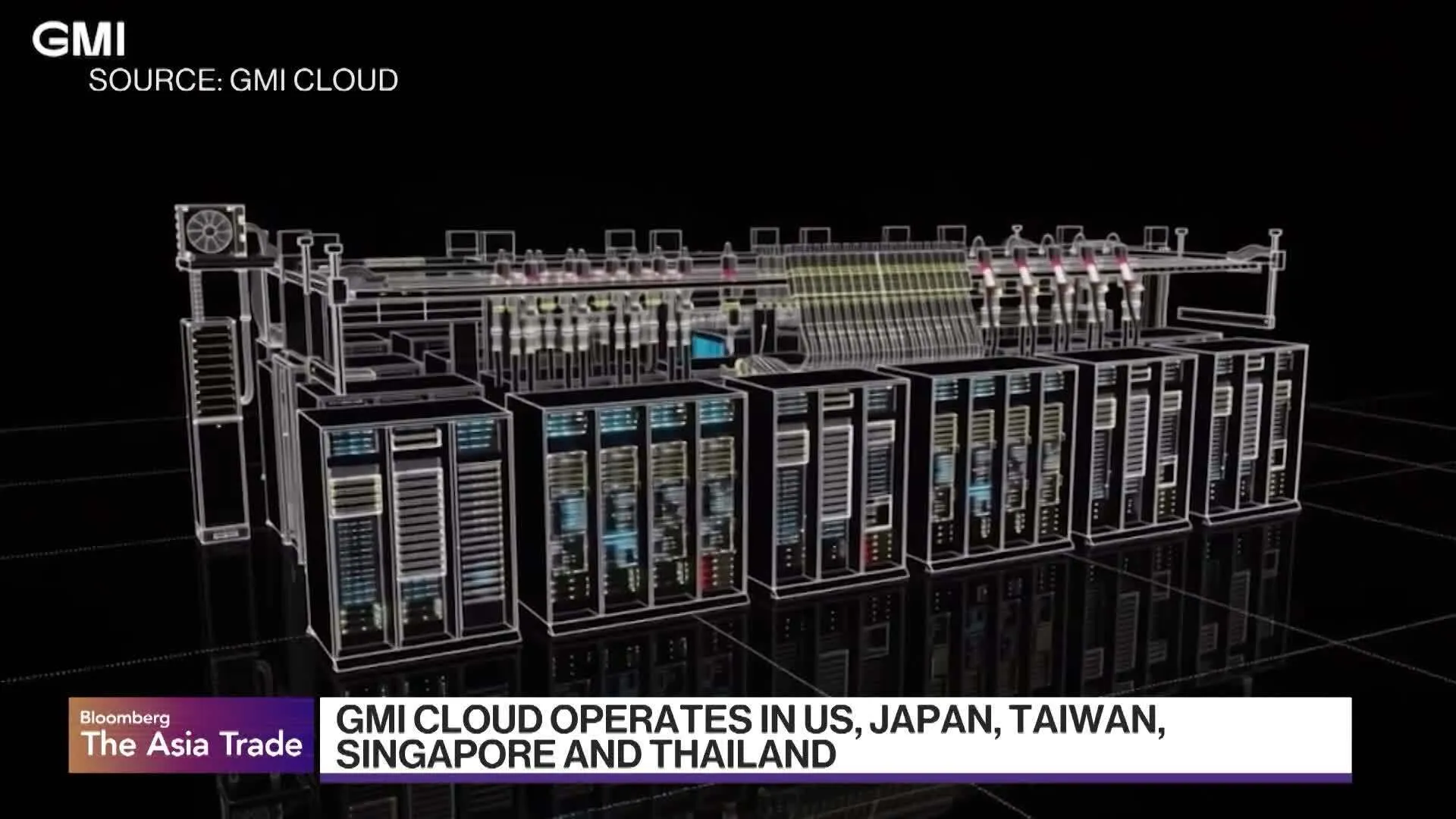
GMI Cloud operates two core lines: GPU infrastructure-as-a-service, renting NVIDIA GPUs (H100, H200, GB200/GB300 NVL72 and others) on-demand or by reservation, and an inference platform serving models via API. Data center footprint is reported across the U.S., Taiwan, Singapore, Thailand and Japan. The economic essence is a leasing-style model: fixed-cost GPU assets are amortized against long-term contracted revenue, making the pace of contract-to-live conversion the central variable.
(vs. YE2025)
(Dollar Value Undisclosed)
Processed
Latest-generation NVIDIA GPU clusters offered on-demand and as private cloud. Long-term committed capacity is the core sale, with asset build-out supported by debt financing.
Model inference via API. Disclosed customers include Fireworks, Higgsfield, Nous Research, OpenRouter, Reflection, Cartesia, Trend Micro and Utopai Studios.
Cluster Engine, a proprietary Kubernetes-based orchestration and resource-management platform, plus GMI Studio, a visual AI workflow tool launched in January 2026, extend the stack upward.
Expansion pipeline: (1) Taoyuan, Taiwan “AI Factory” — announced November 2025 at roughly $500M, with about 7,000 GB300 GPUs across 96 racks and ~16MW planned, housed in a Vantage Data Centers facility (per DCD). (2) Japan — a $12B sovereign AI infrastructure initiative announced March 2026. (3) A Colorado data center and a sovereign AI factory collaboration with Magna AI. Linkage of the new capital to these projects is per company statements.
• Only contracted ARR (>$600M) is quantified in dollars; live ARR is given solely as a growth multiple (>4.5x), so the contract-to-live gap cannot be sized. Some outlets round to “10x / 5x,” differing from the release’s “more than 9x / 4.5x.”
• All usage and ARR figures are self-reported with no independent verification located. Gross margin, GPU count and utilization are undisclosed.
• Taoyuan capacity is cited as ~16MW by GMI versus 25MW total facility power by Taiwan Mobile; GMI’s allocated share is not established.
GMI Cloud’s capital structure follows the classic neocloud pattern of pairing equity with asset-backed debt. Of the $668M headline, equity (Series B) is only $223M, about 33%, while roughly 67% is a credit facility led by CTBC. In our view the split reflects separate funding for the company ($223M) and for hardware ($445M); treating the two as a single round is inappropriate for valuation or dilution analysis.
Launched as a U.S. Bitcoin-mining data center operator and pivoted to GPU cloud in 2023. No external funding was identified for this period.
Led by Headline Asia with Banpu NEXT and Wistron participating. With 82% of the round in debt, reliance on asset financing was evident from the outset. Proceeds supported the opening of a Colorado data center, among other uses.
Large-scale capacity plans structurally expanded financing needs. Announced figures represent planned scale, not deployed capital.
Reported as a multi-tranche facility backed by customer contracts: a five-year NT$13.9B syndicated term loan, a NT$6.4B 12-month bridge and a NT$150M revolver, with the latter two provided by CTBC. The stated use is the Taoyuan AI Factory.
Equity: Led by ARCHIV, a newly formed San Francisco AI and robotics investor, with NVIDIA participating alongside Redwood, DSC Investment, KB Investment, Kyobo Life, KT Corporation and Trend Micro. Debt: A credit facility led by Taiwan’s CTBC. Valuation was not disclosed. The simultaneous participation of four Korean institutions is notable; we read it as a signal of credibility in Asian capital markets but classify individual allocations as unconfirmed.
• Equity (Series B): $223M · Lead ARCHIV · NVIDIA participating
• Debt: $445M credit facility · Led by CTBC (rate, tenor and covenants undisclosed)
• Total: $668M · approx. 33% equity / 67% debt
• Use of proceeds: Capacity expansion in the U.S., Taiwan and APAC (per company)
• Overlapping interests: NVIDIA (supplier and investor); Trend Micro (investor and customer)
• The release states $668M ($223M + $445M), while some outlets cite the credit facility at $440M and the total at $663M. We anchor on company-disclosed figures and preserve the conflict. The requested MarketWatch article was inaccessible to us; we cross-referenced the syndicated press release and secondary coverage.
• Whether the new $445M facility overlaps with, includes or is separate from the NT$20.45B loan package reported in August–September is not established.
• Series B valuation, primary versus secondary composition and individual investor allocations are undisclosed.
GMI Cloud’s edge rests less on proprietary technology than on supply access, geographic proximity and capital-raising networks. We assess four factors, with attention to durability.
The company presents itself as Taiwan’s first NVIDIA Certified Partner and one of a small group of reference-platform partners (reported as six or seven depending on source). NVIDIA’s equity participation in this round deepens the supply relationship. However, peers hold comparable status and the dependence on NVIDIA is high, so we do not view this as a standalone moat.
The founder argues that proximity to server manufacturing shortens the lag between contract signing and go-live. Wistron (investor), CTBC (lender) and Taiwan Mobile (facility partner) form a supportive local network. Proof will come in the conversion speed of contracted ARR into live revenue.
By layering Cluster Engine, an inference API and GMI Studio above GPU rental, the company seeks to reduce exposure to pure price competition. Inference volume (about 4T tokens weekly, self-reported) and developer touchpoints could create switching costs, but margin contribution is undisclosed.
Combining APAC strategic and financial investors (KT, KB, Kyobo, DSC, Trend Micro) with CTBC’s bank line is a tangible advantage in a capital-intensive business. Lender willingness to finance against customer contracts is an indirect signal of contract quality, though repayment schedules run regardless of utilization.
Our overall assessment: The sharp rise in contracted ARR and the concurrent participation of NVIDIA and APAC institutions point to demand visibility. Given the absence of a dollar figure for live ARR and the roughly 67% debt share, the decisive variables for investors are the speed of contract-to-live conversion and the depreciation and resale value of GPU assets.
- Leverage: About two-thirds of the new capital is debt, with repayment independent of utilization.
- Contract-to-live gap: Contracted ARR ($600M+) versus undisclosed live revenue.
- Asset obsolescence: GPU generation cycles may erode collateral value and re-lease pricing.
- NVIDIA dependence: Supply, investment and partner status concentrated in a single vendor.
- Customer concentration: Disclosed customers skew to AI start-ups, implying potential credit dispersion.
- Demand visibility: Contracted ARR up more than 9x and expanding inference traffic.
- Sovereign AI: Regional hubs such as Japan can capture government and enterprise demand.
- Higher-layer expansion: Inference and workflow services may improve the margin structure.
- Capital market access: Diversified equity and bank lines support expansion pace.