
Kahua
AI enterprise construction platform for complex capital programs — Alpharetta, Georgia; minority growth investment from Bain Capital Tech Opportunities
Kahua was founded in 2009 by the team that built and sold Constructware to Autodesk; per Tracxn, the company was formerly known as Integrated Lifecycle Solutions. Per company disclosure, the founders chose not to repeat the SaaS playbook and instead built a configurable platform. In our assessment, this pairs proven domain credibility with a platform-first strategy.
Began on the contracting side as co-founder of Nix-Unger Construction, then helped pioneer early web-based SaaS project controls at Constructware. Launched Kahua with Moore after the Autodesk acquisition (per company leadership page). Frames the thesis around durable, configurable, governance-oriented software for owners.
Joined Autodesk’s executive team after its 2006 acquisition of Constructware and scaled construction technology there. Co-founded Compliance360, a compliance-management software company (per company leadership page). Long-standing partner of Unger dating to Constructware.
Identified as CTO in a 2025 company announcement regarding Microsoft Ignite (via CB Insights). Presumed owner of the AI and cloud roadmap; detailed background not verified in our review.
Investor-side lead on the transaction. Per the release, Bain intends to apply its experience scaling technology businesses as Kahua expands across markets. Any board composition changes are undisclosed.
• Co-founder count: the company and Tracxn center on two founders (Unger and Moore); The Org states seven industry veterans co-founded the company in 2009. We do not resolve this to a single figure.
• Origin narrative: a secondary report (Greek outlet) describes Kahua as founded upon leaving Autodesk, whereas company materials describe a restart after the Constructware exit. This may be a framing difference; exact departure and founding dates are unverified against primary sources.
Kahua is a capital-program management (PMIS) platform that places owners, program managers and contractors in a single governed environment. Per company disclosure, it has reached $100M in annualized revenue, serves 2,500+ customers and supports $400B+ in capital programs on the platform. All figures are self-reported; we found no independent verification.
Customers and partners build or modify apps on kBuilder, an enterprise low-code platform; public apps are distributed via the kStore marketplace. A third-party review site cites 600+ apps built, which is not a company disclosure and is treated as indicative only.
The company cites FedRAMP authorization since 2022, plus SOC 2 Type 2 and ISO 27001. In June 2026 it announced federal approval for AI within its FedRAMP boundary, claimed as an industry first (self-reported). Target verticals include federal and defense, transportation, healthcare and education.
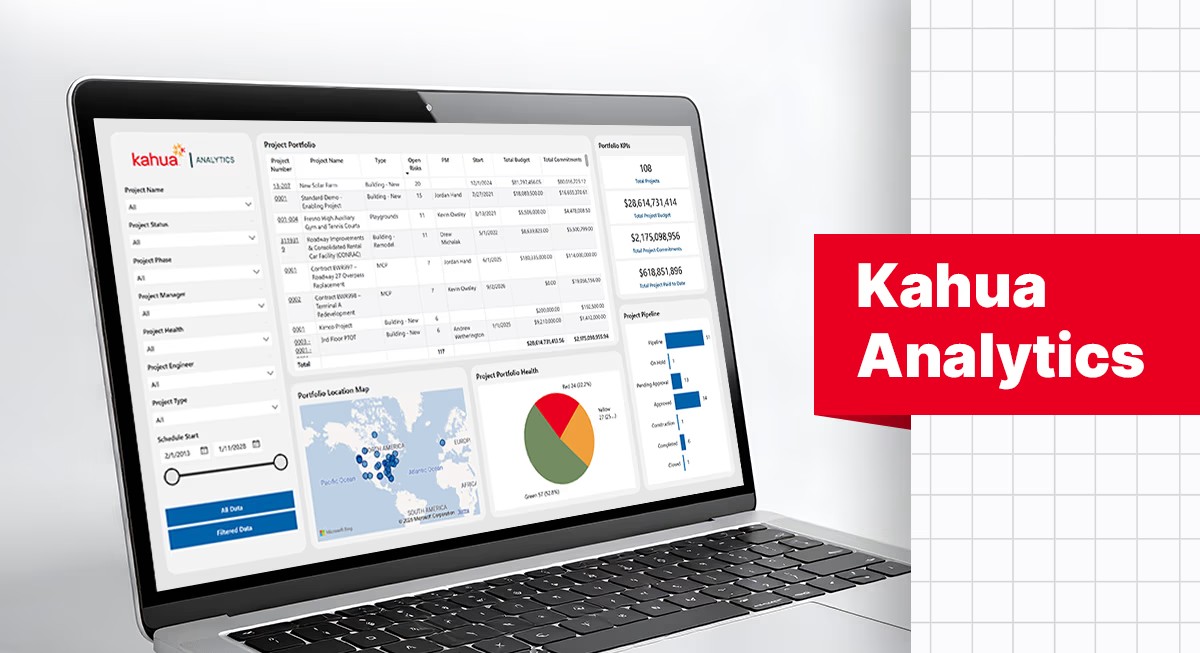
Offerings include the Noa AI assistant (powered by Kahua AI), the kBuilder Canvas no-code environment, Kahua Analytics and the kConnect integration framework. kCapture (360-degree field capture) launched in August 2026, and an ISO 19650 BSI Kitemark certification was announced in September.
Revenue model (our interpretation): We infer an enterprise subscription structure linked to apps, user types and implementation scope, but public pricing and the revenue mix (subscription vs. implementation services) are undisclosed. Stated uses of proceeds: AI and product innovation, go-to-market, customer success and talent development.
• Revenue growth, net revenue retention, gross margin and profitability are not disclosed. The definition of “$100M annualized revenue” (ARR vs. total revenue) is also unconfirmed, so the implied multiple (roughly 10x on a “>$1B” floor) should be read as a reference point only.
• Headcount differs by source: 353 (PitchBook) vs. 389 as of June 30, 2026 (Tracxn).
Kahua has historically grown on modest outside capital, a capital-efficient trajectory in our assessment. The reported ~$250M Bain investment far exceeds prior outside funding (aggregators cite roughly $40M–$55M) and, per Bisnow, compares with a last known valuation of about $100M following a 2019 round, an approximately tenfold step-up.
Restart by the Constructware founding team. Per Tracxn, the first funding round came seven years later, in 2016, suggesting early growth funded largely by founders and internal capital (our inference).
Earliest round listed by Tracxn. Collective Capital Ventures is also reported as an investor.
CBRE took an equity stake and named an executive to Kahua’s board; it stated it was training 5,000+ project managers worldwide on the platform (per the announcement at the time). PitchBook also logs the Project DocControl acquisition in the same period. We view this as the key strategic-distribution milestone.
Bisnow cites a ~$100M valuation after a 2019 round; Tracxn records a $16.4M Series D on February 5, 2021. CB Insights also lists a Paycheck Protection Program loan.
Bain becomes the largest outside investor. Per the release, proceeds fund AI and product innovation, go-to-market, customer success and talent. Kahua and Bain declined to comment on the size; the ~$250M figure derives from an anonymous source cited by Bloomberg, which we treat as an unconfirmed estimate.
• Structure: Minority growth investment (Bain Capital Tech Opportunities)
• Valuation: “Above $1 billion” per company; pre-/post-money not disclosed
• Size: ~$250M per Bloomberg (anonymous source); not confirmed by either party
• Position: Largest outside investor (per Bloomberg)
• Bain scale (reference): ~$225B AUM (self-reported)
• Cumulative funding: Tracxn and Gokhshtein cite $40.4M across three rounds; PitchBook $53.7M; Dealroom $305M (implying roughly $55M pre-Bain if the Bain check is included). We do not converge on a single figure given differing methodologies.
• Latest round label: Caplight lists the August 2017 Series B as most recent, while Tracxn shows a February 2021 Series D. Neither reconciles with Bisnow’s reference to a 2019 round.
• Primary vs. secondary mix, preferred terms and board seats are undisclosed; dilution cannot be estimated.
In our assessment, Kahua’s moat rests on three legs: an owner-centric system of record, security accreditation for regulated buyers, and configurability. Lock-in at the owner and program level is plausibly stronger than for contractor-centric tools, though the risks below warrant parallel review.
Low-code kBuilder and the kStore ecosystem let customers embed their own processes as apps. In our view this can raise switching costs relative to product-first competitors; implementation complexity and services dependence, however, need separate diligence.
Building on FedRAMP authorization since 2022, the company reports June 2026 approval for AI within that boundary (self-reported; the “first” claim is unverified). Where security approval is the bottleneck to AI adoption at federal, defense and infrastructure owners, this is a meaningful entry barrier.
The company argues that a single governed data environment spanning funding, planning, construction and operations is what makes AI useful in workflow. Growth in data-center, energy and other large capital programs is a demand tailwind, per the company.
Founders with 15+ years in the domain since Constructware, together with relationships such as CBRE, support sales credibility. Revenue concentration tied to CBRE is undisclosed.
• Valuation: Roughly 10x step-up from the last known value. With growth undisclosed, the “>$1B / $100M” multiple is difficult to underwrite.
• Competition: Tracxn lists Procore among top competitors. In our view, larger vendors such as Oracle, Autodesk and Trimble likely contest the owner segment (not verified in the sources reviewed here).
• Execution: Long implementation cycles and services intensity are inherent to large programs; a few user reviews mention platform loading issues (limited sample).
• Demand: Larger capital programs in data centers, energy and federal infrastructure are cited by the company as growth drivers.
• AI monetization: AI inside an authorized security boundary could support upsell to public-sector owners.
• Bain’s role: Global expansion and go-to-market scaling experience is the stated expectation. Exit path (IPO or strategic sale) is not addressed in available reporting.