
Kinwong Electronic
The world’s largest automotive PCB supplier lists in Hong Kong nine years after its Shanghai debut — a franchise with a defensible core, compressing margins, and an AI re-rating that is still an option rather than an earnings driver
Shenzhen Kinwong Electronic has been listed in Shanghai (603228.SH) since January 2017 and added a Hong Kong line (3228.HK) on 29 September 2026. The company sold 72.9mn H shares at the top of the range, HK$69.88, for gross proceeds of roughly HK$5.1bn. The Hong Kong public tranche was covered about 93x and the international tranche 9.6x. The stock opened about 7% below the offer price and had recovered to HK$76.40 (+9.3%) by the midday break.
Underwriting rationale. Three legs support the deal. First, a defensive cash-flow core: RMB 6.95bn of FY2025 automotive PCB revenue, #1 globally at 10.6% share, protected by multi-year customer qualification cycles. Second, a growth option: communications and data-infrastructure revenue (AI servers, switches) grew 114.6% YoY in 4M26. Third, a valuation trade: the offer was struck about 37% below the prior A-share close (RMB 95, or roughly HK$111), leaving room for A/H spread compression. The counterweights are a widening gap between revenue growth (+21% in 1H26) and earnings (-7%), a seven-fold rise in interest-bearing debt in sixteen months, and controlling-holder selling ahead of the listing. Together they cap how much multiple the market is likely to pay before margins turn.
Kinwong was established on 9 March 1993 and converted to a joint-stock company in June 2013. It is a family-anchored, dual-controller business: the founding Liu–Huang household controls the company alongside Zhuo Jun, who holds his stake through a Hong Kong vehicle. Headquarters are in Guangming District, Shenzhen.
Born 1962. Liu is a finance operator, not an engineer. He studied accounting at a regional commerce school in the early 1980s, served as head of finance at a Shenzhen radio company and deputy general manager of a Nanshan District industrial development company, and founded Kinwong in March 1993. He completed an executive business program at Peking University HSBC Business School in 2012–14 and holds an accountant designation. Liu ran the company as chairman and general manager for 29 years until August 2022, when he handed day-to-day management to his son and kept the chairmanship, where he sets group strategy and oversees management. He is also a vice chairman of the China Printed Circuit Association. Press accounts credit his 2008 decision to enter automotive PCBs, a market with tougher reliability requirements but higher content per vehicle, as the strategic pivot that defined today’s portfolio.
Age 62; Liu’s spouse, reported by the press as a partner in the 1993 start-up. Executive director and general manager of Jinghong Yongtai, the family holding company, and a company director since June 2013. On the 2025 Hurun list, the Huang family ranked 332nd with an estimated RMB 19bn.
Age 40; son of Liu and Huang. Degrees from Hong Kong Polytechnic (global supply-chain management), CUHK (finance) and Peking University HSBC (EMBA). Joined in 2012 as a purchasing manager, then rotated through FPC division deputy GM, PCB division president and vice president before becoming CEO in August 2022. Owns overseas customer expansion, new business lines and capacity build-out.
Sole owner of Zhichuang Investment, a Hong Kong holding company. At the 2016 A-share IPO the Liu–Huang household and Zhichuang each held 42.226% pre-offering, making this a genuine two-block control structure. Non-executive director.
Liu, Huang, Zhuo and their concert parties (Jinghong Yongtai, Zhichuang, Yizhao Investment, Liu Yu) together hold 561mn shares, or 52.21% of 1.074bn shares outstanding. The nine-member board comprises two executive, four non-executive and three independent directors; three seats are held by one family.
Kinwong makes the full PCB stack: rigid multilayer, HDI, flexible (FPC), rigid-flex, metal-based and high-frequency boards. It operates seven manufacturing bases (Shenzhen, Longchuan, Jishui, Xinfeng, Zhuhai, Fushan and Thailand) across 13 plants with more than 23,000 employees. According to a company-commissioned third-party study (CIC), it ranked first in automotive PCBs by 2025 revenue (10.6% share), 11th across all PCBs (2.5%) and fifth among Chinese peers. Strategy is framed as “1+1+N”: one pillar (automotive electronics), one priority growth line (communications and data infrastructure, i.e. AI) and N smaller options (smart devices, industrial control, energy, medical).
| Financial summary (RMB) | FY2023 | FY2024 | FY2025 | 1H26 |
|---|---|---|---|---|
| Revenue | 10.76bn | 12.66bn | 15.31bn | 8.61bn (+21.4%) |
| Attributable net profit | 936mn | 1.17bn | 1.23bn | 602mn (-7.4%) |
| Gross margin | 23.2% | 22.7% | 21.6% | 18.7% (4M26) |
| Dividends paid | 424mn | 421mn | 740mn | – |
Source: H-share prospectus data as relayed by Bamboo Works, 21st Century Business Herald and Time Finance; 1H26 per press reports. See the Data Integrity Notice for definitional differences in net profit. 4M26 net profit was RMB 317mn versus RMB 424mn a year earlier (about -25%).
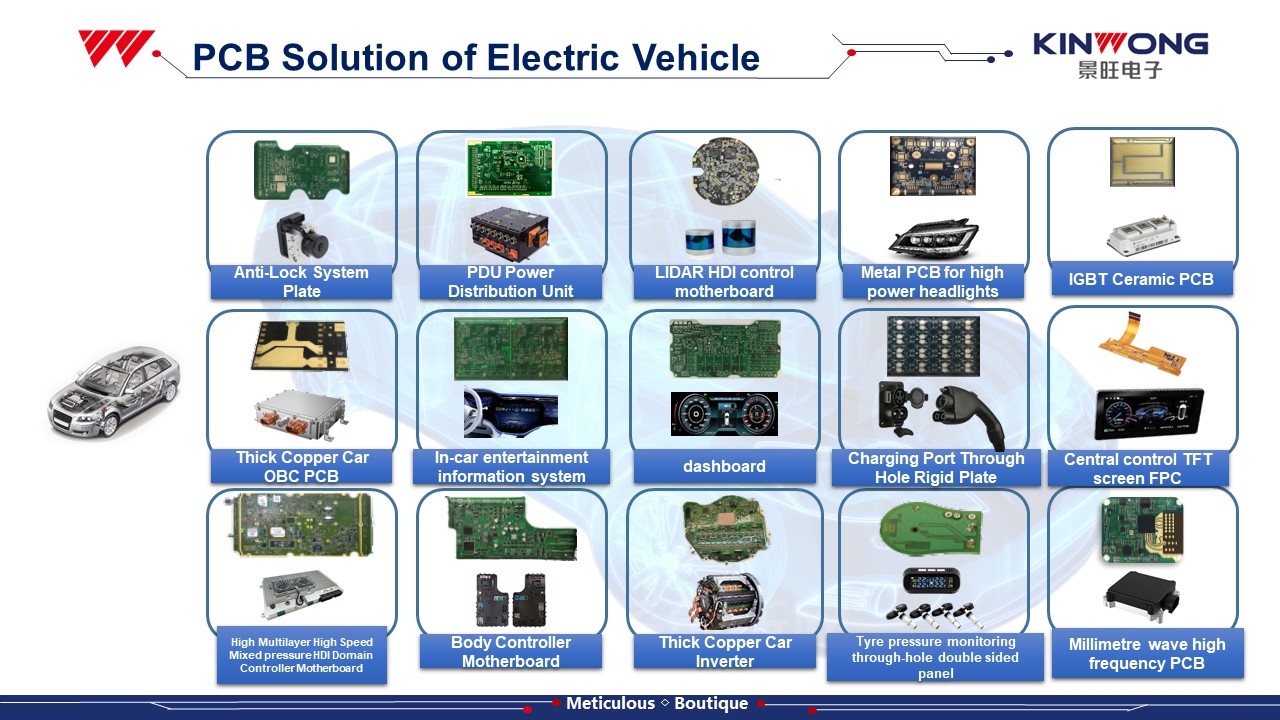
Entered in 2008. Range now extends to millimeter-wave radar and lidar boards and high-voltage boards for 400V/800V platforms. Management says it can supply every PCB in a vehicle. Category growth is slowing, from 8.4% a year in 2020–25 to a forecast 6.2% in 2025–30.
Revenue +70.7% in FY2025 and +114.6% in 4M26 to RMB 833mn (15.6% of sales). Segment gross margin rose from 4.6% (2023) to 8.8% (2024) and 13.3% (2025). AI-related PCB revenue was RMB 198mn in FY2025 (up roughly 12.7x) and RMB 268mn in 4M26.
FPC and HDI for handsets, wearables and edge devices. Flexible-PCB capacity is supported by a Zhuhai joint venture in which Kinwong holds 51% and Luxshare 49%.
Longer qualification cycles and lower volatility make this the “reliability premium” corner of the N bucket.
Technical capability at the AI frontier. Management cites volume production of 40+ layer high-layer-count boards, 22-layer 6-step HDI, 14-layer mSAP HDI and multilayer PTFE FPC. It claims capability for 70+ layer boards, 28-layer 9-step HDI and 12-layer any-layer rigid-flex, with customer qualification for 11-step HDI under way. By product, multilayer boards were 51.6% of 4M26 revenue and HDI 7.0% (Bamboo Works).
Market context. The global PCB market grew from US$69.5bn in 2023 to US$85.2bn in 2025 (10.7% CAGR) and is forecast at US$123.3bn by 2030 (7.7% CAGR). Company-cited forecasts put AI-server PCBs at US$18.5bn (24.3% CAGR) and switch PCBs at US$14.2bn (16.0% CAGR) by 2030. Prismark projects 18+ layer boards growing 79% in 2026, as cited in Chinese press.
- Cornerstone count: Bamboo Works reports 14 cornerstones taking 34.79mn shares (47.69% of the offering). Chinese-language outlets (Time Finance, STNN) report 15 cornerstones and about US$310mn (HK$2.43bn). The HKEX allotment announcement should be checked.
- Net proceeds: Bamboo Works cites nearly HK$4.96bn (US$636mn); Chinese outlets cite about HK$4.94bn. Gross proceeds of HK$5.097bn (72.94mn shares × HK$69.88) reconcile across sources.
- Net profit definition: Rui Caijing reports profit of RMB 911mn and RMB 1.16bn for 2023 and 2024; Time Finance reports attributable profit of RMB 936mn and RMB 1.169bn. This report uses attributable net profit; the gap may reflect definition or restatement.
- Founding narrative: The prospectus records Liu as founding the group in March 1993. The “indebted workshop with RMB 300k” account comes from press reports (21st Century Business Herald, Time Finance) and was not confirmed in the prospectus.
- Market-share data: The 10.6% and 2.5% figures come from a company-commissioned third-party report and are not independently audited.
- Controller selling: The share count (27.81mn) is consistent across sources, but proceeds of “about RMB 1bn” versus RMB 1.07bn are press estimates, not disclosed execution prices.
We found no disclosed VC or PE rounds. Kinwong is a self-funded, retained-earnings story that moved directly into public-market financing. Before the 2017 A-share IPO, the Liu–Huang household (via Jinghong Yongtai), Zhuo Jun (via Zhichuang) and Lai Yiming (via Hengxin Industrial) held 42.226%, 42.226% and 6.357% respectively, per the 2016 prospectus. Since then the sequence has been A-share IPO, three convertible bonds and the H-share IPO. Gross A-share IPO and convertible proceeds total about RMB 5.02bn (our sum: 1.112 + 0.978 + 1.78 + 1.154).
Motorola qualification opened the telecom supply chain, followed by a move to Bao’an (2003), FPC entry (2004), the Longchuan plant (2005) and automotive entry (2008). At the June 2013 joint-stock conversion, the promoters were Jinghong Yongtai, Zhichuang, Hengxin Industrial and an employee partnership, Jingjun Tongxin.
48mn shares were sold at RMB 23.16, lifting total shares to 408mn. The stock hit its daily limit on debut and market value passed RMB 20bn. Cumulative IPO and convertible proceeds since listing were used for Jiangxi, Longchuan and Zhuhai capacity, debt repayment and working capital, according to press reports.
A RMB 978mn unsecured convertible was approved by the CSRC; the proceeds account list includes Jiangxi Kinwong Precision Circuit, so we infer Jiangxi capacity as a principal use. In the same year Kinwong bought 51% of a Luxshare subsidiary in Zhuhai for about RMB 290mn and renamed it Zhuhai Kinwong Flexible Circuits. Luxshare retains 49%, an equity link that has drawn attention after Luxshare’s own Hong Kong listing in July 2026.
Funded Zhuhai Phase I, a 1.2mn sq m per year multilayer PCB project, and listed on 22 September 2020. It was subsequently converted or redeemed almost in full (99.86% converted per Jisilu) and delisted, so in practice it functioned as deferred equity.
Funds a 600k sq m per year HDI line in Zhuhai. Coupons step from 0.30% to 2.00%; maturity is 3 April 2029. The initial conversion price of RMB 25.71 was reset to RMB 23.91 in June 2025. About 99.1% remained unconverted at end-March 2025, and about RMB 731mn of proceeds had been deployed by end-2024 (China Chengxin/Pengyuan rating report).
Jinghong Yongtai, Zhichuang, Liu and Huang sold close to the planned ceiling in roughly six weeks of a three-month window, then ended the program early. The stock rose more than 80% over the period. The timing, alongside H-share IPO preparation, drew criticism as a governance overhang. Proceeds are press estimates.
Kinwong announced an additional RMB 5bn for its Zhuhai Jinwan base in August 2025. It filed a first HKEX application on 1 January 2026, received CSRC approval on 30 June 2026, refiled in early July and passed the listing hearing in September. Joint sponsors were CITIC Securities, BofA Securities and Guolian Securities International.
Priced at the top of the range and about 37% below the 28 September A-share close (RMB 95, roughly HK$111). Allocation was about 10% Hong Kong public (7.29mn shares) and 90% international (65.65mn shares). Cornerstones took close to half the deal under a six-month lock-up. The stock opened at HK$65.00 (-7%), touched HK$64.20, then reversed to HK$76.40 (+9.3%) by midday. Shares outstanding rose to 1.074bn.
Use of net proceeds: 60% for higher-value capacity (36% high-layer and advanced HDI at Zhuhai Jinwan; 24% multilayer FPC at Longchuan), 15% for next-generation R&D (AI accelerator cards, Z-axis interconnect backplanes, ultra-high-speed switch PCBs, automotive radar and domain-controller boards), 15% to repay interest-bearing bank debt and 10% for working capital.
Kinwong’s defensibility rests on four things: (1) automotive Tier-1 qualification barriers, (2) a full-line product stack, (3) an option on AI infrastructure and (4) A+H capital access. Its profitability, however, trails high-performance-computing specialists. The market-share moat has not yet become a margin moat.
FY2025 automotive PCB revenue was RMB 6.95bn, and eight of the ten largest global auto Tier-1s are customers. A reliability failure can trigger recalls, so new-supplier qualification takes years, which makes this a high switching-cost market. Specification content is rising with 800V high-voltage boards and radar and lidar boards. Whole-vehicle coverage supports a land-and-expand motion.
Rigid multilayer, HDI, FPC, rigid-flex, metal-based and high-frequency boards are all in volume production, with 40+ layer and 22-layer 6-step HDI already shipping. Seven bases and 13 plants, including Thailand, give customers a China-plus-one option and a hedge against tariff exposure.
Communications and data-infrastructure revenue grew 70.7% in FY2025 and 114.6% in 4M26, while segment gross margin rose from 4.6% to 13.3%. Yet AI-related PCB revenue was only about 1.3% of FY2025 sales (our calculation), so this is an option value that the multiple already partly prices in.
About RMB 5bn has been raised in public markets since 2017, and roughly RMB 1.6bn in dividends was paid over 2023–25. Access to both Shanghai and Hong Kong capital, plus a cornerstone book mixing industry partners and global long-only funds, supports funding for the capex program.
| Peer benchmark | Positioning | FY2025 gross margin | A-share P/E (Jul 2026) |
|---|---|---|---|
| Kinwong | Auto PCB #1 / full line | 21.6% | ~55x |
| Delton (1989.HK) | High-speed / high-frequency | ~33% | – |
| Victory Giant (2476.HK) | HPC-focused PCB | ~34% | – |
| Shennan Circuit (002916.SZ) | Packaging substrates / comms | – | ~92x |
| WUS Circuit (002463.SZ) | AI server / comms | – | ~68x |
Source: Bamboo Works (13 July 2026). P/E multiples are as of that date and have likely moved. Peer margins reflect different product mixes and are not like-for-like. “–” indicates not available in our sources.
Rapid top-line growth with stalled earnings, rising leverage and governance questions coexist. The capitalization-execution gap, meaning how quickly earnings follow the capex, is the metric to watch.
Gross margin fell from 23.2% in 2023 to 18.7% in 4M26. Raw materials rose from 60.4% to 62.9% of cost of sales. Multilayer board gross margin dropped from 18.0% to 9.7% year on year in 4M26, and the China domestic margin was about 8% (Bamboo Works). Net profit fell about 25% in 4M26 and 7.4% in 1H26.
Interest-bearing borrowings rose from RMB 657mn at end-2024 to RMB 4.80bn at end-April 2026, and the liability-to-asset ratio moved from 40.3% to 50.6% (51.2% at 1H26). The RMB 5bn Jinwan build, Thailand and Longchuan upgrades are running concurrently; cost of sales rose from 76.8% to 81.3% of revenue. Fifteen percent of H-share proceeds is earmarked for debt repayment.
AI-related PCB revenue was RMB 198mn in FY2025 (about 1.3% of sales) and RMB 268mn in 4M26 (about 5%), per our calculation. Company-wide gross margin trails high-end peers, who report 33–40%. Some press coverage points to delays in an AI-relevant HDI project (partial production, pushed to June 2026) and characterizes Kinwong as a late entrant. The company itself says AI mix gains were offset by input costs and new-base ramp-up expenses.
Three family members sit on the board and the control bloc holds 52.21%. Selling of 27.81mn shares in mid-2025, followed by the Hong Kong listing, raised minority-shareholder conflict-of-interest questions. The chairman is in his early-to-mid sixties, and while the CEO succession is complete, key-person risk and alignment between the two controlling blocs remain live.
Renminbi appreciation produced a 1H26 FX loss of RMB 123mn against a RMB 38mn gain a year earlier, a swing of more than RMB 150mn on net profit. Overseas gross margin is reported to have fallen from 35.1% in 2023 to 17.8% in 4M26 (Bamboo Works). With a large export mix, currency and tariff volatility remain structural exposures.
Despite a 37% discount to the A share, the stock opened below the offer price. A 90% international allocation, the cornerstone lock-up expiry around March 2027, a slow A/H spread closure and volatility in AI-themed PCB multiples all compound. The A-share P/E is below Shennan (92x) and WUS (68x), but that reflects lower profitability.
Monitoring checklist
- 3Q26 results: whether the 18% gross margin is the trough, and the timing of copper pass-through
- Communications and data-infrastructure mix and margin versus 15.6% and 13.3%
- Zhuhai Jinwan utilization and the outcome of 11-step HDI qualification
- Interest-bearing debt trend and execution of the 15% debt-repayment allocation
- Any further controlling-holder selling; supply around the cornerstone lock-up expiry
- A/H premium-discount spread