
Enveda Biosciences
An AI foundation model built to read four billion years of evolved chemistry — Boulder’s bet on redesigning where new medicines come from
We view Enveda’s origin as unusually personal relative to the typical AI-native biotech founding narrative. Founder Viswa Colluru, Ph.D., was born into a family of pharmacists in Visakhapatnam, India, and originally trained in computer science. The pivot point, by his own account, was his mother’s 1998 diagnosis with Philadelphia chromosome-positive chronic myeloid leukemia (CML), a disease with no effective treatment at the time. Her condition improved in 2001 following approval of imatinib — one of the first targeted oncology therapies and a drug that helped define the modern era of precision medicine. We read this personal history as the direct catalyst for Colluru’s shift from computer science into biology.
Enveda was founded in 2019 in Boulder, Colorado, and formally launched with a $4.9 million seed round in December 2020, led by True Ventures. The round also included Wireframe Ventures, Village Global, and — as an individual angel investor — Chris Gibson, co-founder and CEO of Recursion Pharmaceuticals. We flag this as a case where the founder’s prior professional network translated directly into early institutional credibility. On the scientific side, the company’s co-founder is Pieter Dorrestein, Ph.D., a professor at UC San Diego’s Skaggs School of Pharmacy and a pioneer of mass-spectrometry-based metabolomics; his work co-developing the GNPS (Global Natural Products Social Molecular Networking) platform underpins part of Enveda’s founding scientific methodology.
Youngest Ph.D. graduate in UW–Madison’s 2011 Cellular and Molecular Biology class. Served as Recursion Pharmaceuticals’ first Innovation Scientist and Product Manager, building its portfolio and early-commercial organization across neurology, oncology, and metabolic disease. Named a UBS Global Visionary in 2023; participant in the World Economic Forum’s Unicorn Innovator Community.
Professor at UC San Diego’s Skaggs School of Pharmacy and Pharmaceutical Sciences; Director, Collaborative Mass Spectrometry Innovation Center. A pioneer of mass-spectrometry-based metabolomics methodology (including molecular networking) and co-developer of the GNPS platform.
The board was strengthened in September 2025 with the addition of Mikael Dolsten, M.D., Ph.D., former Chief Scientific Officer and President of Worldwide R&D at Pfizer, in connection with the Series D. Following the Series E in September 2026, George Petrocheilos, Co-Founder and Managing Partner of Catalio Capital Management, also joined the board. We interpret the sequential addition of senior healthcare-investor figures as a marker of deepening institutional governance involvement rather than a purely financial commitment.
Enveda’s core asset is PRISM (Pretrained Representations Informed by Spectral Masking), an AI foundation model purpose-built for the chemistry of living organisms. Pretrained on more than a billion unlabeled mass-spectrometry spectra, PRISM predicts the structure of molecules found in plants, microbes, and the human body directly from spectral data, and ranks them by therapeutic potential. We read this as fundamentally different from a de novo generative-chemistry approach that designs entirely novel molecules from scratch: Enveda is, in effect, converting chemistry that evolution has already produced into a searchable database.
| Candidate | Indication | Stage | Notes |
|---|---|---|---|
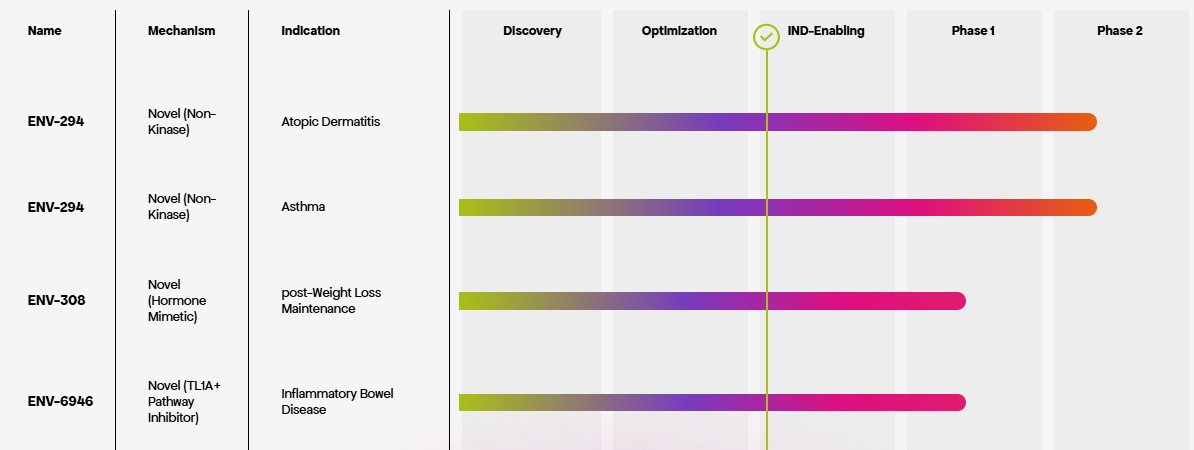
| ENV-294 | Atopic dermatitis (eczema) / asthma | Phase 1b→2 | Once-daily oral therapy. Phase 1b showed an average 85% reduction in eczema severity at Day 42, with no serious adverse events. Phase 2 underway; additional data due at EADV Congress, Oct. 1, 2026 |
| ENV-308 | Metabolic health (post-GLP-1 weight/metabolic maintenance) | Phase 1 | Derived from a molecule the body releases during exercise. Well tolerated in 88 healthy volunteers, with a favorable GI side-effect profile and observed reduction in circulating leptin |
| ENV-6946 | Inflammatory bowel disease (IBD) | Phase 1 | Oral candidate targeting multiple inflammatory pathways simultaneously. IND cleared December 2025; Phase 1 initiated |
Over the past year, Enveda has built out its late-stage clinical and commercial bench, recruiting Nadeem Sarwar, Ph.D. (Global Head of Metabolic Strategy, formerly Senior Vice President at Novo Nordisk), Michael Charlton, M.D. (formerly Head of Clinical Development at Madrigal Pharmaceuticals), and Doug Maslin (formerly Global Medical Affairs lead at LEO Pharma). We read this as an early signal that the organization is transitioning from a discovery-stage platform company toward the execution capability required for an NDA/BLA-track filing.
The disclosed clinical metrics for ENV-294 and ENV-308 (85% average improvement in eczema severity, leptin reduction, etc.) are company-reported figures from small, Phase 1b/Phase 1 trials, some of which are open-label, and none of which have yet appeared in peer-reviewed publication. These are not randomized, controlled results with disclosed statistical power, and we would caution that late-stage reproducibility remains unproven. We would also flag that the “4x faster and 10x cheaper than industry average” platform-efficiency claim, as well as the cumulative “17 development candidates” figure, are unverified company assertions with no disclosed benchmarking methodology.
Enveda has raised more than $845 million since its December 2020 seed round — a span of roughly five years and nine months. What we flag as most notable is the evolution of the investor base: from early regional venture backers (True Ventures, Wireframe Ventures) to healthcare-focused crossover funds (Baillie Gifford, Kinnevik), and most recently to pure technology-growth investors (ICONIQ, Lightspeed, Durable Capital Partners) alongside sovereign-wealth-scale capital. In our view, this progression reflects a market that is increasingly underwriting Enveda as a scalable technology platform rather than as a conventional biotech.
Led by True Ventures. Proceeds funded expansion of the medicinal-plant dataset and early algorithm development, along with preclinical work on a liver-fibrosis lead asset. Participation from Chris Gibson, co-founder and CEO of Recursion, as an individual investor lent early credibility to the round.
Oversubscribed round led by Lux Capital, which went on to remain an active investor through Series D. Proceeds supported early-stage validation of the natural-product discovery platform.
A $68 million Series B combining equity and debt closed in December 2022, followed by an additional $51 million extension in April 2023. Proceeds funded platform scale-up and early pipeline diversification.
Oversubscribed round co-led by Kinnevik and FPV Ventures, announced alongside the Phase 1b initiation of lead asset ENV-294. The company disclosed cumulative funding of $360 million at close.
Led by Premji Invest, the family office of Indian billionaire Azim Premji. The round followed a $20 million Series C extension in February 2025 that included Sanofi as a participant, bringing cumulative funding to $517 million at the time. Mikael Dolsten, former Pfizer CSO and President of Worldwide R&D, joined the board, and the round coincided with first-patient dosing in the ENV-294 Phase 1b trial.
Led by Catalio Capital Management. Notably, the round closed in the immediate wake of back-to-back positive early clinical readouts for ENV-294 and ENV-308 earlier in 2026. Catalio co-founder George Petrocheilos joined the board. Cumulative funding since inception now exceeds $845 million.
The company’s Series E use-of-proceeds disclosure is qualitative only; no line-item percentage allocation has been published. Accordingly, we have not applied the use-of-proceeds bar-chart format used in our IPO-stage reports (e.g., Veradermics) and instead present the disclosure in narrative form. We would also note that the simple sum of individually disclosed round amounts does not fully reconcile with the cumulative totals the company has announced at various points (e.g., $360 million following Series C, $517 million following the Series C extension/ahead of Series D), which suggests the possible presence of undisclosed debt-linked financings or bridge tranches. Post-money valuations for both Series D and Series E remain undisclosed, and the “unicorn status” characterization rests entirely on the company’s own public statements.
The AI-native drug discovery landscape includes a number of players pursuing distinct technical approaches — Recursion Pharmaceuticals (phenotypic screening), Insitro (functional genomics), and Isomorphic Labs/Xaira Therapeutics (generative protein and molecule design), among others. We view Enveda as structurally differentiated by its premise of cataloging and searching chemistry that nature has already produced, rather than designing molecules de novo, and see this differentiation playing out across at least six dimensions.
PRISM’s training set of more than a billion mass-spectrometry spectra, combined with a database spanning roughly 38,000 medicinal plants, reflects years of physical sample collection and automated-lab buildout. We view this as a structural barrier to entry that a fast-follower cannot easily replicate on a compressed timeline.
ENV-294 and ENV-308 both posted positive early clinical readouts in the first half of 2026. With many AI-drug-discovery peers still awaiting a first human proof point, we flag this as evidence supporting the platform’s claimed repeatability.
Starting points are molecules already selected by evolution to interact with living systems. The company’s central hypothesis is that this carries lower toxicity and bioavailability risk relative to fully synthetic molecules designed by purely generative approaches.
The Series E syndicate spans specialist healthcare investors (Catalio, T. Rowe Price’s biotech team, Citadel-affiliated Surveyor Capital) alongside growth investors that backed the defining companies of the internet and AI eras (ICONIQ, Lightspeed, Durable Capital), plus sovereign-wealth-scale capital. We read this as a signal that the platform is being underwritten with tech-company scaling economics in mind, not purely biotech optionality.
The Microsoft Azure compute collaboration underpins PRISM’s training-cost economics, and Sanofi participated as an investor in the Series D. We view these as early-stage strategic relationships with optionality to evolve into licensing or co-development arrangements.
Clinical-development and medical-affairs leadership hired from Novo Nordisk, Madrigal, and LEO Pharma point to a platform transitioning from discovery into an execution-oriented organization capable of pursuing regulatory filings.
What Alex Gorsky’s Involvement (General Partner, ICONIQ; Former CEO, Johnson & Johnson) Signals: We assign some weight to industry-insider validation from a figure who led one of the world’s largest healthcare companies participating personally in the investor syndicate (Alderline Group) and publicly characterizing Enveda’s approach as having “platform potential.” That said, this remains an investor’s assessment and does not, on its own, guarantee clinical or commercial success.