
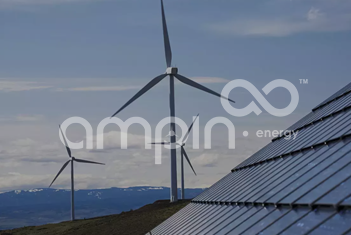
AMPIN Energy Transition
A New Delhi-headquartered utility-and-C&I renewable energy platform — building a globally diversified DFI capital base to fund India’s energy transition
AMPIN Energy Transition (formerly Amp Energy India, “AMPIN”) was founded in New Delhi in 2016 by Pinaki Bhattacharyya. We view the founder’s professional background as the single most useful lens for reading this company’s business model: Bhattacharyya is not a project-development operator by training but a capital-markets and project-finance specialist, and in our assessment his career trajectory is a reasonable explanation for why AMPIN was built from the outset as a capital-raising-oriented renewable platform rather than a pure-play developer.
We read this profile as a substantial part of the explanation for AMPIN’s fundraising track record — sequential capital commitments from European, Japanese, North American and multilateral institutions inside a nine-year window since founding. Where many Indian renewable-energy startups lean on founder engineering or development expertise as their core differentiator, AMPIN, in our view, was structured from inception around capital-markets access as the primary competitive asset.
MBA in Financial Engineering, Cornell Johnson School (2003). Career spans GE Vernova (Alstom Power), InterGen (Shell-Bechtel JV) and New Energy Capital in the US energy-finance sector. Led what was then India’s largest renewable private-equity portfolio (~$300M) at IDFC Private Equity. Co-founded and served as CFO/CIO of Sembcorp Green Infra, then India’s largest renewable IPP at 700MW-plus. Immediately prior to AMPIN, CFO-Infra and Head of New Ventures at Sterlite Power (Vedanta Group). 23-plus years in the renewable-energy sector; named to Cornell SC Johnson College’s “20 for 20” alumni honor in 2025.
AMPIN’s founding sponsor and strategic shareholder is Amp Energy Group, a Canada-headquartered global energy-transition platform — a structure that, in our reading, means AMPIN has operated since inception less as a purely domestic startup and more as the Indian operating arm of an internationally backed platform. The company is headquartered in New Delhi, with regional offices in Mumbai, Bengaluru and Kolkata.
AMPIN operates a combined platform spanning utility-scale renewable energy projects and distributed renewable energy solutions for commercial and industrial (C&I) customers. We view this dual-track model as a structural advantage on revenue diversification grounds: utility PPAs provide stable, long-duration contracted cash flow, while C&I contracts typically command premium tariffs, and the combination should in principle produce a more resilient margin profile than a pure-play utility IPP would achieve on its own.
Beyond its core generation business, AMPIN describes a set of adjacent activities it terms “Energy Transition Enablers” — energy trading, solar cell and module manufacturing, green hydrogen, and battery energy storage (BESS). Its customer base spans ten industry sectors including pharmaceuticals, automotive and cement, which we view as a mitigant against revenue concentration in any single industrial cycle.
Recent Project Milestones: In August 2026, AMPIN reached financial close on a $195 million long-term project-finance facility for a 100MW solar-wind hybrid project with battery storage in Andhra Pradesh. In May 2026, the company signed an agreement to supply renewable power from a 52.3MW wind-solar hybrid project in Harihar, Karnataka, to Grasim Industries (part of the Aditya Birla Group).
AMPIN’s own channels — its corporate website and industry conference materials — have consistently referenced a “25GW by 2030” ambition, while the company’s September 2026 Norfund investment announcement instead cites a “10GWp by 2030” target. We flag this as either (i) a material downward revision to guidance, or (ii) a definitional inconsistency between total pipeline capacity and net installed/operating capacity targets; the public record does not allow us to distinguish between these explanations with confidence. We would treat this as an open item for further diligence rather than resolve it silently.
AMPIN’s fundraising history shows a consistent pattern of adding new investor cohorts roughly annually since its first institutional private-equity round in 2019. We read this less as opportunistic fundraising and more as a deliberate progression — European private equity (Lightrock/LGT) to Asian multilateral infrastructure finance (AIIB) to Japanese banking capital (SMBC) to European industrial capital (Siemens, CIP) to European development finance (FMO, OeEB) to Nordic sovereign-backed development finance (Norfund) — that in our assessment reflects an intentional strategy of building a geopolitically diversified capital base.
Founded in New Delhi by Pinaki Bhattacharyya. Amp Energy Group, a Canada-headquartered global platform, came in as founding sponsor and strategic shareholder.
Lightrock India, part of the LGT group, became AMPIN’s first institutional investor. Copenhagen Infrastructure Partners (CIP) subsequently committed $150 million apiece to development clusters IV and V, extending this growth-capital phase.
SMBC (Sumitomo Mitsui Banking Corporation), ICG (Intermediate Capital Group) and AIIB (Asian Infrastructure Investment Bank) closed combined investments of up to $250 million. This round — combining Japanese banking, European alternative-credit and multilateral-development capital in a single transaction — underpins AMPIN’s own claim to being the only Indian energy-transition company to have attracted marquee investors from Europe, North America and Asia simultaneously.
Secured a EUR 25 million debt facility from OeEB, Austria’s development bank, as part of a broader strategy of layering DFI debt lines onto the project-finance stack.
Siemens AG’s financing arm made an equity investment — the company’s third major capital transaction of that fiscal year, taking cumulative annual proceeds to $270 million. AMPIN cited the round in support of its positioning as the only Indian energy-transition company to have secured leading investors across Europe, North America and Asia.
FMO, the Dutch development bank, provided long-term financing structured as a 100%-green facility, earmarked specifically for greenfield renewable-energy project development.
Norfund’s Climate Investment Fund, managed on behalf of the Norwegian government, committed up to $100 million in new equity, earmarked to support development of approximately 2.0GWp of new solar and wind capacity. Norfund has stated it expects the investment to mobilize up to $700 million of additional private capital. Following this round, AMPIN’s cumulative equity capital raised stands, by the company’s own disclosure, at close to $1.0 billion.
AMPIN’s September 2026 disclosure puts cumulative equity capital raised at approximately $1.0 billion. Tracxn, a third-party startup-data platform, instead records total funding of $448 million across eight rounds from fifteen investors. We suspect this gap most likely reflects (i) a lag in Tracxn’s dataset, (ii) a scope difference between pure equity and combined equity-plus-debt-facility disclosure, or (iii) inclusion or exclusion of project-cluster-level equity alongside corporate-level equity — but as AMPIN is a private company that does not publish audited consolidated financial statements, we would treat the company’s self-reported cumulative figure as unverified pending further diligence.
India’s renewable-energy and C&I markets remain fragmented, with ReNew Power, Adani Green Energy, Tata Power Renewable, CleanMax, Fourth Partner Energy and Avaada Energy among the larger and mid-sized players competing for share. India added roughly 44.6GW of new solar and 6GW of new wind capacity in FY2026, up 87.2% and 45.6% year-on-year respectively — a backdrop of structural market growth that, in our view, somewhat dampens the intensity of head-to-head competition among individual operators. Against that backdrop, we see AMPIN’s competitive positioning resting on six layers.
Stable, long-duration cash flow from utility PPAs combined with premium-tariff revenue from C&I customers. We view this as structurally supportive of a more resilient margin and revenue-diversification profile relative to single-model IPPs.
Institutional capital spanning Europe (Lightrock, CIP, ICG, FMO, OeEB, Norfund), Japan (SMBC, Sumitomo Corporation), Germany (Siemens) and Asian multilateral finance (AIIB) across three continents — reducing reliance on any single region’s capital conditions.
23-plus years of founder experience spanning private equity, project finance and corporate treasury. In our assessment, a leadership profile built around fundraising execution rather than engineering alone, positioning AMPIN relatively favorably as financing conditions tighten.
In-house solar cell (1.3GW) and module (1.9GW) manufacturing capacity. An “Energy Transition Enabler” strategy extending into trading, green hydrogen and storage broadens value capture beyond pure-play generation.
A financing structure anchored on development-finance capital — Norfund, FMO, AIIB, OeEB — used to catalyze additional private capital (Norfund’s $100 million is expected to mobilize up to $700 million). Should support a lower blended cost of capital and larger-scale project-finance capacity.
Against India’s 500GW non-fossil-capacity target for 2030 and the surge in FY2026 solar and wind additions, AMPIN’s existing 23-state footprint and 100-plus C&I customer relationships confer an incumbency advantage in competing for new project awards.
A Competitive Caveat: CleanMax (India’s largest pure-play C&I operator at 3.6GW-plus, with marquee customers including Google and Equinix) and ReNew Power (19.2GW-plus, Nasdaq-listed) both hold scale advantages over AMPIN in their respective segments — C&I specialization and utility scale, respectively. We would characterize AMPIN’s differentiation as resting less on being the scale leader and more on the balance it has struck between capital-source diversification and its dual business model.