
Hubble Network
A software-defined IoT connectivity infrastructure linking standard Bluetooth LE chips directly to a low-Earth-orbit satellite network — Seattle, Washington (per Bloomberg)
Hubble Network is reported to have been founded in 2021; per company disclosure, the founding date falls in late 2021. In our assessment, the founding team spans three domains: consumer location services (Life360), long-range low-power IoT protocols (Iotera, then Ring/Amazon Sidewalk), and space systems engineering. Each maps directly to one element of the business — customer access, wireless protocol, and satellite payload.
Co-founder of Life360 (former CTO and President), with experience spanning the pre-revenue years through IPO. Named to Forbes 30 Under 30 (Consumer Technology) in 2015; holds 12+ patents in location and PNT per event speaker materials (self-reported). Reported to have studied computer science at Pomona College and Harvey Mudd College. Reported (2024) to sit on the Life360 board, which connects to the related-party considerations below.
Electrical engineering background (wireless communications, signal processing, robotics). Founded LoRa-based long-range IoT startup Iotera, sold to Ring; subsequently invented and served as product manager for Amazon Sidewalk and the Ring Always Home Cam at Amazon (per Y Combinator profile). Reported as the originator of the idea to achieve ultra-long-range connectivity on existing silicon via a proprietary protocol.
Aerospace engineer, reported to lead satellite payload testing and development (IEEE Spectrum, 2024). Dealroom additionally lists Josh Barnes as a co-founder, so the founder roster differs by source (see Data Gap Notice below).
Series B lead Ryan Swagar is described in company disclosure as a long-time partner of the CEO, with an early-investor record that includes Life360. Life360 (owner of Tile) is Hubble’s exclusive consumer-application partner. Together with the CEO’s reported Life360 board seat, this creates related-party links on both the commercial and governance sides. We classify this as both a strength (anchor demand) and a concentration risk.
• Co-founder composition: Y Combinator and TechCrunch cite Haro/Wild (and John Kim); Dealroom lists four founders (Haro, Wild, Kim, Josh Barnes). We adopt the three-founder view per company disclosure and TechCrunch, and leave Barnes’ status unconfirmed.
• Headquarters: Bloomberg, TechCrunch and Muon Space reporting cite Seattle; Multiples cites Boston; certain Tracxn pages cite Las Vegas. We adopt Seattle per primary reporting and flag the database discrepancy as unresolved.
• Haro’s Life360 figures (88M+ MAU, $300M+ annual revenue) come from an event speaker bio, are self-reported and undated, and are therefore not used as current metrics.
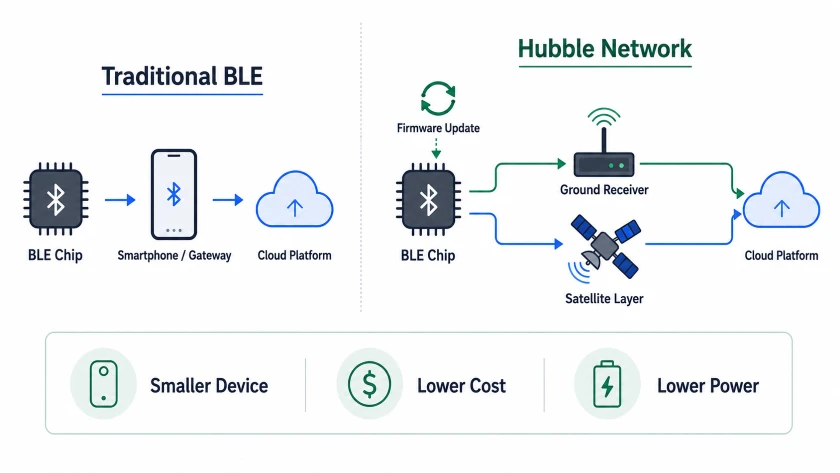
Hubble operates a B2B connectivity service that connects any device with a Bluetooth LE radio to a dual satellite and terrestrial network. Per the company, adopting the SDK and pushing a firmware update is sufficient, with no separate modem or new hardware. Enterprise customers are charged for network access and set end-user pricing themselves (per Dealroom’s description).
Urban, indoor and in-transit coverage via smartphone-based scanning gateways (100M+ per company disclosure), including Life360/Tile. It complements satellite reach in metal containers and indoor environments and serves as the commercially available, near-term revenue channel.
Low-Earth-orbit satellites receive BLE signals directly for remote-area coverage. Muon Space’s MuSat XL (500 kg class, phased-array payload, launch targeted for 2027) is the key next-generation platform; the company’s target is 60 satellites in operation by 2030.
Open SDK with a free Sandbox and a paid upgrade path to Hubble Live. Partnerships with silicon vendors (Texas Instruments, InPlay, Silicon Labs), label maker Reelables and platform provider Samsara (NYSE: IOT) are expanding the device-side ecosystem.
Unit economics (company claim): The company states connectivity adds under $0.50 to the bill of materials on a new design, roughly one-tenth of a cellular modem and one-fiftieth of a satellite modem. Its framing of the problem is that cellular covers about 15% of the Earth’s landmass and dedicated satellite trackers cost $25 or more per device, so sub-pallet asset tracking has lacked viable economics. In our assessment, if this logic holds, the addressable market widens from asset-level to item-level tracking; all figures cited are self-reported.
• Satellite count discrepancy: In August–September 2025, the company and TechCrunch cited seven satellites in operation; the September 2026 Series C disclosure cites six. The reason for the change (end of life, deorbit or reporting error) is undisclosed. We show six per the latest disclosure and flag the inconsistency.
• Target timeline slippage: 2024 reporting on the Life360 letter of intent cited 96 satellites by 2028; TechCrunch (August 2025) cited 60 by 2028; the Series C cites 60 by 2030. In our assessment, the plan appears to have been pushed out in stages. This is consistent with typical satellite-program risk, but we did not find an explicit company explanation.
• Commercial availability of satellite service: The announcement states satellites can hear devices “starting today,” whereas the company homepage text we retrieved describes satellite connectivity as “coming soon” (snapshot date could not be confirmed). The scope of commercial launch is unverified.
• Revenue and customers: No revenue, contract value or paid-conversion data has been disclosed, nor the size of any Samsara expansion. The 500K+ device figure is self-reported, and the definition of “active” is not provided.
Hubble is a Y Combinator alumnus. Per company disclosure, it had raised $100M cumulatively through its Series B and, with the $200M Series C, now totals $300M. We highlight two points: (i) round size expanded roughly 2.9x in the year following the Series B (September 2025, $70M), and (ii) the lead investor shifted from a founder-network individual investor to an institution, Smith Point Capital.
Founded in 2021 by Haro, Wild and Kim; in 2022, the first proof of concept showed off-the-shelf BLE chips could communicate directly with satellites (per company). Participated in Y Combinator. Seed size and date are cited solely by Multiples.
Led by Transpose Platform, with stated use of proceeds for a first satellite launch and pilot customer onboarding. The first satellites launched on SpaceX’s Transporter-10 mission in March 2024, and on April 29, 2024 the company announced the first direct Bluetooth connection between a ground device and a satellite.
Led by Ryan Swagar per company disclosure (early-investment record includes Life360, Ripple, GoFundMe, Liquid Death and ClassPass). New participants included Tom Gonser (DocuSign co-founder), Mike Farley (Tile co-founder), Marc Weiser (RPM; former NASA board member), Tuff Yen (Seraph Group) and Y Combinator. The exclusive Life360/Tile partnership and Muon Space’s MuSat XL first-customer agreement were announced in the same period.
Led by Smith Point Capital, with Seraphim, Carthona Capital, Earthshot Ventures, Y Combinator and RPM Ventures participating. Proceeds are earmarked for constellation build-out and driving down cost of connectivity; Bloomberg reported the round as unicorn status. We read the deal as a signal of transition from terrestrial-network traction to the capital-intensive satellite phase.
• Amount raised: $200,000,000 (per company disclosure)
• Valuation: $1.6B (pre- vs post-money not disclosed)
• Lead: Smith Point Capital (Keith Block, Founder and CEO)
• Cumulative funding: $300M (per company disclosure), versus $100M at Series B, an increase of $200M
• Our calculation (reference only): If $1.6B is post-money, new-share dilution would be roughly 12.5%. This is an assumption-based estimate, not a confirmed figure.
• Use of proceeds: Constellation build-out; reduction in cost of connectivity
• Cumulative funding mismatch: Company disclosure states $100M at the time of the Series B. Multiples reports $121M in total across four rounds (including a $30M undisclosed-stage round in August 2026), PitchBook reports $130M, and Private Market View reports $99.7M. We adopt company disclosure and flag the substance of the August 2026 round as unconfirmed.
• Valuation verification limits: The $1.6B figure is company-stated and cited by Bloomberg; pre/post-money treatment, security type and terms are undisclosed. Prior-round valuations are also undisclosed, and the gap versus a third-party mark (Private Market View, approximately $315M as of August 2025) cannot be verified.
• Series B lead and date: Company disclosure cites Ryan Swagar as lead on September 17, 2025; Tracxn cites October 28, 2025; Multiples lists Seraphim Space IT among the leads. The inter-source discrepancy is unresolved.
• Investor-level allocations: Individual commitment amounts from Series C participants and existing-holder ownership percentages are undisclosed.
Hubble’s differentiation lies less in satellite communications per se than in how far it has reduced the incremental cost added to a device’s bill of materials. We organize four core advantages below and distinguish the current level of verification for each.
Existing BLE chips need only an SDK and firmware, so no dedicated modem is required. The company cites a sub-$0.50 BOM on new designs, and in a 2024 interview the founder claimed a cost 50x lower and battery life 20x longer than incumbent satellite providers (Globalstar cited as the example). Verification level: self-reported; independent benchmarks not identified.
The Life360/Tile smartphone network (90M+ terrestrial gateways per company disclosure) provides immediate coverage density, with satellites supplementing remote areas, an advantage over satellite-only models at the demand-formation stage. Conversely, we note that concentration of the core consumer channel in a related party is a risk.
Reported as the first to establish a direct Bluetooth-to-satellite connection in 2024 (TechCrunch, IEEE Spectrum). The phased-array receiver on MuSat XL targets 30x lower BLE detection power than earlier CubeSat payloads and a 12-hour global revisit (company and Muon materials). Actual performance will be verifiable only after the 2027 launch.
A Life360 co-founder (consumer location), the inventor of Amazon Sidewalk (low-power mesh IoT) and an aerospace engineer cover protocol, customer and space within one team. Financing that scaled from $70M to $200M in a year also indicates capital-market access, though we interpret this as a reflection of expectations rather than evidence of commercial results.
Analyst View: If the company’s claims hold, Hubble could open a price point that RFID, cellular and dedicated satellite solutions have not addressed: item-level tracking. However, we regard the following as key items to confirm before a $1.6B valuation can be justified: (1) the 60-satellite target slipping from 2028 to 2030, (2) inconsistent descriptions of satellite availability across channels, (3) undisclosed revenue and customer concentration, (4) dependence on Life360 for the consumer channel, and (5) the capital intensity of satellite operations. Comparables cited by Multiples and Tracxn (Samsara, Tive, Nexite, ZaiNar and others) are terrestrial IoT and asset-tracking operators, so direct competition and potential partnership are intermixed.
• Core figures, including sub-$0.50 BOM, 50x cheaper and 20x longer battery life versus incumbents, 15% cellular coverage and $13M average theft/loss cost, are all company self-reported; no independent verification was identified.
• Whether six satellites can meet customer requirements for latency and revisit period in live service is unconfirmed. MuSat XL performance (30x sensitivity, 12-hour revisit) reflects pre-launch design targets.
• Customer quotations such as Samsara’s appear in the company press release; contract terms and scale of expansion are undisclosed.