
Ligent Technologies (9856.HK)
Hisense-affiliated global No. 5 optical transceiver supplier — listed on the Hong Kong Stock Exchange, September 2026
Ligent Technologies, Inc. is a Qingdao, Shandong-based supplier of optical communications and connectivity products. Rather than a conventional founder-led venture, Ligent is structured as a corporate carve-out listing under Hisense Group Holdings. Its predecessor entities trace to 2002, when Ligent Tech was established in the United States, and 2003, when Qingdao Hisense Broadband Multimedia Technology Co., Ltd. (“Qingdao Broadband”) was set up as a joint venture in Qingdao. Both were co-founded by Hisense Group and TransLight Limited, an entity held by optical-communications specialist Dr. Huang Weiping. With this listing, Ligent becomes the sixth Hisense-affiliated company to go public.
Age 68. Professor (former Dean) at the School of Information Science and Engineering, Shandong University; formerly a professor at McMaster University and the University of Waterloo in Canada. Senior Member of IEEE and a Fellow of the MIT International Academy of Electromagnetic Science; named to Stanford University’s list of the world’s top 2% of scientists in 2024. A serial entrepreneur, he founded Apollo Photonics Inc. in 1995 — a developer of photonic-device and integrated-circuit design/simulation software — which was sold to US-based Nanovation Technologies in 1999. He co-founded Ligent Tech with Hisense Group in 2002. In August 2025 he transitioned from executive to non-executive director, stepping back from day-to-day management while, per available reporting, continuing to hold equity and receive dividends.
Age 62, Canadian national. BSc (1986) and MSc (1989) in Electrical Engineering from the University of Science and Technology of China (USTC), and a PhD in Electrical Engineering from the University of Waterloo, Canada (1994). Previously Vice President of Intel’s Data Center Group and General Manager of R&D for its Silicon Photonics Products Division, with prior tenures at Ciena Communications and Oplink Communications in Silicon Valley. Appointed CEO in May 2025, he brings more than 30 years of optical-communications industry experience.
Concurrently serves as Director and CEO of Hisense Group Holdings while chairing Ligent’s board in a non-executive capacity — the central node connecting parent-company strategy with Ligent’s own governance and capital-markets planning.
Age 47. BA in Management from Qingdao University of Technology (2000). Formerly Chief Accountant and President of Qingdao Hisense Real Estate and finance lead at Hisense Visual Technology, she joined Ligent in December 2024.
The nine-member board comprises two executive directors, four non-executive directors — Yu Zhitao; Jia Shaoqian (Chairman, Hisense Group Holdings); founder Dr. Huang Weiping; and Zhang Jing (Partner, Primavera Capital) — and three independent non-executive directors: Dr. Zhou Changjun (Dean, Shandong University Law School), Dr. Sun Ying (Professor, Ocean University of China Business School), and Dr. Tang Fuji (Managing Partner, QBN Capital). VP and Chip Division GM Dr. Li Dawei rounds out the senior operating team.
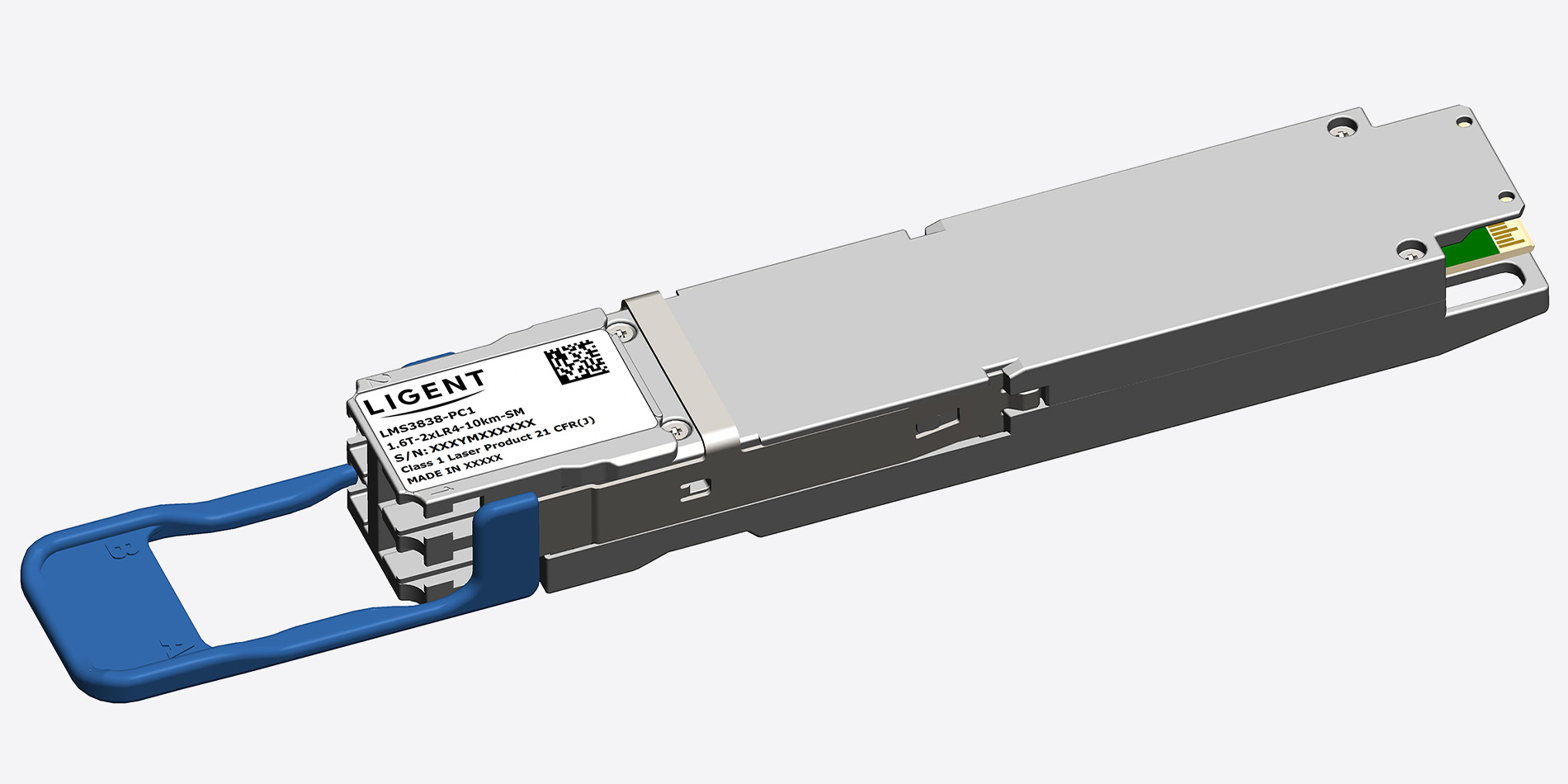
Ligent is a mature supplier of optical communication and connectivity products spanning research, manufacturing and sales of optical transceivers, optical chips, and optical network terminals. The company is one of a small number globally with both scaled optical transceiver mass-production capability and in-house optical chip R&D and manufacturing capability, operating four manufacturing sites in Qingdao, Jiangmen, Thailand and the United States. Per Frost & Sullivan data cited in company disclosures, Ligent ranked fifth globally and third in China among specialist optical transceiver makers by 2025 revenue.
Ligent’s operating model is a vertically integrated three-tier product architecture running from optical chips to transceivers to network terminals.
The core segment, contributing more than 64% of revenue with a rising share. AI data-center (datacom) high-speed transceivers have driven recent growth, with development of next-generation 800G/1.6T products a key competitive variable.
Contributing more than 20% of revenue, these products connect end users to broadband networks while also functioning as edge-computing nodes across residential, enterprise and industrial settings — a long-established, comparatively stable revenue base rooted in the FTTx broadband-access market.
A small share of revenue (1.6% in H1 2026) but the linchpin of Ligent’s vertical-integration strategy. The company mass-produces DFB laser chips, including a 75mW high-power CW-DFB variant, and is developing 100G/200G EML laser chips and CW-DFB chips rated above 100mW. The segment has posted a gross margin of roughly -150% for two consecutive years, reflecting its early, loss-making investment stage.
Financial trajectory: Revenue rose from RMB 4.239B in 2023 to RMB 5.087B in 2024 and RMB 8.355B in 2025, a 40.3% CAGR. Annual net profit moved from RMB 216M (2023) to RMB 89.49M (2024) to RMB 873M (2025), up 875.13% year-over-year in 2025, while gross margin recovered from 20.6% to 17.4% to 20.0% over the same period. In H1 2026, revenue reached RMB 5.393B (+27.91% YoY), net profit RMB 661M (+29.72% YoY), and gross margin improved to 24.2% from 18.7% a year earlier.
Reporting on H1 2026 performance is not fully reconciled across sources. Chinese-language outlets including Tencent News report total company revenue growth of +27.91% year-over-year (to RMB 5.393B), while a secondary source (Tiger Brokers) cites “H1 revenue surged 124%.” Separate reporting notes that the datacom optical transceiver segment specifically grew +162% year-over-year in the same period, suggesting the 124% figure may reference a segment-level (datacom transceiver) metric rather than total company revenue. Pending post-listing financial disclosures, we flag this discrepancy as unverified and adopt the +27.91% total-revenue figure as our working baseline, as it is corroborated by a larger number of independent sources.
Customer base and risk profile: The top five customers account for more than 70% of revenue, a high concentration level, with cloud service providers, telecom and network equipment vendors, and network operators as the principal customer categories. Per company risk disclosures, Ligent has flagged underpayment of social insurance and housing fund contributions (reported at approximately RMB 37.8M by a single source and not independently corroborated), political instability risk at its Thailand manufacturing site, and exposure to US-China trade friction and tariff-policy shifts as material risk factors.
Ligent operated for most of its history as an internal Hisense Group business unit following its 2002–2003 founding, before establishing a Cayman Islands listing vehicle (the current Ligent Technologies, Inc.) in 2009 to prepare for an eventual capital-markets separation. Pre-IPO strategic investment and two rounds of Hong Kong listing applications through 2025–2026 culminated in a formal HKEX listing on September 22, 2026.
Hisense Group and TransLight Limited, held by Dr. Huang Weiping, co-founded Ligent Tech in the US in 2002 to house optical-device R&D and overseas sales. In April 2003 the partners established Qingdao Hisense Broadband Multimedia Technology Co., Ltd. in Qingdao to handle R&D and manufacturing of optical chips, transceivers and broadband terminal products, creating an early dual-hub model coordinating US and Chinese R&D with production and sales.
The group built an offshore holding platform, Hisense Broadband Multimedia Technology (BVI), consolidating US-based Ligent Tech and Qingdao Broadband under a unified capital structure. In February of the same year, the Cayman Islands entity that would become the current listing vehicle was incorporated; Dr. Huang Weiping was appointed a director in March.
Primavera Capital invested a cumulative US$20.3M across two tranches, in June 2011 and November 2013. Through its Global Optical vehicle, Primavera subsequently built a pre-IPO stake of 16.48%, making it Ligent’s largest external shareholder, with partner Zhang Jing serving as a non-executive director.
A Xiamen municipal state-owned capital vehicle invested RMB 330M on a sole-investor basis. Chinese-language reporting placed Ligent’s implied valuation at this round at approximately RMB 10.784B. Other pre-IPO shareholders on record include Archcom LLC, Jiayu Capital, Guosheng Fund, Haiyi Group and Xiamen Torch Group.
Ligent filed its first application for a Main Board listing on the Hong Kong Stock Exchange. The application lapsed after the standard six-month window elapsed without a hearing.
Ligent refiled with Citigroup and CITIC Securities as joint sponsors. Disclosures at this stage, based on 2024 results, showed a 2.9% global market share (rank #5 among specialist makers) and a 7.2% China market share (rank #3).
Ligent cleared its HKEX Main Board listing hearing, the final procedural gate before trading. Updated disclosures at this stage, based on 2025 results, showed an improved 4.0% global market share (rank #5) and 10.1% China market share (rank #3).
Offering structure: Ligent sold 172,014,700 shares at HK$32.96 apiece (plus an over-allotment option of up to 25.8M additional shares), raising gross proceeds of HK$5.67B (~US$727M; net proceeds ~US$723M) at a market capitalization of HK$32.4B (~US$4.13B) at the offer price. The offering comprised 17,201,500 shares in the Hong Kong public offering and 154,813,200 shares in the international offering.
Cornerstone investors: Approximately 30 cornerstone investors committed a combined US$340M pre-IPO, covering 47% of the base offering. Notable participants include Primavera Investment Fund (affiliated with Primavera Capital), GigaDevice, Amlogic Hong Kong, Mirae Asset Securities HK, PAG, Turquoise Hime (ORIX-backed) and Barings.
Subscription and debut performance: The Hong Kong public offering was approximately 35x oversubscribed. Shares rose as much as 19.2% intraday to HK$39.3 on debut before closing up 4.6% at HK$34.48. The stock was the 12th most actively traded name on HKEX that day by turnover, with 68.35M shares changing hands worth HK$2.46B.
• Exchange: Hong Kong Stock Exchange Main Board (Stock Code: 9856.HK)
• Offer price: HK$32.96/share · Shares offered: 172,014,700 (plus over-allotment option of up to 25.8M shares)
• Gross proceeds: HK$5.67B (~US$727M) · Market cap at offer price: HK$32.4B (~US$4.13B)
• Major shareholders: Hisense Group Holdings 40.1% (post-offering) · Primavera Capital (Global Optical) 16.48%
• Sponsors: Citigroup, CITIC Securities (joint)
• Use of proceeds: R&D expansion, capacity expansion, general corporate purposes
- Pre-IPO valuation: Chinese-language reporting placed the implied valuation from the July 2025 Xiamen state-capital round at approximately RMB 10.784B, while a separate English-language source reported the same round’s post-money valuation at HK$11.84B (HK$14.60 per share). The currency basis and valuation methodology across these two figures have not been cross-verified against primary disclosures.
- CEO Dr. Hong Jin’s compensation: Secondary sources report figures ranging from RMB 4.23M (H1 2025) to RMB 3.59M and RMB 4.50M (full-year 2025), which are not internally consistent. Aggregate 2025 director compensation is reported at RMB 12M. Exact prospectus-sourced figures by period require cross-verification against primary listing documents.
- Social insurance/housing fund underpayment: An approximately RMB 37.8M underpayment figure was reported by a single outlet (21jingji.com) and has not been corroborated by other sources.
Ligent’s competitive positioning rests on three pillars: (1) a rare vertically integrated chip-plus-transceiver capability, (2) manufacturing infrastructure, supply-chain depth and capital-markets credibility inherited from Hisense Group, and (3) revenue-mix improvement driven by AI data-center demand. These strengths are counterbalanced by structural weaknesses — chip-segment losses and customer concentration — that argue against complacency on any single advantage.
Ligent is one of a small number of companies worldwide with both scaled transceiver manufacturing and in-house optical chip R&D and production. It already mass-produces DFB laser chips and is developing 100G/200G EML laser chips, a long-term strategy to internalize control over cost and performance of core components. The chip segment’s current structural losses represent the cost of executing that strategy, and the timing of its path to profitability will be a key valuation variable going forward.
Hisense Group brings decades of large-scale manufacturing, quality-control and supply-chain systems built in appliances and telecom equipment, which Ligent leverages directly for optical-product manufacturing. Its geographically diversified four-site footprint (Qingdao, Jiangmen, Thailand, US) provides a partial hedge against tariff and geopolitical risk. Political instability at the Thailand site, however, is a risk that stems from this same structure.
Among specialist transceiver makers, Ligent’s global market share rose from 2.9% (rank #5) in 2024 to 4.0% (rank #5) in 2025, while its China share rose from 7.2% (rank #3) to 10.1% (rank #3) over the same period. Rising server-to-switch data volumes from AI training and inference workloads are structurally driving high-speed transceiver demand, a key factor behind the company’s 64.25% revenue growth and 875.13% profit surge in 2025.
As the sixth Hisense-affiliated company to list, Ligent carries a governance and disclosure track record that underpins market confidence. Roughly 30 cornerstone investors committed US$340M (47% of the base offering) pre-IPO, and the Hong Kong public tranche was approximately 35x oversubscribed — evidence of institutional appetite for exposure to the AI-infrastructure value chain. That said, Hisense Group’s retention of 40.1% post-offering preserves controlling influence, a structure warranting continued monitoring from a minority-shareholder-rights perspective.
Strategic implications of the leadership transition: The shift from an academically rooted founder (Dr. Huang Weiping, a Shandong University professor) stepping back into a non-executive role, to a Silicon Valley- and Intel-trained professional CEO (Dr. Hong Jin) running operations, reflects a broader move from a founder-led technology narrative toward operations-led scale-up management. Layered with a board chair role held concurrently by the Hisense Group Holdings CEO, this produces a hybrid leadership model combining technical legitimacy with parent-company capital and governance backing. Relative to comparable carve-out listings, this is a differentiated source of stability — but it comes with a trade-off in parent-company dependency and diminished minority-shareholder leverage.