
Penelope Health
Structuring payer policy into machine-readable data: an analyst review of the healthcare “rules layer” that Thoreau has committed $100M to back.
Penelope Health was co-founded in 2025 by Dr. Sohum Patel (CEO) and Mattijs De Paepe (CTO). The company frames its origin around a clinical observation: in practice, determining what insurance will cover consumes more effort than delivering the care itself. We view that origin as consistent with the product architecture, which is built as a reference-data layer rather than a service.
Practiced in inpatient and outpatient settings within the UK’s NHS at the Royal Free London and University College London hospital systems before founding the company (company-reported). The company website cites his residency experience of administrative disorder translating into patient harm as the founding motivation.
Leads development of the Penelope intelligence platform. Spent nearly four years at Via Transportation building machine-learning systems for its transit products (company-reported). The company website describes his background as scaling optimization systems for millions of users.
- Unverified education claim: Crunchbase describes the founders as a “Cambridge-trained physician and ML engineer.” We could not find this in the company press release or in EU-Startups coverage. We treat it as unverified and have excluded it from the narrative.
- Inconsistent location data: The Business Wire release carries a New York dateline; EU-Startups, Crunchbase and StartupMap describe a London-based company; PitchBook lists headquarters in Dover, DE. We read this as a US-incorporated entity (Penelope Health Inc.) with UK-based operations, but registered domicile and tax residence cannot be confirmed from public sources.
- Headcount: Crunchbase shows 1-10 employees and PitchBook shows 2. Both appear to pre-date this financing, and we cannot establish when either was last updated.
- Not disclosed: board composition, additional executives (commercial lead, US payer relationships), founder ownership, and any governance rights held by Thoreau.
Within the disclosed information, we see the absence of an executive with US payer or revenue-cycle sales experience as a potential go-to-market bottleneck. Ensemble’s distribution footprint under the same sponsor could offset this, so we would revisit the assessment as hiring announcements and any commercial link to Thoreau’s portfolio become visible.
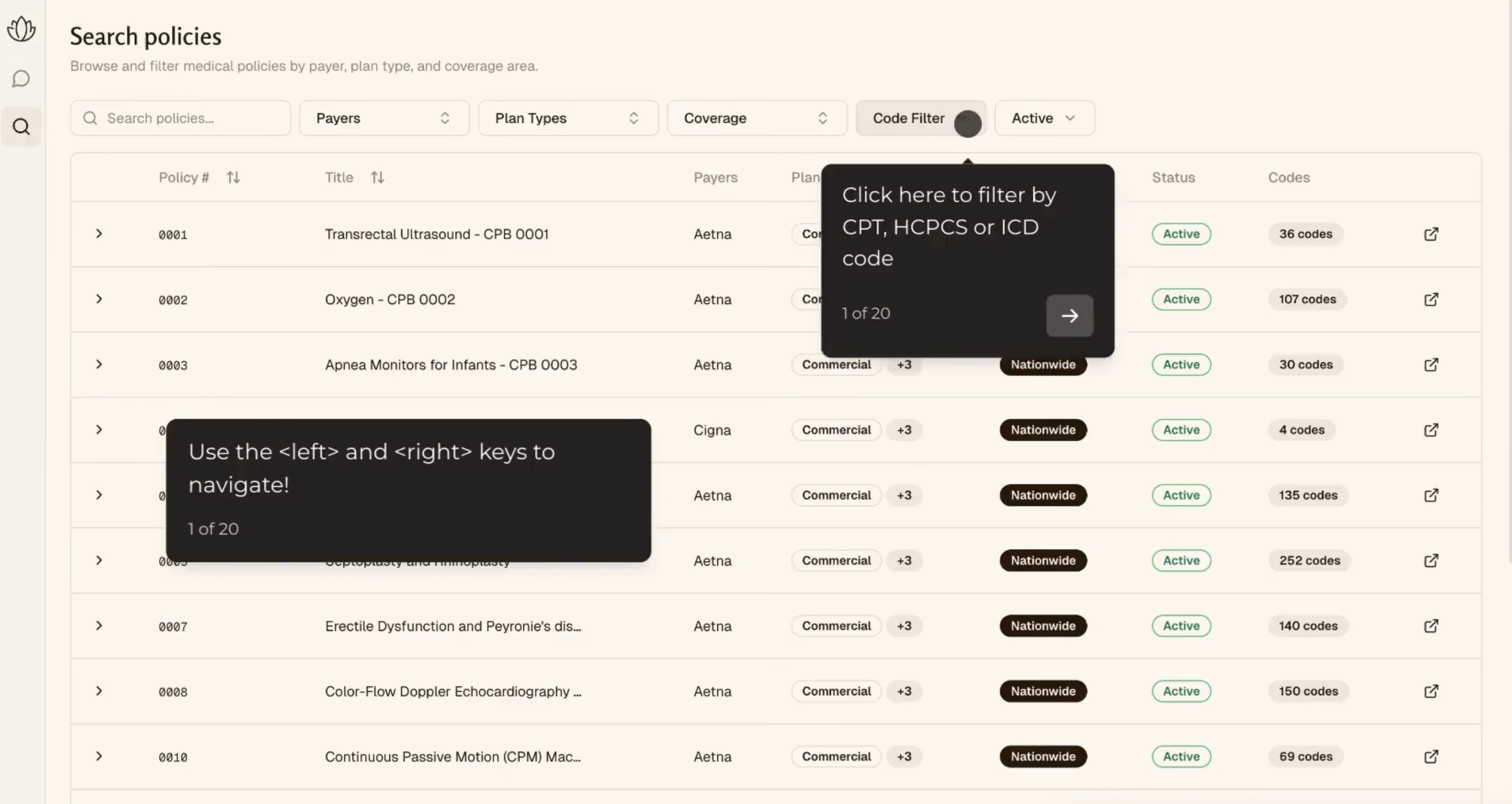
Reimbursement in the US turns on payer coverage policies, prior-authorization requirements, medical-necessity criteria and coding rules. These are scattered across thousands of sources and change continuously. Penelope converts them into structured data delivered through an API, a web application and endpoints designed for AI assistants. The output is a JSON response of coverage requirements by CPT, HCPCS and ICD code, resolved by payer, plan and state, and the company says most customers can begin querying within days.
| Product / Capability | Description | Status | Note |
|---|---|---|---|
| Policy Intelligence API | Coverage rules by payer, plan and state; cross-payer policy comparison | Live | Company website: web app usable immediately after sign-up; API integration in days |
| Web application | Policy search and comparison interface | Live | Cited use cases: claim scrubbing, prior-auth case generation, appeal letters, competitive intelligence, field-sales coverage checks |
| AI assistant / MCP endpoints | Lets AI agents query policy rules directly | Live | Vercel accelerator profile: “API and MCP layer for US medical payments” |
| Public policy-update feed | Change log of payer policy updates | Live | Referenced by RevCycleAI as evidence of how frequently policies change |
| Expanded coverage | Additional insurers and policy types | Funded / Planned | Named use of proceeds; target payers and policy list not disclosed |
| Real-time coverage determination | Pre-service determination at scheduling and ordering | Stated objective | Described as moving “upstream to the point of care”; timing and validation level not disclosed |
| Thoreau / Ensemble linkage | Combining an operating layer with a rules layer | Not announced | No technical or commercial integration has been publicly announced |
- Every scale metric is self-reported and has not been audited or independently verified. The “15,000+ codes” figure (press release) and the “500,000+ extracted codes” figure (Crunchbase) appear to be defined differently, and we do not add or compare them.
- “Largest corpus of payer policies” in Vercel’s accelerator profile is a company claim for which we found no supporting evidence.
- Secondary-source error: A Nelson Advisors weekly roundup describes the deal as automating payer rules across European provider networks, whereas the company’s own materials focus on US payer policy. We read this as a secondary-source misreading and have excluded it.
- No accuracy or SLA data: extraction accuracy, error rates and update latency are all undisclosed. In our view this is the single most important diligence item for a business of this kind.
Regulatory context (for reference): Industry sources report that the CMS Interoperability and Prior Authorization final rule (CMS-0057-F) took operational effect on January 1, 2026, requiring decisions within 7 calendar days for standard requests and 72 hours for expedited ones, with FHIR API requirements extending from January 1, 2027. We read compressed decision windows as raising the value of knowing policy requirements before service. We would caution that these figures come from vendor blog posts and should be checked against the CMS text.
The only publicly verifiable financing event is the $100M commitment announced on September 18, 2026 alongside the Thoreau partnership. Earlier funding carries no disclosed round name, date or amount. The announcement came within roughly a year of founding. Set against PitchBook’s $2.73M cumulative figure (unverified), it represents a step-up of about 37x, which is our own arithmetic. We read the financing as closer to a sponsor-led strategic allocation of capital than a conventional follow-on priced off demonstrated commercial traction.
Co-founded by Sohum Patel and Mattijs De Paepe (EU-Startups). PitchBook records a 2025 founding year and two employees (unverified).
Bertelsmann Healthcare Investments, Twine Ventures and Seedcamp were identified in this announcement as existing backers. Third-party materials describe Twine Ventures Fund I as a $25M seed fund launched in 2022 that writes initial checks of $500K-$750K. We think the earliest financing was likely a small seed, but we cannot confirm this.
Vercel profiled Penelope as the API and MCP layer for US medical payments. PitchBook lists the Vercel AI Accelerator as an investor, but no investment terms are visible. We read this as the point at which AI-agent distribution became part of the product strategy.
Thoreau, together with other investors, has committed $100M (the company’s wording). The three existing backers participate. Proceeds are earmarked for new products, broader insurer and policy coverage, and moving coverage determination toward the point of care. Thoreau named Penelope alongside Ensemble Health Partners among its initial platform partnerships. The round designation, valuation and Thoreau’s individual investment amount were not disclosed.
- “Committed” is not “funded”: the release says only that capital has been committed. Tranche structure, milestone conditions and actual funding dates are not disclosed.
- No lead investor or round label: the phrasing is “Thoreau, along with other investors,” with no Series designation. We do not assign a Series A or B ourselves.
- Namesake contamination risk: a $2.1M pre-seed round from March 2022 that surfaces on Crunchbase under “Penelope” belongs to a retirement-platform company and is unrelated to Penelope Health. We have excluded it.
- FX: the €87M figure is EU-Startups’ conversion, and no rate date is given.
- PitchBook $2.73M and two employees: these come from a subscription-data snippet with no visible as-of date. The 37x step-up is our calculation from that figure and is best treated as indicative only.
- Thoreau figures: the ~$12B Ensemble valuation is a media estimate attributed to Bloomberg, and terms were not disclosed in the company release. The $30B+ combination reflects the plan as reported in January 2026, and the final structure is unconfirmed.
We organize Penelope’s differentiation across four layers (product positioning, data assets, distribution and sponsorship, and capital) and tag each point with its evidence grade: company-reported, third-party, or our own inference. With no revenue or customer validation yet, we would caution that most items below are structural potential rather than demonstrated moat.
Aims to be a machine-readable reference that other applications query, not an assistant that searches PDFs. Workflow apps are easy to swap, whereas rules data that many systems depend on carries structurally higher switching costs. The actual depth of embedding is unverified.
Company-reported Our inferenceThe company reports 200M+ lives, 15,000+ procedure and drug codes, and daily-refreshed policies from major payers including UnitedHealthcare, Cigna, Aetna and Humana. That is an aggressive footprint for a company of this age, but no accuracy metrics accompany it.
Company-reported CrunchbaseOffers MCP endpoints alongside the API. If agents increasingly query a maintained rules source rather than scraping payer documents on their own, this becomes a favorable point of entry.
Vercel · RevCycleAICrunchbase characterizes Penelope as neutral policy infrastructure, and the company names providers, payers and software systems as users. We view neutrality as an asset for winning trust on both sides of the transaction, though the Thoreau linkage discussed below could erode it.
Company-reported Our inferenceEnsemble reports 200+ hospitals and $55B+ in net patient revenue under management. That Thoreau grouped an operating layer (Ensemble) and a rules layer (Penelope) under one strategy is a meaningful signal, but no technical or commercial integration has been announced. We treat it as an unrealized option.
RevCycleAI analysis Our inferenceA single $100M round exceeds Anterior’s cumulative funding of $63.2M and is roughly half of Cohere Health’s cumulative $196M (CB Insights). That leaves room to accelerate data acquisition and engineering, but the ability to deploy it at this headcount is untested.
Company-reported CB InsightsCompetitive and Adjacent Landscape
| Player | Position | Disclosed Funding / Scale | Our Read |
|---|---|---|---|
| Cohere Health | Prior-auth and utilization-management automation for health plans and at-risk providers | ~$196M cumulative (Series C of $90M, May 2025) | Adjacent. Decision layer versus rules-data layer; could be complementary or competitive |
| Anterior | AI-driven utilization management and clinical decision support | $40M Series B (Feb 2026); $63.2M cumulative | Adjacent. Listed by Crunchbase as a possible competitor |
| Waystar | EHR-embedded claims clearinghouse | 5,000 health-plan connections; 1M+ providers (vendor blog) | Potential customer, and a competitor if it internalizes rules functionality. Listed by Crunchbase |
| Availity | Multi-payer provider portal; AuthAI | Not disclosed | Potential customer or competitor. Listed by Crunchbase |
| Payer portals and regulatory APIs | Insurers’ published policies; CMS-mandated FHIR APIs | N/A | Substitute. Standardized policy access would weaken the scarcity of an aggregation layer |
Strategic read-through on Thoreau: Thoreau describes itself as a technology platform that creates, invests in and acquires platforms across provider, payer, employer, life sciences and government markets. Following its first large transaction (Ensemble), the capital it has put behind Penelope is, in our assessment, a signal of intent to assemble an infrastructure stack of operating scale, rules data and AI. As RevCycleAI notes, there has been no announcement that Penelope will become Ensemble’s underlying rules engine, so we would not price that outcome in as a given.
Penelope is an early-stage private company with no public revenue, customer or financial-statement disclosure, and this analysis rests on company statements and secondary sources. Under those conditions we think the appropriate frame is option-value assessment based on sponsorship and market structure, not valuation of a validated business.
Opportunities
- Thoreau channel option: pairing with Ensemble’s 200+ hospital network could markedly accelerate initial customer acquisition. This is not yet realized.
- Regulatory pressure: shorter prior-authorization decision windows (7 days and 72 hours, per industry sources) and expanding FHIR API requirements point toward higher demand for knowing policy requirements in advance.
- AI-agent demand: Bessemer’s State of Health AI 2026 reportedly found that AI drew 55% of 2025 health-tech venture funding (about $14B across 527 deals), as cited on LinkedIn. We read this as structural growth in demand for trustworthy rule sources that agents can reference.
- Consolidation optionality: because Thoreau’s model is to create, invest in and acquire platforms, medium-term integration or a strategic reshuffle within the group is possible. This is our hypothesis.
- No financial disclosure: revenue, ARR, customers, contracts, burn and cash are all undisclosed. We cannot assess the pace of deployment of this $100M or the runway it provides.
- Capital relative to organization size: public sources show a team of fewer than ten people, with the last update date unclear. Deploying $100M efficiently would require heavy hiring and governance build-out, which we flag as a high execution risk.
- Data accuracy and liability (our hypothesis): a mis-structured policy can flow directly into denied claims or faulty prior-authorization submissions. The scope of liability and any SLA are undisclosed, and licensing arrangements for code sets such as CPT are also unconfirmed.
- Untested leap from lookup to determination: RevCycleAI names expansion from policy retrieval into real-time coverage determination as a key item to watch. It is a different order of difficulty on technical, regulatory and liability dimensions.
- Neutrality erosion (our hypothesis): sharing a sponsor with one revenue-cycle operator could lead other RCM vendors and payers to question data neutrality and constrain channels.
- Substitution risk (our hypothesis): broader payer API mandates and the internalization of rules features by large platforms such as Waystar and Availity could dilute the scarcity of an aggregation layer.
- Source reliability: we found inconsistent location data, a secondary-source scope error and a namesake-company data mix-up. Any onward citation should be checked against primary sources such as company announcements and regulatory filings.
Catalysts we are tracking: (1) disclosure of the round label, valuation, Thoreau’s stake and governance rights; (2) disclosure of revenue, customer count and reference customers; (3) publication of policy-accuracy and SLA metrics; (4) launch of real-time coverage determination; (5) announcement of any technical or commercial integration with Thoreau or Ensemble; and (6) large-scale hiring and the appointment of a US commercial lead.