
Kanin Energy
A Calgary-based developer monetizing stranded industrial waste heat as dispatchable baseload power — S2G Investments and Canada Growth Fund anchor a $100M growth-capital commitment
Kanin Energy was founded in April 2020 in Calgary, Alberta, as a developer, owner, and operator of waste heat to power (WHP) and combined heat & power (CHP) assets for heavy industry. Headquartered in Calgary with a dedicated Houston office covering the U.S. market, the company operates a deliberately technology-agnostic model — rather than developing proprietary generation hardware, Kanin deploys commercially de-risked equipment, principally organic Rankine cycle (ORC) turbines with more than four decades of deployment history, into industrial host sites. The founding thesis is best read not as a technology bet but as an origination-and-financing bet: the underlying thermodynamics are well understood, and the addressable opportunity sits in structuring bankable offtake around it.
Tran brings a project-finance and capital-markets background rather than an engineering one — a deliberate complement to her technical co-founders. She holds a Master of Science in Sustainability Management from Columbia University (Earth Institute Fellow) and is a licensed Chartered Professional Accountant (CPA) in Canada. Her operating career began at NRG Energy as a Senior Financial Analyst, where she originated, developed, and acquired renewable microgrid assets. She then spent roughly four to five years as an early employee and Director at Generate Capital, a project-finance investment platform, where she built what is described as North America’s largest portfolio of anaerobic digester assets — direct, pre-Kanin experience underwriting and scaling distributed infrastructure. She is also a co-founder of Student Energy, a global youth-energy nonprofit, giving her a policy- and ecosystem-facing profile alongside her financing background. Kanin was founded in the opening weeks of the COVID-19 pandemic; Tran has characterized the founding thesis as a bet that industrial facilities “already hold the solution to their own energy challenges” and simply require an execution partner with the balance sheet and origination capability to unlock it.
Holds a BA in Political Science and Economics from the University of Calgary. Spent roughly eight years at Alberta’s system operator (AESO) across forecasting and commercial-analyst roles, and advised the Government of Alberta’s Department of Energy on electricity-sector governance restructuring — regulatory and market-design credentials that map directly onto Kanin’s need to structure interconnection and offtake agreements with utilities and grid operators. Immediately pre-Kanin, he served as VP Commercial & Regulatory at geothermal developer Terrapin Geothermics. Fipke and Tran are university classmates with a 14-year prior relationship, underpinning the founding-team formation.
An operating engineer by training, with prior roles as a project and mechanical engineer at Cornerstone Engineering, Wood Group Mustang, and Husky Energy. From 2016 to 2020 he served as Director of Engineering and Technology at Terrapin Geothermics — the same firm where Fipke was working immediately before Kanin’s founding, making the two men’s overlapping tenure there the direct origination point for the Kanin founding team. He now leads technical design and EPC-partner management across Kanin’s project pipeline.
Kanin operates an Energy-as-a-Service (EaaS) model: it develops, finances, constructs, owns, and operates on-site power generation assets that recover industrial waste heat — a byproduct that management and third-party research alike cite as accounting for up to 58% of energy consumed in industrial processes — and convert it into baseload electricity, typically delivered to the host facility or a local off-taker under long-term power purchase agreements at below-market rates. The model is structured as zero-upfront-capex for the industrial host: Kanin carries the development and construction risk in exchange for the long-dated offtake economics.
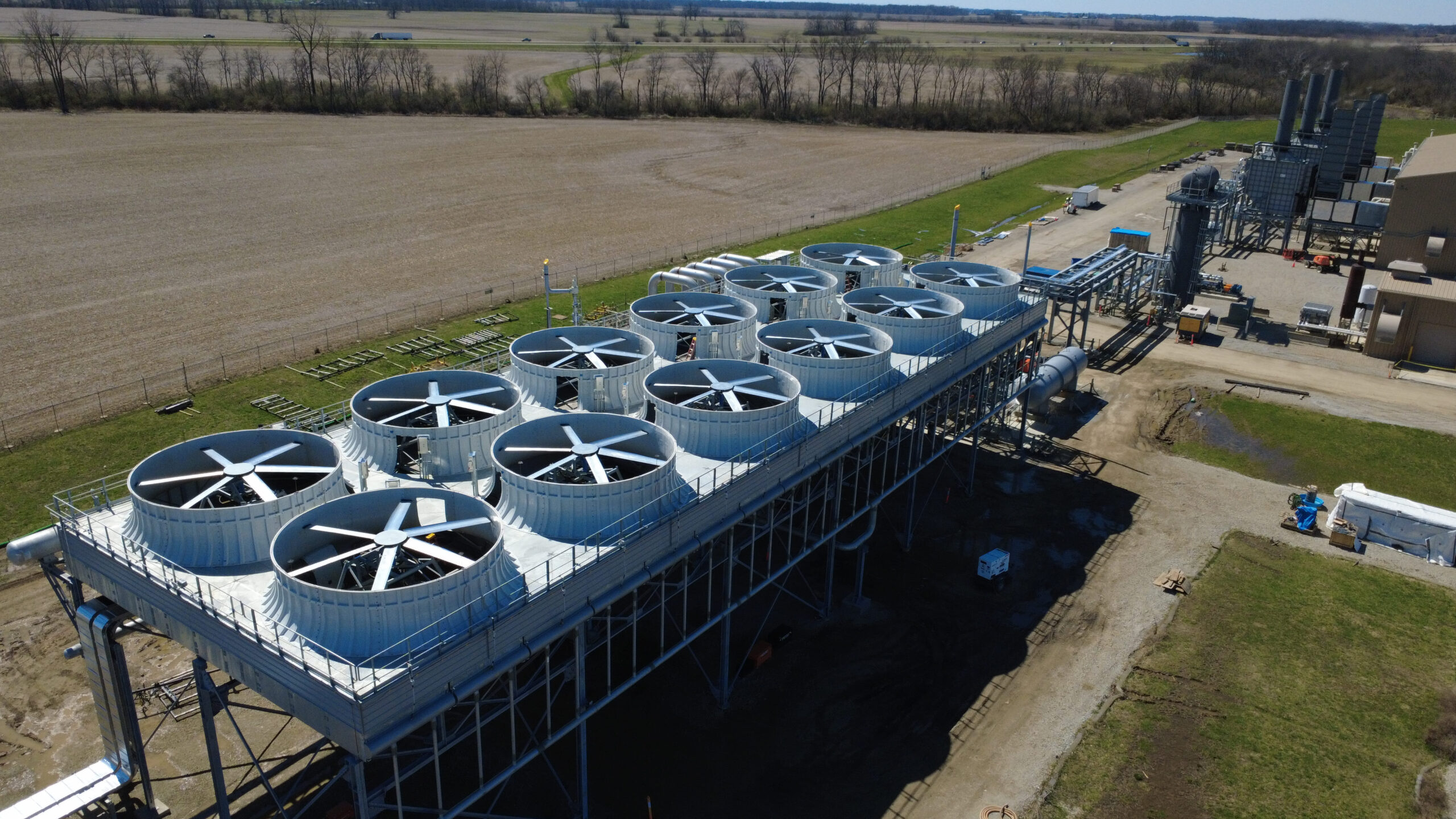
Kanin served as development partner to pipeline operator Tallgrass on a waste-heat recovery facility connected to an existing natural gas compressor station on the Rockies Express Pipeline in Washington Court House, Ohio. Under a 15-year PPA structure, AES Ohio purchases the output and routes it through its local distribution system to serve the University of Dayton’s full campus electricity load. The facility generates approximately 78,000 MWh of carbon-free electricity annually, with an estimated ~55,000 metric tons of avoided CO2 per year. Construction began October 2024, completed early 2026, with commercial flow announced July 2026 — Kanin’s first operating reference asset with a public utility and university counterparty.
A 7MW waste heat to power facility under development at Phillips 66’s Mewbourn natural gas processing plant in Weld County, Colorado. The project is designed to capture heat already generated by the plant’s existing gas-processing operations, improving the host facility’s power reliability and operational resilience alongside its emissions profile.
A technology-agnostic development platform applying WHP, CHP, and other on-site generation solutions across midstream oil & gas, cement, steel, and chemicals verticals. Kanin’s scope spans engineering, project financing, long-term offtake and interconnection structuring, construction, and ongoing O&M — a full-stack developer model rather than an equipment-sale relationship.
Technology Stack — Commercially De-Risked ORC Hardware: Kanin does not develop proprietary generation technology. Its projects are built around organic Rankine cycle turbines with a deployment history exceeding four decades — a deliberate choice that prioritizes bankability and reliability over technology differentiation. This lowers execution risk for project-finance lenders and long-term offtakers, but it also means Kanin’s moat, to the extent one exists, sits in origination and financing rather than in the hardware itself.
Kanin’s capitalization history follows a fairly typical cleantech-developer arc: a sequence of small seed and accelerator-linked rounds funded early platform build-out and pre-development work, followed in 2025 by early project-level debt (a line of credit) as construction activity began, and culminating in September 2026 with the company’s first institutional-scale growth-equity raise — timed to coincide with, and substantially de-risked by, the commercial start-up of its first operating asset. The step-change in round size and investor profile between the seed years and the 2026 raise is itself a signal: Kanin has moved from venture-style capital formation toward infrastructure- and project-finance-style capital formation, consistent with a developer transitioning from platform-proof to portfolio-scale execution.
Kanin closed an initial seed round in December 2020, followed by two further seed tranches in 2022 and July 2023. Earthshot Ventures participated across all three tranches, anchoring the early cap table alongside climate-focused seed investors including Sun Road Syndicate, Wollemi Capital, WovenEarth Ventures, Bandera Capital, and Foresight Canada.
Kanin participated in an accelerator program (Incubator/Accelerator-IV) in March 2023, and in November 2023 closed a $5.2M convertible note round from undisclosed investors. The timing suggests bridge-style financing supporting early-stage development costs on what became the Dayton and Mewbourn projects, ahead of a priced institutional round.
Kanin secured a line of credit in August 2025 — consistent with construction-phase working-capital needs — and in October 2025 was selected for the Unreasonable Impact Americas Program, a global climate-tech accelerator backed by corporate sponsors including Barclays and Chevron. Selection into this program signals deepening access to institutional and corporate-partnership networks ahead of the 2026 growth round.
Round structure: S2G Investments committed up to $50M (~C$69M) and Canada Growth Fund (CGF) committed up to $50M (~C$69M), each as new equity financing. The “up to” framing used in the press release indicates this is best read as a capital commitment tied to pipeline deployment milestones rather than a single fully-drawn equity check — investors should treat the $100M figure as a committed ceiling, not confirmed paid-in capital, pending further disclosure.
Use of proceeds: Development, construction, and operation of additional WHP and on-site power projects across heavy industry in Canada and the United States, scaling the existing commercial pipeline that already includes one operating facility (Dayton) and multiple projects in construction (including Mewbourn).
Investor commentary: S2G Investments Principal Marisa Sweeney characterized waste heat as “a category with real staying power,” citing rising power prices, grid congestion, and reliability constraints as structural demand drivers. Canada Growth Fund Investment Management (CGFIM) CEO Yannick Beaudoin framed the investment explicitly around Kanin’s “proven, commercially operating track record” — underscoring that the round was underwritten on the back of the Dayton asset reaching commercial operation, not on pre-revenue potential.
- Cumulative pre-2026 funding figures are inconsistent across data providers. Tracxn and PitchBook report cumulative funding of $7.55M prior to the 2026 round; CBInsights reports $9.05M. Kanin is privately held with no audited financials in the public domain, so both figures should be treated as unaudited, aggregator-derived estimates rather than confirmed company disclosures.
- The $100M round’s actual funding structure is not fully specified. The press release’s “raised up to $100 million” language suggests a committed-capital structure tied to deployment milestones rather than a single fully-funded close. Confirmed paid-in capital should be re-verified against future company or investor disclosures rather than assumed to equal the headline figure.
- Co-founder count is inconsistently reported. CEO Janice Tran stated in a 2022 interview that Kanin has three co-founders (herself, Fipke, and Bainbridge), consistent with the company’s internal organizational chart (The Org). However, third-party databases including Tracxn and BestStartup Canada list a fourth co-founder, Rod Fitzsimmons Frey. This report follows the company’s own organizational record and the CEO’s stated account, and flags the discrepancy rather than silently reconciling it.
- The Dayton facility’s nameplate capacity (MW) has not been publicly disclosed. Official releases cite only annual output (~78,000 MWh); no MW figure has been confirmed by the company, university, or utility parties. This report presents the annual-output figure as disclosed and does not back-calculate or imply a nameplate capacity.
Kanin’s defensibility does not rest on proprietary hardware. Instead, it rests on a full-stack development-and-financing model, an emerging commercial operating track record, relationships with investment-grade industrial counterparties, and access to government-linked growth capital. The underlying equipment layer — ORC turbines and related waste-heat recovery hardware — is a moderately concentrated OEM market (Ormat, Turboden, Alfa Laval, and other top-five players held roughly 36% share in 2025, in a global ORC WHP market sized at approximately $4.6B in 2025 with a projected 2026–2035 CAGR of 10.6%). Kanin’s positioning is deliberately upstream of that OEM layer: it is a systems integrator and capital allocator that sources equipment from these players rather than competing with them directly on turbine technology.
By bundling engineering, financing, construction, interconnection, and long-term O&M into a single zero-capex offering, Kanin removes the principal barrier to industrial adoption of waste-heat recovery — upfront capital outlay. This structurally differentiates Kanin from equipment-only OEMs, whose sales motion requires the industrial customer to self-finance and self-manage project execution.
By deploying commercially proven ORC technology rather than developing proprietary hardware, Kanin minimizes technology risk and preserves flexibility to select the optimal solution per site. This is a meaningful advantage in securing project-finance debt and long-dated offtake commitments, where lenders and counterparties price bankability heavily.
Execution track record with pipeline operator Tallgrass, integrated energy major Phillips 66, and regulated utility AES Ohio represents a trust asset that later-stage entrants cannot replicate quickly. A signed 15-year PPA is a meaningful proof point for negotiating leverage with future off-takers and regulators.
Securing up to $50M from Canada Growth Fund — a $15B government-backed clean-economy investment vehicle — represents more than a financial commitment; it functions as policy validation. This may translate into preferential access to tax incentives and policy-linked financing relative to purely privately-capitalized competitors, though it also introduces the policy-overhang risk discussed in Section 05.
Next Leg of Growth — Rising Power-Reliability and Data Center Demand: Against a backdrop of tightening North American grid capacity and rising industrial power prices, structural demand for on-site, dispatchable baseload solutions is expanding. Kanin’s stated strategy extends beyond midstream oil & gas into adjacent heavy industry — cement, steel, and chemicals — with data center power demand cited as a plausible, if not yet contracted, future optionality.
Kanin’s investment thesis carries the execution, capital, and counterparty risks typical of an early-commercial developer transitioning into large-scale infrastructure deployment.
At roughly 50MW in operation or construction, Kanin’s proven portfolio remains small relative to the scale implied by a $100M capital deployment. Simultaneous execution across multiple new sites raises the probability of EPC delays, permitting friction, and site-specific engineering variance — the classic scale-up risks facing a developer moving from single-digit-project proof points to portfolio-scale delivery.
Kanin’s flagship projects are concentrated among a small number of large industrial hosts — a pipeline compressor station (Tallgrass) and a gas-processing plant (Phillips 66). An operational disruption, facility closure, or demand reduction at any single host could have an outsized cash-flow impact. Long-term PPA structures mitigate near-term termination risk, but counterparty durability over the full contract term warrants ongoing diligence.
With a government-linked vehicle (Canada Growth Fund) providing half of the new round’s committed capital, any shift in Canadian federal clean-economy policy or in CGF’s investment mandate could affect access to follow-on capital. As Kanin’s U.S. project mix grows, the future trajectory of U.S. clean-energy tax credits (ITC/PTC-type incentives) is a further material variable in project-level economics.
Should ORC equipment OEMs such as Ormat, Turboden, Alfa Laval, or Calnetix internalize development and financing capabilities and approach industrial customers directly, the value-add of Kanin’s “developer-integrator” positioning could compress. In that scenario, Kanin’s differentiation would narrow to its project-finance structuring capability and existing customer relationships — a thinner moat than the current full-stack narrative implies.