
Thatch
Health-budget infrastructure built on ICHRA — a San Francisco fintech-native re-rating candidate engineering “healthcare’s 401(k) moment”
Thatch Health, Inc. was founded in October 2021 in San Francisco, California, as an ICHRA (Individual Coverage Health Reimbursement Arrangement) administration and payments platform. The company operates from 353 Kearny Street in San Francisco with an additional New York office. Consistent with the fintech-in-healthcare playbook, Thatch runs a fully embedded regulatory stack: insurance brokerage is conducted through its licensed subsidiary, Thatch Health Insurance Services LLC, while card-issuing and deposit rails sit with a partner bank (Thread Bank, Member FDIC).
Ellis’s founding motivation traces to a formative loss: his father died of cancer when Ellis was six. He began his career on the scientific side as a cancer researcher at MIT, before pivoting to commercial roles — standing up the U.S. sales organization at clinical software startup Sophia Genetics and later contributing to product development at biotech firm Agilent Technologies. That science-to-commercial arc underpins his stated thesis that healthcare has too few founders willing to disrupt an industry many are reluctant to challenge, and it frames Thatch’s core bet: re-architecting healthcare spend around the consumer rather than the employer.
Stevenson brings the fintech-payments counterweight to Ellis’s clinical background. He spent four years at Humana while running bootstrapped side ventures, then joined Stripe for seven years, building and leading multiple customer engineering teams — direct exposure to modern payments infrastructure design. Like Ellis, Stevenson lost a parent to cancer during his formative years, a shared origin point that the founding team cites as the emotional underwriting rationale for the business.
The early product and engineering team was drawn from consumer fintech names — Stripe, Robinhood, Shopify, and Ramp — instilling a “payments infrastructure” operating culture rather than an insurance-industry one. This is a meaningful positioning delta against ICHRA peers built by insurance-industry incumbents (e.g., Take Command Health markets “60+ years of combined insurance expertise”).
Thatch replaces the traditional group health plan — where the employer selects a single carrier and plan design for the whole workforce — with a per-employee health budget that each employee deploys toward an individually selected plan. The branded program is called CHOICE. Since the February 2023 stealth launch, the customer base has scaled to more than 5,000 employers (up from “over a thousand” disclosed at the April 2025 Series B), and management discloses trailing-twelve-month ARR growth of roughly 7x year-over-year. Initial go-to-market was startup-focused; the base has since broadened toward small and mid-sized employers more broadly.
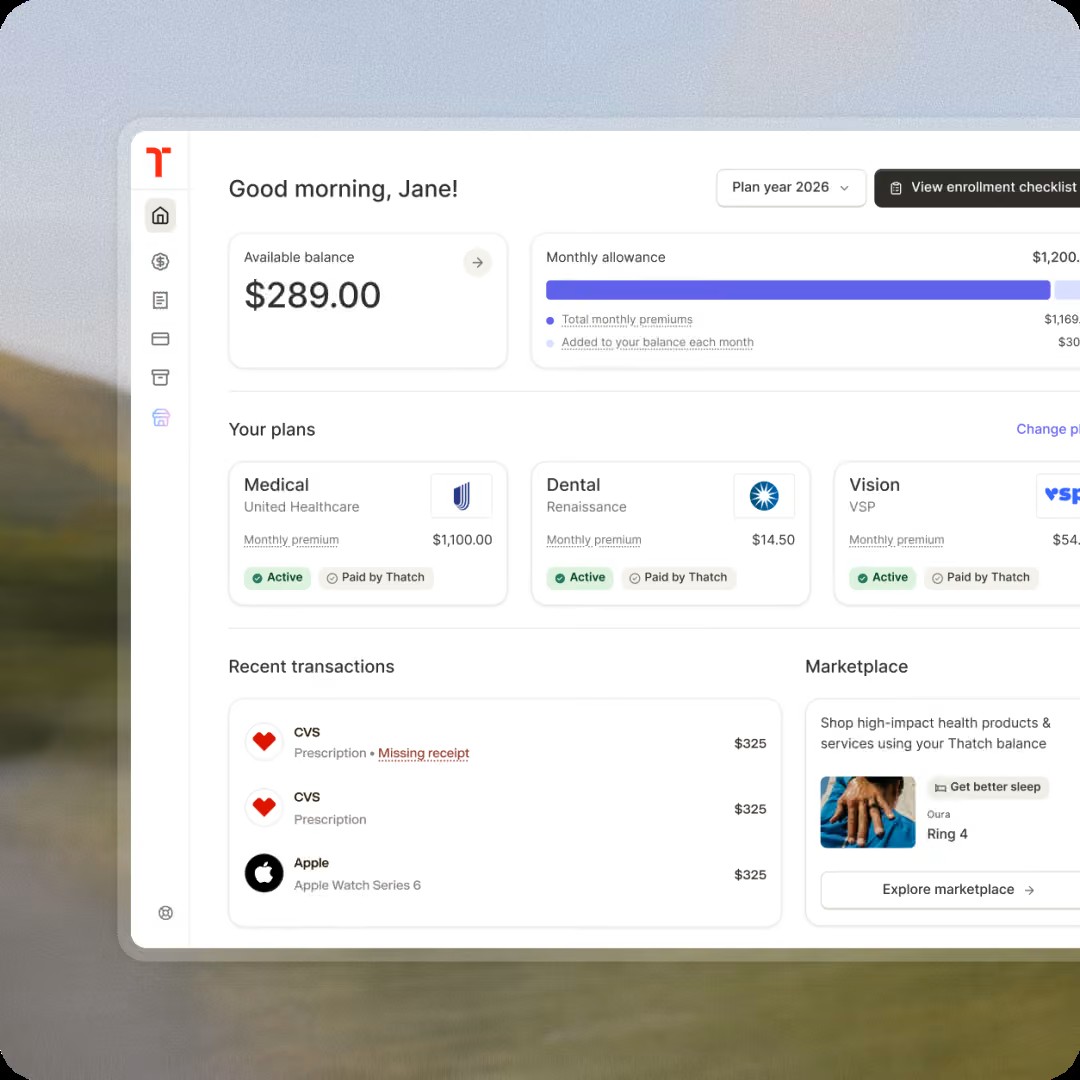
Employers set a monthly per-employee health budget; employees shop and enroll in medical, dental, and vision plans through the Thatch marketplace. The platform automates ICHRA eligibility determination against IRS/DOL rules, HIPAA and ACA compliance documentation, and premium autopay — the full administrative back office that a group plan would otherwise require in-house.
Unused budget is disbursed via a Thatch Visa debit card for copays, prescriptions, and other qualified spend. A “Just-in-Time HSA” intelligently routes payment across checking balance, upcoming paycheck, or HSA balance, while the Ask Thatch AI assistant adjudicates receipt-photo submissions for expense eligibility in real time.
A curated marketplace — Lyra Health (mental health), Function Health (biomarker testing), AliveCor KardiaCare Plus (cardiac monitoring) — lets employees spend pre-tax health-budget dollars beyond premiums. This is the primary wallet-share expansion lever beyond insurance brokerage economics.
Distribution strategy — payroll-embedded channel: Thatch is integrated directly into ADP’s RUN platform, Gusto, Justworks, and Paychex, allowing millions of small businesses to activate Thatch benefits without leaving their existing payroll workflow. This is a structurally lower-CAC acquisition motion than outbound SaaS sales, and it is the mechanism by which capital and distribution have become intertwined (see Section 03).
Inbound consolidation: In 2026, Thatch acquired the customer, broker, and employee base of Venteur, a 2021-vintage ICHRA competitor with roughly 86 employees; Venteur’s own platform has since been wound down. We read this as an early signal of category consolidation, in which capital-constrained ICHRA administrators are being absorbed by better-funded incumbents rather than competing on unit economics independently.
Thatch has raised approximately $192M in cumulative disclosed capital across four rounds since its February 2023 pre-seed/seed, culminating in a $1B post-money valuation at the September 2026 Series C. The investor base has evolved from a pure financial-sponsor stack (Index Ventures, General Catalyst, a16z) toward a hybrid structure that layers in strategic capital from payroll (ADP Ventures, Paychex) and pharma (Eli Lilly) — evidence of a customer-investor circularity where cap-table participants are simultaneously distribution or product partners.
Andreessen Horowitz (a16z) and GV (Google Ventures) co-led a $5.6M seed round, part of over $6M in combined pre-seed and seed capital that financed the public launch. Lux Capital, Quiet Capital, Not Boring Capital, and BrightEdge — the impact-investing arm of the American Cancer Society — participated, alongside angel investor Marc Randolph, co-founder of Netflix. Initial go-to-market was squarely startup-focused.
Index Ventures and General Catalyst co-led, with new entrants SemperVirens and The General Partnership joining, and existing backers a16z and Avid Ventures returning. Index Ventures partner Jahanvi Sardana framed the underwriting rationale publicly: healthcare remains “the last major financial decision still controlled by employers,” drawing an explicit parallel to the pension-to-401(k) transition as the structural re-rating trigger for the category.
Index Ventures led, with a16z, General Catalyst, The General Partnership, SemperVirens, and PeopleTech Partners following on. New strategic investor ADP Ventures entered concurrently with a distribution partnership embedding Thatch into RUN Powered by ADP — a governance-and-channel-lock structure where capital participation and go-to-market access were negotiated as a package. In parallel, Gary Daniels, formerly CEO of UnitedHealthcare’s Pacific Northwest division, joined as Chief Growth Officer, adding payer-side credibility to the bench. Co-founder Adam Stevenson indicated the round priced roughly 3x the Series A mark, though the figure was not formally disclosed and should be treated as directional.
Round composition: The financial-sponsor syndicate comprised The General Partnership, Index Ventures, Scale Venture Partners (new), General Catalyst, and a16z, with follow-on participation from Avid Ventures, Quiet Capital, SemperVirens, and new entrant QuantumLight. Strategic capital came from global pharmaceutical company Eli Lilly and Company and payroll major Paychex, both new to the cap table, alongside continued participation from ADP Ventures.
Reading the pharma strategic: Company messaging explicitly cites cash-pay GLP-1 therapies, therapy, and preventative diagnostics as illustrative uses of leftover health-budget dollars — which positions Eli Lilly’s strategic check as a direct bet on Thatch as a cash-pay consumer distribution channel for GLP-1-class therapeutics, rather than a passive financial stake. Paychex’s entry extends the payroll-embedded distribution motion established with ADP in the prior round.
Stated use of proceeds: Member-facing healthcare navigation tooling, deeper carrier partnerships, expanded payroll integrations, and service depth for the 5,000-plus employer base. Management’s underwriting case leans heavily on a call that 2027 will be the strongest growth year on record for the ICHRA/CHOICE category.
Thatch’s defensibility rests on being the best-capitalized player in the ICHRA category, a fintech-native payments stack, a payroll-embedded distribution motion, and underwriting validation from strategic investors spanning pharma and payroll. It is worth flagging up front that because ICHRA itself is a young regulatory construct (introduced in 2020), the category’s moats look less like durable structural advantages and more like capital-driven first-mover positioning that could compress if the regulatory or competitive landscape shifts.
Roughly $192M of cumulative capital and a $1B print give Thatch a decisive balance-sheet advantage over Take Command Health, Remodel Health, Gravie, and Zorro. The 2026 absorption of Venteur’s customer base is the round-trip proof point: capital advantage converting into inbound M&A. The flip side is that this also signals the category’s unit economics remain unproven — capital intensity, not efficiency, has been the primary differentiator to date.
A founding team drawn from Stripe, Robinhood, Shopify, and Ramp gives Thatch structurally different card-issuing, HSA, and payments-product design capability versus insurance-industry-native peers (Take Command Health markets “60+ years of combined insurance expertise” as its counter-positioning). The market read on this is genuinely split: Take Command frames the contrast as “flashy dashboards versus real insurance expertise,” and the debate over compliance depth versus product polish remains unresolved among brokers evaluating both platforms.
Integration with ADP RUN, Gusto, Justworks, and Paychex, paired with ADP Ventures’ and Paychex’s strategic participation in the Series B and C, structurally combines capital raising with channel access. Organic inflow from millions of SMBs already living inside these payroll workflows implies a lower CAC than outbound sales motions — though rising dependence on a small number of payroll gatekeepers also concentrates negotiating-leverage risk on the other side of the table.
Eli Lilly and Company’s Series C participation reads as validation of Thatch as a consumer-facing distribution channel for cash-pay pharmaceuticals, GLP-1 therapies in particular, and supports the revenue-diversification thesis for Thatch Market beyond pure brokerage economics. We’d flag, however, that no specific commercial agreement with Eli Lilly has been publicly disclosed alongside the equity investment — the strategic logic is inferred from messaging, not confirmed contract terms.
The regulatory-tailwind thesis: Management cites roughly 60% annual growth in the ICHRA category, alongside company-disclosed data showing group health plan costs up ~22% over five years while individual-plan costs have trended down, as the basis for calling 2027 the category’s best growth year on record. If that plays out, the best-capitalized incumbent stands to be the structural beneficiary — but these figures are company-sourced and have not been independently verified against third-party market data.
The investment case rests on structural ICHRA category growth and Thatch’s capital-scale advantage, but several regulatory, competitive, and governance risks warrant explicit underwriting scrutiny.
ICHRA is a relatively young mechanism, introduced in 2020, and the entire business model is downstream of IRS/DOL tax treatment and eligibility rules. A change in administration or Congressional posture toward the tax preference could compress eligibility or benefits — a systemic overhang for the category, not just Thatch specifically.
Competitor Take Command Health offers access to the full Healthcare.gov and state marketplace plan universe, while Thatch is understood to lean primarily on off-exchange plans sourced through carrier partnerships. That structural difference could translate into narrower plan choice for employees in certain states and markets relative to marketplace-agnostic competitors.
Thatch leans on AI chatbot and help-desk ticketing as its primary support layer, whereas several competitors run a hybrid model pairing 24/7 AI support with human advisors. For lower health-literacy SMB employee populations, a tech-first model carries a higher risk of service gaps at moments that matter — plan selection, claims disputes, urgent billing issues.
Reaching a $1B print on a $108M raise appears to price in a meaningful portion of the “best growth year ever” 2027 thesis in advance, leaving limited room for a growth-deceleration scenario without down-round risk. Separately, Venteur’s market exit is itself a leading indicator that the ICHRA category remains high-cash-burn, and that survival outside the best-capitalized handful of players is far from assured.