
CADDi Inc.
A manufacturing-focused AI data platform — dual-headquartered in Tokyo and Chicago, founded in Japan in 2017
CADDi Inc. is a manufacturing-focused AI data platform founded in Tokyo in November 2017, now operating under a dual-headquarters structure spanning Tokyo and Chicago. Under the mission to “unleash the potential of manufacturing,” the company transitioned from internally built parts-procurement software into an externally sold SaaS platform — a classic “dogfooding” origin story in which a solution proven on the company’s own operations was subsequently productized, which we flag as a notable pattern in the founding trajectory.
After graduating from the University of Tokyo, Kato joined McKinsey & Company in 2014, where he spent roughly three and a half years as an Engagement Manager co-leading the firm’s manufacturing procurement and IoT practice. During his tenure he worked on procurement projects for large manufacturers in North America (Chicago, Milwaukee, New Jersey, among others) and Asia, and has stated that observing 30–50% price variance for identical-spec parts across suppliers was a formative motivation for the venture. He co-founded CADDi with Aki Kobashi in November 2017 and now serves as global CEO, having relocated to Chicago to lead the company’s U.S. expansion directly. He has been named to Forbes 30 Under 30 (2019) and Forbes Japan’s list of top 10 entrepreneurs (2023).
Publicly available background indicates Kobashi previously worked as an engineer on Apple’s AirPods team and separately as an engineer at Lockheed Martin. The pairing of Kato’s procurement and business-development background with Kobashi’s hardware engineering experience appears complementary to CADDi’s core technical challenge of handling unstructured manufacturing data such as engineering drawings and CAD files.
On CEO Kato’s academic background, the large majority of press interviews and official company materials consistently cite “graduate of the University of Tokyo,” while his LinkedIn profile lists Carnegie Mellon University. We default to the primary-source figure (company statements and press interviews) but flag this discrepancy explicitly rather than resolving it.
CADDi originally launched as “CADDi Manufacturing,” an Amazon-style marketplace that directly sourced and distributed custom-fabricated parts. The software built internally to manage roughly 5,000 customers and 600 suppliers on that marketplace became the technical foundation for what is now the company’s core business: an “AI data platform.” Over the following two years the company broadened its product portfolio, repositioning from a single procurement tool into a platform operator structuring manufacturing data more broadly.
CADDi’s current product architecture centers on two broad layers.
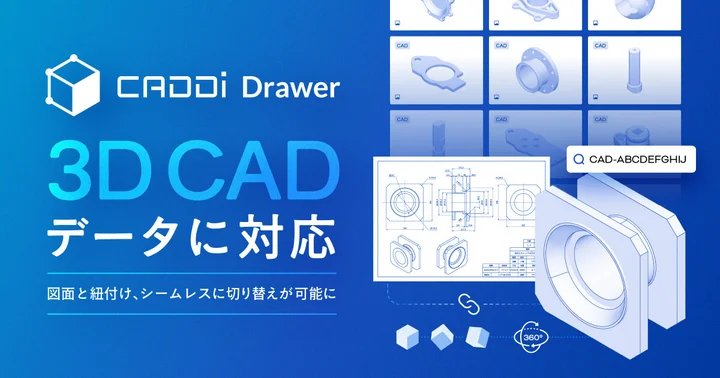
The flagship product ingests technical drawings and CAD files and searches a customer’s own historical database for similar or identical parts. It supports decisions on whether to reuse existing stock, repurchase from an existing supplier, or source anew by surfacing defect-rate data alongside search results — the company’s first commercialized product and, to date, its most broadly adopted module.
An AI agent that supports part-standardization decisions and performs “quality impact assessments” analyzing how a given design change affects performance and safety. CEO Kato states that drawing and CAD interpretation runs on a proprietary, purpose-built AI model rather than general-purpose LLMs, while document- and spreadsheet-type data is handled by general-purpose LLMs in a hybrid architecture.
A set of task-specific modules designed to capture the tacit knowledge of experienced engineers. CADDi Design Review, for example, flags potential errors in new drawings or CAD models based on the history of issues encountered with similar past parts.
Platform Integration Strategy: CADDi positions its core value proposition as unifying disparate customer data sources — CAD files, ERP systems, HR systems — into a structured form usable by both people and AI agents. CEO Kato cites the claim that more than 80% of shop-floor manufacturing knowledge is never documented and exists only as tacit knowledge held by experienced staff as the market-opportunity rationale for this approach (a company estimate that we were unable to independently verify).
In his interview with Fortune, CEO Kato declined to disclose revenue or customer-count figures, offering only the qualitative statement that “sales are more than doubling year over year.” This is an unverified, self-reported figure, and we were unable to obtain independent financial disclosures to corroborate it. The “80%+ undocumented knowledge” statistic is likewise a company estimate that would benefit from independent sourcing.
Since its Series A in 2018, CADDi has closed five external funding rounds over roughly eight years, culminating in a September 2026 Series D that more than doubled the company’s valuation to $1.2 billion. We note a gradual internationalization and strategic broadening of the investor base: an early roster dominated by Japanese VCs (DCM, Globis, WiL) gave way to global investors such as UK-based Atomico from Series C onward, and the Series D brought in Japanese corporate VCs — Toyota’s Woven Capital and Recruit Holdings’ HR Tech Fund — alongside U.S. investors including Moore Strategic Ventures.
Co-founded in Tokyo by Yushiro Kato (CEO) and Aki Kobashi (CTO). The initial business model was not software but a direct sourcing-and-distribution marketplace for custom-fabricated parts (“CADDi Manufacturing”); the software built to run that operation internally later became the technical basis for the company’s core product.
Led by DCM Ventures, with participation from Globis Capital Partners, WiL (World Innovation Lab), and Global Brain. Closed roughly 13 months after founding; these three Japanese VCs went on to become a core investor group that participated repeatedly across subsequent rounds.
Co-led by Globis Capital Partners and WiL, with six new investors joining — DST Global, Tybourne Capital Management, Arena Holdings, Minerva Growth Partners, JAFCO Group, and SBI Investment. TechCrunch, citing sources familiar with the deal, reported a post-money valuation of roughly $450M; this figure was not officially confirmed by the company.
Existing investors (Globis, DCM, Global Brain, WiL, JAFCO, Minerva Growth Partners) were joined by new investors including SMBC Venture Capital and Mitsubishi UFJ Capital. Notably, the round closed at scale despite a broader pullback in venture funding across the supply-chain management sector at the time. The company did not disclose a specific post-money valuation.
A “Series C extension” round led by UK-based Atomico, with re-participation from existing investors Minerva Growth Partners and SMBC Venture Capital. The company officially disclosed a $470M valuation and stated that proceeds would be concentrated on U.S. market expansion.
Deal structure: Eight new and existing investors participated. New investors included Moore Strategic Ventures, Coreline Ventures, Toyota’s growth-stage fund Woven Capital, and Recruit Holdings’ corporate venture arm HR Tech Fund (one additional new investor was not disclosed). Existing investors Atomico, Globis Capital Partners, and the JPS Growth funds — managed by a Japan Post Bank subsidiary — also returned.
Valuation trajectory: The $1.2B post-money valuation represents more than a doubling from the $470M figure disclosed in March 2025, a re-rating over roughly 18 months.
Strategic significance: We read the participation of Japanese corporate VCs Toyota and Recruit as signaling potential strategic linkage to the automotive and workforce-data value chains respectively, while the addition of U.S. investors such as Moore Strategic Ventures reflects growing confidence in the company’s North American expansion narrative.
• Amount raised: $114,000,000
• Post-round valuation: $1,200,000,000 (+155% vs. the prior $470M)
• Number of participating investors: 8 (4 new + 1 undisclosed new + 3 existing)
• Cumulative funding (self-reported): $234,000,000
• Stated use of proceeds: product-line expansion, advancing AI models specialized for 3D CAD and 2D drawing data, North America-centered global expansion, and hiring
On cumulative funding, the company and Fortune report a post-Series D cumulative total of $234M, while the database provider Tracxn lists $232M as of a comparable date — a roughly $2M discrepancy. We default to the primary sources (the company and Fortune) while flagging the possibility of differing aggregation methodologies across startup databases. Note also that the Series B and Series C post-money valuations were never officially confirmed by the company and rest on third-party reporting (TechCrunch, citing sources) or industry estimates, respectively.
CADDi’s competitive position rests on three pillars: a proprietary AI model purpose-built for the unstructured physical data (drawings, CAD) that general-purpose LLMs handle poorly; a data and reference-customer advantage stemming from deep penetration of the Japanese manufacturing base; and organizational investment in “change management” — an adoption barrier that software alone does not solve. We note that a meaningful share of these claimed advantages rests on company disclosure, with limited independent quantitative verification available, and should be weighed accordingly.
CEO Kato states he is not aware of a competitor using general-purpose LLMs to interpret drawings and CAD data, positioning CADDi’s proprietary model for this domain as its central differentiator, paired with general-purpose LLMs for document- and spreadsheet-type data in a hybrid architecture that routes each data type to the model best suited for it. This remains a company assertion, however; we found no independent, head-to-head technical comparison against competitors such as Werk24 or IrisX.
If the company’s disclosed figure — adoption by more than 50% of Japan’s top 100 manufacturers by revenue — holds, it would constitute a meaningful barrier to entry via data network effects and reference customers within that market. The company reports a customer base spanning 22 countries but has explicitly named North America as its core expansion axis, making the degree to which its Japan-market advantage transfers to North America a key variable for forward valuation, in our view.
CEO Kato identifies the primary barrier to adoption as organizational “change management” rather than technology, and states the company runs a Customer Success organization of more than 100 staff — exceeding its sales headcount — alongside a Forward-Deployed Engineer function. This may weigh on margins relative to a pure-play SaaS model, but we read it as an execution-side advantage that lowers the high switching resistance typical of traditional manufacturing customers.
Toyota Woven Capital and Recruit Holdings’ HR Tech Fund, both Series D participants, suggest potential strategic access to the automotive manufacturing value chain and to workforce/organizational data at large Japanese enterprises, respectively. Corporate VC participation can be read as a commercial validation signal, but it also carries the potential for greater strategic-investor influence over future business direction — a governance dimension we believe warrants continued monitoring.
Commercial Implications of the Founding Team Composition: The pairing of Kato (McKinsey background, procurement and business development) with Kobashi (Apple and Lockheed Martin background, hardware engineering) combines customer-problem framing with technical fluency in physical product data — a combination we view as well-suited to the domain expertise and commercial execution that a manufacturing-specific AI platform requires. We note, however, that this remains a qualitative strength commonly cited in such profiles rather than a quantitative metric that translates directly into financial performance.