
Temporal Technologies
The open-source orchestration company that created the “Durable Execution” category — a founding duo’s fourth rebuild of the same problem is now emerging as the reliability standard for the AI agent era
We frame Temporal’s founding not as an accidental discovery but as the fourth or fifth iteration of the same underlying problem. Co-founders Samar Abbas (CEO) and Maxim Fateev (CTO) first met at AWS in 2009 while building Amazon Simple Workflow Service (SWF), and each went on to encounter the same distributed-systems state-management challenge repeatedly across separate career paths. Fateev had previously led the messaging infrastructure that became the foundation for Amazon SQS, while Abbas moved to Microsoft and built the Azure Durable Task Framework out of an internal hackathon — a framework Microsoft later adopted as the basis for Azure Durable Functions.
The decisive turning point came in 2015 at Uber. Abbas and Fateev reunited at Uber’s Seattle development center and co-built Cadence, an open-source workflow engine that scaled to more than 100 internal use cases within three years. Open-sourced in 2017, Cadence spread organically to external engineering organizations including HashiCorp, LinkedIn, Airbnb, and Coinbase. Through that process, the two founders validated that the underlying technology had commercial potential well beyond an internal Uber project. They left Uber in 2019 to found Temporal — a direct successor to Cadence’s design philosophy, but architected from the ground up as a vendor-neutral, general-purpose developer platform rather than a company-specific internal tool.
Spent 11 years at Microsoft, where he designed the Azure Durable Task Framework. Previously contributed to Amazon Simple Workflow Service. As Principal Engineer at Uber, co-created Cadence with Fateev. Holds a degree from Ghulam Ishaq Khan Institute of Engineering Sciences and Technology. Took over as CEO from Fateev in 2024 to lead execution and growth strategy.
At Amazon, led the messaging infrastructure that underpinned SQS and contributed to Simple Workflow Service. Subsequently worked on big-data frameworks at Google. Reunited with Abbas at Uber to co-design Cadence. Handed the CEO role to Abbas in 2024 and transitioned to CTO, focusing on technology and long-term product vision.
The precise timing and circumstances of the Fateev–Abbas CEO/CTO transition (2024) are documented primarily through third-party profile aggregators (Founderland, Startup Intros, and similar sources) rather than a dedicated Temporal corporate announcement we could independently verify. We attribute this gap to the absence of formal disclosure obligations for private-company governance changes, but flag that investors conducting diligence should independently confirm the specific terms of the succession, including any associated changes in equity or board structure.
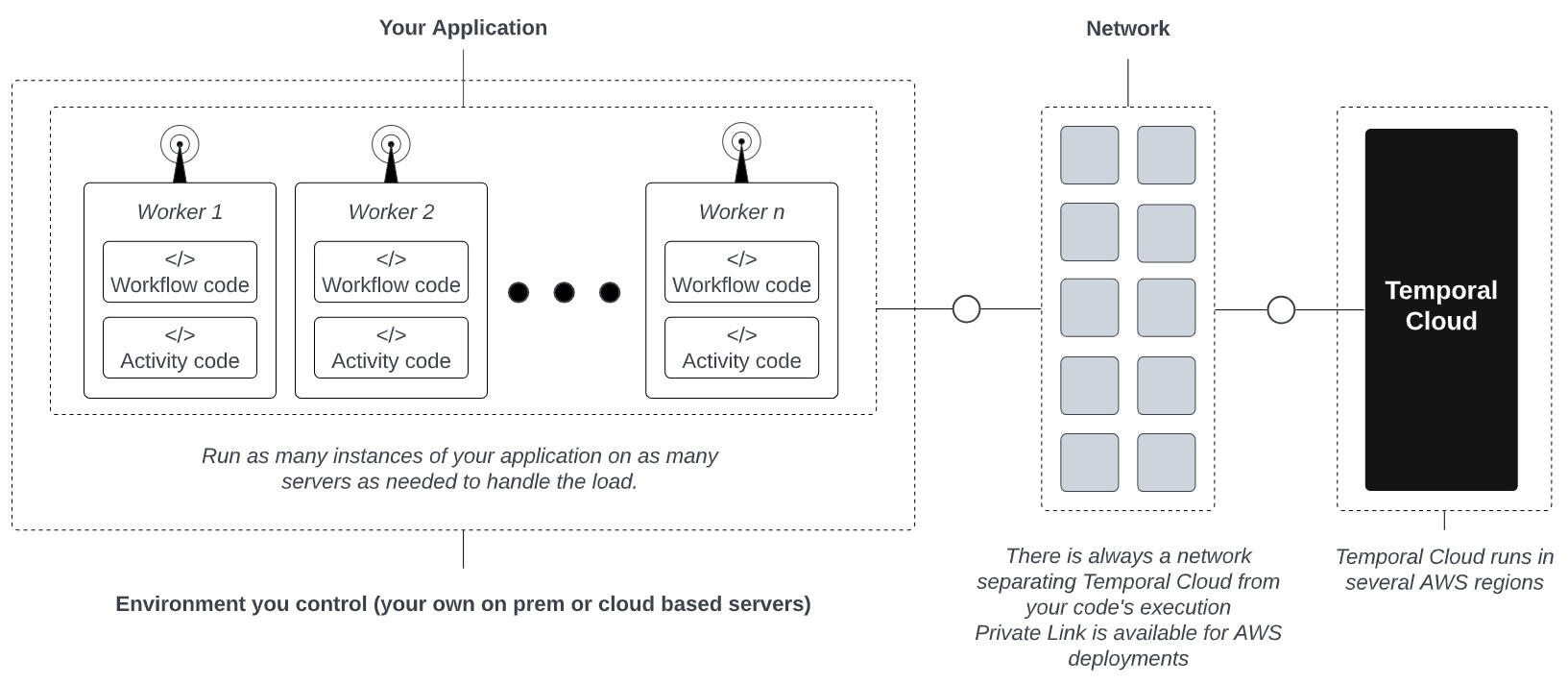
Temporal’s core product philosophy is summarized in a single term: Durable Execution. Developers write workflows in ordinary code (Go, Java, Python, TypeScript, .NET, PHP, Ruby), and Temporal provides the orchestration layer that preserves state and automatically resumes execution through server failures, network partitions, and process restarts. We view this as a category-creating infrastructure product in the sense that it structurally replaces the ad hoc combination of queues, databases, and cron jobs developers previously had to assemble by hand to approximate the same reliability guarantees.
| Product / Capability | Description | Status | Notes |
|---|---|---|---|
| Temporal Server | MIT-licensed open-source core, self-hostable | GA · Open Source | Free-distribution channel and the primary top-of-funnel for paid conversion |
| Temporal Cloud | Fully managed SaaS offering, usage-based pricing | GA | Core revenue driver; runs production workloads for OpenAI, Snap, JPMorgan Chase and others |
| Temporal Nexus | Durable application communication across namespaces and clusters | Scaling | Aimed at multi-tenant and partner-ecosystem interoperability |
| Large Payload Storage | Optimized handling of large payloads (e.g., LLM context windows) | R&D Investment | AI-workload-specific capability explicitly cited as a Series D/E investment area |
| Task Queue Priority & Fairness | Workload prioritization and fair resource allocation controls | R&D Investment | Targets operational stability in multi-tenant enterprise environments |
| Serverless Execution | Execution model removing the burden of operating worker infrastructure | Exploratory / In Development | Positioned to broaden accessibility from “vibe coders” to backend distributed-systems engineers |
The core of the competitive positioning: Unlike AWS Step Functions, which defines workflows declaratively in JSON via the Amazon States Language, or Camunda, which centers on BPMN visual modeling, Temporal takes a code-first approach in which the workflow itself is written as ordinary code in the developer’s language of choice. We view this design philosophy as carrying a real learning curve upfront, but one that structurally raises switching costs once adopted, functioning as a durable lock-in mechanism.
Over seven years since its 2019 founding, Temporal has completed seven capital events (Seed through Series E, including one secondary transaction), with valuation compounding roughly 1,860x from our estimated seed-stage valuation. What we flag as most notable is the acceleration in financing velocity: Series B (2022) to Series D (2026) spanned four years, while Series D to Series E took just seven months, with valuation rising 151% from $5B to $12.55B over that span. We read this as closely tied to the broader capital-flow acceleration into AI-agent infrastructure as a sector, rather than solely idiosyncratic to Temporal.
Raised shortly after the founders left Uber, where they had co-built Cadence. Led by Amplify Partners, which went on to participate in every subsequent round as an anchor investor. Sequoia Capital partner Bogomil Balkansky has recounted meeting the founders shortly after the seed round closed.
Led by Sequoia Capital. Madrona Venture Group joined as a new investor, alongside existing backers Addition Ventures and Amplify Partners. Cumulative capital raised reached $25.5M. Early adopter customers cited at the time included Box, Snap, Coinbase, and Checkr.
Led by Index Ventures, with full participation from existing investors Sequoia Capital, Amplify Partners, Madrona Venture Group, and Addition Ventures. Proceeds earmarked for developer-community growth and maturing the Temporal Cloud offering. Greenoaks joined as a new investor in a February 2023 Series B extension (Series B-II).
Led by Tiger Global Management. MongoDB joined as a strategic investor, signaling a potential alignment with the broader data-infrastructure ecosystem. Management characterized the round publicly as “just the beginning” of the company’s next chapter.
Led by GIC, Singapore’s sovereign wealth fund, with participation from Tiger Global and Index Ventures. We read this as primarily a liquidity event for early investors and employees rather than a primary capital-raise, given its structure as a secondary (share purchase) transaction rather than new equity issuance.
Led by Andreessen Horowitz (a16z), with new participation from Lightspeed Venture Partners and Sapphire Ventures, and full re-up from existing backers Sequoia, Index, Tiger, GIC, Madrona, and Amplify. Management disclosed year-over-year revenue growth exceeding 380%. Raghu Raghuram, former VMware CEO and a16z general partner, joined the board as an observer.
Co-led by Lightspeed, Wellington Management, Growth Equity at Goldman Sachs Alternatives, and Tiger Global, with strong participation from T. Rowe Price and SV Angel. Returning investors a16z, Sequoia, Index, GIC, Sapphire Ventures, and Amplify Partners all re-upped. Valuation rose 151% from Series D in just seven months.
Reported figures for Temporal’s cumulative capital raised diverge across sources. GeekWire and Tracxn reported “$650M raised to date” as of the Series D announcement, while Startup Intros lists “$756M across seven rounds.” By contrast, our own summation of individually disclosed round sizes (Seed through Series E, including the secondary transaction) yields approximately $1.23B. We attribute the discrepancy to inconsistent treatment of the $105M secondary transaction and undisclosed amounts in certain rounds (e.g., the Series B-II extension), but note that no unified, company-issued lifetime total was identified; investors should verify at the individual-round level during diligence. We similarly flag that open-source adoption metrics are reported inconsistently: “183,000 weekly active developers and 7 million-plus clusters” (third-party sources) coexists with “43 million cumulative installs” (Series E announcement). These appear to be differently defined metrics (active usage vs. cumulative installs) rather than directly contradictory figures, but because the company has not published unified metric definitions, we avoid treating them as directly comparable.
The workflow-orchestration market includes multiple credible alternatives: Apache Airflow (data-pipeline-centric), AWS Step Functions, Azure Durable Functions, and Google Cloud Workflows (cloud-native managed services), Camunda/Zeebe (BPMN-based business-process modeling), and Cadence itself (Temporal’s predecessor, still an actively maintained open-source project). We assess Temporal as holding structural differentiation across three layers: product design, ecosystem moat, and market positioning.
Unlike AWS Step Functions’ declarative JSON (Amazon States Language) or Camunda’s BPMN visual modeling, Temporal workflows are written as ordinary code in Go, Java, Python, TypeScript, and other mainstream languages. Native conditionals and loops reduce the burden of learning a separate orchestration syntax.
Workflows can sit idle (sleep) for years without consuming worker resources, with state preserved entirely server-side. The architecture is structurally optimized for the asynchronous, long-running execution patterns — waiting on approvals or agent responses — characteristic of AI agent workloads.
The MIT-licensed open-source core serves as a free distribution channel, driving organic developer adoption (echoing the same pattern seen with HashiCorp and LinkedIn during the Cadence era at Uber) that funnels into paid Temporal Cloud conversion — a product-led growth (PLG) model rather than a sales-led one.
Snap moves 414 million Stories per day on Temporal, and JPMorgan Chase runs it in regulated production. OpenAI’s usage of Temporal has grown 60-fold in under a year. This track record of validation on mission-critical workloads underpins enterprise sales credibility.
Temporal successfully redefined a category — durable execution — that predates the AI boom as core infrastructure for the agentic era. While many competitors are pivoting reactively toward AI use cases, Temporal’s existing architecture aligns naturally with AI workload requirements.
Nearly two decades of iterative design experience spanning AWS SWF, Azure Durable Task Framework, Uber Cadence, and now Temporal. We view the accumulated architectural judgment from repeatedly solving the same problem as a meaningful contributor to early product reliability and the pace of enterprise adoption.
What the crossover-investor participation signals: The Series E round’s inclusion of large, traditionally pre-IPO-focused crossover asset managers — Wellington Management, Goldman Sachs Alternatives, and T. Rowe Price — reads to us as more than a straightforward venture financing signal. These institutions typically invest selectively in companies with meaningful IPO visibility already established, suggesting the market may be beginning to price in a public-listing pathway for Temporal. We note this as our own inference; management has made no public statement regarding IPO plans.
Temporal is a private company that does not file audited financial statements with the SEC or an equivalent body, and the revenue, retention, and usage metrics we cite throughout this report are self-reported and unaudited. Profitability figures (operating income, net income) have not been disclosed. As is typical for open-source infrastructure companies at this stage, we would caution that deliberate loss-bearing in service of ecosystem expansion (a land-and-expand strategy) is common and should not be read as a proxy for near-term profitability.
On the opportunity side, we would highlight ▲ structural demand growth tied to the proliferation of long-running, asynchronous AI agent workloads (ARR growth of 200%+, billable-action volume up 350% YoY) ▲ OpenAI’s reported 60-fold usage growth, which we read as a signal of infrastructure standardization among frontier AI labs ▲ production validation at hyperscale and in regulated industries via Snap and JPMorgan Chase ▲ the participation of crossover asset managers such as Wellington, Goldman Sachs Alternatives, and T. Rowe Price, which suggests a potentially visible path toward an IPO.
On the risk side, we would flag ▲ the 151% valuation increase in seven months ($5B → $12.55B) since Series D, which — even accounting for reported revenue growth in the 200%+ range — appears at least partly correlated with broader valuation exuberance across the AI-infrastructure sector, implying down-round risk in subsequent rounds should sector sentiment reverse ▲ competitive pressure should the three major hyperscalers (AWS, Microsoft Azure, Google Cloud) further subsidize or bundle their native orchestration services (Step Functions, Durable Functions, Cloud Workflows) — notably, Azure Durable Functions traces its lineage to a framework co-founder Abbas himself designed, creating an ironic competitive dynamic ▲ an undisclosed conversion rate from free open-source users to paid Temporal Cloud customers, which limits external verification of the PLG model’s underlying unit economics ▲ succession risk tied to the 2024 CEO/CTO transition, alongside limited public disclosure around private governance structure ▲ the broader information asymmetry inherent to late-stage private companies whose valuations rest substantially on unaudited, self-reported metrics.