
TEMB Intelligent Technology
China’s leading automotive thermal-management components supplier — a Shandong-based thermostat and smart water-valve specialist that priced its Shanghai IPO in September 2026
TEMB Intelligent Technology (Shandong) Co., Ltd. traces its roots to the Qufu Auto Parts Factory, a 1971-vintage state-owned enterprise operating under the Shandong Automotive Industry Group. The business was privatized in September 2001, re-emerging as Qufu TEMB Auto Parts Manufacturing Co., Ltd. with registered capital of RMB 90 million. Headquartered at No. 158 Tianbo Road, Qufu Economic Development Zone, Jining, Shandong, the company carries more than half a century of continuous OEM supply history — a lineage that mirrors the broader arc of China’s domestic auto-parts industry, from planned-economy manufacturing base to privately controlled, family-run public company.
Joined the predecessor Qufu Auto Parts Factory in March 1971 and rose through workshop director, production section chief, and deputy plant manager before taking the top operating role. Following the 2001 privatization he served concurrently as general manager and chairman for two decades, building the thermostat franchise into the domestic market leader. A recipient of the “Outstanding Figure of China’s Automotive Industry — 30 Years of Reform and Opening-Up” and Shandong Province Model Worker honors, Lü represents a first-generation industrialist archetype common among China’s privatized manufacturing champions. He remains on the board following the 2022 leadership transition, anchoring continuity in the governance structure.
Holds a master’s degree and senior engineer credential. Spent 2002–2005 in the Qufu Comprehensive Law Enforcement Brigade and 2005–2019 in the Qufu Investment Promotion Bureau — a local-government career track — before joining the board in 2015 and eventually succeeding his father as chairman. Together with his father, Lü controls 95.57% of voting rights through the Tianbo Investment holding vehicle (55.70%) and the Tianbo Enterprise Management partnership (22.08%), making him the operative center of the company’s controlling-family structure.
Runs day-to-day operations and holds a direct 4.43% equity stake, making him the most significant non-family executive shareholder. Oversees production, quality, and OEM account management under the Lü family’s board-level control.
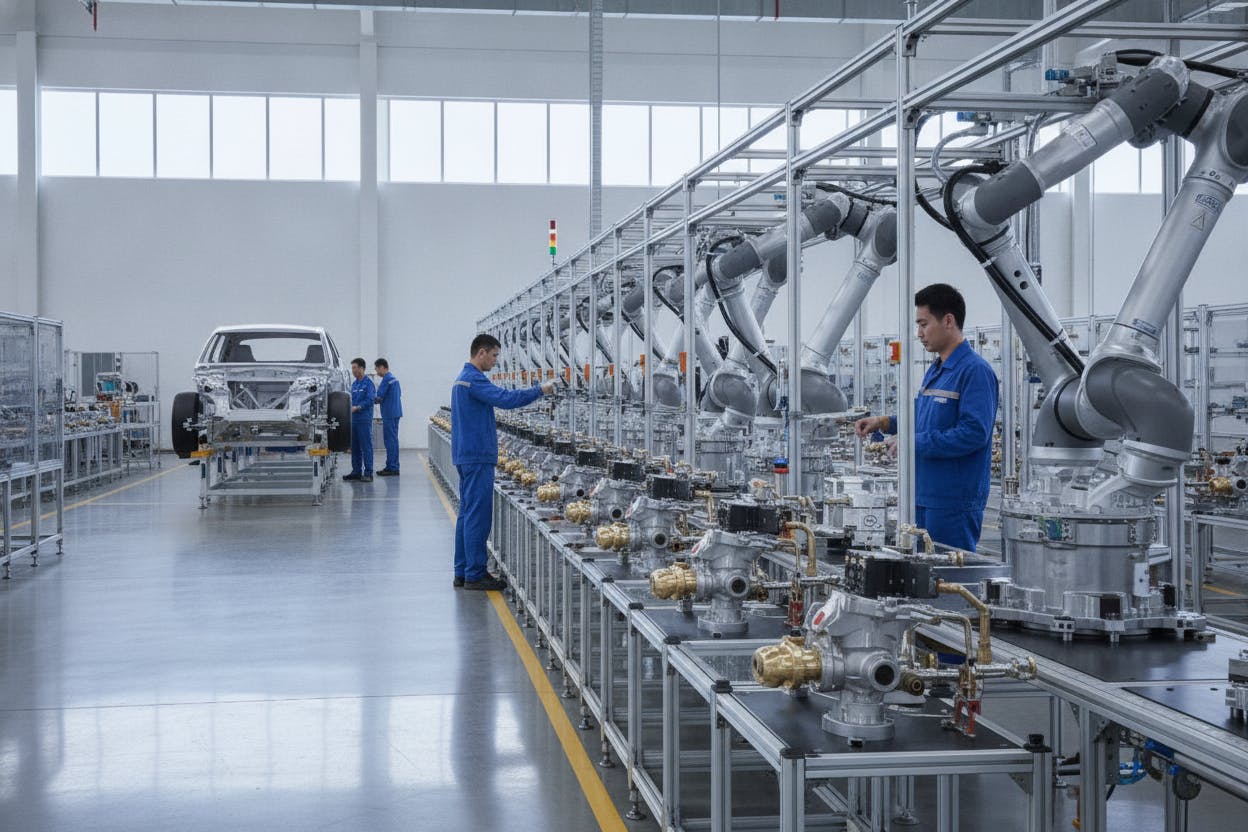
TEMB is a Tier-1 automotive supplier of thermal-management components organized into four product families: thermal-control parts (thermostats, smart water valves), sensing components (temperature sensors, oil-pressure alarms, TPMS), acoustic components (AVAS low-speed pedestrian warning systems), and switch components. The portfolio spans internal-combustion, hybrid, and battery-electric platforms alike. As of 2025, TEMB counts every one of China’s top-10 automakers by volume as a customer, and 29 of the top 30.
Core coolant-temperature control component. Per Frost & Sullivan (2024 basis), TEMB ranks first domestically and third globally by thermostat revenue, and is a drafting participant on multiple national and industry product standards.
Core thermal-management component for EV three-electric (motor/battery/power-electronics) systems; unit volumes have doubled twice over the past two years — the company’s principal growth driver. Now cross-selling into energy-storage and AI data-center liquid cooling, with Sungrow Power Supply as a newly won customer outside the automotive vertical.
Temperature sensors, oil-pressure alarms, and TPMS tire-pressure sensors. Wheel-speed sensor technology was absorbed via the 2013 Continental joint venture, Lubo Electronics.
Low-speed pedestrian-warning acoustic systems for EVs. TEMB has participated in drafting three related national standards, and pairs the line with switch components to serve OEMs’ one-stop sourcing preference.
Second growth curve — thermal-management IP extending beyond automotive: TEMB is applying its smart water-valve technology to energy-storage and AI data-center liquid cooling, having already begun shipments to Sungrow Power Supply. The move mirrors the diversification playbook pursued by larger domestic peer Sanhua Intelligent Controls, though TEMB’s non-automotive revenue contribution remains at an early, pre-scale stage.
Financial performance: Revenue compounded from RMB 968.2 million (2022) to RMB 1,270 million (2023), RMB 1,693 million (2024), and RMB 1,961 million (2025) — a 32.2% three-year CAGR. Net income attributable to the parent has been considerably more volatile: on the sponsor-certified basis (the lower of pre- and post-non-recurring-item profit), the company reported RMB 172.5 million (2022), RMB 112.1 million (2023, a sharp year-over-year decline), RMB 282.1 million (2024), and RMB 350.9 million (2025). Certain media accounts cite unadjusted headline net income figures for 2022 (RMB 487 million) that are materially higher — these appear to include investment gains and fair-value movements excluded from the sponsor’s adjusted metric, and should be treated as a distinct, less conservative measure when assessing earnings quality.
Unlike a typical venture-backed growth story, TEMB’s capital-markets arc runs from state-enterprise privatization through organic growth inside China’s auto supply chain to a Shanghai main-board listing — a path that is archetypal for Chinese industrial IPOs. The September 2026 listing marks the first time this half-century-old family enterprise has submitted itself to public-market scrutiny and pricing discipline.
Established as a state-owned enterprise under the Shandong Automotive Industry Group, beginning decades of technical accumulation in automotive thermal-sensing components.
Converted to a private limited-liability company via equity restructuring. Founding chairman Lü Xinmin assumed the general manager and chairman roles concurrently, building out the thermostat and acoustic-component OEM supply base. Proxy-held employee shareholding and a delayed state-equity transfer from the privatization were fully resolved by 2009.
Partnered with Germany’s Continental — a global thermal-management and chassis Tier-1 — to form Lubo Electronics, producing wheel-speed sensors and related components. The relationship has remained stable ever since. In 2025 TEMB deepened the tie further, planning a Hungary-based joint venture with Vitesco-linked spinoff Oumowei.
Redirected R&D emphasis from internal-combustion-centric thermostats toward smart water valves and other electrified-platform thermal components, which subsequently became the primary revenue growth driver.
Founding chairman Lü Xinmin stepped back and his son Lü Yawei assumed the chairman and legal-representative roles. The company was simultaneously converted from Qufu TEMB Auto Parts Manufacturing Co., Ltd. into TEMB Intelligent Technology (Shandong) Co., Ltd., a joint-stock company structure, with registered capital increased by RMB 30 million.
Filed IPO coaching registration with the Shandong Securities Regulatory Bureau, formally initiating the path to a public listing.
SSE accepted TEMB’s main-board listing application, moving the filing into formal review.
Initial strategic placement was set at 6 million shares (20% of the offering). Planned use of proceeds totaled RMB 2.057 billion across four projects — an intelligent thermal-management component manufacturing base, a capacity-expansion technical-renovation project, the TEMB R&D center, and an IT-systems upgrade — versus actual net proceeds of RMB 1.782 billion, a shortfall of roughly RMB 275 million that will likely require supplementary self-funding or bank financing to close.
Shares opened at RMB 94.69 versus the RMB 62.65 issue price, a roughly 51% first-day pop, pushing market capitalization above RMB 10 billion (~$1.6 billion). The National Social Security Fund and the Basic Pension Insurance Fund both took institutional allocations — a signal that state-directed long-duration capital sees credibility in the China EV-supply-chain thesis. CSC Financial acted as sponsor; GF Law Firm advised TEMB, with DeHeng Law Offices serving as counsel on the strategic placement.
- Succession timing: The sponsor’s official biographical disclosure dates Lü Yawei’s chairmanship from January 2022, while an August 2025 local media report describes the handover as having occurred “late last year” (implying late 2024). This report adopts the official filing date (2022) as the primary reference while flagging the discrepancy.
- Net income measurement basis: Media-cited “attributable net income” figures (e.g., RMB 487 million for 2022, RMB 322 million for 2024) appear to reflect unadjusted headline profit inclusive of investment gains and fair-value movements. These diverge materially from the sponsor’s official filings, which report net income on a “lower of pre- and post-non-recurring-item” basis (RMB 172.5 million for 2022, RMB 282.1 million for 2024). This report uses the sponsor-certified figures for valuation and earnings-quality purposes.
- Domestic thermostat market share: Older recruiting materials cite a 45% share figure, while 2025 management commentary cites 55%. The formal prospectus avoids a specific percentage, instead citing Frost & Sullivan rankings (#1 domestic, #3 global). This report defaults to the ranking-based disclosure as the more authoritative source.
TEMB’s competitive positioning rests on four pillars: switching costs built up over a half-century of OEM qualification history, near-universal top-OEM coverage, a technology-transfer relationship with a global Tier-1, and early-stage diversification of its thermal-management IP into non-automotive end markets. Set against this, the company remains meaningfully sub-scale relative to domestic giants Sanhua Intelligent Controls, Yinlun, and Tuopu Group, and dwarfed by global thermal-management majors Denso, Valeo, Mahle, Bosch, and Continental — a gap investors should weight explicitly in any relative-value framework.
A-grade supplier status with Volkswagen since passing its Asia-Pacific quality audit in 2003, IATF 16949 certification, and drafting participation on four product standards create structural re-qualification barriers that are difficult for later entrants to replicate once a design win is secured.
TEMB now supplies all of China’s top-10 automakers by volume and 29 of the top 30, evidencing broad land-and-expand penetration. The offsetting risk: top-5 customer concentration has climbed from 28.52% (2022) to 42.35% (H1 2025), with BYD, Chery, and Great Wall alone exceeding 30% combined — expanding logo coverage and rising concentration are running in parallel.
The 2013 Lubo Electronics joint venture with Continental, and the 2025 Hungary JV planned with Continental spinoff Oumowei, give TEMB an inbound technology channel that most purely domestically-R&D’d competitors lack — a differentiated, if modest, source of technical credibility.
Applying smart water-valve technology to energy-storage and AI data-center liquid cooling, with Sungrow Power Supply as a newly secured customer, offers a path to reducing cyclical dependence on auto-OEM production volumes. Revenue contribution from this vector remains nascent, however, and should not yet be underwritten as a core valuation driver.
Underwriting watch items: Post-listing share performance is likely to hinge on three variables: (1) the pace at which smart water-valve revenue from energy-storage and data-center cooling becomes visible in the P&L; (2) whether top-customer concentration continues to rise; and (3) the trajectory of OEM in-house substitution — particularly BYD’s internal smart water-valve development. The 21.43x IPO multiple screens cheap relative to Sanhua’s public-market valuation, but that gap is arguably a fair reflection of TEMB’s smaller scale, narrower brand recognition, and negligible international revenue base.
The source news article (Dealroom) contains no risk disclosure; the items below are compiled independently from TEMB’s prospectus and sponsor filings for a fuller institutional-diligence picture.
Several large customers, including BYD, are known to be developing smart water valves internally — a direct substitution threat to TEMB’s principal growth product line.
Top-5 customer revenue concentration rose from 28.52% (2022) to 42.35% (H1 2025). Intensifying price competition among Chinese OEMs is being transmitted upstream as component-price pressure on suppliers like TEMB.
Receivables as a share of current assets rose from 30.76% to 45.59%, and TEMB recognized actual bad-debt losses in 2023 tied to distressed OEM customers. Inventory has also expanded, carrying incremental write-down risk.
The sharp 2022–2023 net-income decline was driven by large swings in investment gains and fair-value movements rather than core operating performance, undermining the predictability of reported earnings.
The Lü family controls 95.57% of voting rights against 46.4% economic ownership, a structure expected to persist post-listing and one that materially limits minority-shareholder influence over strategic and capital-allocation decisions.
Sanhua Intelligent Controls, Yinlun, and Tuopu Group all operate at substantially greater scale domestically, while Denso, Valeo, Mahle, Bosch, and Continental dominate globally with far larger customer bases — leaving TEMB reliant on its niche leadership in thermostats and water valves rather than broad-based scale advantages.
Planned capital expenditure across four IPO-funded projects (RMB 2.057 billion) exceeds actual net proceeds (RMB 1.782 billion) by roughly RMB 275 million, implying reliance on supplementary self-funding or debt financing to complete the stated capex program in full.