
The Boring Company
A tunneling startup born from a traffic-frustration tweet — now a $23 billion infrastructure platform underwritten by sovereign capital
The Boring Company (“TBC” or “the Company”) traces its origin to December 17, 2016, when Elon Musk vented publicly about Los Angeles traffic and announced, in the same breath, that he intended to build a tunnel boring machine. We read this founding moment not as a one-off stunt but as an extension of the “first-principles hardware redesign” playbook Musk had already applied at SpaceX and Tesla — this time directed at urban infrastructure. The entity was formally organized in January 2017 as a SpaceX-affiliated project and was spun off into a standalone corporation in 2018.
Day-to-day management sits with a professional executive rather than the founder himself. Steve Davis, who has served as President and CEO since 2018, is a two-decade Musk lieutenant who joined SpaceX in 2003 as an early engineering hire and worked on the Falcon 1, Falcon 9, and Dragon programs. Davis also served as the de facto operational lead of the U.S. Department of Government Efficiency (DOGE) in 2024–2025 — a data point we flag as relevant context for the Company’s government-relations leverage and permitting negotiations.
Founder of SpaceX and Tesla. Published an open-source Hyperloop white paper in 2013 that laid the intellectual groundwork for TBC. Registered the Company the same day he publicly vented about Los Angeles traffic in December 2016.
Holds dual master’s degrees in particle physics and aerospace engineering from Stanford. SpaceX’s 22nd hire (2003), with a background in Falcon rocket development. Known across the Musk portfolio (Tesla, X, TBC) as a cost-cutting specialist; served as day-to-day lead of DOGE in 2024–2025.
Arun Prakash serves as Chief Financial Officer, and Jared Birchall — who runs Musk’s family office — holds the roles of director, treasurer, and corporate organizer. In our view, TBC’s governance structure is highly concentrated around Musk and a small circle of trusted lieutenants, a structural risk factor we flag explicitly for investors evaluating the Company.
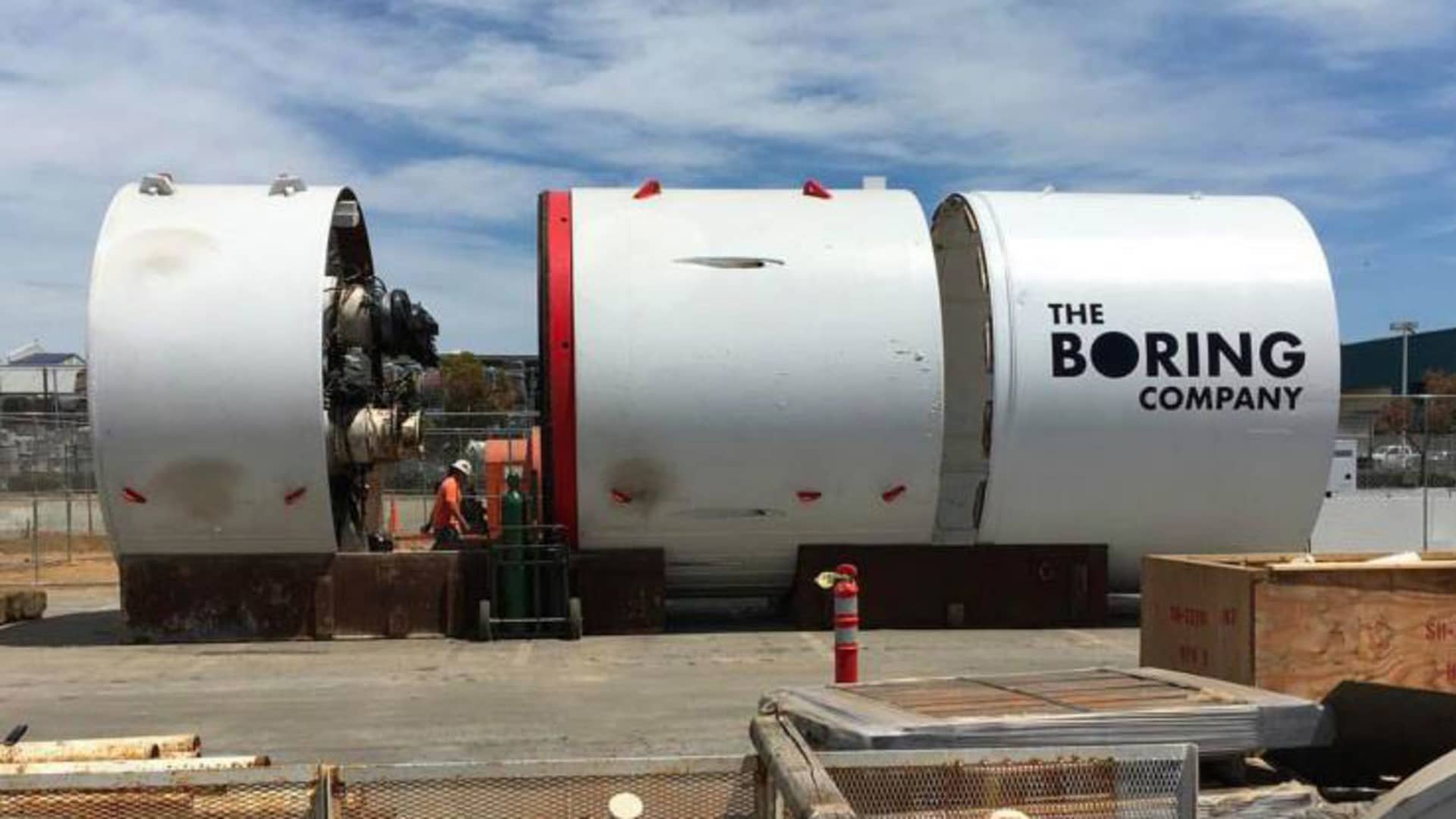
TBC’s business model rests on two connected pillars: (1) development and operation of “Prufrock,” a proprietary small-diameter tunnel boring machine (TBM) platform, and (2) construction and operation of “Loop,” an underground transit network built on that boring capability. Unlike conventional subway systems, Loop moves passengers point-to-point without intermediate stops using Tesla electric vehicles — eventually intended to shift to purpose-built autonomous shuttles — routed through the tunnels.
| Project | Location | Status | Notes |
|---|---|---|---|
| Vegas Loop | Las Vegas, Nevada, USA | Operating | 11 stations in commercial operation; Clark County entitlement supports expansion to 68 miles and 104 stations. Currently boring its 14th tunnel in the city (25th overall) |
| Music City Loop | Nashville, Tennessee, USA | Boring underway | Company’s first hard-rock geology project. Boring began February 2026 following a Tennessee Department of Transportation permit — a key test of the model in a conventional commuter market |
| Dubai Loop | Dubai, United Arab Emirates | Contract signed | Construction contract signed with Dubai’s Roads and Transport Authority for a 6.4km pilot phase with four stations. Construction expected to begin in late 2026 — TBC’s first international construction contract |
| UAE-wide tunnel program | United Arab Emirates (nationwide) | Early stage | Envisions 150+ km of tunnel under the partnership with the UAE government and affiliated investment entities that led the Series D — a materially larger follow-on program beyond Dubai Loop |
| Other (proposed) | Baltimore–Washington D.C.–Virginia, USA | Under discussion | Media reports have flagged potential involvement in large-scale U.S. infrastructure projects, including an Amtrak corridor, but no formal contract has been confirmed |
The Core of the Business Model Shift: In our assessment, TBC sits at an inflection point, transitioning from a single-city pilot operator into a repeatable, multi-city and multi-continent infrastructure contractor. With Vegas Loop standing as the only operating asset backed by real, fare-paying ridership data, the outcomes of the Nashville and Dubai projects will be the key milestones for validating the replicability of this model.
Across disclosed rounds from its 2018 Series A through its 2026 Series D, TBC has raised more than $3.9 billion. What stands out to us is the valuation trajectory: from roughly $800M–$920M in 2019, to $5.675B in 2022, to $23B in 2026 — a nearly 4x re-rating in the most recent round alone. We read this as being driven less by conventional revenue-growth metrics and more by the inflow of sovereign-adjacent strategic capital and the commercial proof-of-concept established by Vegas Loop — a re-rating pattern that does not map cleanly onto traditional venture growth multiples.
The entity was formally registered in January 2017, shortly after Musk’s December 2016 announcement. Early operations relied on a small SpaceX engineering team and the Hawthorne, California site for initial test boring. The Company was spun off as a separate entity in 2018.
Estimated at approximately $113 million per third-party data aggregators; the Company has not officially confirmed this figure, so we treat it as indicative only. Coincided with completion of the Los Angeles test tunnel and funded early proof-of-concept work.
Raised via a stock sale to venture capital firms. Implied valuation at the time was estimated in the $800M–$920M range. Proceeds funded development of the Las Vegas Convention Center Loop.
Co-led by Vy Capital and Sequoia Capital at a confirmed $5.675B valuation. Notably, real estate strategics — Brookfield, Lennar, Tishman Speyer, and Dacra — joined as new participants, a signal we read as pointing toward a future transit-oriented development revenue model. Proceeds were earmarked for a large-scale hiring push across engineering, operations, and production, plus continued Prufrock development.
Not a formal priced round but an employee share-liquidity event; press reporting (The Information) implied a valuation of roughly $7.0 billion. No audited financial statements or offering documents were made public, so we treat this figure as a reference point only.
Led by the United Arab Emirates government and affiliated investment entities, valuing the Company at $23 billion — roughly 4x the 2022 Series C mark. The Company states proceeds will fund 150+ km of tunnel construction in the UAE, hiring across engineering, operations, and production, continued build-out of Vegas Loop, Music City Loop, and Dubai Loop, and further development of the Prufrock platform. We note that the UAE is simultaneously the lead investor and the customer behind the Dubai Loop contract, aligning investor and off-taker incentives.
The tunneling and urban infrastructure market includes legacy TBM manufacturers such as Herrenknecht and Robbins, conventional public subway procurement systems, and adjacent substitute mobility such as autonomous robotaxis (Waymo, Tesla). In our view, TBC’s differentiation stems less from any single technology and more from the combination of three layers: a re-engineered cost structure, proven revenue-generating operations, and alignment with sovereign capital.
Small-diameter, continuous boring designed to structurally undercut conventional subway tunneling costs. If the Company’s $3M–$4M per-mile target is realized, it would represent an overwhelming cost advantage versus traditional public transit procurement.
Vegas Loop has carried more than 4 million fare-paying passengers — real commercial proof-of-concept, in contrast to Hyperloop-style concepts that never advanced past the design stage. Most competing tunnel-transit concepts remain at the pilot or planning phase.
As of August 2026, the Company claims full automation of its ring-building process, with boring monitored remotely from a control center rather than requiring in-tunnel personnel. If sustained, this structurally lowers labor cost and safety risk versus conventional TBM operations.
The UAE, which led the Series D, is simultaneously the off-taker behind Dubai Loop and the proposed 150-km follow-on program — a capital structure in which investor and customer incentives are aligned, offering greater pipeline visibility than typical venture funding.
Vehicle platforms rely on Tesla EVs and, prospectively, Cybercab, allowing shared autonomy, battery, and manufacturing know-how across affiliated companies. That said, we would caution against conflating this synergy with an independently defensible moat versus reliance on Musk’s personal brand.
Beyond Las Vegas’s comparatively favorable geology, the Company is now expanding into Nashville (hard rock) and Dubai (international regulatory environment) — a test of whether the model can move from a single-city curiosity to a repeatable infrastructure export business.
What the UAE Capital Signals: We view UAE government and affiliated entities leading the Series D as more than a passive financial investment — it reads as a state-level strategic bet to directly fund and accelerate a large-scale (150+ km) domestic infrastructure program through sovereign capital. This gives TBC a stable order pipeline, but it also concentrates revenue and capital-raising exposure around a narrow set of state-linked counterparties.
TBC remains a private company with no audited financial statements in the public domain, and management has not officially disclosed revenue or profitability figures. We flag this financial opacity explicitly as a core data gap for investment decision-making.
Core operating metrics — including Vegas Loop ridership and station counts — rely entirely on company self-reported disclosures, with no independent third-party verification identified. We also note instances where the Company’s own website has lagged behind more current figures cited elsewhere, producing discrepancies with external trackers, which warrants caution around the recency and precision of disclosed metrics. Early-round figures for the 2018 Series A and 2019 Series B are likewise sourced from third-party data aggregators rather than official company confirmation.
On the opportunity side, we would highlight: ▲a $23B valuation re-rating and a confirmed 150-km-scale international pipeline secured through UAE sovereign capital in the Series D; ▲a path toward validated mass-transit throughput, with Vegas Loop targeting roughly 90,000 riders per hour at full build-out; ▲the potential, if Nashville and Dubai succeed, to prove a replicable infrastructure-export model and reduce single-city concentration risk; and ▲optionality around large-scale U.S. public infrastructure work, including reported interest in an Amtrak Baltimore–Washington D.C. corridor.
On the risk side, we would flag: ▲financial opacity stemming from private, unaudited status and heavy reliance on operating metrics that cannot be independently verified; ▲a pattern of recurring regulatory and governance friction, including a 2025 Nevada safety fine that was rescinded the following day and a separate fine tied to wastewater discharge; ▲reputational and permitting risk tied to the political activities of Musk and key management (Steve Davis’s DOGE role and the evolving relationship with the Trump administration); ▲unresolved uncertainty over whether boring cost and speed can be replicated outside Las Vegas’s favorable geology, particularly in hard-rock and international regulatory settings; and ▲order-book and capital-raising concentration around a small number of large investors and off-takers, chiefly the UAE.