
Yingmu Technology (INMO)
Pioneer of integrated-body optical-waveguide AI+AR smart glasses — a Shenzhen-founded, Chengdu-headquartered Chinese wearables maker now in the early stages of IPO preparation
Yingmu Technology (brand name INMO) was incorporated in Shenzhen on December 30, 2020 (now operating as Sichuan Yingmu Technology Co., Ltd., with founder Yang Longsheng as legal representative), and develops consumer-facing AR/AI smart glasses. The company pairs a proprietary integrated-body (wireless, single-housing) optical-waveguide display with a self-developed operating system, AIOS, to position smart glasses not as a smartphone accessory but as a standalone next-generation mobile computing terminal. In 2024, the company relocated its marketing and management headquarters from Shenzhen to Chenghua District in Chengdu, while retaining its R&D organization in Shenzhen under a dual-hub structure.
Graduate of the finance program at Dalian University of Technology. Per company accounts, Yang entered the smart-glasses field around 2013 after trying an early Oculus prototype, and went on to co-found an early module-development startup in the space. He subsequently joined smartphone maker Coolpad’s smart-wearables division to lead lightweight AR-glasses R&D (media accounts place his join date variously in 2015, 2016, or 2018). When Coolpad restructured in late 2020, the division was spun out as Yingmu Technology (then Shenzhen Yingmu Technology Co., Ltd.), with Yang assuming the CEO role. His end-to-end hardware manufacturing track record — spanning smartphones, smartwatches, and smart glasses — is frequently cited as the team’s core asset.
Graduate of Shanghai Jiao Tong University. Company materials credit Lu with prior roles as Global CMO of the Coolpad Group and head of Huawei’s ecosystem market development. Since co-founding Yingmu, he has led brand strategy, content-ecosystem development, and external partnerships (including China Mobile and Tencent’s Yingyongbao app store), and has served as the company’s primary spokesperson across successive financing announcements.
Official corporate registration records list the incorporation date as December 30, 2020, while founder interviews and portions of media coverage describe the project as having “formally launched in early 2021” or as an “independent venture founded in 2021,” creating interpretive ambiguity around the effective start of operations. Yang Longsheng’s join date at Coolpad is likewise reported inconsistently across sources — variously 2015, 2016, and 2018 — and this report presents both figures rather than resolving them into a single asserted fact.
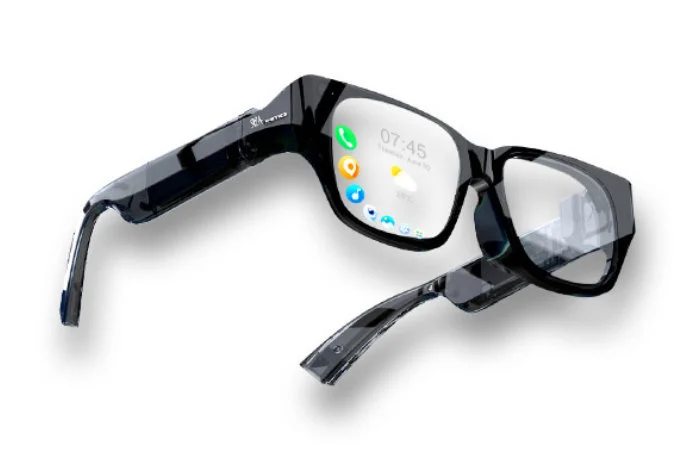
Yingmu positions itself as one of the earliest producers of mass-market, wireless, integrated-body consumer AR glasses in China. Per company disclosure, it has held the #1 domestic shipment position in smart glasses and in integrated-body AR glasses specifically for three consecutive years — a claim whose consistency with independent third-party research is addressed later in this report. Since inception, the company has maintained an integrated-body design philosophy, housing optical display, local compute, and AI sensing within the glasses frame itself, which management presents as the key differentiator versus phone- or host-device-dependent architectures.
The product portfolio is organized into three lines.
The flagship line carries the company’s full spatial-computing stack. The 2024 AIR3 was disclosed as featuring a 0.44-inch Micro-OLED display (1920×1080 resolution) co-developed with Sony and marketed as a world-first at this form factor, alongside virtual large-screen projection, multi-screen linking, and AI-agent functions.
A lighter-weight line built around voice interaction and AI-agent capability. The 2023 GO integrated large-language-model capability in a form close to on-device; the 2024 GO2, per company disclosure, became the segment’s first product to surpass ten thousand units sold on the strength of real-time translation. The 2025 GO3 added cloud-linked agentic task execution — booking flights, checking email, drafting meeting notes — triggered entirely by voice command.
A lifestyle-oriented line targeting specific consumer segments rather than a single mass-market SKU. This includes the INMO x Magic AI series developed with WHL (the agency representing idol Jackson Wang), and a photography-oriented collaboration aimed at female consumers — reflecting a persona-segmented rather than one-size-fits-all product strategy.
INMO AIOS — Three-Layer Architecture: (1) Spatial layer — monocular VIO, 6DoF spatial positioning, spatial anchoring, mixed-reality rendering, and gesture interaction, all self-developed and shipped in production. Only the low-latency-critical functions (positioning and rendering) run on-device; large-scale spatial reconstruction is offloaded to the cloud under an edge-cloud hybrid model designed to trade cloud compute for on-device weight and thickness. (2) AI-native layer — the company does not maintain its own foundation model and instead supports flexible switching across multiple third-party model vendors, concentrating its own R&D on higher-layer capabilities such as multimodal context understanding and agentic task orchestration. (3) Unified base system — the AIR and GO lines, among others, share a common technical foundation with capability tiers layered by product positioning, intended to maximize R&D reuse across the portfolio.
IPO Preparation: As of the September 2026 disclosure, the company stated it had formally begun IPO preparation work, without specifying a target listing venue or timeline. In a 2025 interview, the founder had set a goal of listing within three years.
Per publicly available Tianyancha corporate records, Yingmu has completed a cumulative seven financing rounds since its 2021 angel round. Notably, it closed three rounds — B2, B3, and C1 — within calendar year 2025 alone (approximately RMB 500 million combined), and continued that pace into 2026 with the C1 through C3 tranches, bringing cumulative Series C proceeds to approximately RMB 1.0 billion. This cadence places Yingmu among the most actively financed companies in China’s AI+AR smart-glasses segment by our assessment.
Participants included 37 Interactive Entertainment (三七互娱) and Eagle Fund (老鹰基金). Proceeds were directed toward initial product manufacturing and team-building immediately following the spin-out from Coolpad’s smart-wearables division.
Matrix Partners China led the round, with JOY Capital, Junsheng Capital, and existing shareholders participating as follow-on investors. Proceeds were allocated to product mass-production, delivery, and brand development.
Zhiwen Group, parent company of Chinese social platform Momo, invested as the sole participant, with Mucotton Capital serving as exclusive financial advisor. Proceeds were directed toward building INMO’s content ecosystem, with a particular focus on social and entertainment content.
Participants included Sichuan Development Hongxin Fund, Chenghua Technology Venture Capital, and Jiangxi Zhonghuan Investment Group. This round coincided with the company’s decision to establish its headquarters in Chenghua District, Chengdu, alongside announced content-ecosystem partnerships with Mango Media and Momo.
Puhua Capital, Liangxi Industrial Development Group, and Shenqi Capital co-invested. Proceeds were earmarked for next-generation product R&D, core AI capability-building, supply-chain deepening, and offline channel expansion.
Multiple outlets consistently reported that Yingmu closed B2, B3, and C1 within 2025, but the individual investor composition and deal size for B3 were not separately disclosed in detail.
Chengdu Technology Innovation Investment, Nanshan Strategic Emerging Industry Investment, and Pufeng Capital co-invested. Per Tianyancha-sourced reporting, this round valued the company at approximately RMB 2.0 billion and represented the final tranche of a three-round sequence (B2 + B3 + C1, roughly RMB 500 million combined) completed within calendar 2025. CEO Yang Longsheng reiterated a target of listing within three years.
The round’s existence is confirmed only indirectly, through language in the September 2026 Series C3 press materials referencing “C1 and C2, completed earlier this year.” Investor composition and deal size for C2 have not been separately disclosed as of this report.
Sichuan Zhenxing Technology Innovation Fund led the round, with Jing’an Capital, Shibei Hi-Tech, Guangzhou Industrial Investment, Sichuan Zhongshi, Meishan Zhongshi, and Dongpo State-Owned Investment participating as follow-on investors. Proceeds are earmarked for next-generation spatial-intelligence hardware R&D, continued iteration of the INMO AIOS platform, deepened hardware-software core capability, and expanded brand-building and omnichannel commercialization. The company formally confirmed the start of IPO preparation alongside this round.
• C1 (Jan 15, 2026): Chengdu Technology Innovation Investment, Nanshan Strategic Emerging Industry Investment, Pufeng Capital; RMB 2.0bn valuation disclosed
• C2 (2026, timing and detail undisclosed): Investors and deal size not publicly reported
• C3 (Sep 2026): Sichuan Zhenxing Technology Innovation Fund lead, with six additional follow-on institutions
• Cumulative Series C proceeds: ~RMB 1.0 billion (company/media-disclosed aggregate; per-tranche breakdown undisclosed)
• Concurrent development: Formal announcement of IPO preparation
The C1 tranche is well documented, with both investor composition and a disclosed RMB 2.0 billion valuation. Series C2, by contrast, is confirmed only indirectly via language in the C3 press release, with no separately disclosed investor names, deal size, or closing date. Accordingly, the widely cited “~RMB 1.0 billion cumulative Series C” figure represents the combined total of three tranches, and the precise per-tranche allocation cannot be independently verified as of this report. The post-money valuation attached to C3 itself has also not been disclosed.
Yingmu’s competitive positioning rests on its early-adopted integrated-body optical-waveguide technology path, a proprietary AIOS software stack tightly coupled to its hardware, and a founding team with prior consumer-hardware manufacturing experience. That said, as of H1 2026, the top-selling brands in China’s smart-glasses online retail channel — Thunderbird Innovation (雷鸟创新), Rokid, Qwen, and Huawei — do not appear to include Yingmu among the leading four, which in our view warrants further investor scrutiny as to whether the company’s stated technical advantages have yet translated into commensurate market-share outcomes (see Section 05).
While most competitors adopted split-architecture designs (e.g., BirdBath, tethered to a host device), Yingmu has held to an integrated-body path from inception, housing optical display, local compute, and AI sensing entirely within the glasses frame. The company reports having launched China’s first full-color waveguide smart glasses for consumers in 2021, which it credits with accumulated optical, thermal-design, and miniaturization know-how relative to later entrants.
Rather than maintaining its own large-language-model foundation, Yingmu concentrates on the upper software layer — multimodal context understanding and agentic task orchestration — while retaining the flexibility to switch across third-party model vendors. This reduces single-vendor dependency risk and positions the company’s core competitive claim around system-level orchestration of spatial and AI functions within the tight power and latency envelope specific to smart glasses.
The 2024 GO2, built around real-time translation, is positioned by the company as the segment’s first product to surpass ten thousand units sold, and drew media coverage at events including the Boao Forum for Asia for its role in simultaneous-interpretation support. This is a meaningful early proof point that AI smart glasses can deliver tangible utility in a specific, well-defined use case, and it laid the groundwork for GO3’s bidirectional real-time conversational translation.
Since the 2024 Chengdu relocation, Sichuan- and Chengdu-affiliated state-capital investors (including Sichuan Development Hongxin Fund, Chenghua Technology Venture Capital, Chengdu Technology Innovation Investment, and Sichuan Zhenxing Technology Innovation Fund) have repeatedly participated across the B-through-C financing rounds, alongside access to government-linked cultural-tourism AR pilot programs. In our assessment, this gives the company a comparatively stable funding channel even amid tighter private venture-capital conditions, functioning as a financial buffer.
In our assessment, Yingmu combines genuine technical differentiation and state-capital backing with a market-share position that remains unconfirmed by independent, third-party data amid a rapidly reshuffling Chinese smart-glasses competitive landscape — a tension we view as the central variable for investment underwriting.
- Third-party reporting on H1 2026 online smart-glasses sales share in China places Thunderbird Innovation, Rokid, Qwen, and Huawei as the top four brands, with Yingmu absent from that list — a divergence from the company’s self-reported “three consecutive years as #1 in shipments” claim that we flag as requiring further independent verification.
- Large platform players — Huawei, Baidu, Alibaba, and Xiaomi among them — are entering or expanding in the smart-glasses category, potentially placing Yingmu at a structural disadvantage in brand reach, distribution, and balance-sheet firepower relative to a startup.
- Incomplete disclosure around recent financing, including the C2 tranche (valuation, per-investor allocation), limits an outside investor’s ability to fully reconstruct the current capitalization table and dilution history.
- Hardware and software constraints — battery life of roughly four hours per company commentary, and an application ecosystem still at an early stage of maturity — remain a meaningful technical gap before any full smartphone-substitution scenario becomes realistic.
- Industry forecasts, including those from the China Academy of Information and Communications Technology, project China smart-glasses shipments growing from roughly 1 million units in 2025 to over 2 million in 2026, indicating a structurally expanding category.
- The financing cadence — three rounds within 2025 alone and a further three-tranche Series C sequence in 2026 — is, at minimum, evidence of sustained financial-investor engagement.
- Early market validation of a specific, well-defined use case (translation/interpretation, via GO2/GO3) suggests a genuine utility proposition beyond pure hardware-spec competition.
- Formal confirmation of IPO preparation raises the likelihood of improved disclosure standards going forward (audited financials, cap-table transparency), which could progressively narrow the information asymmetries noted above as the listing process advances.