
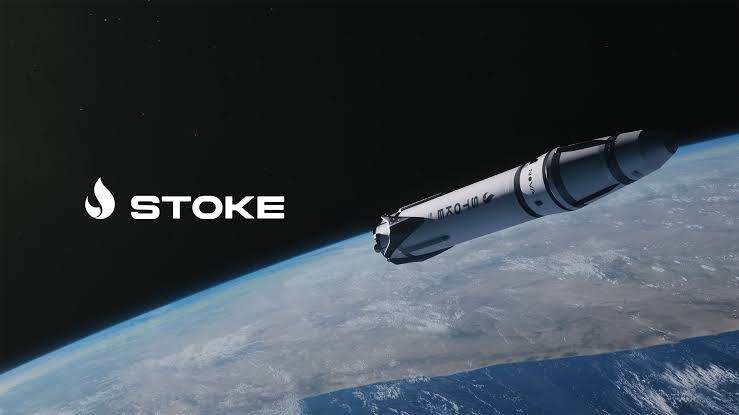
Stoke Space Technologies
A Kent, Washington-based space launch company developing Nova, a fully and rapidly reusable launch vehicle family — closed the initial tranche of a $1 billion Series E in September 2026
Stoke Space Technologies is a Kent, Washington-headquartered launch vehicle company co-founded in late 2019 by Andy Lapsa and Tom Feldman, both Blue Origin alumni. The two founders met while working together in Blue Origin’s propulsion organization and, observing that none of the roughly 150 rocket startups active at the time were seriously tackling full reusability — of both the booster and the upper stage — decided to found the company themselves.
Holds a B.S. in mechanical/aerospace engineering from Cornell University and a Ph.D. in aerospace engineering from the University of Michigan. An early core member at Blue Origin, he contributed to development of the BE-4 engine before spending roughly a decade as Director of the BE-3 and BE-3U engine programs, accumulating hands-on experience across liquid-hydrogen propulsion systems. At Stoke, he serves as the business-facing co-founder, leading strategy and large-scale capital formation.
Began his aerospace career as a SpaceX intern before spending roughly six years at Blue Origin as a design engineer on the BE-4’s oxidizer pump and thrust chamber. As Stoke’s technical lead, he directs the company’s core propulsion and structural technology, including the Zenith and Andromeda engine architectures and the fully reusable upper-stage thermal protection system.
Former Chief Product Officer of OpenAI and a Silicon Valley technology executive who previously led product and growth at Meta, Twitter (X), and Planet Labs. He first connected with Lapsa when Stoke went through Y Combinator in 2021, and he and his spouse were early personal investors in Stoke through their fund, Scribble Ventures. He joined the board ahead of Nova’s first flight to reinforce product and scaling capability as the company transitions toward commercial operations.
Phil Harris (Partner), Christian Garcia, Kelly Hennig, Steve Angel, and John Shaw are listed as outside directors, with several board seats held by representatives of key investors including Point72 Ventures — reflecting governance ties between the company and its capital-markets backers (per our own research).
Following their departure from Blue Origin, the two founders began analyzing the technical and economic feasibility of full reusability out of Feldman’s basement starting in the fall of 2019, and formalized corporate activity in May 2020 after securing a $225,000 SBIR Phase I grant from the National Science Foundation (NSF).
Stoke Space’s stated founding year varies across sources — “2019” (per founder interviews, GeekWire, the Milken Institute, Contrary Research, and others) versus “2020” (per Wikipedia and select databases). Given that substantive founding activity began in the second half of 2019 while the first government grant and formal corporate activity were not established until May 2020, this report characterizes the company as “founded in 2019, with corporate activity formalized in 2020,” and flags the discrepancy across source material.
Stoke is developing Nova, a family of fully and rapidly reusable two-stage launch vehicles. Nova Pathfinder, the first orbital configuration, is progressing through integration and qualification testing toward a targeted first flight in early 2027; as of June 2026, the company had reportedly completed proto-qualification of the first-stage structure across 46 structural verification tests at its Moses Lake test site. In September 2026, Stoke unveiled Nova Block 2 for the first time — a larger, fully reusable configuration delivering 15 metric tons to LEO — which is under parallel development with a targeted first flight in 2029.
Stoke’s operating model centers on launch services spanning commercial, government, and civil customer segments, complemented by external licensing of its internally developed engineering software as a secondary revenue stream.
Stoke’s core addressable market is the sustained deployment and replenishment demand of large satellite constellations. Against a backdrop of a worsening industry-wide launch capacity shortage as of August 2026, Nova Block 2’s 15-metric-ton fully reusable payload capacity is designed to serve bulk, orbital-plane-scale deployment demand.
In March 2025, Stoke was selected alongside SpaceX, ULA, and Blue Origin for the U.S. Space Force’s National Security Space Launch (NSSL) Phase 3 Lane 1 program, earning eligibility to bid on up to $5.6 billion in national security launch contracts. The company is currently executing an initial $5 million capability-assessment task order; actual mission awards, however, only become available following a successful Nova orbital flight.
Stoke rebranded its internally developed, cloud-based hardware engineering platform (formerly Fusion) as “Boltline” in August 2025 and now licenses it externally to aerospace, biotech, and advanced-manufacturing customers. With the core launch business still pre-revenue, we view this as a secondary revenue stream that complements the company’s capital-intensive rocket development (our own assessment; revenue scale undisclosed).
NASA Collaboration: In June 2026, NASA announced a Space Technology Mission Directorate collaboration with Stoke, via its Ames Research Center, to advance reentry, descent, and landing (EDL) technologies for Nova’s reusable upper stage. Following prior support from NSF, the U.S. Space Force, and DIU, this points to Stoke’s core reuse technology having been validated and backed by a broadening roster of government agencies.
Core Propulsion Technology — Zenith Engine (Stage 1): Zenith is a first-stage engine built around a full-flow staged combustion (FFSC) cycle fueled by liquefied natural gas (LNG) and liquid oxygen (LOX). Pathfinder flies with seven units, while the larger Nova will carry fourteen — a design intended so that flight heritage and the production system built up on Pathfinder carry directly into the larger vehicle program.
Starting with a 2020 NSF SBIR grant, Stoke has raised sequential rounds from Seed and Series A through Series E, with total capital raised standing at $2.3 billion per the company’s official disclosure as of September 8, 2026. Point72 Ventures and Y Combinator (which Stoke passed through in its Winter 2021 cohort) stand out as anchor investors that have participated continuously from the earliest rounds through Series E.
Andy Lapsa and Tom Feldman left Blue Origin and began early technical and economic feasibility analysis of full-reuse upper-stage propulsion. In May 2020, the company formalized corporate activity after securing a $225,000 SBIR Phase I grant from the National Science Foundation (NSF).
Secured seed capital in early 2021 and joined Y Combinator’s Winter 2021 cohort. Closed a $65 million Series A in December of the same year, scaling up early propulsion and structural technology development.
Led by Industrious Ventures with participation from the University of Michigan, Sparta Group, Long Journey, and others; existing investors Breakthrough Energy Ventures, Y Combinator, Point72 Ventures, NFX, MaC Ventures, Toyota Ventures, and In-Q-Tel also re-upped. The same month, the reusable upper-stage prototype “Hopper” completed a successful flight demonstration, pairing technical validation with the capital raise.
New and existing investors — including Breakthrough Energy Ventures, Glade Brook Capital Partners, Industrious Ventures, Point72 Ventures, Seven Seven Six, University of Michigan, Woven Capital, and Y Combinator — participated in roughly a 50:50 split. The round closed shortly after the first successful vertical-stand hotfire of the Zenith first-stage engine.
Stoke gained eligibility, alongside SpaceX, ULA, and Blue Origin, to enter the national-security launch IDIQ contract (with an ordering period through June 2029). Alongside Rocket Lab, Stoke became one of the first new entrants on-ramped to Lane 1 — a key milestone underpinning the company’s technical credibility with capital markets.
Series D was initially announced in October 2025 at $510 million and expanded to $860 million via an extension closing on February 10, 2026. Proceeds funded completion of Launch Complex 14 activation at Cape Canaveral and expansion of Nova production capacity. Participants included General Innovation Capital Partners and Washington Harbour Partners.
Kevin Weil, former Chief Product Officer of OpenAI and an early personal investor in Stoke, joined the board of directors, reinforcing commercialization and scaling capability ahead of Nova’s first flight.
Co-led by Point72 Ventures and Spark Capital, with participation from General Innovation, Glade Brook Capital, US Innovation Technology, Washington Harbour Partners, Woven Capital, and Y Combinator. Concurrently, Stoke unveiled its new, larger LEO-15-metric-ton launch vehicle, “Nova Block 2,” expanding the product roadmap for the first time.
• Round Size: $1,000,000,000 (initial closing, per company disclosure)
• Co-Leads: Point72 Ventures, Spark Capital
• Participants: General Innovation, Glade Brook Capital, US Innovation Technology, Washington Harbour Partners, Woven Capital, Y Combinator, and other new and existing investors
• Cumulative Capital Raised: $2,300,000,000 (per official disclosure as of September 8, 2026)
• Use of Proceeds: Preparation for Nova Pathfinder’s first flight, expansion of production, test, launch, and recovery infrastructure, and acceleration of Nova Block 2 development
Stoke’s cumulative capital raised varies materially by source: the company’s official September 8, 2026 press release states “$2.3B,” while its own February 2026 disclosure cited “$1.34B,” and third-party databases report yet other figures — $1.34B (Tracxn), $1.746B (CB Insights), $1.9B (Startup Intros), and $2.24B (Yahoo Finance/Forge). We attribute this to differences in disclosure timing, whether debt-like instruments are included, and database refresh cadence. This report follows the company’s most recent official disclosure of $2.3B.
Valuation is likewise undisclosed. Forge Global’s private-market pricing model implies an estimated valuation of roughly $9.1 billion, while Tracxn cites approximately $2 billion — a wide spread among third-party estimates. Because the company has not published an official valuation, investors should treat any third-party figure with caution.
Stoke’s competitive positioning rests on its singular commitment to a fully reusable architecture — an approach few peers are pursuing to the same extent — credibility earned through entry into national-security launch programs, and what we view as a strong founder-market fit. Where SpaceX reshaped launch economics through booster reuse alone, Stoke differentiates itself by targeting the next frontier head-on: full reusability that extends to the upper stage as well.
The industry’s conventional ceramic-tile passive heat shield carries meaningful risk of individual tile failure and requires precise inspection after every flight. Stoke instead extends the actively cooled approach proven inside rocket engines to reentry thermal protection: a ring of small thrust chambers arrayed circumferentially around the upper-stage engine is integrated with a liquid-hydrogen-cooled metallic base heat shield (BHS). The Block 2 version of Andromeda uses 12 independent engines (two thrust chambers each), which also delivers engine-out redundancy at the vehicle level.
By adopting a full-flow staged combustion (FFSC) cycle — widely regarded as the most difficult engine cycle to develop — fueled by LNG and LOX, Stoke minimizes the thermal and mechanical stress placed on turbomachinery, structurally lowering wear and maintenance burden across repeated flights. LNG also leaves fewer soot deposits than kerosene, reducing the cleaning cycle required between flights.
Pathfinder and Block 2 are designed to share the same stainless-steel skin-and-stringer construction and build/test methodology, minimizing reliance on fixed tooling and allowing the production system to scale directly from the smaller to the larger vehicle. Both are sized for over-the-road transport, enabling movement among the Kent, Moses Lake, and Cape Canaveral sites without dependence on barges or the Panama Canal.
Stoke’s March 2025 selection alongside SpaceX, ULA, and Blue Origin as a certified provider under the U.S. Space Force’s NSSL Phase 3 Lane 1 program secured bidding eligibility in a national-security launch market that admits only a small number of new entrants. That said, actual mission awards only become available following a successful Nova orbital flight, so no meaningful contract awards have materialized to date (see Data Gap Notice).
Strategic Strength of the Founding Team: Both Lapsa and Feldman built hands-on development experience across Blue Origin’s BE-3, BE-3U, and BE-4 engine programs before striking out on their own — what industry observers describe as a clear “problem-founder fit.” The division of labor between business lead (Lapsa) and technical lead (Feldman) is well defined, and the continuous participation of Point72 Ventures and Y Combinator from seed through Series E is, in our view, a signal of sustained conviction among Stoke’s earliest backers.
- Nova Pathfinder remains pre-flight as of September 2026; any slippage in the early-2027 first-orbital-flight target would push out the timing at which the company becomes eligible for NSSL Lane 1 mission awards.
- Far better-capitalized competitors — including SpaceX’s Starship and Blue Origin’s New Glenn — are also pursuing large, fully reusable architectures, and industry-wide development risk for new large launch vehicles remains elevated, as illustrated by reported New Glenn test anomalies (explosion) in May 2026.
- Valuation and detailed financials are undisclosed, and the wide spread among third-party estimates introduces uncertainty for outside investors attempting to assess valuation (see Data Gap Notice).
- Early NSSL Lane 1 task-order awards have skewed toward incumbents (particularly SpaceX), leaving uncertainty around the pace at which new entrants such as Stoke will convert eligibility into actual contract awards.
- Against a structurally tightening launch-capacity shortage, the 15-metric-ton fully reusable Block 2 is squarely aimed at future large-constellation replenishment demand.
- Cumulative technical validation and funding support from multiple government agencies — NSF, the U.S. Space Force, DIU, and NASA — can be read as a form of third-party validation that mitigates technology risk.
- The Boltline software business provides a secondary revenue stream that, in our view, represents a relatively capital-efficient attempt at cash-flow diversification alongside the capital-intensive launch business.
- The co-leadership of Series E by established late-stage investors such as Point72 Ventures and Spark Capital signals continued institutional conviction in the company.