
TabaPay Inc.
Single-API instant money-movement infrastructure provider — headquartered in Palo Alto, integrating card and bank payment rails
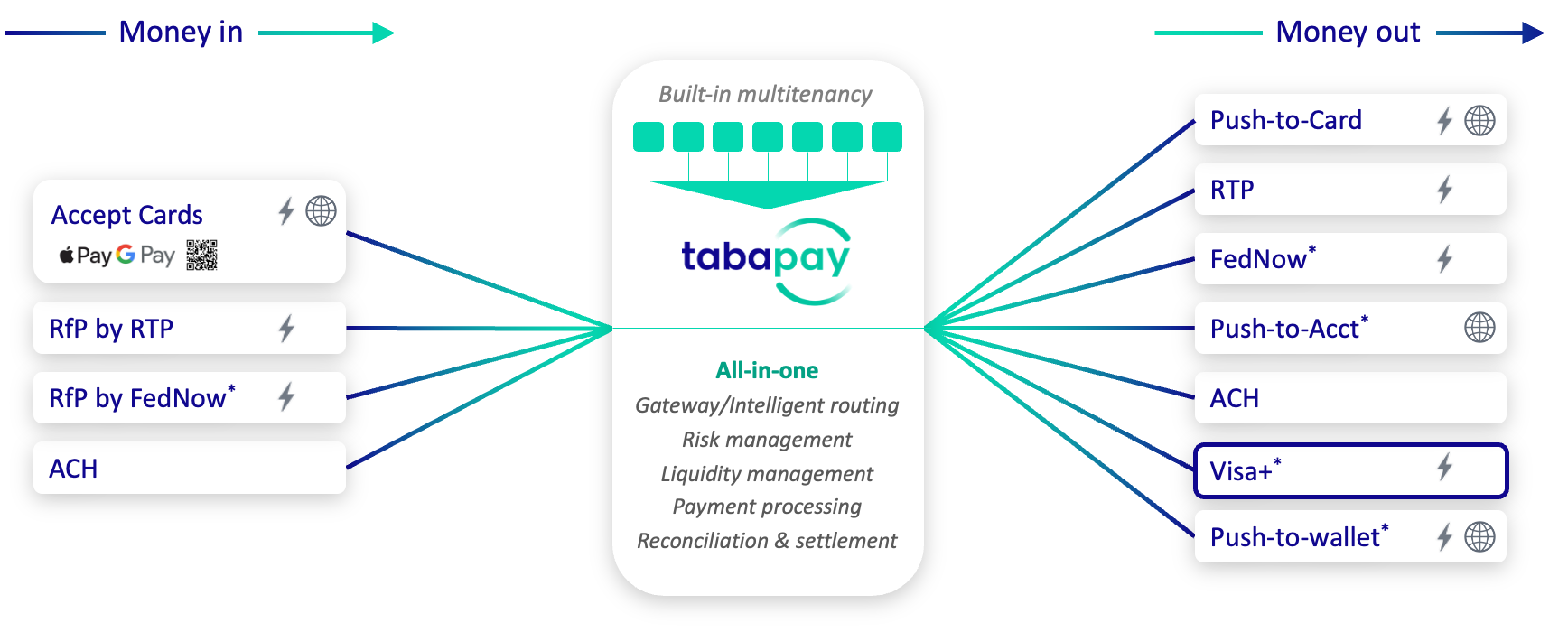
TabaPay Inc. was co-founded in April 2017 in Palo Alto, California (also referenced elsewhere as Mountain View) by Rodney Robinson, Manoj Verma, and Marvin Mah. The company’s core business is instant money-movement infrastructure: a single API through which fintechs, lenders, and platform businesses can access payments and payouts across both card rails (Visa, Mastercard, Discover, and regional debit networks) and bank rails (ACH, RTP, FedNow, and wire).
Holds a bachelor’s degree from Stanford University and an MBA in marketing and finance from Santa Clara University. Prior roles span IBM, Edify, Teknowledge, Intuit (Director of Product Management), and Obopay (VP of Product Management), before co-founding Omney in 2012 and selling it to Mastercard in 2014. Self-described as a four-time founder with more than 40 years in payments and financial services, spanning late-1990s account aggregation through instant-deposit and Push-to-Card technology.
Holds an MBA in finance from the Wharton School. Brings more than 20 years of sales and business-development leadership from Amazon, Yahoo!, and IAC across financial services and consumer internet, and leads TabaPay’s go-to-market execution and partnership expansion.
A fintech technologist with more than 30 years of experience. Previously co-founded Omney alongside Robinson and served as its CTO, building the original Push-to-Card technology, and separately founded the consultancy Financial Internet Solutions. Leads architecture for TabaPay’s multi-rail routing engine.
Announcing the planned launch of TabaBank, Robinson stated that bringing a bank into the TabaPay ecosystem “has been a goal of mine for the past three years,” indicating the bank-charter strategy was a long-planned step in the company’s vertical integration (per company disclosure, LinkedIn post).
TabaPay connects to more than 20 partner banks and 14-plus payment networks through a single API, delivering instant payments and payouts across both card and bank rails. The company states this can reduce customers’ payment costs by up to 75% (self-reported, unverified), positioning improved reliability and simplified money-movement workflows as its core value proposition.
Customers reportedly include earned-wage-access and short-term liquidity fintechs such as Earnin, Dave, and DailyPay, along with Chime and ADP (per Forbes reporting). TabaPay ranks among the leading processors on instant-payment rails including Visa Direct, Mastercard Send, The Clearing House’s RTP network, and Visa+.
The core business: unifying card rails (Visa Direct, Mastercard Send, Discover, and others) and bank rails (ACH, RTP, FedNow, wire) behind a single API. Per the 2023 Nilson Report rankings, TabaPay placed 6th among card-not-present (CNP) acquirers and 20th overall by combined card purchase volume and transaction count.
Works with 20-plus partner banks to support customers’ regulated money-movement programs. Certain customer segments — notably lending and other higher-risk categories — are underserved because existing sponsor banks are often unwilling to take on the associated risk, a gap TabaPay is now addressing via its own bank charter.
A planned acquisition of Transact Bank, N.A. (Denver, Colorado; OCC-chartered and FDIC-insured) would give TabaPay its own bank charter, bringing payments and banking capabilities under one roof. The deal is targeted to close in Q4 2026, subject to regulatory approval.
Strategic implications of TabaBank: Owning a bank charter would let TabaPay operate alongside its existing sponsor-bank network while extending service to customer segments — higher-risk verticals and lenders in particular — that many sponsor banks decline due to risk exposure. Bank acquisitions of this kind typically require approval from regulators such as the OCC and FDIC, and the potential for delayed or conditional approval remains an execution risk.
TabaPay appears to have funded most of its growth internally, supplemented by a small number of strategic rounds (per Forbes reporting). The $155 million growth financing led by FTV Capital, announced in September 2026, represents the largest publicly disclosed external capital raise in the company’s history and is being executed alongside its vertical-integration push into banking.
Co-founded by Rodney Robinson, Manoj Verma, and Marvin Mah, drawing on their Omney/Mastercard Send development experience to build a card-and-bank-rail money-movement platform. Reported early angel investor lists vary by source, so we do not present a single confirmed figure.
A growth round with participation from SoftBank Investment Advisers and Aligned Partners. At the time, the company self-reported a 2018–2021 CAGR of 111% in transaction count and 153% in dollar volume, along with connections to 15 banks and 14 networks. These growth figures are company-reported and we could not identify independent third-party verification.
As banking-as-a-service (BaaS) provider Synapse proceeded through Chapter 11 bankruptcy, TabaPay announced in April 2024 an agreement to acquire Synapse’s assets and affiliates. Three weeks later, on May 9, TabaPay withdrew from the deal, citing “failure to meet the purchase agreement closing conditions.”
TabaPay cited unmet closing conditions as the official reason for withdrawing. Synapse CEO Sankaet Pathak instead attributed the collapse to Synapse’s banking partner, Evolve Bank & Trust, allegedly failing to fully fund its for-benefit-of (FBO) accounts. Evolve, in turn, stated it was not a party to the TabaPay-Synapse agreement and had no closing conditions to meet. Given these three conflicting accounts, we present them side by side rather than resolve them to a single narrative. Following the collapse of the deal, Synapse was unable to reconcile customer funds, a failure widely viewed as having accelerated tighter regulatory scrutiny across the BaaS sector.
Deal structure: A $155 million strategic growth financing led by FTV Capital, combining primary capital raised through new share issuance with a secondary transaction involving existing shareholders. FTV Capital partner Robert Anderson joined TabaPay’s board of directors as part of the transaction.
Concurrent announcement — Transact Bank acquisition: TabaPay simultaneously disclosed its intent to acquire Transact Bank, N.A., an OCC-chartered and FDIC-insured bank based in Denver, Colorado. Upon completion, the bank would be rebranded TabaBank, N.A., with closing targeted for the fourth quarter of 2026 subject to regulatory approval. Financial Technology Partners (FT Partners) served as TabaPay’s exclusive financial advisor.
Signal of market confidence: FTV Capital explicitly cited TabaPay’s “scale, reliability, and profitable growth” as the investment rationale — a distinction worth noting given that many payments-infrastructure peers continue to prioritize growth over profitability (per investor commentary; our interpretation).
• Amount raised: $155,000,000 (blended primary capital and secondary transaction)
• Lead investor: FTV Capital (sector-focused growth equity firm founded 1998, with more than $10.2B raised)
• Concurrent acquisition target: Transact Bank, N.A. (Denver, Colorado; OCC-chartered, FDIC-insured)
• Post-acquisition name: TabaBank, N.A. (planned rebrand)
• Expected close: Q4 2026, subject to customary regulatory approval
• Financial advisor: Financial Technology Partners (FT Partners), advising TabaPay exclusively
TabaPay’s competitive position rests on its unified card-and-bank-rail API infrastructure, its founding team’s payments-network domain expertise (the Mastercard Send lineage), and the capital discipline demonstrated through its handling of a failed acquisition. Its pursuit of a bank charter for vertical integration is a strategic choice most payments-infrastructure peers have not made.
Unifying card networks (Visa, Mastercard, Discover) and bank rails (ACH, RTP, FedNow, wire) behind a single API spares customers from integrating separately with each rail. Replicating this requires years of accumulated bank and network partnership management — a barrier to entry that new entrants cannot quickly close.
While most payments-infrastructure companies depend entirely on third-party sponsor banks, TabaPay is pursuing its own bank charter through the Transact Bank acquisition. This creates the potential to serve higher-risk and lending-adjacent customer segments that sponsor banks typically decline — though it also carries regulatory-approval execution risk.
The company-reported 2024 GAAP net income of $12.5 million (on $45 million in net revenue) is a relatively uncommon outcome in a payments-infrastructure landscape where many startups still operate at a loss. FTV Capital explicitly cited “profitable growth” as part of its investment rationale. This figure is self-reported, however, and we could not confirm whether independently audited results have been made public.
TabaPay’s withdrawal from the Synapse asset acquisition just three weeks after signing, citing unmet closing conditions, is open to more than one reading. It could suggest gaps in diligence or deal structuring, but it can equally be read as evidence that management is willing to walk away from a transaction rather than force it to close on unfavorable terms. We present this as a neutral data point worth monitoring as a reference case for gauging execution on the pending Transact Bank deal.
Strategic strength of the founding team’s composition: The founding team combines Rodney Robinson’s payments-network operating experience (developer of the Push-to-Card technology behind Mastercard Send), Manoj Verma’s commercialization leadership (Amazon, Yahoo!, IAC), and Marvin Mah’s technical architecture expertise (co-founder and CTO of Omney). This blend pairs payments-network domain credibility with commercial execution capability. That said, all three founders have worked together since Omney in 2012, and whether the company broadens its senior leadership beyond this long-tenured core group is a governance point worth watching going forward.