
Wonderful
$5B in 18 months — a Tel Aviv-engineered, Amsterdam-commercialized enterprise AI OS compressing a decade of scaling into a year and a half
Wonderful was founded in January 2025 as an enterprise AI agent and workflow orchestration platform. Its commercial headquarters — the European hub — sits in Amsterdam, but the core engineering organization (a roughly 40-person nucleus) is based in Tel Aviv. A legal-domicile framing of Wonderful as “a Dutch tech company” understates the actual risk profile. We treat the company instead as an Israeli-founded enterprise with Amsterdam functioning as global commercial headquarters and Tel Aviv as the core R&D base — a distinction that feeds directly into the geographic concentration risk flagged in Section 05.
An early employee at IronSource — the app-scaling platform that peaked at an $11B valuation — where he led global expansion. He subsequently co-founded Approve.com, an enterprise payment-automation platform, and exited to U.S. fintech Tipalti within two years of founding it (2021). Wonderful’s origin thesis centers on the gap between what AI can technically do and what most enterprises are actually running in production — a framing consistent with an operator whose prior track record is scaling and monetizing, not deep research. That IronSource-to-Approve.com lineage is squarely in payments and go-to-market execution rather than foundation-model research, which supports the delivery-first positioning but leaves an open question about where the durable technical moat actually sits.
Founder of AI localization platform Kaps, with a background spanning multilingual/multicultural AI processing and leadership of security engineering teams. He is understood to drive Wonderful’s localization architecture and its model-agnostic design philosophy.
Winkler’s payments/workflow-automation delivery experience paired with Lalazar’s AI localization background set the original thesis: close the gap between demo-stage AI and production-grade enterprise deployment. The combination skews toward go-to-market velocity over deep technical differentiation.
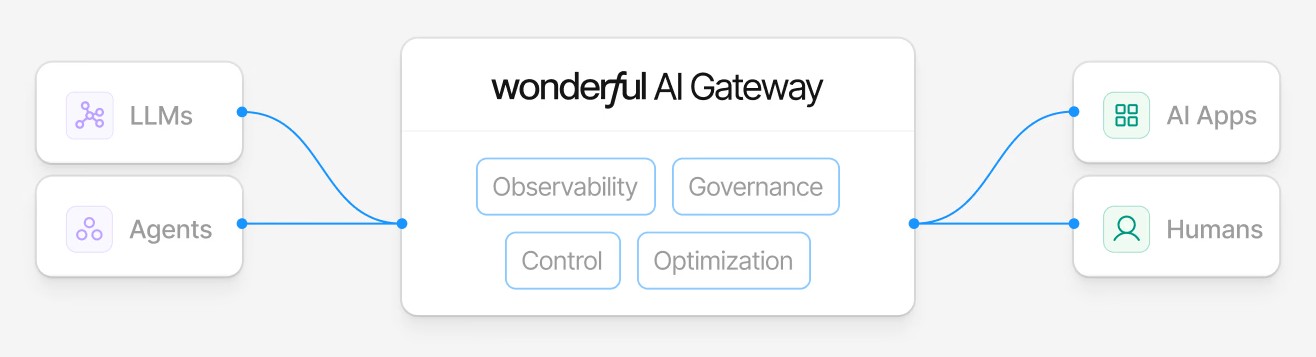
Wonderful began as a customer-service AI agent vendor and, as of the September 2026 Series C, has repositioned itself as an “AI Operating System” for the enterprise. The platform spans workflow automation, productivity agents, AI-native applications, and conversational agents on a single stack, delivered through forward-deployed engineering pods that co-build the first production use case with a customer before transferring capability in-house.
Orchestration layer automating complex end-to-end enterprise processes, integrated with legacy ERP and core systems to unify data flow across otherwise siloed infrastructure.
An agent suite supporting internal employee productivity and decision-making — targeting repetitive back-office work for augmentation or outright replacement.
Voice, chat, and email agents tuned for local language and cultural nuance — the original core product, now repositioned as one module within the broader AI OS.
Model-Agnostic, Modular Architecture: Wonderful positions itself as unbound to any single foundation model, deployable across any cloud environment including on-premise. Management explicitly emphasizes that customers can export everything they build and integrate freely with outside systems — a deliberate reduction in switching costs. That same openness is a double-edged design choice: it likely weakens the lock-in economics that typically underpin durable enterprise-software retention.
Delivery Model: Local deployment teams operate in every market Wonderful enters, customizing for language, culture, and regulatory context. This “hyper-local” go-to-market approach is effective for early market penetration, but it is inherently labor-intensive and structurally caps gross-margin expansion relative to a pure-software delivery model.
⚠ Data Integrity Note: The “~$100M” ARR figure is not disclosed in Wonderful’s official Business Wire release; it derives from secondary media coverage (e.g., CryptoBriefing) and should be treated as an unaudited, company-adjacent estimate rather than an audited financial figure. The 70%+ customer expansion rate is similarly self-reported with no independent verification identified. Neither metric should be relied upon as GAAP-equivalent disclosure; both are directional color only.
Since emerging from stealth in July 2025, Wonderful has raised a cumulative $834M (Seed through Series C) in roughly 14 months, reaching a $5B valuation. Round-to-round spacing has averaged just 4–6 months — an unusually compressed fundraising cadence — with Index Ventures and Insight Partners alternating lead status across every round from Seed through Series C.
Index Ventures led the initial seed round with participation from Bessemer Venture Partners and Vine Ventures — six months post-founding. Proceeds funded immediate deployment of the customer-service agent platform across Europe and Latin America.
A large Series A closed just four months after the seed round. Insight Partners and IVP joined as new investors, while Bessemer and Vine Ventures followed on. Proceeds funded entry into 10 additional countries and senior-executive hiring in each. Cumulative funding reached $134M.
Closed roughly four months after Series A, with lead status rotating from Index Ventures to Insight Partners. Wonderful crossed a $2B valuation at the one-year mark and announced plans to scale headcount from 350 to approximately 900 by year-end — a ~2.6x increase.
Round Characteristics: Closed roughly six months after Series B; the single-round proceeds of $550M exceed the combined total of the prior three rounds ($284M) by roughly 1.9x. Insight Partners led again, and Salesforce joined as a new strategic investor — a notable addition given Salesforce’s own competing Agentforce product line. 9Yards also entered as a new backer alongside returning investors Index Ventures, IVP, Vine Ventures, and Bessemer.
Use of Proceeds: (1) accelerating enterprise-wide deployment of the AI OS, (2) scaling forward-deployed engineering globally, (3) capturing enterprise demand shifting from department-level AI pilots to full-organization AI OS adoption.
Market Confidence Signal: Insight Partners co-founder Jeff Horing characterized Wonderful as pursuing “one of the largest opportunities in enterprise AI,” citing early production deployments across multiple markets as evidence.
⚠ Data Integrity Note: Wonderful’s official Business Wire release discloses only the Series C round size ($550M) and post-money valuation ($5B); it does not disclose cumulative funding, ARR, or an explicit revenue multiple. The “$834M cumulative” and “$800M+” figures cited across this report are derived by summing individually announced round sizes and cross-checking against secondary press coverage (Seed $34M + Series A $100M + Series B $150M + Series C $550M = $834M). Minor variance exists across outlets (e.g., “over $800M” vs. our summed $834M), but directionally the figures are consistent.
Wonderful’s defensibility rests on a proven founding team, an unusually compressed market-penetration timeline, a hyper-local delivery organization, and a top-tier investor bench (Insight Partners, Salesforce, and others). The moat, however, skews more toward execution, capital access, and partnership leverage than toward pure technical differentiation — a distinction that matters for how durable the advantage is against well-capitalized incumbents.
CEO Bar Winkler led early global expansion at IronSource (peak valuation $11B) and sold Approve.com to Tipalti within two years of founding it. That is a repeatable pattern — rapid scale followed by a capital-markets event — rather than a first-time-founder story, and it is the primary basis on which investors have justified an aggressive early-stage valuation premium.
Localization of language, culture, and regulation via dedicated in-market teams is a barrier that Western-centric competitors cannot easily replicate on short notice. CTO Roey Lalazar’s AI-localization background (Kaps) underpins the technical foundation of this strategy. The trade-off is a labor-intensive delivery model that pressures gross margin as the business scales.
Repeated lead investment from Insight Partners (>$90B AUM, 900+ portfolio companies, 55+ IPO track record) and Salesforce’s Series C participation deliver enterprise sales-channel access and reference-customer credibility beyond pure capital. That said, Salesforce runs its own competing Agentforce product line, so the strategic investment carries a counterparty-circularity risk that should be tracked alongside its channel benefits — coopetition dynamics could cut either way.
Independence from any single foundation model or hyperscaler gives customers flexibility as underlying models evolve, and on-premise support is well-suited to regulated industries (financial services, insurance, healthcare). Management’s own emphasis on low switching costs is a genuine trade-off, however — the openness that eases adoption also weakens the lock-in economics that typically drive durable retention.
Positioning Strategy — the Pivot to “AI Operating System”: Wonderful began as a customer-service chatbot vendor and, by the Series C, had repositioned as an enterprise-wide “AI operating system.” Management frames this with a cloud-computing analogy — AI OS becoming as foundational to the enterprise as cloud infrastructure once was. Whether this reflects genuine architectural expansion of the product or a category-redefinition exercise timed to capital-markets narrative remains an open question, and one that will be testable against forward revenue mix and customer-expansion data over the next several quarters.
Wonderful’s investment thesis leans heavily on a compressed growth narrative, which carries meaningful upside optionality alongside multi-layered risk. The factors below represent the primary re-rating triggers we would monitor.
An unofficial estimated ARR of ~$100M against a $5B valuation implies a forward revenue multiple in the neighborhood of 50x — premium territory typically reserved for top-tier AI infrastructure names. Any deceleration in ARR growth or stalling customer-expansion rate exposes the company to significant down-round risk. It also bears repeating that the underlying ARR figure itself is not company-disclosed.
Core R&D remains concentrated in Tel Aviv, exposing product-development continuity, talent retention, and customer risk perception to regional geopolitical instability. Amsterdam’s role as commercial headquarters provides only a partial hedge; absent geographic diversification of the engineering organization itself, this remains a structural, not merely optical, risk factor.
The enterprise AI orchestration/agent platform space is crowded with well-funded venture-backed peers (Sierra, Decagon, Sinch, Hyro) alongside incumbent SaaS majors extending their own AI OS ambitions (Salesforce Agentforce, Microsoft Copilot Studio, ServiceNow). The presence of Salesforce as a new strategic investor — while also a direct competitor — introduces a counterparty-circularity tension between strategic capital and product competition that warrants ongoing scrutiny.
Headcount has scaled from 350 toward a 900-person target and now sits above 650 — a pace that risks outrunning culture, quality control, and governance infrastructure. Reliance on a two-person founding team (Winkler and Lalazar) is high, and this marks both founders’ first venture running a pure AI deep-tech company at this scale.
Management’s self-described “easy to leave” open architecture builds customer trust but, by design, weakens structural lock-in relative to competitors — implying potentially lower revenue retention. Without disclosed net revenue retention metrics, the actual financial impact of this trade-off cannot presently be assessed with confidence.
All growth metrics disclosed to date — ARR, customer-expansion rate, deployment case studies — originate from company self-reporting or media interviews, with no identified third-party audit or standardized SaaS disclosure (NRR, CAC payback, logo retention). This is typical for a private growth-stage company but, at a $5B valuation, the resulting information asymmetry should be explicitly priced as an investment risk rather than treated as a formality.