
Nexeon
An Imperial College London spin-out challenging the graphite anode — the two-decade silicon materials story the UK’s National Wealth Fund just backed
We think it is worth stating plainly at the outset that Nexeon did not emerge from a clinician’s frustration or a garage founder’s insight — it is a textbook UK university spin-out. The company was formally incorporated in 2006 to commercialise proof-of-concept research on structured silicon anode materials that Professor Mino Green had been conducting since 2004 in the electrical engineering department at Imperial College London, with backing from Imperial Innovations (now IP Group). We would flag this origin as structurally distinct from a founder-led operating company, with implications for how governance, incentive alignment, and long-run strategic commitment should be assessed by prospective investors.
Nexeon’s early capital history — a £10 million Series B in February 2009 (Imperial Innovations, Invesco, PUK), a £40 million Series C in 2011, a 2013 strategic partnership with Wacker Chemie, and a £30 million round in 2016 that brought in Neil Woodford’s Woodford Investment Management — took disclosed cumulative funding to roughly £85 million. Through this period, Nexeon operated a capital-efficient licensing and joint-development model rather than owning manufacturing. We regard the 2022 strategic tie-up with Korea’s SKC as the clear inflection point at which the company committed to building and owning volume production capacity — a materially more capital-intensive path.
Professor of electrical engineering at Imperial College London who led structured silicon anode proof-of-concept research from 2004. Originating inventor behind Nexeon’s core silicon-structuring IP, which now underpins a portfolio of 290-plus patents.
PhD in Chemistry; MBA with Distinction from Oxford Brookes University. Senior executive team member through CDT’s 2004 NASDAQ IPO; prior roles at Dow Corning and Sumation. Since joining as CEO in 2009, has led the pivot from a licensing model to owned manufacturing and, per industry reporting, has overseen cumulative fundraising in excess of $400 million.
We would also note that the board skews toward venture and industrial-capital expertise rather than clinical or scientific leadership — a natural consequence of the spin-out structure. Andrew Hosty chairs the board; Russ Cummings, a 30-year venture investor and former CEO of Touchstone Innovations (now part of IP Group), with prior roles at Scottish Equity Partners and 3i Group, brings deep spin-out governance experience. David Lamb serves as CFO. The shareholder register has since expanded well beyond its UK academic roots to include Korean private equity (SJL Partners, Daishin, Shinhan), specialty chemicals strategics (Wacker, Ingevity), and — as of this latest round — a UK sovereign institution (National Wealth Fund) and a Japanese automotive corporate venture arm (Honda Xcelerator Ventures).
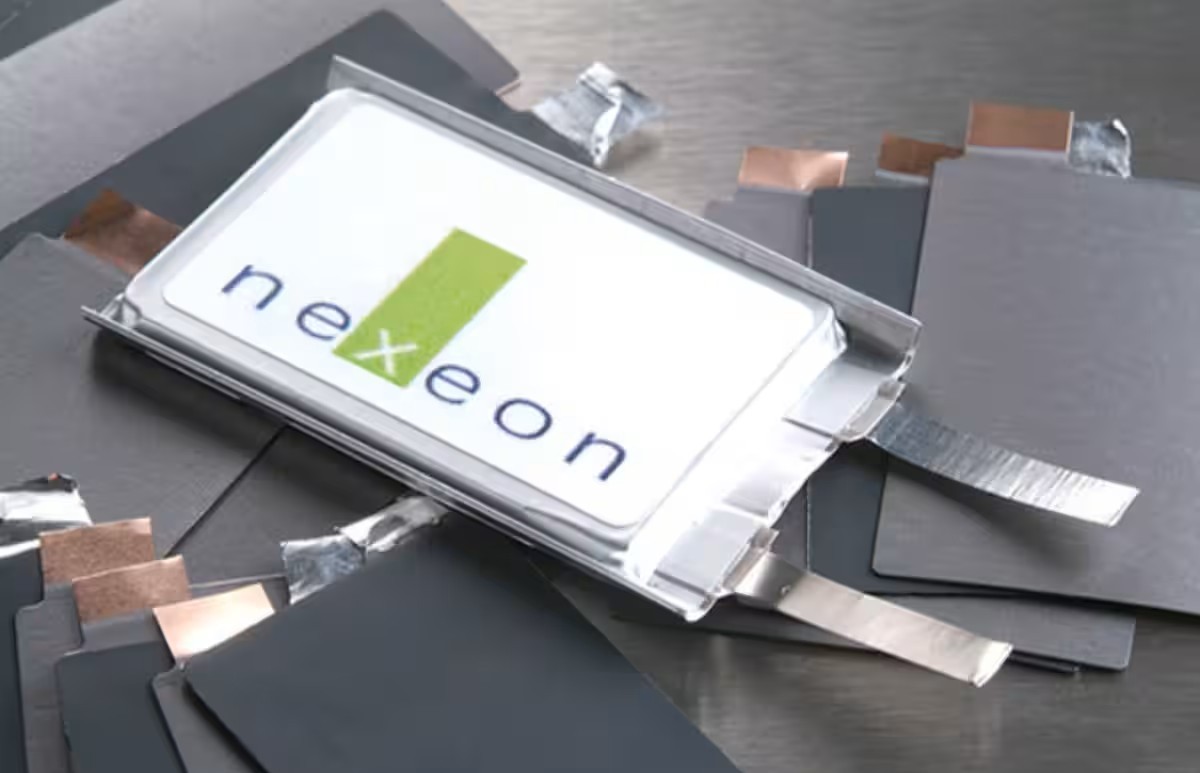
Nexeon’s core technology is a proprietary silicon-based anode materials platform — branded NSP1 and NSP2 — designed to replace or partially displace graphite in lithium-ion battery anodes. The stated commercial pitch is straightforward: higher energy density at lower volume, with drop-in compatibility into existing cell production lines rather than requiring bespoke manufacturing processes. Per company disclosure, NSP2 can deliver up to a 50% improvement in energy density versus graphite at roughly half the volume for equivalent capacity. We would stress that these are company-sourced figures; we are not aware of an independently published third-party benchmark validating them at this time, and investors should treat them as vendor claims pending further verification.
| Business Line | Description | Status | Notes |
|---|---|---|---|
| NSP1 / NSP2 | Silicon-based anode materials platform | Commercial Supply | Drop-in integration into existing cell lines. Target end-markets: EVs, consumer electronics, medical devices |
| Gunsan Plant (Korea) | First global volume-production facility for silicon-carbon materials | Production-Ready | Reached production-ready status late 2025; final automotive-grade customer qualification in progress as of January 2026 |
| Panasonic Supply Agreement | Binding long-term supply contract (signed 2023) | Early Fulfillment | Targets Panasonic’s De Soto, Kansas gigafactory |
| UK Pilot Facility | National Wealth Fund-backed R&D and manufacturing expansion | Early Build-Out | Primary use of proceeds for the August 2026 round; intended to expand the advanced manufacturing technology unit and create skilled jobs |
| Exploratory Partnerships | Joint development agreement with PPES (Panasonic–Toyota JV) | Ongoing JDA | Repeatedly extended funded JDA targeting e-mobility applications |
The core business-model shift: Prior to 2022, Nexeon operated primarily as an IP-licensing business. The SKC/SJL Partners-led financing marked a decisive shift to a vertically integrated materials manufacturer and supplier. In our view this is a double-edged transition — it meaningfully raises capital intensity and execution risk, but it is also the structural precondition that made a binding, volume-based supply agreement with a Tier-1 customer like Panasonic possible in the first place.
We would characterise Nexeon’s 20-year funding history as falling into three distinct phases: (i) 2006–2016, UK-centric capital drawn from the Imperial College ecosystem (Imperial Innovations, Invesco, Woodford); (ii) 2022, a pivot to Korean industrial capital (SKC, SJL Partners and related Korean investors) that financed the shift into owned manufacturing; and (iii) 2026, a tri-national strategic round combining a UK sovereign institution, a Korean policy bank, and a Japanese automotive OEM venture arm. The changing character of the capital base at each stage is, in our view, as informative as the capital amounts themselves.
Formally incorporated with Imperial Innovations’ backing, building on Prof. Mino Green’s proof-of-concept research dating to 2004. Silicon anode IP established as the company’s core asset.
February 2009 Series B (£10M) with Imperial Innovations (£4M), Invesco and PUK participating. 2011 Series C (£40M) led by Imperial Innovations at £15M, with Invesco returning. Joint development agreements with an automotive OEM and a consumer electronics maker signed in parallel.
A 2013 strategic partnership with German chemicals group Wacker Chemie (amount undisclosed). A 2016 £30M round brought in Neil Woodford’s Woodford Investment Management as a new investor alongside Imperial Innovations (£5M) and Invesco. Disclosed cumulative funding stood at roughly £85M at this point.
First close of $80M in January 2022, led by SKC and SJL Partners, establishing a strategic manufacturing partnership with SKC. Second close in August 2022 brought total financing to $170M, with a further $50M of separate commercial investment. Ingevity Corporation joined as a new strategic investor with a board seat.
The National Wealth Fund — wholly owned by HM Treasury — committed £52.6M ($70M), completing a £100M ($133M) round. The Korea Development Bank and Honda Xcelerator Ventures, Honda’s global open-innovation venture arm, joined as new investors. Proceeds are earmarked for a UK-based pilot manufacturing facility and expansion of the advanced manufacturing technology unit and R&D team.
A note on cumulative funding: As a private company, Nexeon does not formally disclose life-to-date cumulative funding on a consistent basis. PitchBook data put cumulative disclosed funding at approximately $332M as of the 2022 round; adding the 2026 round of $133M implies a cumulative total in the region of $465M. We would treat this figure as an analyst-level estimate synthesised from third-party aggregators rather than a company-confirmed number, and flag it accordingly.
The silicon anode materials market has entered a capital-intensive scale-up race. US-based Group14 Technologies has raised a roughly $463M round led by SK, Sila Nanotechnologies has raised a further $300M, Amprius Technologies is relocating manufacturing capacity from China to South Korea, and a cluster of Korean domestic entrants — Daejoo Electronics Materials, Posco Future M and SK Materials — are also entering the space. Against this competitive backdrop, we see Nexeon’s differentiation resting on the following pillars.
The Gunsan facility is positioned by the company as the first global volume-production site dedicated to silicon-carbon materials, having reached production-ready status in late 2025 — placing Nexeon ahead of several peers on commercial-scale manufacturing track record.
Co-location with OCI’s polysilicon facility provides direct pipeline access to byproduct monosilane. We contrast this with Group14’s need to acquire Germany’s Schmid Silicon to secure its own silane supply — a costlier, more capital-intensive route to the same input security.
The 2023 long-term supply agreement with Panasonic, targeting the De Soto, Kansas gigafactory, is paired with an ongoing joint development agreement with PPES (the Panasonic-Toyota JV) — reinforcing credibility within the automotive OEM value chain.
The National Wealth Fund is wholly owned by HM Treasury, and this investment is explicitly tied to UK industrial policy on battery supply-chain resilience — potentially signalling further policy support or a more favourable UK regulatory posture ahead.
Honda’s open-innovation venture arm joining as a new investor reads, in our view, as more than a passive financial stake — it plausibly signals a path toward future adoption within Honda’s own electrification battery supply chain. The parallel Korea Development Bank commitment further deepens ties to the Korean battery ecosystem.
Two decades of accumulated R&D since 2004 have produced an IP base that could function as a barrier to later entrants. That said, patent count alone does not guarantee commercial defensibility, and licensing or litigation monetisation of this portfolio has not been separately disclosed.
A balanced view on competitive intensity: Set against Group14’s roughly $463M raise and Sila’s additional $300M, we would not characterise Nexeon as capital-advantaged relative to the top tier of its competitive set. What we would credit the company with is having progressed an actual commercial-scale production facility to production-ready status and secured a binding Tier-1 customer contract — placing it among a relatively small number of silicon anode companies that have moved meaningfully past the technology-validation stage.
As of the August 2026 round, Nexeon remains a privately held company, and no audited figures on commercial revenue or profitability are publicly available. A third-party estimate (RocketReach) puts 2026 revenue at approximately $27.3M — a figure we would treat as unofficial and unverified. In our assessment, the central premise for any investment view here is that, despite roughly two decades and an estimated $465M-plus of cumulative capital, the company remains at a relatively early stage of commercial ramp.
On the opportunity side, we would highlight: ▲the potential for a step-up in commercial revenue as the Gunsan plant moves from production-ready to full-volume output under the Panasonic supply agreement; ▲the credibility and future fundraising optionality implied by simultaneous strategic capital inflows from the National Wealth Fund, the Korea Development Bank and Honda Xcelerator Ventures; ▲structural tailwinds from EV and consumer-electronics demand for faster charging and lighter form factors, which support underlying growth in the silicon anode materials category; and ▲the two-decade R&D and patent moat relative to newer market entrants.
▲ Nexeon likely remains at a relative capital disadvantage versus top-tier competitors such as Group14 (~$463M raised) and Sila Nanotechnologies (an additional $300M raised) given the extreme capital intensity of this industry; ▲ as of January 2026, the Gunsan plant was still completing “final customer production qualification processes” for automotive-grade standards, leaving real execution risk before full commercial ramp; ▲ early revenue appears concentrated around a single major customer relationship (Panasonic), implying meaningful customer-concentration risk; ▲ the company’s own CEO has publicly acknowledged a slowdown in EV market demand, a dynamic that, if sustained, would pressure the underlying end-demand growth thesis; ▲ a shareholder base now spanning the UK, South Korea, Japan and the US introduces governance complexity that could complicate any future exit path, whether IPO or strategic sale; and ▲ nearly all quantitative figures cited in this analysis — cumulative funding, headcount, and revenue — derive from third-party aggregators (PitchBook, Tracxn, Golden, RocketReach) rather than audited company disclosure, a fundamental data-quality limitation investors should weigh carefully.