
Medici Brands, Inc.
New York-based food-tech company scaling from a single protein-bar SKU into a “low-calorie consumer brand house” — parent of David Protein, HallPass, and Epogee
Medici Brands is a New York-based consumer holding platform that grew out of the protein-bar brand David Protein. The legal entity is Linus Technology, Inc. (dba David Protein), and the “Medici Brands” name was formally brought to the fore as a multi-brand holding company with the September 2026 Series B announcement. Founder Peter Rahal is a repeat entrepreneur who co-founded RXBAR in 2013 and sold it to Kellogg for $600 million in 2017, remaining as RXBAR CEO for roughly 18 months following the acquisition.
Co-founder of RXBAR, launched in Chicago in 2013 with childhood friend Jared Smith and sold to Kellogg for $600 million in 2017. Rahal has publicly discussed his dyslexia diagnosis, reframing it as a pattern-recognition strength in his founder narrative. He launched David in September 2024 and currently serves as CEO overseeing all of Medici Brands. He studied political science at Wittenberg University in Ohio.
Previously founded Mikey’s and Stuffed Puffs, the latter acquired by Mount Franklin Foods in 2024. Co-founded the low-calorie confectionery brand HallPass with Peter Rahal and led its nationwide Walmart launch in August 2026. He has publicly framed the brand’s positioning strategy as making “HallPass the Coke Zero of candy.”
Participated as an angel investor in David’s initial seed round (August 2024, $10M) and currently serves as David’s Chief Science Officer. A physician with broad public recognition in longevity and metabolic health, he functions as an advisory executive contributing to the brand’s scientific-credibility positioning.
In August 2024, Food Business News reported Ranen — a former investor and founder of Raize — as having “co-launched” David alongside Rahal. Subsequent official releases and press profiles, however, consistently describe Rahal as sole founder and CEO, leaving the continuity of any early co-founder role unclear.
Early press coverage of David’s launch (August 2024) described Zach Ranen as having co-launched the brand alongside Peter Rahal, while subsequent official materials and press profiles consistently describe Rahal as sole founder and CEO. We present both accounts rather than resolving them to a single narrative, and note that Medici Brands’ formal cap table and founder roster warrant separate verification against primary disclosure documents (e.g., a PPM).
Rahal’s family has a food-industry background (his father’s side in ingredient supply, his mother’s side in juice manufacturing), an element he cites repeatedly in his founder narrative. In our assessment, his track record of repeat category creation across RXBAR, David, and HallPass supports a qualitative execution premium for Medici Brands.
Since launching direct-to-consumer with a single product (a protein bar) in September 2024, David has expanded within roughly two years into frozen dessert and ready-to-drink shakes, and is now sold in more than 35,000 retail locations including Walmart, Target, and Costco. On this trajectory, the company is projected to surpass $300 million in revenue in 2026, which management self-reports as the fastest any food company has reached that revenue milestone (company-disclosed, self-reported).
Medici Brands’ operating model is being restructured not around a single brand, but around a multi-brand platform that shares common technology assets and a common product-development methodology.
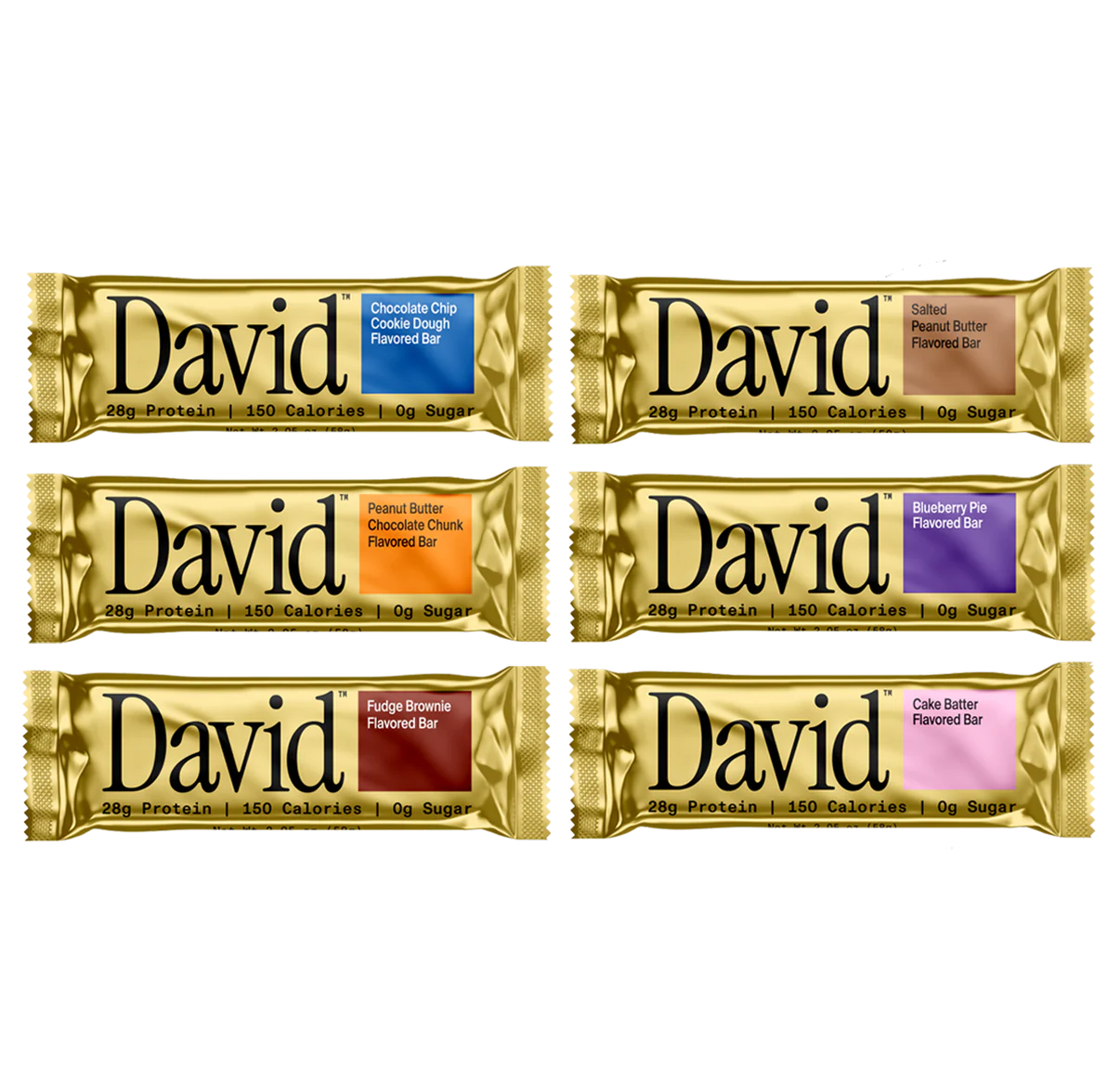
Launched with a high-protein bar delivering 28g protein, 150kcal, and 0g sugar per bar, since expanded into frozen dessert and RTD shakes. Maintains an omnichannel distribution structure spanning mass retail (Walmart, Target, Costco, Wegmans) alongside DTC.
A low-calorie confectionery brand launched nationwide in Walmart stores and online on August 30, 2026, offering a 70kcal / 1g sugar per-serving nutritional profile across three SKUs (peanut cup, peanut-cream crispy wafer, and chocolate candy pieces). Priced at parity with conventional candy rather than at the premium typically charged by “better-for-you” incumbents, pursuing volume penetration over premium margin.
A food-tech company acquired alongside David’s Series A in May 2025, which owns EPG (esterified propoxylated glycerol), a plant-based fat substitute that sharply lowers calories relative to fat while replicating a similar mouthfeel. David consumed roughly 90% of Epogee’s supply prior to the acquisition, and the deal internalized a core raw-material supply chain.
The “Technology-Enabled Food Platform” Thesis: Greenoaks partner Neil Shah has described Medici as the food industry’s first “technology-enabled platform,” emphasizing that David was the starting point rather than the company’s end goal. The structure by which David and HallPass share Epogee’s EPG technology implies economies of scale in which each new brand launch need not repeat raw-material and process R&D from scratch. The company plans to launch a third consumer brand, Rowdy, within the year; the specific category has not yet been officially disclosed.
Organizational Structure: Medici Brands functions as the holding company for David Protein and HallPass, with the legal entity name Linus Technology, Inc. (dba David Protein). Peter Rahal holds the dual role of group CEO, and future brand launches are expected to operate under the same management structure.
Since its August 2024 seed round, Medici Brands (David Protein) has completed a total of three capital raises over roughly two years, exhibiting a classic high-growth CPG financing curve in which valuation steps up sharply with each round. The September 2026 Series B was reported at roughly 3x the prior year’s valuation, reflecting existing investors’ repeated follow-on conviction in the company’s consumer traction (retail expansion and revenue growth).
Completed a seed round led by Rahal, with participation from Valor Siren Ventures, Dr. Peter Attia, and Dr. Andrew Huberman. Dr. Layne Norton also appears among the early investors. At this point David had not yet launched a product.
Launched with a single-SKU flagship protein bar delivering 28g protein, 150kcal, and 0g sugar. Reports cite $1 million in first-week sales (per company interviews, unverified), followed by expansion to more than 3,000 retail doors within eight months.
Completed a $75 million Series A led by Greenoaks with participation from Valor Equity Partners. A significant portion of the proceeds funded the acquisition of plant-based fat-substitute company Epogee, and the round brought David’s post-money valuation to $725 million. Neither Greenoaks nor Valor had participated in the seed round, marking their entry as new institutional investors; in our assessment, this indicates the brand’s early traction was sufficient to attract institutional capital.
On January 23, 2026, a class action (Lopez et al. v. Linus Technologies, Inc.) was filed in the U.S. District Court for the Southern District of New York, alleging that David protein bars’ labeled calorie and fat content differed from actual content. The suit was voluntarily dismissed by the plaintiffs on March 30, 2026, “without prejudice” (i.e., re-filing remains possible). We classify this as a risk factor and note that voluntary dismissal does not constitute a determination of the underlying facts (see Risk Assessment below).
Low-calorie confectionery brand HallPass launched nationwide across all Walmart stores and online. Coming just three days before the Series B announcement, this launch is read as a strategically timed demonstration to investors of the new brand’s retail-execution capability.
Deal Structure: Completed a $250 million Series B co-led by existing investors Greenoaks and Valor Equity Partners, with participation from CEO Peter Rahal and new investors ICONIQ and Imaginary Ventures.
Valuation: The round brought the company’s valuation to $2.25 billion, reported at roughly 3x the prior year’s figure.
Use of Proceeds: Earmarked for expanding HallPass’s retail footprint and product range, David’s entry into new formats and categories, product innovation, and infrastructure to launch and scale new brands including Rowdy.
• Amount Raised: $250,000,000
• Post-Money Valuation: $2,250,000,000 (~3x prior year)
• Co-Leads: Greenoaks, Valor Equity Partners (both existing Series A investors)
• New Participants: ICONIQ, Imaginary Ventures, CEO Peter Rahal (personal participation)
• Use of Proceeds: HallPass expansion, David category entry, Rowdy launch infrastructure
Bloomberg reported this round’s valuation as “roughly 3x the prior year,” but the official post-money valuation at the time of the prior year’s (May 2025) Series A was $725 million per press reporting; a straight 3x of that figure yields approximately $2.175 billion, a modest gap versus this round’s disclosed $2.25 billion. We attribute this to rounding conventions or option-pool adjustments, but do not treat the precise cap-table-basis multiple as confirmed pending review of the official term sheet.
Medici Brands’ investment thesis hinges not on the durability of a single hit product, but on whether its proven “low-calorie, taste-parity reformulation” methodology can be converted into a repeatable brand-launch engine. We assess the following four factors as core competitive advantages.
Peter Rahal founded RXBAR in 2013 and sold it for $600 million within four years — a track record he is now reproducing at a comparable pace with David (projected to surpass $300 million in revenue within two years of launch). In our view, having demonstrated that a single success is repeatable has favorably shaped later-round investors’ confidence relative to early-stage backers.
David was Epogee’s largest customer, consuming 90% of its supply, before acquiring the company — internalizing raw-material supply-chain risk while securing a structure in which EPG technology can be reused across new brands such as HallPass. In our assessment, this is a core asset underpinning platform economics built on shared technology infrastructure rather than a simple brand portfolio.
Within two years of launch, distribution expanded to more than 35,000 stores including Walmart, Target, and Costco, and HallPass likewise entered Walmart’s national footprint simultaneously with its launch — evidence of parent-company-level buying power and retail relationship assets that materially compress the retail-acquisition cycle for new brands.
HallPass departs from the premium pricing structure typically charged by “better-for-you” confectionery incumbents, positioning at price parity with conventional candy (under $2 per SKU). In our view, this strategy targets mass-market penetration not confined to health-oriented consumers, addressing a comparatively larger addressable market than the existing better-for-you category.
- Labeling / Regulatory Risk: The class action filed in January 2026 over David’s calorie and fat labeling was voluntarily dismissed in March, but “without prejudice” — meaning the legal possibility of re-filing has not been fully extinguished. Because EPG’s digestibility-based calorie-accounting methodology was itself the subject of the suit, a risk exists that similar issues could extend to other brands that share EPG, such as HallPass.
- Key-Person Risk: Peter Rahal, as CEO, oversees strategy and execution across David, HallPass, and Rowdy alike, concentrating key-person risk relative to a more distributed leadership structure.
- Valuation Validation: The $2.25 billion valuation reflects a private-market mark that has not yet been tested by public markets, and with the majority of revenue across the three brands estimated to derive from David alone, portfolio diversification benefits remain at an early stage.
- Repeatable Playbook: The successful transplant of the reformulation methodology from David to HallPass suggests a comparable probability of success for future brands including Rowdy, and new-round proceeds directly fund this expansion.
- Platform Premium Valuation: With Greenoaks explicitly articulating a “first technology-enabled food platform” thesis, the company carries potential to command a higher multiple than single-brand CPG peers in future rounds.
- Continued Insider Follow-On: Greenoaks and Valor’s repeated investment across every round since seed is, in our view, a positive signal of sustained insider conviction in the company’s traction.