
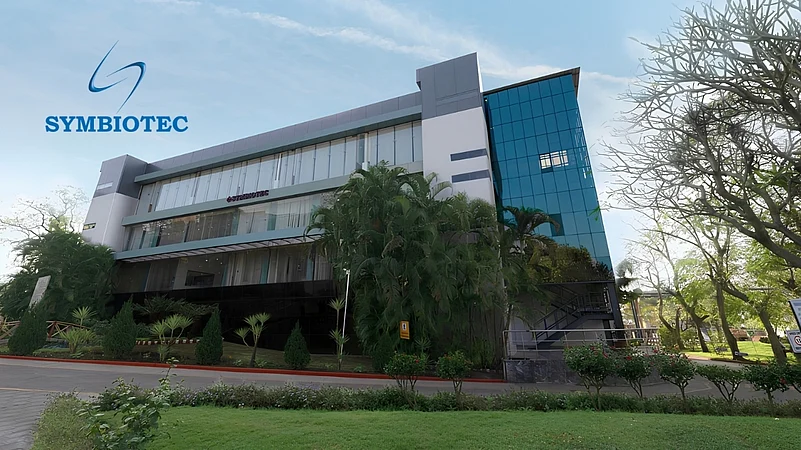
Symbiotec Pharmalab
The global volume leader in corticosteroid and steroidal-hormone APIs — a three-decade Indore, India franchise makes its dual NSE/BSE debut
Symbiotec Pharmalab is a corticosteroid and steroidal-hormone active pharmaceutical ingredient (API) manufacturer headquartered in the Pigdamber/Rau belt of Indore, in India’s Madhya Pradesh state. The company’s roots trace to 1995, when its founders ran small-scale R&D and pilot operations; the business was formally incorporated as a private limited entity in 2002, and commercial-scale manufacturing began in 2004 with the commissioning of the Rau facility. We view this three-decade, organically built history as a meaningful point of differentiation within India’s current wave of API and CDMO listings, most of which carry far shorter operating track records.
Anil Satwani, the company’s founder, serves as Chairman and Managing Director. He has led the business continuously since its 1995 origins as a laboratory-stage operation — nearly three decades of unbroken operational continuity through IPO. The promoter group also includes Kashish Satwani, Sushil Satwani, and the corporate entity Satwani Holdings LLP. Public disclosures put the promoter group’s pre-IPO stake in a range of roughly 26.9% to 28.8% on a fully diluted basis, with the discrepancy owing to differing source dates; we would flag this as a data point best confirmed against the final Red Herring Prospectus (RHP).
Has led the company from its 1995 laboratory-stage beginnings through incorporation in 2002 and into industrial-scale operations today. His continued presence at the helm through IPO is, in our read, a positive signal for management continuity.
Acquired control alongside India Business Excellence Fund III in December 2018 and now stands as the largest shareholder. The single largest offer-for-sale (OFS) seller in the IPO, offloading up to ₹988 crore of stock. Prior-generation investors reportedly included Actis, Franklin Templeton, and the late Rakesh Jhunjhunwala.
Beyond the three promoter directors, the board includes non-executive/nominee directors understood to represent Rosewood and India Business Excellence Fund III, including Rohit Mantri and Hariharnath Buggana. We view the private-equity-influenced board composition as constructive for post-listing governance discipline, but we would flag that the scale of the sponsors’ planned exit — ₹1,607 crore of OFS, or 91.5% of total proceeds — leaves the stock exposed to a post-listing overhang risk that investors should not discount.
Symbiotec develops and manufactures more than 60 corticosteroid and steroidal-hormone APIs across three technology platforms — organic chemistry, biotechnology, and complex injectables. Its flagship molecules include hydrocortisone, betamethasone, methylprednisolone, progesterone, estrogen, and testosterone, serving therapeutic areas spanning respiratory care, dermatology, pain management, oncology, and women’s health. In our view, this molecular breadth is a structural strength that meaningfully insulates the company from single-product risk relative to narrower API peers.
| Business Segment | Status | Stage | Notes |
|---|---|---|---|
| Corticosteroid APIs | Hydrocortisone, betamethasone and 60+ products | Core Franchise | 38.2% global volume share (FY26); the primary cash-generating engine at 96.07% of FY26 revenue |
| Steroidal-Hormone APIs | Progesterone, estrogen, testosterone, and others | Core Franchise | 23.8% global volume share (FY26); only Indian company with presence across the top-10 category |
| Complex Injectables | New capacity near the SEZ campus, early commercialization | Scaling | Two additional facilities commissioned during FY26; revenue contribution still modest relative to the core API business |
| CDMO / GLP-1 / Insulin | Exploratory, early-stage commercialization | Exploratory | Diversification strategy built on shared fermentation capabilities; commercial contribution currently limited |
| Nutraceuticals | Plant-based Vitamin D3, algal DHA | Exploratory | Dedicated hub commissioned in 2026 with four 100KL fermenters; FSSC and FSSAI certified |
Regulatory Breadth and Backward Integration: Symbiotec holds 43 US FDA-registered Drug Master Files and 23 European Certificates of Suitability (CEPs), and sources more than 80% of its products, by revenue, through in-house precursor production. Manufacturing capacity spans 584.67 metric tonnes of chemical synthesis and 300 kilolitres of fermentation across two industrial-scale, Madhya Pradesh-based facilities holding WHO-GMP, US FDA, and EU-GMP certifications. Exports accounted for roughly 67.04% of FY26 revenue, spanning more than 40 countries and 200-plus customers — a genuinely global-facing commercial footprint for a company of this scale.
Symbiotec’s capital history diverges from the classic venture funding-round template; it instead reflects a pattern of sequential private-equity ownership transitions. Following the 2018 Rosewood/IBEF III buyout, the company operated privately for roughly seven years, filing its DRHP with SEBI only in late 2025. We view this extended private operating period, with a fully audited profit history, as providing a more conventional valuation anchor than the typical loss-making growth IPO — investors are pricing an established, cash-generative business rather than a pre-revenue story.
Operations began in 1995 with small-scale R&D and pilot manufacturing. The business was formally incorporated as Symbiotec Pharmalab Private Limited in 2002, establishing the legal foundation for the corticosteroid API franchise.
Commercial-scale manufacturing began in 2004 with the Rau facility. The company’s first institutional funding round, in August 2007, brought in outside capital for the first time, followed by sequential participation from global private equity investors Actis Capital and Franklin Templeton Investments.
Rosewood Investments (advised by InvAscent) and India Business Excellence Fund III acquired the outstanding stakes of prior investors, emerging as the controlling shareholders. Cumulative disclosed funding across public databases totals roughly $61.1 million across four rounds and 23 investors — a figure that we would caveat as encompassing acquisition-related transactions rather than pure primary capital raised.
JM Financial, Motilal Oswal Investment Advisors, and Nomura Financial Advisory were appointed as lead managers. The original filing proposed a ₹150 crore fresh issue alongside a ₹2,030 crore offer for sale; the OFS component was subsequently trimmed to ₹1,607 crore in the final RHP.
₹526.20 crore was allocated to anchor investors on August 21. The public bidding window from August 24–27 closed with the issue oversubscribed 71.26 times overall (QIBs at 172.03x, non-institutional investors at 73.63x, retail at 12.96x) — the institutional demand that ultimately anchored pricing at the top of the ₹938–988 band.
Shares listed at the ₹988 issue price on both the NSE and BSE (zero listing-day gain at open). The stock subsequently slid to an intraday low of ₹934.20 before buying interest pushed it to ₹1,092.40 by 11:30 AM (+10.6%), touching an intraday high of ₹1,098. We read the flat-open, intraday-rally pattern as evidence of a genuinely volatile debut session, and would flag the need to confirm price stability over the following trading sessions before drawing conclusions about durable investor demand.
Analyst Flag — A Thin Primary Capital Component: Of the ₹1,757 crore total offering, the company itself receives only ₹150 crore (8.5%) in fresh capital. The remaining 91.5% (₹1,607 crore) is an offer for sale by Rosewood Investments (up to ₹988 crore), India Business Excellence Fund III (up to ₹475 crore), and Satwani Holdings LLP (up to ₹144 crore). We would characterize this structurally as a financial-sponsor exit vehicle more than a growth-capital raise, and would encourage investors to weigh the limited balance-sheet benefit to the company accordingly.
India’s API industry spans a wide competitive spectrum, from large diversified players such as Divi’s Laboratories and Laurus Labs to specialized, fermentation-focused peers such as Concord Biotech and Cohance Lifesciences. Symbiotec is materially smaller by revenue than these names (₹869 crore in FY26), but we would stress that its differentiation rests less on scale than on structural leadership within a narrow, deep niche — corticosteroid and steroidal-hormone APIs.
A 38.2% global volume share in corticosteroid APIs and 23.8% in steroidal-hormone APIs (FY26) places Symbiotec at the top of its category. Dominant shares in flagship molecules — hydrocortisone (80.1%), testosterone (76.4%) — suggest, in our read, a degree of pricing power that peers in more fragmented API categories generally lack.
More than 80% of products, by revenue, are sourced through in-house precursor production, giving the company meaningful control over cost and supply chain. Combined fermentation (300KL) and chemical synthesis (584.67MT) capabilities create a manufacturing moat that raises the bar for new entrants.
43 US FDA Drug Master Files and 23 European CEPs, across WHO-GMP, US FDA, and EU-GMP certified facilities. This regulatory clearance represents a time-and-cost barrier that new competitors would need years to replicate.
Roughly 67% of FY26 revenue derives from exports across more than 40 countries and 200-plus customers, meaningfully reducing single-market regulatory or demand-shock exposure relative to domestically concentrated peers.
Expansion underway into complex injectables, CDMO services, GLP-1 and insulin products, and plant-based nutraceuticals (Vitamin D3, algal DHA). These adjacencies share the company’s fermentation platform and, if successful, could gradually reduce API concentration risk over time.
A 26.59% FY26 EBITDA margin ranks among the stronger profiles in the Indian API sector. EBITDA CAGR of 14.47% between FY24–26 outpaced revenue growth of 10.16%, evidencing genuine operating leverage.
A Balanced View of These Advantages: Notwithstanding the strengths above, we would flag that Symbiotec’s competitive position is heavily concentrated in a small number of core molecules — hydrocortisone, testosterone, methylprednisolone among them. With the top five products accounting for 62.27% of FY26 revenue, any intensification of competition or pricing pressure within this narrow molecule set could translate into outsized earnings volatility.
Symbiotec listed on September 1, 2026 as an already profitable, revenue-generating business — a materially cleaner valuation setup than most loss-making IPOs. FY26 revenue came in at ₹869.14–872.26 crore (up roughly 15% year-over-year), with net profit of ₹109.90 crore (up roughly 14%). That said, three-year (FY24–26) net profit CAGR of just 4.81% trailed both revenue and EBITDA growth, and PAT margin slipped from 13.83% in FY24 to 12.60% in FY26. At the top of the price band (₹988), the post-issue P/E works out to roughly 56.81x; based on the morning listing-day price of ₹1,092, that multiple expands further to approximately 57.79x.
On the opportunity side, we would highlight: ▲ a potential re-rating catalyst as diversification into complex injectables, CDMO, GLP-1, and insulin gains commercial traction; ▲ a favorable industry backdrop, with the global API market estimated at approximately $305.5 billion in 2025 and projected to grow at a 6.8% CAGR; ▲ geographic risk diversification via a roughly 67% export mix; and ▲ the strong institutional endorsement implied by ₹526.20 crore of anchor demand and 172.03x QIB subscription, which we read as a vote of confidence in the underlying business fundamentals.
On the risk side, we would flag: ▲ a structural limitation in that 91.5% of the offering is an OFS, meaning minimal fresh capital actually reaches the company; ▲ high product and segment concentration, with the top five products at 62.27% of revenue and the core API business at 96.07% of FY26 revenue; ▲ a deteriorating profitability trend, with ROE falling from 14.98% to 11.19% and ROCE from 14.03% to 11.56% across FY24–26; ▲ near-term liquidity pressure implied by a current ratio of 0.92; ▲ tax disputes and an audit qualification disclosed in the RHP, the specific magnitude and substance of which we would encourage investors to verify directly in the filing rather than rely on secondary summaries; and ▲ a flat listing-day open despite 71x overall oversubscription, which in our read suggests the market may have already priced in much of the near-term optimism ahead of the debut. We would note that while some sell-side commentary frames the roughly 56–58x P/E as reasonable relative to listed peers such as Concord Biotech and Divi’s Laboratories, the combination of decelerating PAT growth and declining return metrics argues, in our view, for a measured rather than aggressive stance on valuation.