
Cornerstone Robotics
Hong Kong-born surgical robotics unicorn entering a global commercialization inflection via its strategic Medtronic partnership
Cornerstone Robotics (“CSR” or “the Company”) was founded in 2019 at the Hong Kong Science and Technology Park, with the founding team originating from the technology-transfer program at the Chinese University of Hong Kong (CUHK). In our assessment, one of CSR’s core intangible assets is the interdisciplinary background of Founder & CEO Professor Samuel Au (Au Kwok-wai), whose profile combines foundational robotics research with hands-on commercial surgical-robotics experience — a relatively uncommon combination.
Holds a robotics research degree from MIT and served as a postdoctoral associate at the MIT Media Lab from 2007, where he co-developed optimization and control algorithms for prosthetic devices. He subsequently spent roughly eight years in a hands-on role at a leading U.S.-based surgical robotics company, which we view as top-tier commercial experience within the sector. He later returned to academia as a professor at CUHK before founding CSR in 2019. He holds more than two decades of medical robotics research and development experience.
Per disclosures from CUHK’s technology-transfer office (KTO/ORKTS), the founding team consists of PhD holders from leading universities worldwide. The Company has not disclosed detailed individual profiles, so we focus on the structural characteristic of a founding team rooted in CUHK’s academic ecosystem rather than individual-level detail.
Certain third-party startup databases (Tracxn) list CSR’s founder as “Zerui Wang,” whereas the Company’s official channels, CUHK’s technology-transfer office, and multiple media outlets (SCMP, Pharma Boardroom, ACN Newswire, among others) consistently identify Samuel Au as Founder & CEO. We have based this report on the latter, which is corroborated by multiple primary and secondary sources, and flag the former as an unverified data gap.
Per company disclosure, CSR is headquartered at the Hong Kong Science and Technology Park and operates three global R&D hubs and six business centers across Hong Kong, Shenzhen, Beijing, Shanghai, London, and Portsmouth. Manufacturing capacity is concentrated at a roughly 30,000-square-meter (approximately 150,000 sq ft) proprietary facility in the Longhua district of Shenzhen, staffed by more than 200 engineers who custom-build components in-house, per available disclosure. We interpret this as a cost-competitiveness strategy built around Greater Bay Area (GBA) manufacturing infrastructure.
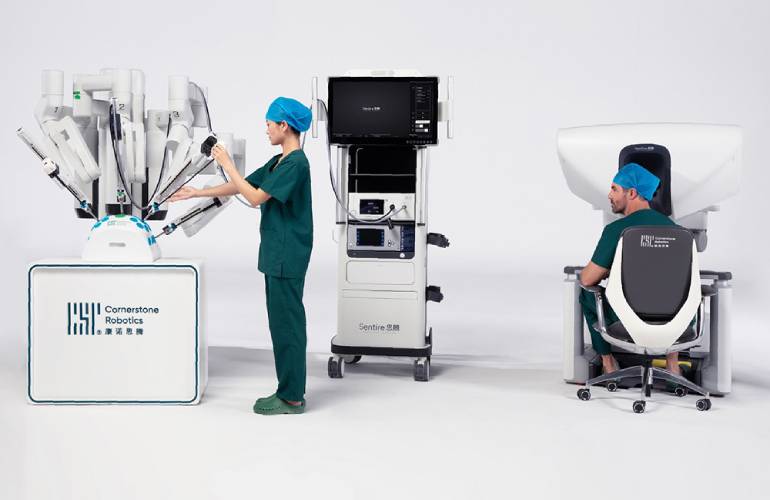
CSR’s operating model rests on three pillars: a proprietary product platform, a vertically integrated value chain, and a distribution partnership with a major global strategic player.
A proprietary multi-arm surgical robotics platform featuring an in-house-developed immersive console with dual-console capability. The system holds NMPA approval in China (2024) and received EU CE Mark and Singapore HSA approvals (May 2026, covering general surgery, gynecology, thoracic, and urologic indications) simultaneously, following completed multi-center clinical trials in China and the UK (Portsmouth). It is reportedly already deployed in clinical use at leading hospitals across Asia-Pacific and Europe.
CSR develops and internalizes the full stack — hardware, control software, algorithms, and proprietary imaging and energy platforms. Management states this structure enhances control over product integration, quality, and supply-chain resilience, which we view as a structural differentiator versus competitors more reliant on external components.
In September 2026, CSR entered a strategic partnership with Medtronic, securing an investment of approximately $700 million while granting Medtronic distribution rights for Sentire across ex-U.S. markets where the system holds regulatory approval. The arrangement creates a two-platform portfolio alongside Medtronic’s existing Hugo system; for CSR, this offers access to a major medical-device company’s hospital channels without having to build a proprietary global sales network.
Clinical & Commercialization Status: Per company disclosure, Sentire is among a small number of China-originated robotic platforms with approvals spanning China, Europe, and Singapore, and we flag the simultaneous EU CE Mark and Singapore HSA approvals secured in May 2026 as a notable milestone. That said, the Company has not disclosed granular data on how these approvals are converting into hospital procurement volumes, so revenue scale and installed base remain unverified.
Since its 2019 founding, CSR has raised capital through a sequence of venture rounds, and since 2025 the composition of its capital base has shifted noticeably from pure VC funding toward sovereign/strategic capital (Hong Kong’s HKIC, Medtronic). Following the November 2025 round, CSR’s valuation was reported to exceed $1 billion, conferring unicorn status — a trajectory we view as reaffirmed by the September 2026 Medtronic partnership.
Founded out of the CUHK research ecosystem and based at the Hong Kong Science and Technology Park. Per company disclosure, the Company completed proof-of-concept work followed by initial validation on cadaver and animal models in Hong Kong and Shenzhen.
Per company disclosure, CSR closed a Series B round in excess of $75 million. A third-party data vendor (CBInsights) estimates the round’s post-money valuation at approximately $694 million; we note this is a third-party estimate rather than a company-disclosed figure.
The Company disclosed an additional $90 million-plus raised in a Series B+ round, bringing cumulative funding to approximately $120 million as of that point, per its own disclosure. Third-party data (CBInsights) separately records a “Series C” round closing on June 30, 2023 — the alignment between round naming and timing across these sources has not been fully verified.
CSR closed a round in excess of $70 million led by global private equity firm EQT. We view this as an early signal of the investor base broadening from pure venture funding toward large institutional participation.
Deal structure: CSR closed a $200 million round led by the Hong Kong Investment Corporation (HKIC), the Hong Kong government’s investment arm, with participation from existing investors including Qiming Venture Partners, Gaorong Ventures, and Bridgeone Capital.
Strategic significance: The Company characterized the round as reflecting “the Hong Kong government and local investors’ long-term commitment to supporting unicorn enterprises.” Media reports placed CSR’s valuation above $1 billion following the round, conferring unicorn status; however, the precise post-money valuation has not been officially disclosed.
Policy context: We note that this round is directly linked to the Hong Kong SAR government’s biotech and innovation-industry promotion policy and its GBA manufacturing strategy, which we view as a supportive policy tailwind for CSR.
Global medical-device major Medtronic announced a strategic partnership involving an approximately $700 million investment in CSR. In exchange, Medtronic secured distribution rights for Sentire across ex-U.S. markets where the system holds approval, and stated the deal creates a two-platform portfolio alongside its existing Hugo robotic surgery system. Medtronic shares closed at $91.82 following the announcement, up 1.26%.
CSR’s cumulative funding total varies materially across third-party data vendors — Dealroom reports “over $200 million,” Tracxn reports “$459 million” (across 4 rounds, labeling the most recent round “Series D”), and CBInsights reports “$473.57 million” (across 8 rounds, labeling the November 2025 round “Series C-III”). Round sub-classification (Series C-II/C-III versus Series D) and individual round sizes are also inconsistent across sources. We do not treat these third-party estimates as verified figures, and have relied only on rounds confirmable via official company announcements or primary reporting (SCMP, BigGo Finance, etc.) — namely the January 2025 EQT-led $70M+ round, the November 2025 HKIC-led $200M round, and the September 2026 Medtronic $700M investment — as reliable data points.
• Investment size: Approximately $700,000,000 (per reporting; precise equity stake and security type undisclosed)
• Distribution scope: Ex-U.S. markets where Sentire holds regulatory approval (currently China, EU, Singapore)
• Portfolio structure: Two-platform arrangement combining Medtronic’s Hugo system with Cornerstone’s Sentire system
• Medtronic advisors: Financial advisor Morgan Stanley & Co. LLC / Legal counsel Cleary Gottlieb Steen & Hamilton LLP
• CSR advisors: Legal counsel Kirkland & Ellis, Global Law Office
In our assessment, CSR’s competitive positioning rests on four pillars: (1) cost and quality control derived from vertical integration, (2) an unusually rapid multi-jurisdictional regulatory approval track record, (3) global distribution access secured through the Medtronic partnership, and (4) the founder’s interdisciplinary expertise. China’s surgical robotics market is intensifying, with domestic competitors including MicroPort MedBot, Edge Medical, Sizherui, and Surron Robotics contending alongside Intuitive’s (Fosun joint venture) da Vinci system — we view the durability of CSR’s differentiation as the key variable for its forward valuation.
CSR develops and internalizes hardware, control software, algorithms, and proprietary imaging and energy platforms in-house. Management states this reduces reliance on external components and software, strengthening quality control and supply-chain risk management; we view this as a structural differentiator versus China-based domestic competitors (MicroPort MedBot, Edge Medical, Sizherui, Surron) amid intensifying price competition. That said, vertical integration also implies a heavier upfront capital-expenditure burden, which warrants consideration.
CSR holds NMPA approval in China (2024) and secured simultaneous EU CE Mark and Singapore HSA approvals in May 2026. Achieving approval across three major regulatory markets within seven years of founding is fast relative to industry norms, which we interpret as a commercialization-timeline advantage versus emerging peers. Quantitative data on how these approvals are converting into actual hospital procurement volumes, however, remains limited.
The partnership allows CSR to accelerate commercial scale-up in ex-U.S. approved markets by leveraging Medtronic’s existing hospital network and Hugo ecosystem, without building a proprietary global sales force. That said, we flag (i) that the partnership does not include U.S. market access, and (ii) channel-prioritization risk given that Medtronic simultaneously owns a competing platform (Hugo).
Professor Samuel Au’s profile — combining MIT robotics research with hands-on experience at a commercial U.S. surgical robotics company — represents a relatively rare case of academic rigor paired with clinical commercialization capability. CSR’s founding structure, rooted in CUHK’s technology-transfer program, appears to have contributed to sustained local ecosystem support (including the HKIC investment), aligned with the Hong Kong SAR government’s biotech promotion policy.
Our Overall Assessment: Within seven years of founding, CSR has achieved a relatively rare combination of milestones — multi-jurisdictional regulatory approval, a $1 billion-plus valuation, and a strategic partnership with a major global medical-device company. We flag as risk factors: (1) China’s robotic surgery penetration rate remains low, at roughly 1%; (2) CSR’s advantage relative to domestic competitors has not yet been fully validated through quantitative metrics such as revenue or installed base; and (3) consistency across funding-related disclosure data remains limited across sources.