
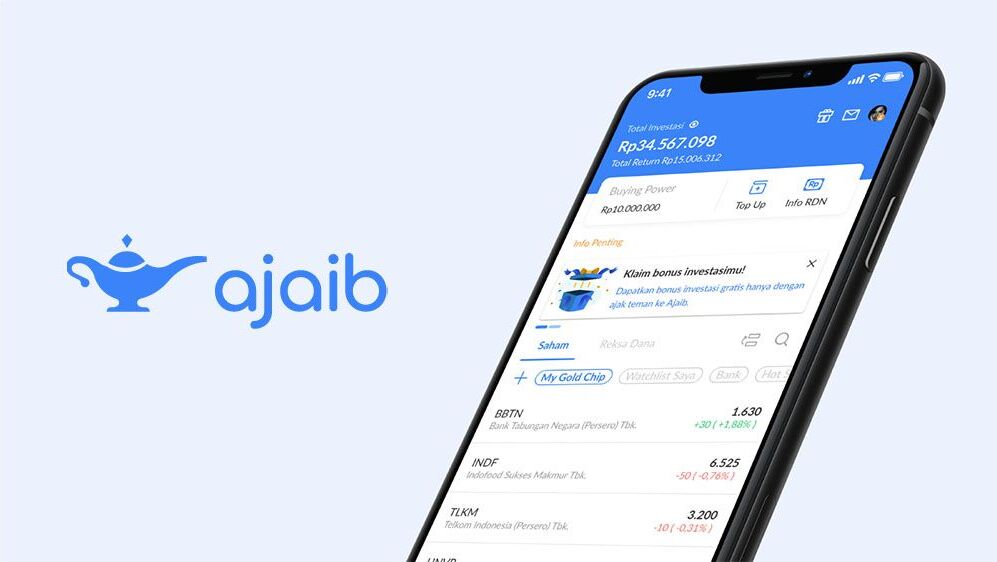
Ajaib
Indonesia’s first fully online brokerage — built by two Stanford MBA classmates into a retail investment super-app, now backed by a $270M strategic investment from SBI Holdings
Ajaib was co-founded in 2018 in Jakarta, Indonesia, by Anderson Sumarli and Yada Piyajomkwan, classmates at the Stanford Graduate School of Business. We view the founding thesis as distinct from a typical Silicon Valley product play: rather than starting from a technology insight, the founders anchored the business in a structural capital-markets gap. While completing their MBAs, they identified that stock-market participation in Indonesia stood at roughly 1% of the population and set out to build a mobile-first brokerage modeled on Robinhood to close that gap.
The company went through Y Combinator’s Summer 2018 (S18) batch before formally launching its app in 2019, and adoption accelerated through the pandemic as smartphone-native millennials and Gen Z users moved into online trading in large numbers. Winston Lays, a University of Southern California graduate and founder of the technology consultancy Delos, joined as co-founder and Chief Technology Officer in 2020, completing the three-person founding team. Ajaib crossed a $1 billion valuation within two and a half years of launch, a pace we flag as the fastest unicorn timeline recorded in Indonesia to date.
Graduated summa cum laude from Cornell University in Applied Economics and Management with a finance concentration. Prior experience at JPMorgan, IBM’s Chief Analytics Office, and Boston Consulting Group as a management consultant, before earning his MBA at Stanford GSB. Named to Forbes 30 Under 30 Asia 2020 and recipient of the EY Young Entrepreneur of the Year award (2022).
Began her career in brand management at Unilever, then advised ASEAN governments on financial-inclusion policy as a consultant at McKinsey & Company. Attended Stanford GSB as a Fulbright scholar, where she met Sumarli and co-founded Ajaib. Named to Forbes 30 Under 30 Asia 2020 alongside Sumarli.
Co-founder and CTO Winston Lays brought his engineering-and-product background from Delos to build out Ajaib’s technology organization. We see the founding team’s complementary skill set — Sumarli in strategy and financial-services operations, Piyajomkwan in product and consumer insight, Lays in engineering — as a key driver of the company’s early execution speed.
Ajaib launched as Indonesia’s first fully online securities brokerage and has since evolved into a multi-asset investment platform spanning equities, ETFs, mutual funds, bonds, international equities, crypto assets, stablecoins, foreign exchange, and commodities. Its brokerage subsidiary, Ajaib Sekuritas, is licensed and supervised by Indonesia’s Financial Services Authority (OJK) and is directly connected to the country’s self-regulatory infrastructure — the Indonesia Stock Exchange (IDX/BEI), the central securities depository (KSEI), and the clearing house (KPEI).
| Business Line | Description | Status | Notes |
|---|---|---|---|
| Equities & ETF Brokerage | Online trading of IDX-listed securities | Core Business | Origin of the company; operated through OJK-licensed Ajaib Sekuritas |
| Mutual Funds | Distribution of third-party asset-manager funds, many commission-free | Operating | Serves as a low-ticket, recurring-investment acquisition channel |
| Crypto Assets (Ajaib Kripto) | Trading across multiple pairs on a regulated platform | Growth Segment | No leverage offered; operates under Indonesia’s evolving crypto regulatory framework |
| International Equities & Bonds | Access to U.S. equities and fixed income for domestic investors | Operating | Addresses onshore investor demand for portfolio diversification |
| Stablecoin & Cross-Border Settlement | OTC stablecoin settlement and liquidity services for corporate and institutional clients | New Expansion | Tied to SBI Holdings’ JPYSC (yen stablecoin) distribution partnership in Southeast Asia |
Regulatory licensing as a structural moat: In our view, Ajaib’s status as an OJK-licensed broker-dealer with direct SRO connectivity is a meaningful advantage relative to later entrants. Indonesian capital-markets licensing is time- and capital-intensive to obtain, and this licensing base is what allows Ajaib to extend from brokerage and mutual funds into crypto and stablecoin settlement without rebuilding regulatory infrastructure from scratch.
From its 2018 Y Combinator batch through the August 2026 strategic investment from SBI Holdings, Ajaib has raised more than $500 million cumulatively since 2019. We flag two features of this history as analytically relevant: first, the recurring presence of Robinhood’s own investor syndicate — DST Global, Ribbit Capital, Iconiq Capital, and IVP — across multiple rounds; and second, the fact that the 2026 SBI round closed as Indonesia’s largest technology fundraising since 2022, at a time when regional venture capital had otherwise contracted sharply.
Graduated from Y Combinator’s Summer 2018 (S18) batch before formally launching. Raised early seed capital from SoftBank Ventures Asia, Insignia Ventures Partners, and Alpha JWC Ventures. App launched publicly in 2019.
Opened with a $25M tranche co-led by Horizons Ventures and Alpha JWC, then extended with a $65M tranche led by Ribbit Capital — a Robinhood investor — closing the round at $90M in total. Participants included Bangkok Bank, Y Combinator Continuity, Iconiq Capital, and Nubank founder David Vélez as an individual investor.
Led by DST Global, with full participation from the existing syndicate — Ribbit Capital, Iconiq Capital, IVP, Insignia Ventures, Alpha JWC, Horizons Ventures, and SoftBank Ventures Asia. The round pushed Ajaib’s valuation past $1 billion, making it Indonesia’s seventh unicorn and, at two and a half years from founding, the fastest company in the country’s history to reach that milestone.
Japan’s SBI Holdings acquired an approximately 20% stake through a subsidiary, making Ajaib an equity-method affiliate. The round closed at a valuation above the roughly $1 billion mark set in the 2021 Series B, though neither party disclosed the exact figure. Against a backdrop of a sharply contracted Southeast Asian venture market since 2022, the round stands as Indonesia’s largest technology fundraising in years and pushed Ajaib’s cumulative capital raised past $500 million.
Indonesia’s retail investment-platform market is fragmented, with Stockbit (affiliated with Sinarmas Sekuritas, positioned around community and analytics), Bibit (a Sequoia India-backed mutual-fund robo-advisor), Pluang (specialized in gold and crypto), and recent entrant Webull Indonesia all competing for the same retail wallet. In our assessment, Ajaib’s competitive position rests on the following six dimensions.
As Indonesia’s first fully online brokerage, Ajaib has accumulated more than three million users and ranks among the country’s top brokerages by transaction volume, converting early-mover advantage into brand recognition and network effects.
Equities, mutual funds, crypto, bonds, and FX are all offered within a single app, versus single-asset-focused rivals such as Stockbit (equities), Bibit (funds), and Pluang (gold/crypto) — a structural advantage for cross-sell and customer lifetime value.
Access to a major Japanese financial group’s balance sheet and digital-asset infrastructure — including stablecoin issuance and cross-border settlement rails. We view this as a business-development relationship, not merely a passive capital injection, that positions Ajaib to expand regionally in digital assets.
DST Global, Ribbit Capital, Iconiq Capital, and IVP — all Robinhood investors — have backed Ajaib since its early rounds, bringing global fintech governance and operating know-how alongside capital.
Ajaib holds an OJK-licensed brokerage and maintains direct connectivity to IDX, KSEI, and KPEI infrastructure. Indonesian capital-markets licensing is slow and capital-intensive to obtain, functioning as a structural barrier against new entrants.
Indonesian stock-market participation stands at roughly 1%, well below comparable economies. The retail consumption market is estimated at approximately $375 billion, with more than 20 million retail investors, positioning capital-markets deepening as a durable long-term tailwind.
The catalytic effect of Bukalapak’s 2021 IPO: Ajaib’s unicorn round in October 2021 followed shortly after e-commerce leader Bukalapak’s record-setting IPO. In our view, the retail-investor enthusiasm that IPO generated contributed materially to Ajaib’s valuation re-rating at the time, underscoring that Ajaib’s growth trajectory has historically been closely correlated with broader Indonesian capital-market cycles.
Ajaib remains a privately held company, and as of the August 2026 SBI Holdings round, no audited financial statements have been made public. We recommend that investors weigh the following opportunity and risk factors against this information gap.
Opportunities include ▲the structural growth runway implied by Indonesia’s roughly 1% investment-penetration rate ▲potential expansion into digital assets and stablecoin infrastructure enabled by the SBI Holdings partnership ▲continued backing from the Robinhood investor syndicate (DST Global, Ribbit Capital, and others), which we read as a signal of governance credibility ▲and the fundamental competitive strength implied by closing a large round even as Southeast Asian venture funding contracted sharply after 2022.
Risks include ▲intensifying fee competition from Stockbit, Bibit, Pluang, and new entrant Webull Indonesia ▲the broader macro contraction in Indonesian startup funding, which fell from a 2021 peak of $9.44 billion to roughly $340 million in 2025 ▲regulatory fluidity in Indonesia’s evolving crypto-asset framework, including potential jurisdictional shifts ▲limited means of verifying financial performance given the company’s private status ▲and Indonesian macroeconomic risk, including rupiah volatility.
- Inconsistent deal characterization: Dealroom- and TechCrunch-affiliated outlets describe the SBI round as a “Series C,” while Bloomberg, Nikkei Asia, and MarketScreener describe it as a 20% equity stake acquisition making Ajaib an equity-method affiliate — a strategic investment rather than a conventional venture round. We treat this as a transaction with hybrid characteristics and flag that official disclosure of valuation and governance terms has not been made.
- Wide variance in non-financial metrics across sources: Reported user counts, assets under management, and revenue figures vary substantially by data provider — from roughly one million to as high as twelve million reported users across different sources, a spread exceeding 3,000%. Some lower-tier secondary sources report internally inconsistent figures within the same document. We flag that any such figure should be weighted by source reliability; this report uses the conservative, press-corroborated figure of “more than three million users.”
- Single-source revenue estimate: The approximately $142M 2025 revenue figure appears in only one data provider (Getlatka), with no corroboration from company disclosure or a second independent source. This should be treated strictly as an unverified estimate.
- Speculative IPO commentary: Some lower-tier sources speculate about a future IDX or international listing. We flag that this reflects analyst or blog speculation, not any official company statement.