
REGENT Craft Inc.
The world’s first commercial-stage Seaglider™ developer — a Rhode Island-based, dual-use maritime mobility company serving both commercial and defense markets
REGENT Craft Inc. — formally Regional Electric Ground Effect Nautical Transport Craft Inc. — was co-founded in 2020 in Burlington, Massachusetts by MIT aerospace engineering classmates Billy Thalheimer and Mike Klinker. The company relocated its headquarters to Quonset Business Park in North Kingstown, Rhode Island in 2022, securing roughly $13 million in state tax incentives in connection with the move.
Holds a B.S. and M.S. in Aerospace Engineering from MIT. Prior to REGENT, he held roles at Blue Origin and Virgin Galactic before joining Boeing subsidiary Aurora Flight Sciences, where he led the flight-physics team for Boeing’s electric air-taxi program (PAV) and later moved into program management and business development. He authored Aurora’s proprietary aircraft-design code and holds an aerobatic pilot certification.
Also holds a B.S. and M.S. in Aerospace Engineering from MIT, with a focus on aircraft controls and autonomy. His prior experience spans Airware, Raptor Maps, MIT Lincoln Laboratory, and Aurora Flight Sciences. Raised in a lobster-fishing family in New Hampshire, his childhood exposure to both maritime and aviation environments is frequently cited as the personal origin of the Seaglider concept.
The co-founders first met in an undergraduate aerospace engineering course at MIT and later worked together at Aurora Flight Sciences prior to its acquisition by Boeing in 2017 — a shared operating history we view as a credibility anchor for REGENT’s core thesis of “aircraft-grade speed within boat-grade regulatory and infrastructure constraints.” Tom Huntley, VP of Government Relations and Defense, leads the company’s defense and government affairs function. Headcount was reported at approximately 100 employees as of 2025, with no updated official figure disclosed since.
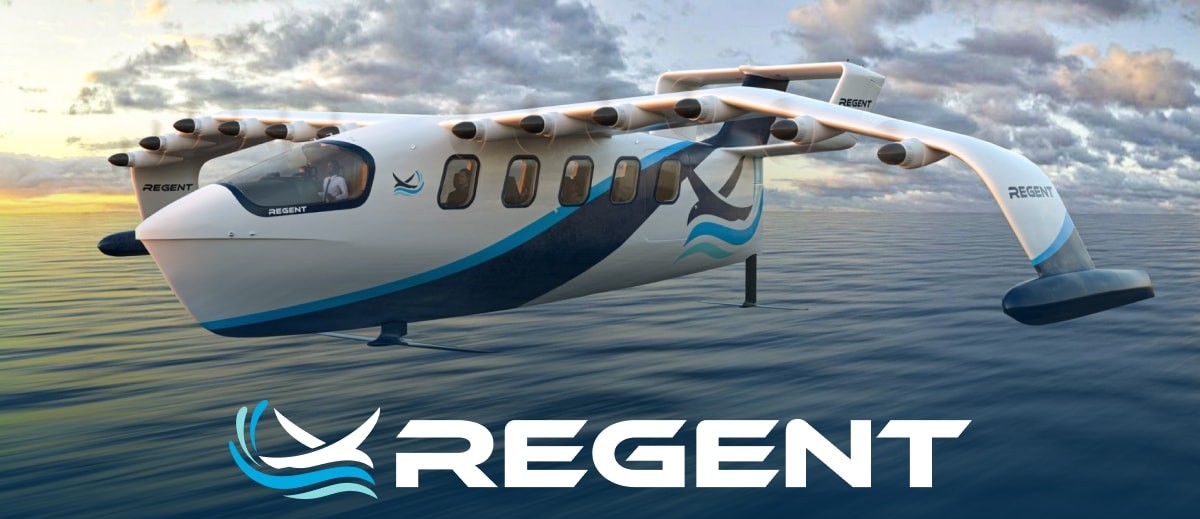
REGENT develops and manufactures Seagliders™, a new mobility category combining hydrofoil and wing-in-ground-effect (WIG) technology. The craft operates in three sequential modes — docking and maneuvering like a conventional vessel (Float), rising onto hydrofoils at low speed to reduce drag (Foil), and cruising just above the water’s surface within one wingspan of altitude using ground-effect aerodynamics (Fly). The platform is fully electric, targeting a cruise speed near 180 mph (290 km/h) and a range of approximately 180 miles (290 km).
REGENT’s operating model applies a single core platform technology across two independent but complementary demand pools — commercial transportation and national defense — a structure we would characterize as classic dual-use positioning.
A 12-passenger all-electric Seaglider marketed to airlines and ferry operators. The customer base includes Mesa Airlines, Brittany Ferries, FRS, Southern Airways (operating under the Mokulele Airlines brand), UrbanLink (now The Twenty Five), and Brazil’s Synerjet, with cargo and search-and-rescue mission variants also under development. The company is targeting first crewed flight in 2026, with initial customer deliveries guided to 2027.
Developed under the REGENT Defense business unit, Squire is an uncrewed surface-and-aerial vehicle (USA-V) capable of speeds up to 70 knots (130 km/h), a planned range beyond 100 nautical miles, and a configurable 50-lb payload. REGENT has formalized relationships with the U.S. Marine Corps Warfighting Lab and U.S. Special Operations Command (USSOCOM), targeting electronic warfare, reconnaissance, and contested-logistics missions.
REGENT completed a 255,000-square-foot manufacturing facility in Quonset, Rhode Island in August 2026, marking the company’s transition into full-scale production. In parallel, it is building regional partnerships — Abu Dhabi’s Strategic Development Fund (UAE), Balnord (Poland, Baltic Sea defense demand), and iGrow (Greece, Aegean commercial demand) — to support local operations and manufacturing expansion.
Strategic significance of the certification path: Because the Seaglider is legally classified as a vessel rather than an aircraft, REGENT is pursuing certification through a Design Basis Agreement filed with the U.S. Coast Guard rather than the FAA — a route we view as structurally faster and less capital-intensive than conventional aircraft certification. That said, this remains a novel certification category with no direct precedent, and residual timeline risk around final regulatory sign-off has not been fully eliminated.
REGENT’s disclosed commercial order book has escalated across company communications — from $8B (2023) to $9B (2025) to $10B+ (August 2026). CEO Billy Thalheimer has stated directly, in an Inc. Magazine interview, that this figure reflects “a combination” of firm and provisional orders. We therefore flag that a meaningful — but undisclosed — portion of the backlog may not represent contractually binding revenue. We present this as a self-reported, company-disclosed figure and do not adjust it.
Since its seed round in 2021, REGENT has completed at least four discrete capital raises, reaching cumulative funding of $340 million (equity plus debt) as of August 2026. The most recent Series B is notable for its 50/50 equity-debt split, with debt capital provided by defense-focused Erebor Bank — a structural shift in the company’s capitalization approach worth flagging for investors.
REGENT was incorporated in Burlington, Massachusetts. A follow-on seed/bridge-style raise of approximately $28.8 million is understood to have closed in January 2022, per third-party disclosure. That same year, the company relocated its headquarters to Quonset Business Park, Rhode Island, and on August 15, 2022, achieved its first successful flight of a quarter-scale prototype in Narragansett Bay, validating the full Float-Foil-Fly flight envelope.
The round formalized previously announced strategic investments from Japan Airlines Innovation Fund, Lockheed Martin, and Yamato Holdings, and added new participants including Point72 Ventures, Caffeinated Capital, Mark Cuban, the UAE’s Strategic Development Fund, and Future Planet Capital. Proceeds were allocated toward building and testing a full-scale prototype ahead of crewed flight trials in 2024.
Following completion of a $4.75 million Phase 1 feasibility contract with the Marine Corps Warfighting Lab (MCWL), REGENT signed a Phase 2 agreement worth approximately $10 million (with extension options) in March 2025. Construction began on the 255,000-square-foot Seaglider manufacturing facility in Quonset, and in March 2025 the company unveiled its full-scale Viceroy prototype (named “Paladin”) and began crewed sea trials.
The uncrewed Squire Seaglider reached 70 knots (130 km/h) in what is reported as the first autonomous flight of a U.S. military WIG craft. Company leadership briefed Secretary of War Pete Hegseth and senior defense officials in February 2026, and in August demonstrated electronic-warfare payload integration at the “Silent Swarm” defense exercise. REGENT also formalized a development relationship with USSOCOM during this period.
Deal structure: An even split between equity and debt (approximately $120M each) was co-led by Mare Liberum, a maritime-defense-focused investment firm, and AE Ventures, the venture platform of AE Industrial Partners. Debt capital was provided by Erebor Bank, the defense-focused national bank co-founded by Palmer Luckey.
New participation: Deep-tech investor DCVC joined as a new investor, alongside continued participation from Founders Fund, Caffeinated Capital, Lockheed Martin Ventures, Japan Airlines, and Giant Step Capital.
Use of proceeds: The company has guided that proceeds will fund manufacturing ramp-up at the new facility, first crewed flight and certification milestones for Viceroy, and production capacity across both defense and commercial pipelines.
• Total raised: $240,000,000 (50% equity / 50% debt)
• Co-leads: Mare Liberum (maritime defense specialist), AE Ventures (aerospace & national security specialist, ~$9.4B AUM)
• Debt provider: Erebor Bank (co-founded by Palmer Luckey; OCC-chartered national bank)
• Cumulative funding: $340,000,000 (equity + debt, per company disclosure as of August 2026)
• New investor: DCVC / Follow-on participants: Founders Fund, Lockheed Martin Ventures, Japan Airlines, Caffeinated Capital, Giant Step Capital
PitchBook’s company profile lists REGENT’s cumulative funding at $127M (across 48 tracked investors, with an unclear last-update date), a material gap versus the company’s own disclosed figure of $340M (August 2026). Separately, third-party aggregator data (Seedtable) puts early-round funding at $46.81M across three rounds, which does not fully reconcile with company-disclosed round detail. We adopt the company’s official press release (GlobeNewswire, August 27, 2026) figure of $340M as our primary reference, while flagging this cross-source inconsistency explicitly for investors rather than resolving it unilaterally.
We see REGENT’s competitive positioning as resting on three pillars: regulatory pathway design, energy-efficiency physics, and dual-use demand diversification. Where eVTOL peers such as Archer Aviation and Joby Aviation are locked into the structurally slower, more capital-intensive FAA aircraft-certification track, REGENT built its category from inception around maritime law — in our view, a fundamentally different risk/return profile from the broader AAM (advanced air mobility) peer set.
By classifying the Seaglider as a “vessel” under U.S. Coast Guard jurisdiction, REGENT avoids the roughly decade-long, $1 billion-plus FAA certification burden typically associated with new aircraft development. We view this as a structural advantage capable of meaningfully compressing REGENT’s commercialization timeline relative to eVTOL competitors — though as a novel certification category, final regulatory sign-off timing risk has not been fully retired.
Unlike vertical-takeoff eVTOL designs, REGENT’s three-stage operating sequence — hydrofoil acceleration followed by ground-effect cruise — achieves a comparatively long range (~180 miles) and high cruise speed (~180 mph) at current battery energy-density levels. We regard this as an elegant engineering workaround to the core bottleneck constraining electric aviation more broadly.
By deriving two independent revenue lines — Viceroy (commercial) and Squire (defense) — from a single core platform, REGENT reduces its dependence on any single market cycle. The defense segment, anchored by live contracts with the U.S. Marine Corps and USSOCOM, offers a comparatively faster path to cash flow and, in our assessment, partially offsets the longer certification and production-scaling risk inherent to the commercial line.
The cap table includes Lockheed Martin (defense), Japan Airlines (commercial aviation operations), AE Industrial Partners (aerospace and national-security-focused private equity), Mare Liberum (maritime defense specialist), and Erebor Bank (defense-focused banking). We view this as a network asset extending well beyond passive capital — one capable of providing meaningful support across certification, procurement, and customer acquisition.
Strategic strength of the founding team: Co-founders Thalheimer and Klinker share both an MIT aerospace engineering pedigree and prior operating history together at Boeing subsidiary Aurora Flight Sciences, where they worked on an electric air-taxi program. In our view, this combination of a proven co-founder working relationship and direct aircraft design/certification expertise reduces execution risk relative to comparable AAM startups.
• Pre-revenue stage: The company remains pre-revenue ahead of targeted first customer deliveries in 2027, and a meaningful portion of the $10B+ order book is understood to be non-binding, provisional demand.
• Rising debt leverage: Half of the Series B was structured as debt, which could tighten financial flexibility in the event of certification delays or production disruptions.
• Certification uncertainty: The maritime-law certification pathway is itself a novel track with limited precedent; final U.S. Coast Guard approval timing could slip relative to company guidance.
• Competitive intensity: REGENT competes for capital, talent, and defense budget allocation against adjacent aerospace and maritime defense-tech players including Archer Aviation, Joby Aviation (eVTOL), Anduril Industries, Saronic, and BETA Technologies.