
AusperBio
A US-China dual-hub biopharma founded by former Gilead antiviral R&D leaders, racing to challenge GSK’s early lead in chronic hepatitis B functional cure with its Med-Oligo™ and Au-HALO™ oligonucleotide platforms
AusperBio is a clinical-stage biopharmaceutical company operating a dual-hub structure spanning San Francisco/San Mateo, California and Hangzhou, China, founded in 2019. The company was co-founded by two scientists out of Gilead Sciences’ antiviral discovery organization, Dr. Guofeng Cheng and Dr. Chris Yang. We view this founding pedigree as directly relevant to how the pipeline was designed, and we believe it warrants more analytical weight than founder biographies typically receive in early-stage biotech diligence.
The Chinese operating entity, Ausper Biopharma Co., Ltd., traces back to a Hangzhou-based pharmaceutical company. We flag a corporate-structure discrepancy here: third-party data platforms record the legal predecessor under two different names — “Hangzhou Haobo Pharmaceutical Co., Ltd. (浩博医药)” per Crunchbase versus “Hangzhou Chengyue Biopharmaceutical Co., Ltd.” per PitchBook. We attribute this most plausibly to the entity-naming complexity common to cross-border biotech holding structures, but we cannot fully reconcile it from public sources, and we treat it as an open item for further diligence rather than resolve it ourselves.
Ph.D. in Microbiology & Immunology, University of Illinois at Chicago; postdoctoral fellowship at the Scripps Research Institute under Frank Chisari, a leading authority on HBV immunopathology. As Senior Director of Antiviral R&D at Gilead, contributed to the discovery of the Harvoni/Epclusa/Vosevi HCV cure franchise before leading Gilead’s HBV cure research (cccDNA inhibitors, HBsAg inhibitors, gene-editing collaborations).
Spent 14 years at Gilead Sciences, serving as DMPK (Drug Metabolism and Pharmacokinetics) Director, co-leading discovery and development programs during his tenure. At AusperBio, oversees clinical development strategy for lead asset AHB-137 and technical direction of the Med-Oligo™ and Au-HALO™ platforms.
We would stress the point that matters most here: both founders spent their prior careers inside a large-pharma antiviral organization that actually achieved “cure” as a development endpoint — a considerably harder bar than viral suppression, and one that fewer than a handful of oncology or infectious-disease teams globally have crossed. In an HBV field where the existing standard of care (nucleos(t)ide analogues) achieves functional cure in roughly 1% of patients, we read this as a qualitative underpin for the credibility of AusperBio’s program design. We would caution, however, that this remains a qualitative read on founder track record; the actual clinical edge still needs to be earned in Phase 3 data, not assumed from résumés.
AusperBio positions itself as a “near-commercial” biopharmaceutical company, with an initial focus on achieving a functional cure for chronic hepatitis B (CHB) through targeted oligonucleotide therapeutics. Per the World Health Organization, CHB affects an estimated 254 million people worldwide and drives approximately 1.1 million deaths annually, primarily from cirrhosis and hepatocellular carcinoma. Current standard-of-care nucleos(t)ide analogues suppress viral replication but rarely produce a cure, leaving most patients on lifelong therapy.
The company runs two proprietary platforms. Med-Oligo™ encodes AusperBio’s design and optimization insights for unconjugated antisense oligonucleotides (ASOs) and underpins the lead asset, AHB-137. Au-HALO™ is a hepatocyte-targeted delivery platform, first clinically validated through the siRNA candidate AHB-171. In our read, running two distinct oligonucleotide modalities on two separate platforms — rather than one modality applied twice — meaningfully diversifies mechanism-specific failure risk across the pipeline, which is a structural point we’d flag as more relevant to risk-adjusted valuation than the platform branding itself.
| Candidate | Platform / Indication | Stage | Notes |
|---|---|---|---|
| AHB-137 | Med-Oligo™ ASO · CHB (HBeAg-negative, on NA therapy) | Phase 3 | China AUSHINE registrational trial (CTR20252792/NCT07246889). Enrollment of 570+ patients completed ahead of schedule, Dec 2025, five months after CDE approval |
| AHB-137 | Med-Oligo™ ASO · CHB (treatment-naive, global) | Phase 2 | NCT06829329. Part A (placebo-controlled) end-of-study data presented at EASL 2026, showing high HBsAg loss rates in low-baseline-antigen subgroup |
| AHB-137 | Med-Oligo™ ASO · CHB (Asia-Pacific region) | Phase 2 | NCT07370207. Evaluating quantitative HBsAg markers and seroconversion rates at Weeks 24/48/72 |
| AHB-171 | Au-HALO™ siRNA · CHB | Phase 1 | First clinical candidate on the Au-HALO™ platform; first patient dosed. Hepatocyte-targeted siRNA intended to validate combination potential with the ASO backbone |
| Next-Gen Combinations | ASO backbone + HBV vaccine / siRNA combinations | Exploratory | Preclinical AAV-HBV mouse model data show sequential vaccine dosing after AHB-137 prevents HBsAg rebound and generates neutralizing antibodies. Part of Series C proceeds earmarked to accelerate this strategy |
Our Read — A Caveat on the “Near-Commercial” Label: AusperBio describes itself as a “near-commercial biopharmaceutical company,” but the company has not yet secured any regulatory approval. Actual commercialization is entirely contingent on AUSHINE meeting its primary efficacy endpoint and subsequent NDA/BLA review outcomes. We would treat this characterization as company marketing language rather than a factual regulatory status, and would encourage investors to do the same.
Public sources do not disclose seed- or angel-stage financing detail from AusperBio’s 2019 founding; the visible institutional fundraising trajectory effectively begins with the Series A in July 2024. Per company disclosure, AusperBio raised a cumulative $360 million between 2024 and the close of its Series C in August 2026 — a roughly two-year span that we would characterize as an unusually rapid round cadence for a pre-commercial HBV therapeutics developer, even relative to well-capitalized biotech peers.
We flag a reconciliation gap between third-party venture data platforms and company disclosure. PitchBook and Tracxn separately estimate AusperBio’s cumulative funding at approximately $258 million and $223 million, respectively (measured prior to full reflection of the August 2026 Series C), against the company’s own August 27, 2026 press release figure of “$360 million raised since 2024.” We attribute part of this variance to differences in as-of dates and lag in reflecting the $120 million Series C, but a residual gap remains unresolved from public data alone, and we treat this as an unverified metric. Additionally, no source discloses lead-investor ownership stakes or post-money valuation for any round.
Co-founded by Guofeng Cheng and Chris Yang, with entities established in both Hangzhou (Ausper Biopharma Co., Ltd.) and San Francisco/San Mateo (AusperBio Therapeutics, Inc.). Seed-stage financing detail is not disclosed in public sources.
Led by existing investor InnoPinnacle Fund. Completed after AHB-137 had already received Breakthrough Therapy designation in China, and on the heels of preclinical data at EASL 2023 and Phase 1 data at EASL 2024.
Led by HanKang Capital, with Sherpa Capital, CDH Investments, and an undisclosed strategic investor joining as new participants. Completed shortly after a late-breaking oral presentation at AASLD, reinforcing a recurring pattern of financing timed closely to clinical data readouts.
Led by an undisclosed existing investor. Proceeds earmarked for Phase 2 trials of AHB-137 outside mainland China, closing near the EASL 2025 late-breaking poster on HBsAg loss and seroconversion.
Closed roughly four months after Series B+, with the company citing acceleration of AHB-137’s pivotal development and expansion of global clinical footprint as rationale. We read the tight spacing between rounds as consistent with capital needs scaling alongside accelerating clinical execution, though it also implies a comparatively higher frequency of dilution events for existing holders.
Over 570 patients enrolled within five months of CDE approval, ahead of the company’s own initial expectations and demonstrating clinical-operations execution capability that we believe is not trivial in a field where trial delays are common. Not a financing event in itself, but we would view it as likely having strengthened AusperBio’s negotiating position ahead of Series C.
Led by an unnamed “leading strategic investor,” with RA Capital Management, L.P. joining as a new participant. All prior institutional backers — HanKang Capital, Sherpa Capital, InnoPinnacle Fund, Qiming Venture Partners, YuanBio Venture Capital, and CDH Investments — returned. Proceeds are directed toward completing AHB-137’s Phase 3 program and commercialization readiness, accelerating AHB-171, and advancing next-generation combination strategies.
We would first stress that AusperBio is not competing in a vacuum. GSK/Ionis’s bepirovirsen, an ASO of the same modality, has already reported Phase 3 topline data (B-Well 1 and B-Well 2, more than 1,800 patients across 29 countries) — 19% functional cure in the overall population and 26% in the lower-viral-activity subgroup, versus 0% for standard of care alone. It has secured the first global approval in this class in Japan under the brand Hibsago, and holds Breakthrough Therapy and Priority Review designation from the FDA, with a PDUFA date of October 26, 2026. In our view, this is the single most important variable in assessing AusperBio’s competitive position.
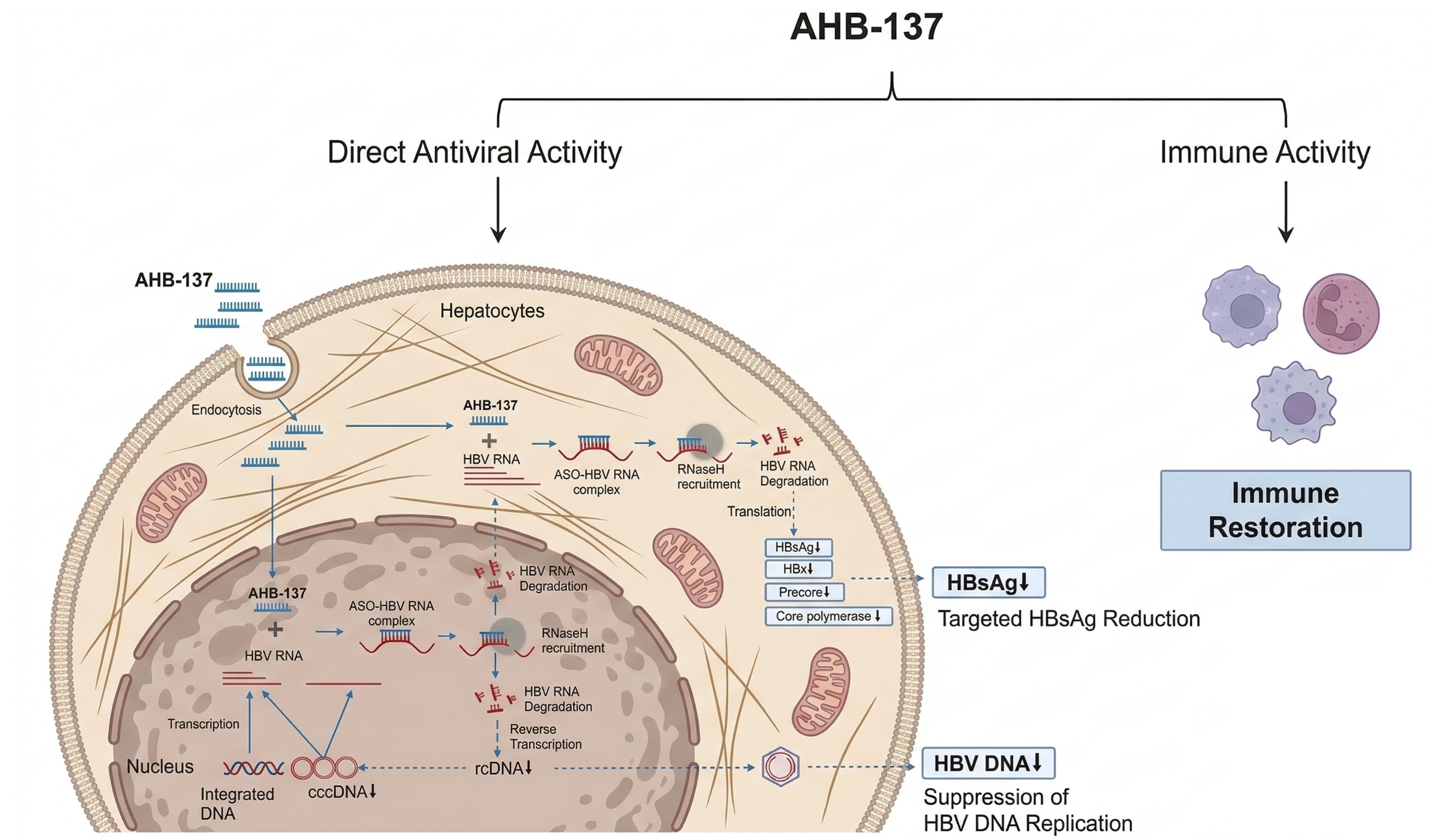
AHB-137’s simultaneous targeting of HBsAg production, viral DNA replication, and immune reactivation offers a theoretical differentiation versus single-mechanism competitors. We flag that whether this translates into clinical superiority remains unverified absent head-to-head data.
Enrolling 570+ patients within five months of CDE approval is a concrete execution data point in a field where many competitors have struggled with trial delays. Leveraging China’s large, lower-cost registrational trial infrastructure is a capital-efficiency advantage in our assessment.
Med-Oligo™ (ASO) and Au-HALO™ (siRNA delivery) as independent platforms mean a single mechanism’s failure would not necessarily collapse the entire pipeline. The preclinical sequential combination strategy (ASO backbone plus vaccine or siRNA) offers option value toward deeper functional cure rates over time.
A leadership team that helped deliver an actual cure franchise brings a credible track record to HBV cure program design, regulatory engagement, and late-stage trial strategy. This remains a qualitative factor that does not translate directly into financial value.
RA Capital Management is a well-known biotech/healthcare-focused crossover investor. The market typically reads the entry of this type of investor into a late-stage private round as a signal that an IPO or major pharma licensing/M&A discussion may be on the horizon.
254 million people living with HBV globally, roughly 1.1 million related deaths annually, and a standard-of-care cure rate near 1% together create conditions for rapid market penetration by any successful cure therapy. We would note this argument is shared industry-wide, including by GSK.
Our Read — “Well-Capitalized Fast Follower” Is the More Accurate Frame Than “Category Disruptor”: Rather than positioning AusperBio as a game-changer in HBV cure, we believe it is more precisely characterized as a well-capitalized second-wave entrant competing against a field that already includes an ASO (GSK’s bepirovirsen, now regulatory-stage) and multiple siRNA and capsid-inhibitor programs (Arbutus’s imdusiran, Aligos’s ALG-000184, GSK’s own siRNA combination of daplusiran and tomligisiran). The ultimate investment thesis rests entirely on whether AUSHINE’s Phase 3 primary endpoint is met.
AusperBio is privately held, and financial detail — P&L, cash burn rate, remaining runway — is not available in SEC-style public filings. Unlike a listed biotech such as Veradermics, the financial commentary in this report relies on company press releases and unverified third-party venture data platforms (PitchBook, Tracxn, Crunchbase), a distinction we would ask investors to keep firmly in view.
On the opportunity side, we would flag ▲ the early completion of China Phase 3 (AUSHINE) enrollment of 570+ patients, which brings the key data readout into closer view ▲ pipeline diversification via the triple-mechanism design and dual-platform (ASO + siRNA) structure ▲ the entry of a biotech-specialist institutional investor such as RA Capital, which we read as suggestive of a possible future IPO or major-pharma partnership path ▲ the prospect that FDA approval of GSK’s bepirovirsen later in 2026 could validate the ASO-based HBV cure mechanism more broadly among physicians and payers, indirectly benefiting a fast-follower like AusperBio through category validation.
1) First-mover risk — GSK/Ionis’s bepirovirsen has already secured approval in Japan (Hibsago) and carries an FDA PDUFA date of October 26, 2026; by the time AusperBio’s China Phase 3 data matures, the leading competitor in the same modality could already be established as standard of care across multiple developed markets. 2) Geographic concentration risk — The current registrational Phase 3 program is running exclusively in China; a concrete pathway and timeline for a US or other global registrational trial is not disclosed in public materials. 3) Cross-border structural risk — The dual US-China corporate structure carries exposure to geopolitical tension and evolving regulatory scrutiny of China-linked biotech investment and technology transfer. 4) Financial opacity — As a private company, cash burn, actual valuation, and dilution history are not disclosed, limiting independent investor verification. 5) Data comparability — The company’s headline 84% HBsAg loss figure (EASL 2026) derives from a small (n=19) subgroup, and cannot be directly benchmarked against GSK’s Phase 3 19–26% functional cure rate given differences in trial phase, patient population (treatment-naive versus NA-suppressed), and sample size. 6) Entity-naming inconsistency — Discrepant legal names for the Hangzhou subsidiary across data sources warrant further corporate-governance diligence.