
Ingenic Semiconductor
A Chinese fabless semiconductor platform spanning memory, compute, and analog — the global #1 supplier of automotive-grade SRAM, now broadening its capital access via a Hong Kong secondary listing
Ingenic Semiconductor (legal entity: Beijing Ingenic Semiconductor Co., Ltd.) is a Beijing-headquartered fabless chip designer founded in July 2005. The company listed A-shares on Shenzhen’s ChiNext board (300223) in May 2011 and, in August 2026, completed an H-share listing on the Hong Kong Stock Exchange (3223.HK) — establishing an A+H dual-primary-listing structure.
Born 1969 (age 56), Chinese national. Liu holds a bachelor’s degree in welding engineering from Tsinghua University, a Ph.D. in computer systems architecture from the Institute of Computing Technology, Chinese Academy of Sciences, and completed an Executive MBA at CEIBS — a technical-founder profile atypical for China’s semiconductor entrepreneurs of his cohort. In 1997 he joined Sunrise Electronic Technology (方舟科技) as VP of R&D, leading the “Sunrise-1” (方舟一号) domestic CPU program under the Ministry of Science and Technology’s national 863 strategic initiative. After initial tape-out in 2001, the project failed to achieve commercial traction and was ultimately shelved — an experience that shaped Liu’s subsequent approach to chip commercialization. In 2005 he exited Sunrise with his core R&D team to found Ingenic, targeting self-developed, industrializable domestic embedded CPU technology rather than another government-directed R&D exercise. He is regarded as one of the pioneers of China’s embedded processor industry, named a “Zhongguancun High-End Leading Talent” in 2009 and one of Xinhua’s “Top 10 Zhongguancun Innovation and Entrepreneurship Talents” in 2010.
A founding shareholder with an initial 14% stake, Li has acted in concert with Liu Qiang as a co-controlling shareholder since inception. Following the dilution triggered by the 2019–2020 ISSI acquisition, however, a substantial portion of his remaining holding has since been pledged as collateral — a governance overhang that warrants separate monitoring by counterparties and investors alike.
Both are Sunrise alumni who each held a 14% founding stake. Zhang Jin oversees chip architecture, microarchitecture, and logic-circuit design, having led multiple embedded-CPU R&D programs; Xian Yonghui, as Deputy General Manager, is broadly involved in operating management. Three of the four founding principals sharing a Sunrise background underpinned the technical trust and cohesion of the early team.
Ingenic operates a pure fabless model, outsourcing wafer fabrication and assembly/test to third-party partners. Its portfolio is organized into three product lines — compute chips, memory chips, and analog & interconnect chips — sold predominantly into automotive electronics, industrial and medical equipment, AIoT, and smart-security end markets that demand high reliability over long product lifecycles.
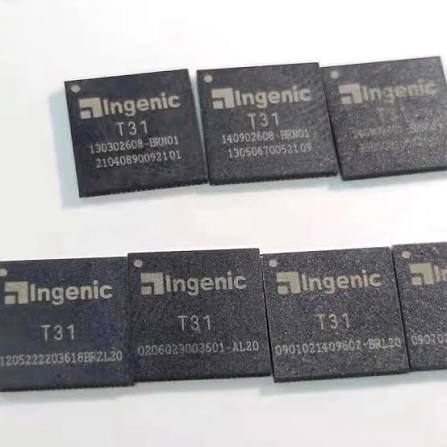
Anchored by IP-Cam SoCs alongside embedded MPUs and AI-MCUs, targeting AIoT, security surveillance, barcode recognition, display control, and printing applications. The company is migrating its core-IP center of gravity from proprietary XBurst to RISC-V to sustain compute competitiveness.
The core revenue engine, secured via the 2019–2020 acquisition of ISSI (formerly Nasdaq-listed). Product breadth spans synchronous/asynchronous and high-speed QDR SRAM, industrial- and automotive-grade niche DRAM, NOR/NAND Flash, and eMMC/UFS — the single largest contributor to group revenue.
A broad automotive LED lighting-driver lineup (headlamps, DRLs, turn signals) alongside LIN, CAN, GreenPHY, and G.vn in-vehicle and inter-vehicle networking chips — high-reliability analog solutions purpose-built for automotive, industrial, and appliance customers.
3D DRAM / AI-MCU Pipeline: The company is developing next-generation 3D DRAM and AI-MCU products, backed by RMB 2.10 billion of cumulative R&D spend across FY2023–2025. These product lines remain pre-commercial, however, and the timing and magnitude of any eventual revenue contribution carry meaningful uncertainty — a “spend now, monetize later” profile that requires continued verification rather than being underwritten at face value.
Automotive-Grade Reliability Standards: Automotive and industrial chips are held to materially stricter qualification standards than consumer parts. Temperature tolerance ranges from 0–70°C for consumer-grade to -40–85°C for industrial-grade and -40–125°C for automotive-grade; useful life extends from 1–3 years in consumer applications to 7–15+ years in industrial and automotive contexts. Ingenic’s sustained focus on this high-reliability segment has produced cumulative automotive-grade chip shipments exceeding one billion units.
Ingenic’s capital-formation arc breaks into four phases: (i) the 2011 ChiNext IPO that provided early growth capital; (ii) the 2019–2020 ISSI acquisition that reshaped the business mix; (iii) a 2021 private placement that brought in a strategic, related-party investor; and (iv) the August 2026 Hong Kong H-share listing that extends the company’s reach into global capital markets. Notably, the Hong Kong listing was not a liquidity-driven raise — as of Q1 2026, the company carried total assets of RMB 13.83 billion against a debt-to-asset ratio of just 7.74%, with cash and equivalents exceeding RMB 3.4 billion. This was, in balance-sheet terms, a strategic access raise rather than a funding necessity.
Founded with a five-shareholder cap table: Liu Qiang (44%), Li Jie (14%), Zhang Jin (14%), Xian Yonghui (14%), and independent third party Liu Jun (14%). Backed by prominent domestic venture capital, the company set out to develop and industrialize proprietary embedded CPU technology in China.
Three years after completing its joint-stock restructuring, the company issued 20 million A-shares on Shenzhen’s ChiNext board, raising RMB 876 million gross (including RMB 499 million of over-allotment proceeds), or RMB 826 million net. It was only the second domestic embedded-CPU design house to list on ChiNext — a foundational entry into China’s public capital markets.
Following conditional approval from the China Securities Regulatory Commission (CSRC) in November 2019, Ingenic — through subsidiary Hefei Ingenic — acquired 100% of Beijing Xicheng via a combination of share issuance and cash, for total consideration of RMB 7.2 billion, closing the transaction in May 2020. Beijing Xicheng was the vehicle behind the December 2015 take-private of Nasdaq-listed ISSI by a China-based consortium led by Uphill Investment, for approximately US$783 million (roughly RMB 5.37 billion equivalent at the time). The deal, priced at roughly 29.4x trailing earnings — below the multiple implied at the original take-private — brought DRAM, SRAM, Flash, and analog product lines into Ingenic’s portfolio, completing a “processor plus memory” combined platform and establishing a beachhead in automotive and industrial end markets.
Completed a targeted private placement to investors including Shaoxing Weihao (controlled by non-executive director Yu Renrong), raising RMB 1.281 billion net, deployed toward R&D across “smart video chips + automotive chips + smart IoT chips.” The related-party nature of the lead investor is a governance data point worth flagging for counterparty due diligence.
Offering structure: Issued 31.29 million H-shares at a maximum offer price of HK$102.80, raising up to HK$3.22 billion (approximately US$410 million; Freshfields’ deal announcement cited a net figure of US$401 million) with Guotai Junan International as sole sponsor. Eleven cornerstone investors anchored roughly US$191.7 million — about half the deal size — including Emerald Prime, GF Fund Management, Perseverance Asset Management, Shanghai Gao Yi, Huatai Capital Investment, Singapore Huajin, ICBC Wealth Management, Huitianfu (Hong Kong), and Singularity Asset.
Use of proceeds: 50% for technology innovation and product development across memory, compute, and analog lines; 25% for strategic investment and M&A; 15% for sales-network expansion and marketing; the remainder for working capital and general corporate purposes.
Demand versus debut: The Hong Kong public tranche drew margin-financed subscriptions of roughly HK$23.83 billion against a HK$320 million retail allocation — a 73.1x oversubscription — yet the stock’s actual trading debut on August 25, 2026 closed roughly flat to modestly lower (approximately -0.3% to -1%, settling near HK$99.5–99.75), a pattern press coverage characterized as a “muted debut.” The gap between blowout retail demand and lukewarm institutional follow-through is itself a data point worth weighing. Separately, the H-share offer price implied a valuation of roughly 62.6% of theoretical parity versus the A-share close (RMB 143.62, or HK$167.15 equivalent, on August 14) — a sizable A-H discount by the standards of typical dual-listing structures.
Ingenic’s defensibility rests on entrenched share positions built over a long operating history in niche memory segments, the high qualification and switching barriers characteristic of automotive semiconductors, an integrated “processor + memory + analog” platform, and the funding flexibility afforded by its A+H dual-listing structure.
Per Frost & Sullivan (FY2025 revenue basis), Ingenic ranks #2 globally in SRAM (23.9% share, #1 in China), #7 globally in niche DRAM (#2 in China), and #7 globally in NOR Flash (#3 in China). In the automotive-grade sub-segment specifically, all three core product lines rank in the global top five — #1 in automotive SRAM (~60% share), #5 in automotive niche DRAM, and #4 in automotive NOR Flash — giving the company structural share leadership in the high-reliability, lower-volume niches that larger memory majors tend to underserve.
Automotive and industrial semiconductors require multi-year qualification cycles and must withstand temperature extremes of -40°C to 125°C over product lifespans of 7–15+ years. Once a supplier clears Tier 1 or OEM design-in, displacement is rare given the cost and risk of requalification. Cumulative shipments exceeding one billion automotive-grade units represent a track record that new entrants cannot readily replicate on a short time horizon.
The 2019–2020 ISSI acquisition transformed Ingenic from a processor-centric business into a diversified platform spanning memory and analog. Customers can source compute, storage, power/lighting, and communication solutions from a single vendor rather than qualifying multiple suppliers — a meaningful integration-cost advantage that is particularly valuable to automotive Tier 1 customers navigating rigorous component-validation processes.
The 2026 Hong Kong secondary listing granted simultaneous access to onshore (A-share) and offshore (H-share) capital markets, executed from a position of financial strength — a debt-to-asset ratio near 7.7% and ample cash reserves. This broadens the company’s options for financing future overseas strategic investment and M&A while expanding exposure to global institutional investors, a potential catalyst for valuation re-rating over time.
Next Leg of Growth — RISC-V Transition and the 3D DRAM / AI-MCU Pipeline: Ingenic is shifting its compute-chip core-IP strategy from proprietary XBurst toward RISC-V while developing next-generation 3D DRAM and AI-MCU products. These lines remain pre-commercial, however, and the pace at which R&D spend converts into revenue will be the key swing factor for any re-rating thesis.
From an institutional standpoint, the following structural risk factors must be weighed before any valuation or position-sizing conclusion is drawn on the Ingenic thesis.
FY2024 revenue of RMB 4.213 billion (-7.03% YoY) and net income of RMB 366 million (-31.84% YoY) reflect ongoing earnings pressure; some third-party research cites a cumulative FY2023–2025 net-income decline of roughly 29.4% and gross margin compression to as low as 32.8%. Conviction that the semiconductor down-cycle has fully bottomed remains, at best, unproven.
Inventory turnover of roughly 323 days elevates the risk of inventory write-downs should demand recovery lag production ramp. Production volume and inventory levels rose 58.99% and 42.53% YoY, respectively, in FY2024 — a buildup that magnifies the downside if demand-timing assumptions prove overly optimistic.
The top five customers account for more than 50% of revenue, creating meaningful earnings sensitivity to any single customer’s order pattern. As a fabless operator dependent on third-party foundries and OSAT partners, the top five suppliers represented 45.1% of FY2025 procurement — exposing the company to capacity-allocation constraints and supply-continuity risk.
New-share issuance for the ISSI acquisition diluted co-controlling shareholders Liu Qiang and Li Jie from a combined 32.75% stake to just 13.68% as of June 2025, with the state-backed Yitang Shengxin investment fund now the second-largest shareholder. Li Jie has pledged 30.56% of his remaining holding to a financial institution — a forced-liquidation risk in a sharp share-price decline that adds a layer of governance uncertainty.
Despite RMB 2.101 billion of cumulative R&D across FY2023–2025, new products including 3D DRAM and AI-MCU remain in development, leaving limited visibility on the timing and scale of any eventual revenue contribution relative to the capital already deployed.
Beyond the structural cyclicality inherent to the semiconductor industry, the company is exposed to US-China technology friction, export-control risk, and broader supply-chain realignment. Separately, the H-share offer priced at roughly 62.6% of theoretical A-share parity, and the stock’s flat-to-weak trading debut despite 73.1x retail oversubscription, together point to a gap between strong retail appetite and more cautious institutional positioning — and to a market applying a conservative valuation lens at the outset.
Data Integrity Note: Financial and market-share figures in this report were cross-referenced against company disclosures (annual reports, A/H listing filings), Frost & Sullivan research, and press coverage (SCMP, The Standard, Freshfields, MarketScreener, among others). Certain real-time IPO data points — including the first-day closing price — are subject to revision over time, and metrics such as the H-share-to-theoretical-value ratio are sensitive to the FX rate and A-share price prevailing at the time of calculation; readers should confirm against the most current disclosures.