
Emerald AI
Grid-orchestration software that turns AI data centers into flexible power assets — Nvidia’s bet on the industry’s binding constraint: electricity
Emerald AI is a grid-flexible data-center software company founded in 2024 and headquartered in Washington, D.C., emerging from stealth in July 2025. The company’s thesis is that AI data-center power draw can be dynamically shaped to grid conditions in real time, unlocking capacity on the existing electricity system rather than waiting on new generation and transmission buildout.
A physicist and energy-policy operator with an unusually deep pre-founder résumé for an early-stage CEO. Sivaram holds a BS in engineering physics and a BA in international relations from Stanford (Phi Beta Kappa, Truman Scholar) and a DPhil in condensed matter physics from Oxford, where he was a Rhodes Scholar researching perovskite solar cells. He served as Chief Strategy and Innovation Officer at Ørsted A/S, the Fortune Global 500 offshore-wind leader, running a roughly 180-to-200-person organization spanning corporate strategy, capital allocation, technology innovation, and M&A, and previously held the CTO seat at ReNew Power (NASDAQ: RNW), India’s largest clean-energy company. On the policy side, he served as Managing Director for Clean Energy at the U.S. State Department under climate envoy John Kerry, where he stood up the multilateral First Movers Coalition. He is the author of three books, including the bestseller Taming the Sun — named by the Financial Times among the best books of the decade — and is a senior fellow for energy at the Council on Foreign Relations. The founding insight traces to his time at Ørsted, where he watched AI-driven power demand outrun the buildout pace of new generation capacity: convinced that “we couldn’t build our way out of this” and that the industry needed intelligent demand rather than more supply, he launched Emerald AI in 2024.
A Boston University professor who leads Emerald’s core algorithmic research. A peer-reviewed paper published in March 2026 under her authorship quantified 18–55% power-flexibility headroom across representative AI workload types — training, inference, and fine-tuning — providing an academic backstop to the company’s performance claims.
Some outlets refer to Sivaram as “co-founder and CEO,” implying additional founding members, but no other named co-founder or equity structure could be confirmed in publicly available sources as of this writing. To be updated upon confirmation.
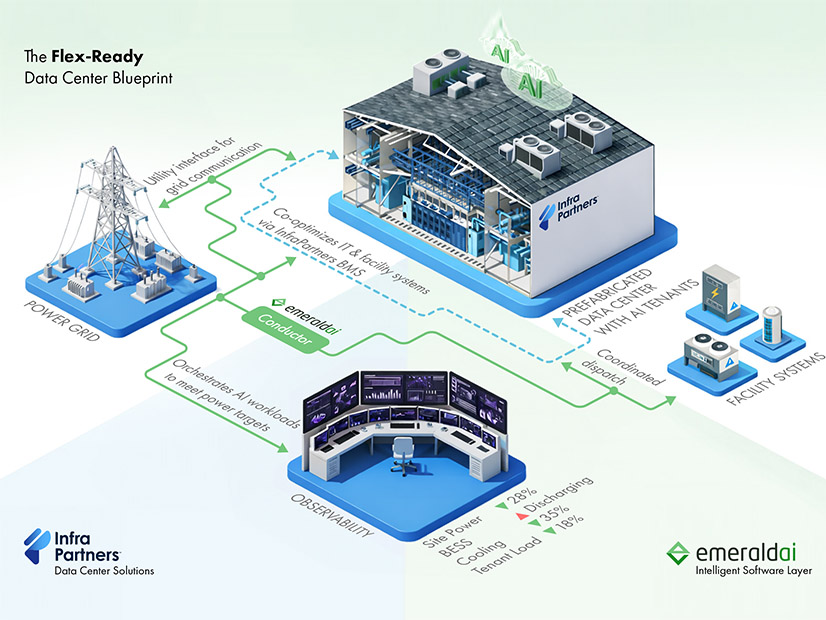
Emerald AI is a pure software company — it does not sell hardware. Its flagship product, the Emerald Conductor platform, orchestrates AI workloads across a data-center fleet in response to grid signals, built as a closed-loop system pairing an autonomous agent with a digital-twin simulator. Sivaram describes it as “an AI for AI.” Commercial revenue has not been publicly disclosed, and the company reads as being in transition from field-validation to commercial-deployment scale rather than fully scaled today.
Deploys three levers to shape power draw dynamically: temporal shifting (delaying workloads that tolerate latency), geographic shifting (rerouting less latency-sensitive workloads to other sites), and on-site resource coordination (batteries, backup generation). The platform ingests grid-operator signals and forecasts to cut load precisely on demand, or monetizes flexibility via frequency-regulation and load-shifting incentives when conditions allow.
A commercialization program designed to compress typical five-to-ten-year interconnection queues by leveraging regulatory tracks in which a load pays for full capacity upfront but agrees to curtailment in operations. Active engagement with ERCOT (Texas) and PJM aims to secure earlier grid access without waiting on generation buildout to complete.
Embeds Emerald’s software into Nvidia’s new DSX OS data-center reference architecture, beginning with a Silicon Valley Power (Santa Clara) pilot as the collaboration moves from demonstration toward commercial-scale “grid-responsive AI factory” deployment. Nvidia’s 96MW AI factory in Manassas, Virginia — a joint effort with Digital Realty, EPRI, and PJM Interconnection — is the named target site for what would be the world’s first commercial-scale power-flexible AI factory.
Phoenix, Arizona field trial: A joint demonstration with Oracle, Nvidia, the Electric Power Research Institute (EPRI), and utility Salt River Project showed a 25% reduction in AI workload power consumption sustained over three hours during a grid-stress event, while holding compute performance (SLA) constant. The result was peer-reviewed and published in a leading scientific journal, lending independent technical credibility to the claim.
Commercial traction: Emerald advises the ERCOT Large Flexible Load Task Force on policy design and has run cross-region inference workload-shifting demonstrations within PJM alongside National Grid, EPRI, and Nebius/Nvidia. At COMPUTEX Taiwan in June 2026, the company formalized a commercial pilot with Silicon Valley Power alongside Nvidia’s DSX OS launch. That said, the pace and scale at which these pilots and demonstrations convert into recurring commercial revenue has not been disclosed to the market with any precision — the key overhang for anyone underwriting the growth story today.
Emerald AI has raised across three rounds in the sixteen months since its July 2025 seed launch, totaling $68M on the company’s own disclosure — third-party databases put the figure marginally lower, in the $66.5M–$67.5M range. Investor composition has shifted materially round over round: early rounds were anchored by marquee individual backers from the climate-tech and AI world, while the most recent round pulled in a materially heavier weighting of power-and-energy strategics and hyperscaler-ecosystem participants. No official valuation has been disclosed; a ~$250M post-money figure surfaced in February 2026 sourcing was attributed to unnamed sources, with the company and lead investor both declining to comment — worth flagging as unconfirmed rather than treating as fact.
Radical Ventures led the company’s first institutional round, with Nvidia and AMPLO participating. The individual-backer list — John Kerry (former U.S. climate envoy), John Doerr (Kleiner Perkins chair), Jeff Dean (Google chief scientist), and Fei-Fei Li — reads more like a policy-and-AI-elite endorsement roster than a typical seed cap table, an unusually deep trust network for a company this early.
Existing lead Radical Ventures was joined by climate-tech specialist Lowercarbon Capital to co-lead an extension round. The timing — following the Phoenix field-trial results — suggests the raise was earmarked to fund the transition from early validation toward commercial readiness.
Round characteristics: Energy Impact Partners (EIP), a growth fund capitalized by a consortium of electric utilities, led via its Frontier Fund (lead partner Shayle Kann); the round was formally announced March 31, 2026. The investor base skews unusually industrial for a growth-stage software round: Nvidia’s NVentures, Eaton, GE Vernova, Siemens, and Samsung Ventures — power and industrial-equipment manufacturers — joined alongside Salesforce Ventures, In-Q-Tel (IQT, the CIA and U.S. intelligence community’s venture arm), and returning backers Amplo, Lowercarbon, and Radical Ventures.
Use of proceeds: ① relieve interconnection bottlenecks across the roughly 50GW U.S. data-center pipeline currently under development, ② stand up the Manassas, Virginia 96MW AI factory — a joint effort with Nvidia, Digital Realty, EPRI, and PJM Interconnection — as the world’s first commercial-scale power-flexible deployment, ③ deepen utility and industrial partnerships through the newly formed Fortune 500 Strategic Advisory Board.
Valuation note: Axios reported a sourced post-money valuation of roughly $250M, but both the company and EIP declined to confirm the figure officially — from an analyst standpoint this should be treated as unconfirmed rather than a hard mark.
Emerald’s defensibility rests on four pillars: an asset-light, software-only model; embedded status within Nvidia’s reference architecture; the founder’s outsized access to policy and utility networks; and peer-reviewed field validation. These are relative advantages versus hardware- and battery-based competitors rather than a durable moat in the absolute sense — the company’s operating history is simply too short to make that claim with confidence.
Owning no proprietary hardware or battery assets, Emerald can in principle deploy on top of existing data-center infrastructure faster than capital-intensive demand-response operators that must build out their own battery or generation fleets. Lower capital intensity and faster time-to-deployment is the company’s core differentiation claim versus hardware-anchored competitors.
Integration into Nvidia’s new DSX OS data-center reference architecture positions Emerald to become a default software layer if Nvidia succeeds in standardizing next-generation “AI factory” design. This is a genuine structural advantage — but it is also a dependency on the durability of a single strategic relationship, addressed under Risk Factors below.
Sivaram’s C-suite tenures at Ørsted and ReNew Power, plus his State Department role as Managing Director for Clean Energy, confer utility and regulator access that is atypical for an early-stage startup. Emerald’s advisory seat on the ERCOT Large Flexible Load Task Force and live field collaborations with PJM and National Grid corroborate this claim, and access speed matters disproportionately in a heavily regulated power sector where deployment timelines hinge on institutional trust as much as technology.
The Phoenix field trial’s 25% load-reduction result (with Oracle, Nvidia, EPRI, and Salt River Project) cleared peer review and was published in a leading journal; a separate paper quantified 18–55% flexibility headroom across workload types. Performance claims grounded in independently verifiable data — rather than marketing assertion — should carry disproportionate weight in utility and hyperscaler sales cycles where trust is the binding constraint.
The cap table doubles as a go-to-market channel — Fortune 500 Strategic Advisory Board: With Eaton, GE Vernova, Siemens, Samsung Ventures, and Salesforce Ventures all serving simultaneously as strategic investors and potential channel partners or customers, Emerald has effectively raised capital and secured a large-enterprise distribution network in the same transaction — a rare combination for a company at this stage. The flip side is worth stating plainly: this is the same investor-customer circularity that shows up as a risk factor below, and the two should be read together, not separately.
Notwithstanding a strong investor roster and credible field validation, Emerald AI remains a sub-two-year-old company, and structural risks warrant explicit underwriting alongside the growth narrative.
Against $68M in cumulative capital raised, no recurring commercial revenue figure has been disclosed. The flagship 96MW Manassas AI-factory deployment remains a stated target rather than an operating asset, and the timing and magnitude of pilot-to-contract conversion remain genuinely unclear from public information.
Nvidia has participated in all three funding rounds while simultaneously serving as Emerald’s core technology and commercial partner. This investor-is-also-largest-partner structure — a recurring pattern across AI infrastructure names broadly — concentrates risk: any deterioration in the Nvidia relationship would pressure the business model on multiple fronts at once, not just one.
Emerald’s monetization path depends heavily on how regional power markets (ERCOT, PJM, and other RTOs/ISOs) structure demand-response and capacity mechanisms. Changes or delays in FERC Order 2222 implementation, PJM capacity-auction outcomes, or ERCOT’s large-load interconnection framework could push out the company’s revenue-realization timeline regardless of technical performance.
2026 has brought rising, genuinely bipartisan community and political opposition to new data-center construction — New York’s moratorium under Governor Hochul and construction curbs announced by Texas Governor Abbott among the most visible examples. This is a top-down risk to Emerald’s growth premise, which depends on a large ongoing pipeline of new data-center capacity. Emerald’s technology could plausibly be positioned as part of the political fix — easing grid strain is precisely the backlash’s core grievance — but the company carries dual exposure either way: a shrinking pipeline shrinks the addressable base for flexibility sales regardless of how favorably Emerald’s own narrative is received.
The ~$250M post-money mark from the latest round rests on sourced reporting that neither the company nor its lead investor confirmed. Cumulative funding also shows a modest discrepancy between the company’s own disclosure ($68M) and third-party databases ($66.5M–$67.5M), which limits the precision available for comparable-based valuation benchmarking.
Established demand-response aggregators such as Voltus are already entering the data-center vertical through offerings like “Bring Your Own Capacity,” and bring existing multi-market track records across PJM, ERCOT, CAISO, and NYISO. Whether Emerald’s software-only, Nvidia-integrated positioning constitutes a durable edge or a first-mover advantage that fast followers can replicate is a question the next 12–24 months of contract-conversion data, not current narrative, will need to answer.
- Co-founder structure: some outlets label Sivaram “co-founder,” implying additional founding members, but no other named co-founder could be verified in public sources as of this writing and is therefore omitted rather than assumed.
- Cumulative funding: the company’s own disclosure ($68M, as of March 2026) differs modestly from third-party databases — Tracxn ($66.5M) and Startup Intros ($74.7M, on a differing round count). This report defaults to the company’s official figure while flagging the discrepancy.
- Post-money valuation (~$250M): sourced exclusively from Axios reporting attributed to unnamed sources; neither the company nor its investors have confirmed this figure, and it should be treated as unconfirmed.
- Headcount: sources diverge between an 11–50 range (standard startup-database bucketing) and a specific 39-employee snapshot as of May 2026; both are presented as a range rather than a single figure.