
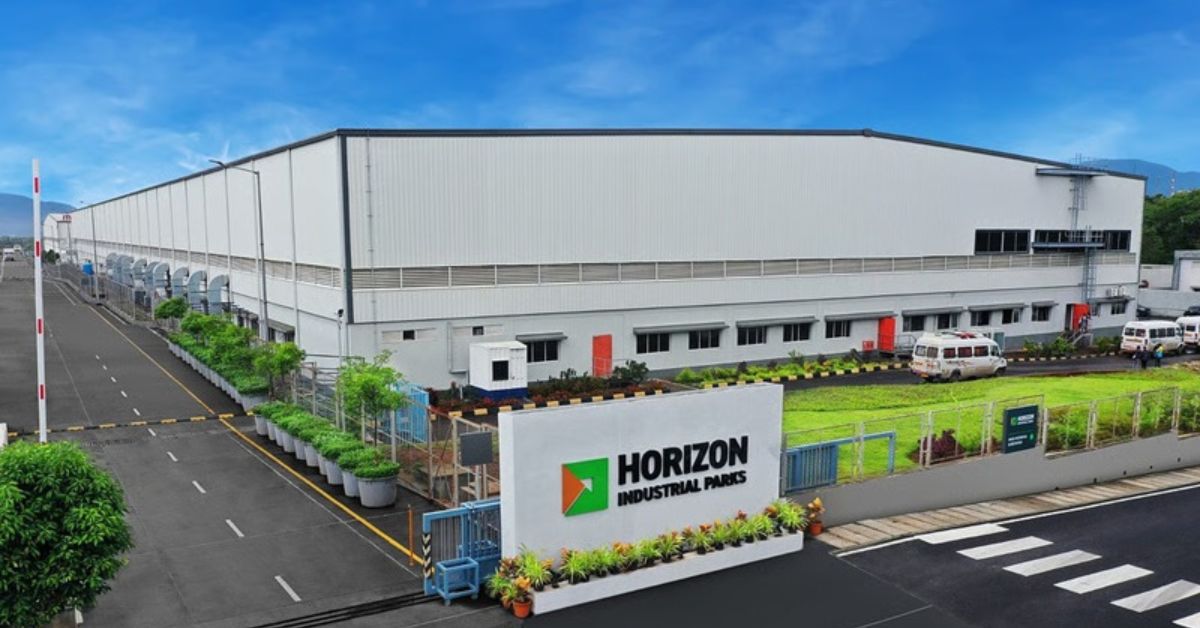
Horizon Industrial Parks
Blackstone-sponsored roll-up of Grade-A industrial and logistics infrastructure across India, taken public via a debt-paydown-oriented IPO in August 2026
Horizon Industrial Parks Limited (“Horizon” or “the Company”) is not a founder-led venture in the conventional sense — it is a sponsor-built infrastructure platform, conceived and capitalized from the outset by global alternative asset manager Blackstone Inc. That distinction is material to how we underwrite governance and capital allocation. The legal entity was incorporated on September 22, 2009 in Bengaluru, Karnataka as ‘JEM Cements Private Limited,’ and was renamed ‘Embassy-Maini Logistics Bangalore Private Limited’ in November 2011 following a joint venture between the Embassy Group and the Maini Group. Blackstone Real Estate funds subsequently acquired and consolidated equity control, re-platforming the business under the ‘Horizon Industrial Parks’ brand around 2022 as a pan-India roll-up vehicle. The company converted to a public limited company and adopted its current name following shareholder approval on June 30, 2025 and a certificate of incorporation issued July 28, 2025.
The Company’s promoters are not individuals but three Blackstone-affiliated investment vehicles — BREP Asia II EIP Holding (NQ) Pte. Ltd., BREP Asia II Indian Holdings Co. VI (NQ) Pte. Ltd., and BREP Asia III India Holdings Co. III Pte. Ltd. — which together held 88.74% of pre-issue equity. Logistics and industrial real estate rank among Blackstone’s highest-conviction Asia themes, and the firm has scaled Horizon into what is characterized as India’s largest logistics portfolio by network. Post-listing, the promoter group retains an overwhelming supermajority, meaning governance and capital-allocation discipline remain effectively unchanged by the public listing — a structural feature investors should price accordingly, both for the referral-network upside it confers and for the counterparty concentration it implies.
Appointed CEO in November 2025. Rambhia joined from Blackstone’s India real estate team, where as Principal he supported investments spanning data centers and logistics and was instrumental in establishing the Horizon platform in 2022. A qualified chartered accountant (ICAI), he represents an investment-operator profile rather than a traditional real estate developer executive — consistent with the platform’s PE-native construction.
Kunal Harun Shah serves as Chief Financial Officer, overseeing leverage management and deployment of IPO proceeds, while Shraddha Poddar serves as Company Secretary and Compliance Officer handling listed-entity governance obligations. The board includes independent directors Sangeeta Singh and Michael David Holland, alongside non-executive directors Alok Kumar Jain and Anshu Prakash.
Per a JLL report cited in the offering documents, Horizon is India’s largest developer, owner and operator of industrial and logistics infrastructure by total network. The portfolio spans 45 assets totaling 58.58 msf across 10 key Indian cities — Delhi-NCR, Chennai, Bengaluru and Pune chief among them — organized into three asset categories: Fulfilment Centres, Industrial Facilities, and In-City Centres. The underlying business model is a capital-intensive, lease-driven one: acquire and develop large contiguous land parcels, then monetize through long-tenor leases to enterprise occupiers. As of May 31, 2026, committed occupancy across the 28.55 msf Operational Network stood at 93.56%.
Large-format bulk warehousing serving e-commerce, third-party logistics, FMCG and retail occupiers. At 15.55 msf, this is the platform’s largest asset category and its most direct beneficiary of India’s e-commerce and quick-commerce expansion.
Assembly, light engineering and manufacturing space supporting renewable energy, EVs, auto-ancillary, electronics, aerospace and specialty chemicals tenants. At 10.36 msf, this category is the platform’s most direct exposure to India’s manufacturing and PLI-linked industrial policy.
17 centres totaling 6.91 msf supporting dark stores, micro-fulfilment, cold storage, retail and R&D uses, providing proximate last-mile access to more than 20 million urban consumers.
Financial Performance (Restated Consolidated, FY24 → FY26): Revenue from operations scaled from ₹228.86cr to ₹390.29cr to ₹691.38cr — a roughly 74% two-year CAGR — while EBITDA rose from ₹151.51cr to ₹339.12cr to ₹607.80cr, with margin expanding from 61.71% to 79.16%. Net loss, however, widened every year: ₹162.21cr, ₹178.78cr and ₹203.65cr respectively, as depreciation and a rapidly growing interest burden (finance costs alone approximated 70% of total income in FY26) more than offset operating leverage gains. This is the textbook signature of a debt-funded, asset-heavy infrastructure roll-up: strong unit economics at the EBITDA line, structurally disconnected from GAAP profitability while the balance sheet is still scaling.
Revenue Diversification: Rental income accounted for roughly 84% of FY26 total income, the platform’s core recurring revenue engine. Ancillary offerings include turnkey fit-out construction for large occupiers, rooftop solar generation, on-site staff accommodation, and cold storage. A 115-key hotel is under development at the Dobbaspet park in Bengaluru, and management has signaled intent to extend into adjacent verticals such as airport logistics and cold-chain infrastructure.
Horizon’s capital history does not follow a conventional venture funding arc; instead it traces a sponsor-to-public exit path — Blackstone’s equity build-out of the platform, a late-stage pre-IPO round, and a fully primary IPO in August 2026 explicitly structured for balance-sheet deleveraging rather than promoter monetization. The absence of any offer-for-sale component is the defining structural feature of this listing: essentially the entire proceeds mandate is repayment of company- and subsidiary-level borrowings.
Incorporated in Bengaluru in 2009 as ‘JEM Cements Private Limited,’ renamed ‘Embassy-Maini Logistics Bangalore Private Limited’ in 2011 following an Embassy Group–Maini Group joint venture. Blackstone Real Estate funds progressively acquired control and re-platformed the business under the ‘Horizon Industrial Parks’ brand around 2022, by which point the network had scaled to 42 parks and roughly 54 msf.
Ahead of listing, Horizon completed a pre-IPO round with participation from 360 ONE, SBI Life Insurance, State Bank of India, prominent individual investor Radhakishan Damani, EAAA and DSP Investments. The round provided a domestic institutional valuation reference point ahead of the public offering, and several of the same investor names resurfaced in the subsequent anchor book.
Horizon filed its draft red herring prospectus with India’s Securities and Exchange Board. Roughly ₹2,250cr of proceeds were earmarked for repayment/prepayment of borrowings across the company and named subsidiaries — including Bagur Logistics Park, Embassy Industrial Park Hosur, and Farukhnagar Logistics Parks — with the balance allocated to general corporate purposes.
On August 14, 2026, Horizon allotted 19.46 crore shares (₹1,167.75cr) to anchor investors at the top of the band (₹60). The public subscription window ran August 17–19 and closed at a comparatively soft 1.45–1.52x overall coverage. The issue priced at the upper end, ₹60 per share. Half of anchor holdings unlock on September 18, 2026 and the remainder on November 17, 2026 — a supply overhang worth tracking.
Horizon listed at a modest premium on NSE and a modest discount on BSE, broadly in line with a thin grey-market premium heading into debut — a “muted” listing by most sell-side characterizations. The stock traded down as much as 3.1% intraday, touching ₹58.38. Resulting market capitalization is estimated in the ₹16,600–17,300cr range, and the implied P/B of 5.76x represents roughly a 150% premium to the peer median of 2.30x.
Horizon’s competitive moat rests on scale leadership in India’s industrial and logistics network, the capital access and tenant-referral network conferred by its Blackstone sponsorship, a high-margin asset-light leasing model, and a substantial pre-secured development pipeline. These strengths should be weighed alongside the balance-sheet and concentration risks detailed in Section 05.
The #1 ranking by total network size (45 assets, 58.58 msf per JLL) confers scale economics and supplier negotiating leverage. Blackstone contributes a global tenant-sourcing network, lower borrowing spreads, and disciplined capital allocation — advantages that would be difficult for a standalone local developer to replicate on a comparable timeline.
No single tenant among 118 enterprise occupiers exceeds 10% of gross rentals, and 54.05% of committed space is leased to Fortune 500 companies. Committed occupancy of 93.56% as of May 2026 evidences solid demand absorption in the Grade-A industrial leasing market.
FY26 EBITDA margin of 79.16% (up sharply from 61.71% in FY24) reflects the operating leverage inherent in the leasing-driven model. With rental income at approximately 84% of total income, this is a recurring cash-flow business that retains further margin upside as fit-out, solar and cold-storage ancillary services scale.
A pre-secured, paid-for pipeline of 30.03 msf provides a credible path to more than double leasable area over time. India’s largest In-City last-mile network (17 centres, 6.91 msf) provides proximity access to more than 20 million urban consumers — a location-based moat that is inherently difficult for competitors to replicate on short notice.
Structural Industry Tailwind: Industry data cited in the RHP indicates India’s combined Grade A and Grade B warehousing stock stood at 548.9 msf as of Q1 CY2026 and is projected to reach 1,237.7 msf by CY2030 — an implied ~18.4% CAGR, with Grade A stock growing faster still at an estimated 25.3% CAGR. Structural demand drivers include e-commerce and quick-commerce penetration, third-party logistics growth, and government infrastructure initiatives such as Dedicated Freight Corridors and production-linked incentive (PLI) schemes.
From a hedge fund underwriting perspective, Horizon presents an asymmetric profile: durable operating fundamentals set against a highly leveraged, capital-intensive balance sheet. The following risk factors are synthesized from DRHP disclosures and post-listing market behavior, and should be weighed jointly with the competitive advantages above rather than in isolation.
Net loss widened every year from FY24 through FY26 — ₹162.21cr, ₹178.78cr and ₹203.65cr respectively — as depreciation and finance costs consistently outpaced operating profit growth. Until this trend inverts, dividend capacity is nil and GAAP-based valuation metrics such as P/E remain uninformative.
Total external borrowings stood at ₹6,884.34cr at FY26 year-end (net debt ₹4,242.22cr), implying a debt-to-equity ratio of roughly 1.18x. Finance costs approximated 70% of total FY26 income. Even after IPO and pre-IPO proceeds are applied to debt paydown, pro forma net debt is estimated to remain around ₹2,100cr, and the bulk of investment properties and lease receivables are pledged as security, constraining financial flexibility.
The top 10 customers contributed between 42.60% (FY26) and 53.97% (FY24) of pro forma revenue, and Delhi-NCR, Chennai, Bengaluru and Pune together accounted for 79.00% of FY26 revenue. A tenant departure or region-specific regulatory or macro shock would carry outsized earnings impact relative to a more geographically diversified peer.
35 of the 45 portfolio assets (approximately 62%) were acquired in just FY25 and FY26, a meaningful share via related-party transfers. Pro forma financial statements are indicative only and may not fully reflect steady-state operating performance; the fairness of related-party transaction terms warrants continued scrutiny.
Of the 30.03 msf development pipeline, 75.96% remains at the “Planned” stage with under 1% construction completion. Combined with the structural scarcity of large contiguous land parcels (typically 50–100 acres) in target markets, this creates meaningful exposure to construction delay and cost overrun — a key swing factor for whether the growth thesis is realized on schedule.
At 5.76x P/B, Horizon trades at roughly a 150% premium to the peer median of 2.30x, while P/E remains uninformative given negative earnings. Subscription coverage of 1.45–1.52x was comparatively soft, and the stock traded down as much as 3.1% intraday on debut. Anchor lock-up expirations in September and November 2026 represent an additional near-term supply risk to monitor.