
Poolside
An enterprise foundation-model coding platform founded by GitHub’s former CTO and a pioneer of AI-on-code — and what Nvidia’s $7B commitment tells us about where it stands
We view Poolside’s founding thesis as unusually coherent for a 2023-vintage AI startup: the company was built by two operators who had already spent their careers at the frontier of AI-on-code, rather than by researchers pivoting into a commercial wrapper after the fact. Poolside was incorporated in San Francisco in April/May 2023 by Jason Warner, the former Chief Technology Officer of GitHub, and Eiso Kant, a repeat developer-tooling founder. The company was originally registered under the name “Snowball” before a trademark conflict with AWS Snowball forced a rebrand. In our assessment, the founding team’s shared conviction — that software development would be the first domain where AI reaches and surpasses human-level capability — has directly shaped both the product roadmap and, as we discuss in Section 3, the capital-raising strategy.
B.S. in Computer Science from Penn State; M.S. from Rensselaer Polytechnic Institute. Led engineering for Ubuntu Desktop at Canonical, then served as VP of Engineering at Heroku (2014–2017), before becoming CTO of GitHub (2017–2021), where he oversaw the incubation of Copilot, GitHub Actions, and Code Search. Spent 2021–2023 as Managing Director at Redpoint Ventures before co-founding Poolside.
Dutch repeat entrepreneur, educated at IE University in Madrid. Founded source{d}, widely credited as the first company applying deep learning to source code, and Athenian, a Paris-based developer-analytics startup. First met Warner in 2017 when Warner attempted to acquire Kant’s company for GitHub’s AI capabilities; the acquisition did not close, but the relationship persisted for six years before crystallizing into Poolside.
We flag that Poolside’s early capitalization was heavily networked: Redpoint Ventures led the $26M seed round through partners Erica Brescia and Jacob Effron, with Brescia joining the board on the strength of her prior working relationship with Warner at GitHub. A subsequent $100M round led by Felicis Ventures, with participation from French entrepreneur Xavier Niel, coincided with a temporary relocation of headquarters to Paris — a decision the company has since partially reversed, maintaining a distributed structure across the U.S. and Europe.
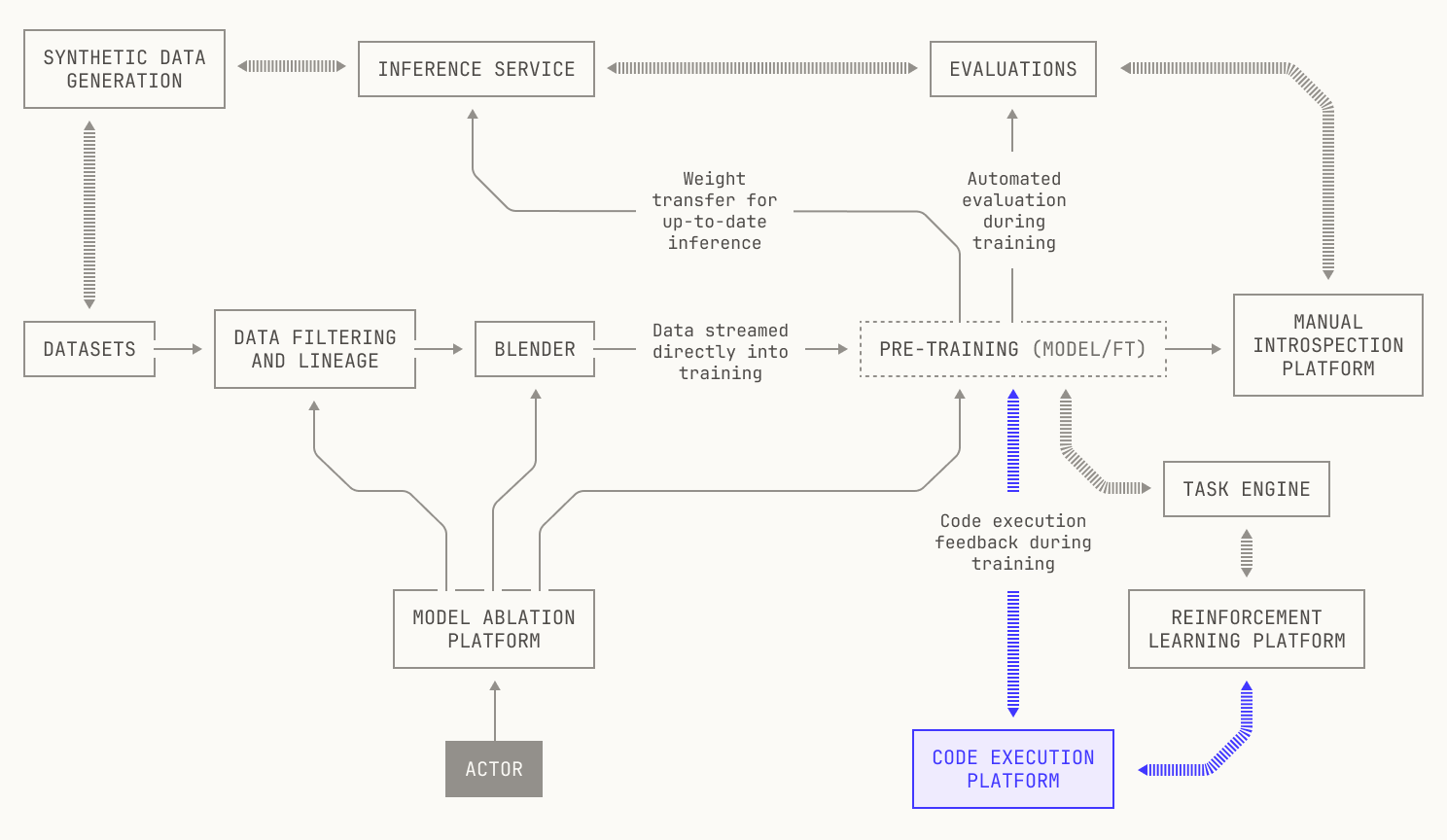
Poolside’s core technical differentiator is a training methodology it calls RLCEF — Reinforcement Learning from Code Execution Feedback. Rather than relying purely on language-model scaling, RLCEF trains on unambiguous execution signals — compilation results, test outcomes, and runtime traces — to improve reliability in code generation, debugging, and refactoring. The internal platform that operationalizes this approach is “Model Factory,” which is, notably, the exact asset at the center of the August 2026 Nvidia transaction discussed in Section 3. The models produced through Model Factory make up Poolside’s Laguna family (XS.2, M.1, S 2.1, among others).
| Asset / Initiative | Category | Status | Notes |
|---|---|---|---|
| Model Factory | Model-training platform | Licensed to Nvidia | Subject of the $6.0B non-exclusive licensing agreement announced August 2026 |
| Laguna XS.2 / M.1 / S 2.1 | Coding-focused foundation models | Shipping | Models for code writing, debugging, and optimization; delivered via enterprise-specific fine-tuning |
| Project Horizon (2GW Texas campus) | Proprietary compute/power infrastructure | Stalled / seeking partner | Announced with CoreWeave in Oct. 2025; the partnership was mutually terminated in April 2026. Poolside is reportedly in talks with alternative partners, including Google |
| PIC (Poolside Infrastructure Company) | Spun-off infrastructure entity | Spun out Jan. 2026 | Initially run by co-founder Kant; operational leadership has since passed to construction executive Robert Bonar |
| Public sector / defense channel | Regulated customer base | Established | In-Q-Tel is a disclosed investor; the U.S. Department of Defense has been reported as a customer |
We estimate Poolside’s cleanly confirmed cumulative equity raise — from the $26M 2023 seed through the $500M October 2024 Series B at a $3B valuation — at roughly $626M. A subsequent Nvidia-led $2B round reported in October 2025 appears, based on the founder’s own later comments, to have never formally closed; it became entangled with the collapse of the Project Horizon infrastructure partnership in April 2026. The August 2026 Nvidia transaction — a $6.0B licensing deal paired with a $1.0B equity investment — re-rates the company to a $12B pre-money valuation, roughly 4x the 2024 mark, though we would stress this re-rating did not occur through an arm’s-length competitive process (see risk callout below).
Led by Redpoint partners Erica Brescia and Jacob Effron — Brescia had previously worked alongside Warner at GitHub. The round closed almost immediately after Warner stepped down from his Managing Director role at Redpoint to found the company, illustrating how founder-network capital can move quickly at inception.
Led by Felicis Ventures with participation from French entrepreneur Xavier Niel. The round coincided with a temporary headquarters move to Paris, a decision the company has framed around access to European AI talent and France’s government-backed AI incentive programs.
Led by Bain Capital Ventures, with participation from DST Global, StepStone Group, Schroders Capital, Premji Invest, and a notably strategic cohort — Nvidia, Citi Ventures, Capital One Ventures, HSBC Ventures, LG Technology Ventures, and eBay Ventures. The round valued Poolside at $3B, its first unicorn mark. We view Nvidia’s participation here as the opening move in what would become a recurring — and ultimately much larger — relationship.
Poolside announced Project Horizon, a 2GW AI campus in West Texas, with CoreWeave committing more than 40,000 Nvidia GB300 NVL72 GPUs as anchor tenant. Around the same time, Bloomberg reported Nvidia could invest up to $1B as part of a $2B round at a $12B valuation. We flag, however, that Warner told Forbes in July 2026 the company had “not raised since 2024” — a statement that casts real doubt on whether this round ever formally closed.
Per Financial Times reporting, the CoreWeave partnership unraveled after Poolside failed to stand up its first GPU cluster within the agreed timeline. CoreWeave, newly flush with an $8.5B loan facility backed by its Meta contract, pivoted to a multi-partner strategy rather than a single fixed-tenant commitment. Separately, the FT reported Poolside had been unable to convince investors it could train models to a level competitive with more established frontier labs. Project Horizon has since been carved out into the standalone PIC entity, which is reportedly in talks with Google and other cloud providers.
Per reporting from Newcomer and The Information, Nvidia agreed to a $6.0B non-exclusive licensing deal for Poolside’s Model Factory platform, alongside a $1.0B equity investment at a $12B pre-money valuation. 109 employees who worked on the Laguna models received job offers from Nvidia. In a letter to investors, the founders stated: “This is not an acquisition and it is not an acquihire.” Nvidia has structured comparable licensing-plus-talent transactions before, including with Groq ($20B) and Enfabrica ($900M).
We would stress that the $12B pre-money mark was set in a transaction where Nvidia — already an existing shareholder — sits on both sides of the deal, as licensee and as new equity investor. Unlike a price discovered through an IPO or a competitive multi-bidder process, this is not an arm’s-length valuation independently tested by multiple buyers, and we think it should be treated with corresponding caution as a proxy for fair market value.
The AI coding tools market has grown to roughly $12.8B in 2026, with GitHub Copilot (4.7 million paid subscribers, 90% Fortune 100 penetration), Cursor ($2B ARR, 1 million-plus paying users), and Claude Code (roughly $2.5B in annualized revenue, capturing 42% of enterprise coding workloads) holding commanding leads on revenue and usage metrics. We would place Poolside not as a direct competitor to this group but alongside Cognition, Reflection AI, and Magic — companies betting capital on long-horizon autonomous agents rather than incremental autocomplete. Within that framing, we see the following differentiators:
Fine-tunes dedicated models on customer codebases without data leaving customer infrastructure — a materially lower adoption barrier in banking and defense than the API-centric models used by Copilot, Cursor, and Claude Code.
Trains on execution feedback — compilation, test results, runtime traces — rather than benchmark scores alone, embedding correctness verification directly into the training loop rather than relying purely on language-model scale.
In-Q-Tel’s participation as an investor, along with reported U.S. Department of Defense customer relationships, represents a commercial-relationship asset that consumer-first competitors would struggle to replicate quickly.
From the 2024 Series B, through the 2025 infrastructure discussions, to the 2026 $7B transaction, Nvidia’s escalating engagement plausibly confers preferential compute access and a degree of trust that peers lack.
Warner’s direct experience incubating Copilot and GitHub Actions as GitHub’s CTO translates into a deep understanding of enterprise developer needs and procurement processes.
A managed deployment option through Amazon Bedrock and Trainium extends market reach to customers unwilling to operate their own training infrastructure.
We would caution, however, that these advantages remain largely unproven in the market: Poolside has never shipped a consumer product, which makes independent benchmarking against Copilot, Cursor, or Claude Code difficult, and the company has not disclosed revenue. In our view, the differentiators above are currently qualitative positioning arguments rather than metrics validated by disclosed market share, and we would weight them accordingly in any investment framework.
Poolside remains a private company. As of the August 2026 Nvidia licensing and equity transaction, we would characterize its risk profile as late-stage venture, with several concerning signals converging at once: undisclosed revenue, a collapsed infrastructure partnership, and the departure of a substantial share of technical staff to its own investor and licensee.
1) Revenue and financial opacity — Warner declined to disclose company revenue in a July 2026 Forbes interview and stated the company had not formally closed a new funding round since 2024, casting doubt on the substance of the October 2025 $2B round reported at the time. 2) Infrastructure execution failure — Project Horizon, the 2GW Texas campus with CoreWeave, collapsed after Poolside failed to stand up its first cluster on schedule, costing the company both its anchor tenant and the financing tied to it. 3) Reported failure to demonstrate competitiveness — the Financial Times reported that Poolside struggled to convince investors it could train models at a level competitive with established frontier labs. 4) Departure of core technical talent — the transfer of 109 employees who built the Laguna models to Nvidia raises real questions about the remaining organization’s model-development capacity. 5) Constrained valuation independence — the $12B mark was set in a transaction where existing shareholder Nvidia sits as counterparty on both the licensing and equity legs. 6) Intensifying competition — Copilot (4.7M paid users), Cursor ($2B ARR), and Claude Code (~$2.5B annualized revenue) have already captured the dominant revenue and usage metrics in the category, while low-cost, open-weight Chinese entrants such as Z.ai’s GLM-5.2-powered ZCode are pressuring the lower end of the market.
On the opportunity side, we would point to: ▲ Nvidia’s escalating and repeated strategic commitment, which plausibly confers durable compute-access and trust advantages; ▲ the $6.0B licensing pool providing existing investors a long-sought liquidity event and stabilizing the company’s balance sheet; ▲ an on-premises, regulated-industry go-to-market that could carve out a defensible niche distinct from consumer-first competitors; and ▲ the PIC spin-out, which isolates infrastructure execution risk from the core model business while the company continues to seek a new compute partner, reportedly including Google.
Our overall read: despite the founders’ insistence that the Nvidia transaction is “not an acquisition and not an acquihire,” we view the combination of a 109-person technical staff transfer with a $6.0B liquidity distribution to investors as functionally closer to a substantial transfer of the Model Factory asset and its associated talent to Nvidia. Poolside the legal entity persists, but in our assessment, whether the remaining organization retains the capability to operate as an independent frontier model developer post-transaction is a question that will require further validation through subsequent disclosures and product roadmap execution — not one we consider resolved by the deal announcement itself.