
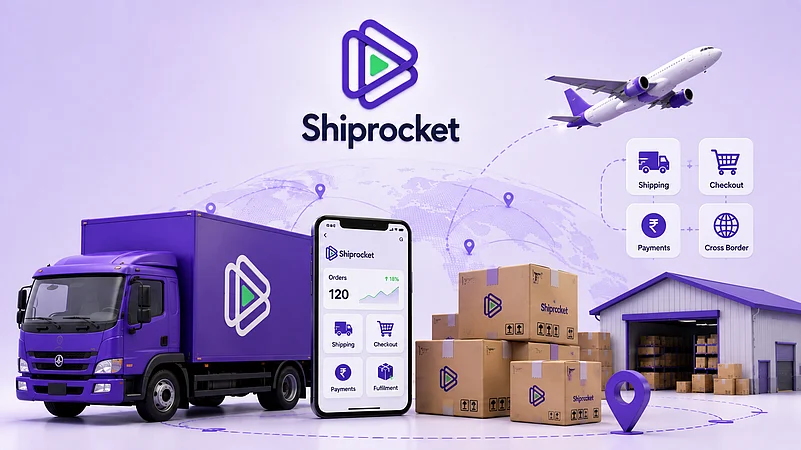
Shiprocket
India’s largest new-age end-to-end e-commerce enablement platform — unifying shipping, fulfillment, and checkout for 250,000+ MSME and D2C merchants
Shiprocket (legal entity: Bigfoot Retail Solutions Pvt. Ltd.) was founded in New Delhi in 2012 by four co-founders — Saahil Goel, Gautam Kapoor, Vishesh Khurana, and Akshay Gulati. We would flag that the company’s origin story contains two distinct strategic pivots that are worth surfacing for diligence purposes. The business began under the name KartRocket, positioned as an India-focused Shopify equivalent offering website-building tools for small merchants. In 2017, the founding team concluded that the true bottleneck constraining Indian e-commerce sellers was not storefront technology but fragmented, unreliable logistics — and executed a full pivot away from the store-builder model into courier aggregation under the Shiprocket brand.
Co-founder and CEO/Managing Director Saahil Goel holds an MBA and MS-MIS from the University of Pittsburgh’s Katz Graduate School of Business, with prior operating experience at eBay and Bain & Company that we believe informed his approach to e-commerce and logistics strategy. Co-founder Gautam Kapoor serves as Chief Operating Officer and has a track record of multiple prior ventures, including Zop and the original KartRocket entity. The board is chaired by Chetan Kumar Mathur. We would also flag Arjun Sethi of Tribe Capital — an early institutional backer — as a long-tenured board participant who, in our read, has provided both capital continuity and access to a broader Silicon Valley network across the company’s growth-stage rounds.
MBA / MS-MIS, University of Pittsburgh (Katz Graduate School of Business). Prior experience at eBay and Bain & Company. Founded Bigfoot Retail Solutions (KartRocket) in 2012 and led the 2017 strategic pivot into logistics aggregation as Shiprocket. Widely referred to internally as the company’s de-facto CPO, given his continued direct oversight of product and growth strategy.
Oversees Shiprocket’s day-to-day operations. Track record includes founding roles at Zop, Mokshabongs, and the original KartRocket venture. Has maintained an operating partnership with Saahil Goel for close to fifteen years, spanning both the store-builder and logistics-aggregator eras of the business.
We would note that Shiprocket’s roughly fourteen-year path from founding to IPO is comparatively long by the standards of India’s new-age technology cohort, with the founding team retaining operating control through listing. The 2026 offer-for-sale (OFS) component includes partial secondary sales by Saahil Goel, Gautam Kapoor, and Vishesh Khurana; in our assessment, this is best characterized as partial founder monetization rather than a full exit, though the magnitude of individual founder stake reductions was not fully disclosed in public reporting at the time of this analysis.
Shiprocket operates an asset-light aggregation model, deliberately forgoing ownership of trucks, aircraft, or last-mile delivery fleets. The platform integrates 17 to 25-plus courier partners — including Delhivery, Blue Dart, XpressBees, Ekart, DTDC, FedEx, and Aramex — behind a single API and dashboard layer, allowing individual merchants to compare rates, generate labels, track shipments, and manage returns without negotiating separate contracts with each carrier. Per Redseer Report data cited in company disclosures, Shiprocket has held the position of India’s largest new-age end-to-end e-commerce enablement platform by revenue in both FY25 and FY26.
| Business Line | Core Offering | Status | Notes |
|---|---|---|---|
| Core Business | Domestic shipping aggregation, carrier routing, COD reconciliation | Revenue anchor | Contributes roughly 80% of revenue. FY24–FY26 revenue CAGR of 24% reflects steady core-business growth |
| Emerging Business | Cross-border shipping, checkout (Fastrr), marketing and ad tools | High growth | Revenue of ~₹326Cr in FY25, up 41% YoY. Select sub-segments growing 70–100% YoY |
| Shiprocket Capital | Working-capital lending referrals for merchants via financing partners | Early stage | Embedded-finance model leveraging platform transaction data for underwriting |
| Shiprocket Omuni | Omnichannel inventory management and fulfillment (built on Arvind Internet acquisition) | Scaling | Integrated online/offline inventory targeting larger enterprise retail accounts |
| AI Strategy | Meaningful share of IPO proceeds earmarked for AI and technology infrastructure | Investment ramp | Positioning shift underway from pure shipping aggregator toward a broader merchant “operating system” |
Revenue model: Shiprocket monetizes through a hybrid structure combining subscription fees (reported in the $24–36/month range per company disclosures we have not independently verified) with per-shipment charges (approximately $0.28 per 500g, again per company-sourced figures). Transaction-based fees from the Emerging Business segment layer on top of this base. In our view, continued mix-shift toward the higher-growth Emerging Business segment is the key structural lever for margin expansion going forward.
Between its first institutional round in 2014 and its final private round in December 2024, Shiprocket completed roughly 13 to 14 funding events, raising a cumulative total that different data sources place between approximately $322M and $357M — we would flag this discrepancy explicitly rather than resolve it, and note that cross-referencing multiple sources points to a figure in the low-to-mid $300M range as the more consistent estimate. The company subsequently raised an incremental ₹885.5Cr (approximately $100M on an illustrative FX basis, 1 USD ≈ 88 INR) in fresh-issue proceeds through its August 19, 2026 listing on the NSE and BSE. We would specifically flag the progression of the investor base as noteworthy: the capitalization table evolved from an India-focused venture base (Bertelsmann India Investments, Tribe Capital) toward a mix of sovereign capital (Temasek), strategic corporate investors (Zomato/now Eternal, PayPal Ventures), and global bank-affiliated venture capital (MUFG Bank) — a progression we would characterize as a gradual broadening of institutional credibility rather than a single inflection event.
Founded in 2012 as Bigfoot Retail Solutions (KartRocket). Bertelsmann India Investments became the first institutional backer in September 2014, anchoring the Series A round. Bertelsmann subsequently maintained its position through to listing, making it the longest-tenured anchor investor on the cap table by our assessment.
Led by Silicon Valley-based Tribe Capital, with participation from Innoven Capital and existing backer Bertelsmann India. At the time, the company was processing roughly 2 million shipments monthly across 35,000 sellers and used the proceeds primarily for international expansion. Tribe Capital partner Arjun Sethi subsequently assumed the board chairmanship, marking the start of a long-tenured governance relationship.
Co-led by Tribe Capital and March Capital. The round enabled partial exits for several earlier backers — including funds advised by Recruit Strategic Partners, Nirvana Venture Advisors, and 500 Startups — at reported returns of 6x to 40x. This growth capital was raised against a backdrop of the company already having achieved profitability in FY19.
Co-led by PayPal Ventures and Bertelsmann India Investments, with participation from Info Edge Ventures, March Capital, and Tribe Capital. Notably, well-known angel participants — Cred founder Kunal Shah and Zomato founder Deepinder Goyal — joined in personal capacity, which we would read as a signal of industry-insider confidence at the time. Proceeds were directed primarily toward Middle East expansion.
Co-led by Zomato (now Eternal), Temasek, and Lightrock India, reportedly Zomato’s first significant strategic investment following its own public listing. Moore Strategic Ventures and 9Unicorns joined as new participants. The round pushed cumulative funding past $280M and lifted the implied valuation to approximately $930M.
Led by Lightrock India, with follow-on participation from nearly the full existing syndicate — Temasek, Bertelsmann India, Moore Strategic Ventures, PayPal, March Capital, and Huddle. Per Fintrackr’s post-money estimate, the round valued the company at approximately $1.23B (roughly ₹10,650Cr), formalizing unicorn status. The round coincided with the company’s acquisition of Pickrr Technologies for approximately $200M in a cash-and-stock transaction.
Led by new investor KdT Ventures, with participation from MUFG Bank, Huddle Collective, Sai Global India, and Tribe Capital. The implied valuation of approximately $1.21B (₹10,195Cr) represented a modest downward adjustment versus the prior round — consistent with a down-round structure. Internal company documentation reviewed by TechCrunch at the time indicated a targeted IPO window of 12 to 18 months.
Book-running lead managers: Axis Capital (lead BRLM), Kotak Mahindra Capital, JM Financial, and BofA Securities India; registrar KFin Technologies. Final price set at the top of the ₹92–97 band. The offer comprised a fresh issue of ₹885.5Cr (9.13Cr shares) and an offer-for-sale of ₹731.98Cr (7.55Cr shares) from selling shareholders including Lightrock, Tribe Capital, Bertelsmann, Arvind Ltd, and founders Saahil Goel, Gautam Kapoor, and Vishesh Khurana. Overall subscription reached 99.38x, with the QIB (qualified institutional buyer) book covering 122.8x. Shares listed at ₹131 on the NSE (+35.05%) and ₹129.50 on the BSE (+33.51%), touching an intraday high of ₹144 (+48.5%). Post-listing market capitalization stood at approximately ₹9,422Cr, up from the ₹7,057.5Cr implied at the issue price.
India’s e-commerce logistics landscape features asset-owning carriers such as Delhivery (listed 2022), Ecom Express (which has itself pursued a DRHP filing), XpressBees, Shadowfax, and Blue Dart, alongside aggregator/enablement platforms such as Shiprocket. In our assessment, Shiprocket’s competitive positioning derives principally from its ability to compound data advantages without carrying the balance-sheet weight of physical asset ownership. We highlight the following factors as the primary structural differentiators.
Capex runs below 1% of revenue by our estimate, avoiding the heavy fixed-cost burden of trucks, warehouses, and delivery personnel while reselling capacity across 17–25 courier partners. Capital intensity is structurally lower than Delhivery’s, supporting a scalability profile closer to that of a SaaS business.
The CORE/RADAR routing engine, trained on roughly 620 million annual transactions, represents an asset a new entrant could not readily replicate on a short timeframe. Learned patterns — which PIN codes see carrier failures, which phone numbers correlate with fraudulent orders — translate directly into RTO (return-to-origin) reduction, a key cost lever in Indian e-commerce logistics.
Per the Redseer Report, Shiprocket has held the position of India’s largest new-age end-to-end e-commerce enablement platform by revenue across both FY25 and FY26. Its base of 250,000 to 400,000-plus active merchants appears, by our reading of available data, to be the largest of its kind in the category.
Roughly 60% of total volume originates outside metro markets, differentiating the platform from the more enterprise- and metro-concentrated Delhivery. Redseer projects Tier 2+ B2C e-commerce volumes will rise to 70–80% of total industry volume by FY2029, a structural tailwind that aligns closely with Shiprocket’s existing geographic strength.
The 2022 acquisition of key rival Pickrr Technologies for approximately ₹1,600Cr in cash and stock structurally reduced price-based competitive pressure in the aggregator segment. The subsequent Omuni (Arvind Internet) acquisition added omnichannel inventory-management capability, extending the platform’s reach into larger enterprise retail accounts.
Emerging Business (cross-border, checkout, marketing) contributed roughly 20% of FY25 revenue while growing 70–100% YoY. Relative to the increasingly commoditized core shipping-fee business, this segment carries structurally higher margin potential — in our view, the pace of mix-shift here is the key determinant of any future valuation re-rating.
What the institutional cap table signals: The sequential entry of a structurally diverse anchor investor base — Temasek (Singaporean sovereign wealth), MUFG Bank (major Japanese banking group), Zomato/Eternal (a listed Indian strategic partner), and PayPal Ventures (a global fintech strategic investor) — has, in our read, involved repeated rounds of financial and governance diligence across the company’s growth-stage history. We would characterize this as a modestly positive qualitative signal, though we would stress it should not be treated as an independent basis for an investment decision.
For fiscal year FY26 (year ended March 2026), Shiprocket reported revenue of ₹2,024.14Cr, consistent with a 24% CAGR across FY24–FY26. Net loss stood at ₹79.25Cr, a modest widening of roughly 6.8% year-over-year on a reported basis — though we would flag that a separately cited adjusted-loss figure of ₹76Cr appears in parallel reporting, a discrepancy we attribute most likely to differing treatment of one-off items such as ESOP charges, and which we have not been able to fully reconcile from public disclosures. Operating cash flow turned positive at ₹52.6Cr in FY26, consistent with the broader trend of adjusted EBITDA losses narrowing from ₹351Cr in FY24 to ₹76Cr in FY26. Return on capital employed (ROCE) stood at -2.65% and return on net worth (RoNW) at -5.20% as of March 31, 2026 — both metrics remain in negative territory, and in our assessment, a full transition to net profitability is likely to require further time.
Among the opportunity factors we would flag are: ▲ continued 70–100% YoY growth in the Emerging Business segment (cross-border, checkout, marketing), with structural margin-expansion potential as mix shifts away from commoditized core shipping; ▲ a current EV/Sales multiple of roughly 3.2x on FY26 revenue, a discount to Delhivery’s 4.0–4.5x range that leaves room for re-rating; ▲ a deliberately conservative IPO pricing strategy, with the offer priced at approximately a 30% discount to the company’s last private-round valuation (~₹10,650Cr versus a ~₹7,057Cr issue-price valuation), preserving potential upside for public-market investors; and ▲ direct exposure to the structural growth of Tier 2–4 e-commerce in India, which Redseer projects to grow at a 35% CAGR.
1) In-house logistics disintermediation risk — Meesho’s proprietary logistics arm, Valmo, reportedly handled approximately 50% of platform orders in Q1 FY27, while FirstCry’s in-house logistics initiative, RocketBees, handled 40% of shipments in Q4 FY26. We view the accelerating in-house logistics build-out by large marketplaces as the single largest structural threat to third-party aggregators such as Shiprocket over the medium term, with direct implications for both market share and revenue base.
2) Continued net losses and capital efficiency — While operating cash flow has turned positive, the company remains loss-making on a net income basis, and both ROCE and RoNW remain negative. Visibility into the timing of a full transition to net profitability remains limited at this stage, in our view.
3) Carrier dependency structure — As an aggregator without owned delivery infrastructure, Shiprocket’s economics are directly exposed to rate and SLA negotiation dynamics with core courier partners such as Delhivery and Blue Dart. Should these partners choose to deepen direct-to-merchant offerings, intermediary margin compression is a plausible outcome.
4) Goodwill impairment exposure — Accumulated goodwill from multiple acquisitions (Pickrr, Omuni, among others) carries impairment risk should underlying performance in those acquired businesses disappoint going forward.
5) Anchor lock-up unlock overhang — Fifty percent of anchor investor allocations unlock on September 16, 2026, with the remaining fifty percent unlocking on November 15, 2026. Investors should be attentive to potential near-term share-price volatility around these dates as anchor holders become free to sell.
6) OFS-heavy deal structure — A substantial portion of the offer was structured as an offer-for-sale (₹885.5Cr fresh issue versus ₹731.98Cr OFS), meaning only a portion of proceeds flow to the company’s own growth initiatives, with the remainder representing partial monetization by existing investors and founders. We would flag this mix as a relevant consideration for investors assessing capital-allocation alignment.