
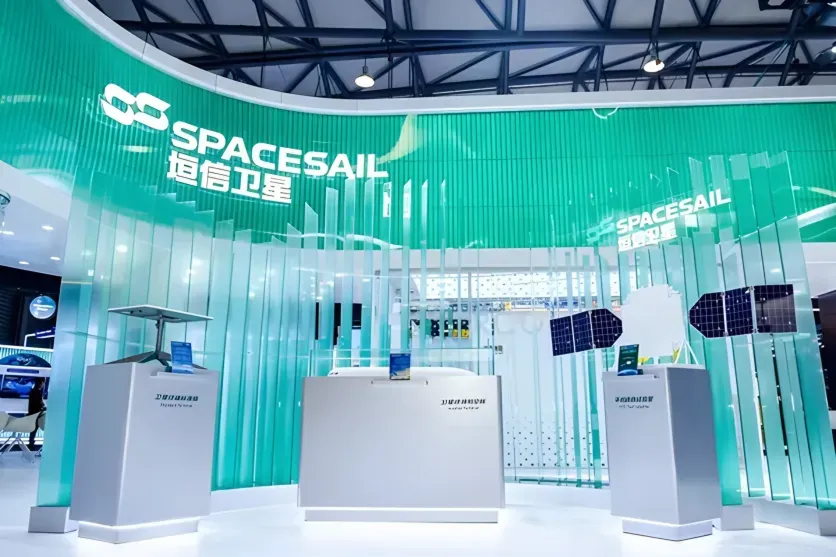
Yuanxin Satellite
Operator of the Qianfan (SpaceSail) constellation — a Shanghai state-capital vehicle structured to preserve sovereign orbital and spectrum rights, not to generate near-term commercial returns
This is not a founder-led venture in any conventional sense. Yuanxin Satellite was conceived, incorporated, and capitalized from inception by Shanghai’s municipal state-asset management apparatus as a sovereign infrastructure project. Accordingly, this section is organized around governance lineage and the bureaucratic/SOE career paths of senior management rather than a founder narrative — a framing that carries through directly into how the fundraising, competitive-position, and risk sections below should be read.
Shanghai Yuanxin Satellite Technology Co., Ltd. (“Yuanxin” or the “Company”) was incorporated on March 19, 2018 in Shanghai’s Songjiang District, with registered capital of RMB 2.138 billion. The Company was founded and is majority-controlled by Shanghai Alliance Investment Ltd. (“Shanghai Alliance”), the flagship state-owned technology investment platform wholly controlled by the Shanghai State-owned Assets Supervision and Administration Commission (Shanghai SASAC). Shanghai Alliance, with roughly RMB 10 billion in registered capital and nearly three decades of operating history, has incubated multiple STAR Market-listed companies, including United Imaging Healthcare and Visionox.
Born 1967, with an engineering background and a career built entirely inside Shanghai’s state-owned enterprise and government system rather than in entrepreneurship. Prior roles include executive director of Shanghai Chemical Plant, vice chairman of Shanghai Pacific Biotech, president and deputy Party secretary of Shanghai Huayi (Group), District Chief of Songjiang District, chairman of Shanghai Information Investment Co., and Party secretary/chairman of Shanghai Alliance Investment. His legal-representative status at Yuanxin derives directly from his concurrent chairmanship of Shanghai Alliance — this is a career administrator rotating through state-asset leadership posts, not an operator who built the company from a founding insight.
Born 1970; a research-track PhD and adjunct professor at the University of Science and Technology of China, Shanghai Jiao Tong University, and Beijing University of Posts and Telecommunications. He spent two decades at the Shanghai Institute of Microsystem and Information Technology (SIMIT), Chinese Academy of Sciences, researching broadband mobile communications, and previously served a postdoctoral term at Nokia’s R&D center in Finland. He chaired Shanghai Hanxun Communication Technology (300762.SZ) from 2010 to 2016 and remains its controlling beneficial shareholder today — a fact with direct bearing on the related-party exposure flagged in the risk section below, since Hanxun is a core communications-payload and ground-station supplier to Yuanxin.
Li Guotong (CTO) previously served as chief commander of the BeiDou-3 satellite system and assistant director of the CAS Innovation Academy for Microsatellites — a career satellite-systems architect. Cai Wenqi (CFO) previously held finance and legal leadership roles at Shanghai Guosheng Real Estate. The board additionally includes a concurrent Shanghai Alliance CTO appointee and a former Shanghai Mobile general manager, giving the board itself a composition drawn almost entirely from state-capital and telecom-regulatory networks rather than industry operators or outside investors.
The constellation’s formal designation is the “Global Multimedia Satellite System,” marketed domestically as Qianfan (千帆, “Thousand Sails”) or the G60 Starlink, and internationally as the SpaceSail Constellation. The project was initiated in 2018, with the first two test satellites launched in November 2019 aboard a Kuaizhou-1A vehicle; formal networked-satellite launches began in August 2024.
Deployment roadmap: Phase 1 targets 1,296 satellites (regional coverage, originally slated for 2027), Phase 2 approximately 10,000 (global coverage, by 2030), and Phase 3 more than 15,000 (integrated communications, remote sensing, and 6G convergence). Launch cadence accelerated sharply in the first half of 2026, already exceeding full-year 2025 volumes. That acceleration follows a deployment pause in the second half of 2025 caused by thruster and gyroscope failures on some satellites — the root cause of which SpaceSail has not disclosed publicly — with launches resuming in April 2026. The pause pushed the Company’s own previously stated year-end 2025 target of 648 satellites into 2026.
Maritime, aviation, and enterprise broadband connectivity. A June 2026 state-media (CCTV) demonstration recorded peak throughput of 394 Mbps in a controlled test environment; no independent third-party benchmark of the service exists.
China’s first direct-to-cell voice call using an unmodified commercial smartphone, enabled by a dedicated satellite launched in June 2026 operating on the 3GPP 5G NR-NTN standard at ~550km altitude. To date the demonstrated track record is a single successful test call.
Real-time Automatic Identification System (AIS) tracking capability covering vessel identity, position, course, and speed, with an early commercial pilot conducted aboard a cruise vessel in Hong Kong waters alongside China Mobile Hong Kong.
Revenue and loss trajectory (unaudited, company-disclosed): Revenue of RMB 49,300 (~$7,300) in 2023, RMB 1.15 million (~$171,000) in 2024, and RMB 188,700 (~$28,000) across all of 2025 — effectively immaterial, and reconfirmed at zero for Q1 2026. Net losses reached RMB 8.1 billion (~$1.2 billion) in 2024 and RMB 890 million (~$132 million) in 2025. For a privately capitalized operator these figures would signal distress; under a state-controlled patient-capital structure they function as an expected operating condition rather than a going-concern flag.
Yuanxin has completed four capital raises since founding, reaching a post-money valuation of approximately RMB 50 billion (~$7.41 billion) at the latest round. The defining pattern across every round is that lead and follow-on capital has come almost exclusively from Shanghai municipal and central-government state funds — a fundamentally different financing logic from a conventional venture growth narrative, and one that should reframe how each subsequent round is read.
Concurrent with incorporation. The sole investor, Shanghai Information Investment Co., is — like founding shareholder Shanghai Alliance — ultimately controlled by Shanghai SASAC, making this a wholly state-capital round from day one.
Founding shareholder Shanghai Alliance followed on, joined by the Shanghai Engineering Center for Microsatellites, one of China’s principal satellite-systems design institutes. The Center subsequently held a 3.21% stake, functioning as a combined capital-plus-technical-support strategic shareholder rather than a passive financial investor.
The CDB Manufacturing Transformation and Upgrading Fund, backed by China Development Bank, entered as new lead investor in what was, at the time, the largest single funding round ever completed by a Chinese commercial satellite company. Founding shareholder Shanghai Alliance continued its strategic follow-on, and five of the round’s 14 investors — Shanghai Alliance, Guosheng Capital, SAIC Hengxu Capital, the CCTV Media Convergence Fund, and Guotai Junan Innovation Investment — carried explicit Shanghai state-capital backing. Registered capital stood at RMB 1.571 billion at the time, with Shanghai Alliance holding a 47.63% controlling stake.
Deal structure: Disclosed via the Shanghai United Assets and Equity Exchange, the offering explicitly prohibited any foreign capital from participating from the outset of the disclosure. The terms fixed a hard ceiling of 20% post-raise equity for all outside investors combined, with existing — overwhelmingly state — shareholders required to retain at least 80%.
Participants: The largest single subscriber was a 24-member consortium led by the National Integrated Circuit Industry Investment Fund Phase II Collaborative Development vehicle, contributing RMB 5.764 billion (11.52% of the new equity issued). Founding shareholder Shanghai Alliance followed on with RMB 552 million (1.10% of new equity), alongside re-participation from existing shareholders including Shanghai Xinwei Technology Group (CAS-affiliated). The remaining roughly 20 new investors are predominantly local-government industrial funds.
Reported ownership stakes for lead shareholder Shanghai Alliance vary by source and date — 42.57% (August 2024 reporting), 47.62–47.63% (February 2024), and 49.9% (per the August 2026 English-language reporting on the latest round). This most likely reflects dilution across successive rounds combined with reporting-date differences, but the Company has not disclosed a current, definitive capitalization table, so no single figure should be treated as confirmed. Revenue and loss figures are unaudited company disclosures; registered capital also appears inconsistently across sources (RMB 1.571 billion as of early 2024 versus RMB 2.138 billion most recently), suggesting an intervening capital increase that has not been separately dated in available reporting.
Yuanxin’s positioning is not a product of market competition; it derives from policy-conferred assets and privileged capital access. This is better characterized as regulatory and capital scarcity value than as a conventional competitive moat, and should be read as such.
ITU low-Earth-orbit spectrum and orbital slot allocation runs on a first-registered, use-it-or-lose-it basis. Yuanxin filed for rights covering approximately 15,000 satellites at founding in 2018, securing one of the largest registered spectrum/orbital claims globally — an asset competitors cannot retroactively acquire. Provided deployment milestones continue to be met, this functions as a near-permanent barrier to entry independent of commercial execution.
Because state capital holds an overwhelming controlling stake, Yuanxin can sustain large recurring losses indefinitely without the return-timeline pressure a privately capitalized peer would face. This mirrors Beijing’s prior industrial-policy playbook in high-speed rail and solar manufacturing, and gives the Company a time horizon for scale economics that private-sector competitors structurally cannot match.
Satellite manufacturing runs through Shanghai Alliance affiliate GalaxySpace-adjacent entity Genesat (established December 2023 as a dedicated satellite “digital factory”), while communications payloads, ground stations, and terminal equipment come primarily from Shanghai Hanxun (300762.SZ) — the listed company where CEO Bu Zhiyong remains controlling shareholder. This internalizes much of the critical supply chain, a supply-security advantage that is simultaneously a related-party exposure addressed in the risk section below.
As Starlink absorbs political friction tied to its role in the Ukraine conflict, Elon Musk’s political profile, and regulatory disputes in Brazil and South Africa, Yuanxin is positioning itself as a non-US-controlled alternative for the roughly 30–40% of the world’s population governed by countries that prefer not to route national communications through American infrastructure — with early commercial traction in Brazil, Malaysia, Thailand, and Kazakhstan translating that thesis into signed agreements.
Yuanxin’s risk profile diverges fundamentally from that of a typical growth-stage operator. Geopolitical, regulatory, and governance risk dominate over financial risk in the traditional sense, and tolerance for these factors varies sharply by investor type.
The structural exclusion of foreign capital from equity participation materially constrains future avenues for international capital inflow, including a Hong Kong or US listing or acquisition by a global private equity sponsor. From an international institutional perspective, liquidity and exit optionality are effectively foreclosed by design, not by market conditions.
CEO Bu Zhiyong’s continued status as controlling shareholder and former chairman of core communications-equipment supplier Shanghai Hanxun (300762.SZ) introduces structural conflict-of-interest exposure in the procurement relationship. Independent verification of arm’s-length pricing and volume allocation in this supplier relationship is warranted.
Article 7 of China’s National Intelligence Law obligates all organizations and citizens to support national intelligence work, with no threshold requirement and no judicial approval process; the Data Security Law and Cybersecurity Law add further government-access provisions. Yuanxin’s existing maritime AIS-tracking capability, and any future direct-to-cell subscriber location data, sit squarely within this legal framework — a structural exposure for any international enterprise or government customer regardless of contract terms.
Under ITU rules, filings require first-satellite launch within 7 years, 10% deployment within 9 years, 50% within 12 years, and 100% within 14 years of registration — placing key milestones for Yuanxin’s 2018 filing around 2025, 2027, 2030, and 2032. The 2025 deployment pause caused by technical failures illustrates how a launch delay converts directly into permanent loss of a sovereign asset, not merely a schedule slip.
SatNet’s rival GuoWang constellation (planned at ~12,992 satellites) — itself state-backed — has repeatedly outpaced Yuanxin’s launch cadence, including stretches of six launches in a month and three in seven days during the second half of 2025. Both projects compete for the same finite domestic launch-site and rocket-payload capacity.
Starlink operates 10,400+ satellites, serves 10 million-plus commercial subscribers, and generated $11.387 billion in 2025 connectivity-segment revenue with $7.168 billion in adjusted EBITDA. Yuanxin operates 238 satellites, has zero commercial subscribers, and generated approximately $28,000 in 2025 revenue. Direct-to-cell tells the same story: Starlink-T-Mobile is commercially live across 20+ countries, while Yuanxin has completed a single successful test call.
Bottom line: These factors collectively argue against evaluating Yuanxin on conventional income-statement terms. The asset’s practical value is a function of (i) whether orbital and spectrum rights are successfully preserved, (ii) continued willingness of Shanghai municipal and central-government sponsors to fund the deficit, and (iii) the pace of international adoption as a geopolitical substitute. For international institutional investors, this is better characterized as a geopolitical infrastructure watch item than as an investable growth equity.