
Point2 Technology Inc.
Developer of RF-based interconnect solutions for AI data-center infrastructure — headquartered in San Jose, California; e-Tube™ platform positioned as an alternative to copper and optical interconnect
Point2 Technology Inc. is a fabless semiconductor company co-founded in 2016 in San Jose, California by Sean Park and Dr. HM Bae. The company develops ultra-low-power, ultra-low-latency RF and mixed-signal interconnect SoCs, initially built around a connectivity SoC franchise — including its UltraWire™ smart retimer line — serving data-center and 5G bandwidth demand. In recent years, Point2 has re-centered its business around e-Tube™, an RF-based interconnect platform purpose-built for AI data-center infrastructure.
Ph.D. in Electrical Engineering from the University of Washington; also attended Seoul National University. Brings over 25 years of experience across semiconductors, wireless, and networking, including roles at IDT and as a Director at Marvell Semiconductor, and prior to Point2 founded and led TeraSquare as CEO and CTO. In our assessment, Park’s background positioning him as having “pioneered the world’s first RF waveguide interconnect product” is a company/press characterization rather than an independently verified industry designation. He received the 10th Prime Minister’s Commendation at a 2025 Korea technology conference, indicating meaningful public-sector visibility in Korea.
A serial entrepreneur and academic with more than 25 years of experience in semiconductors and networking. Held leadership roles at Finisar and Intersymbol Communications and has founded or chaired multiple semiconductor ventures. Currently holds a professorship at KAIST, combining academic standing with operating experience — a profile we view as a credibility asset for technical due diligence and talent recruitment.
BSEE from The Ohio State University. Career spanning GEC Plessey, NEC/Datapath, Emulex/Broadcom, LinkA-Media/SK Hynix, and ClariPhy/InPhi Semiconductor, with a track record of four successful exits across high-performance SoC, telecom, and storage-networking ventures. In our view, Norouzian’s exit history is a relevant signal for downstream M&A or strategic-partnership optionality.
BS and MS in Electrical Engineering from Stanford University, MBA from Harvard Business School. Brings experience scaling high-growth technology companies through complex financial and operational environments. His appointment in May 2026 — roughly three months ahead of the $136M Series B close — is, in our assessment, consistent with a company preparing its finance function for a commercialization-stage capital structure.
The broader leadership bench also includes Jake Eu (VP of Engineering), Gus Lignos (SVP, Worldwide Sales), Thomas Cho (CTO), David Kuo (AVP, Product Marketing & Business Development), Tim Heenan (Executive Advisor, Global Operations), and Soomin Kim (VP of Finance), reflecting a build-out across silicon design, global sales, and finance functions.
Point2’s founding year varies by source. CB Insights comparison data consistently cites 2016, while at least one third-party database (StartupHub) lists 2020. Given evidence of an accelerator/incubator funding event in January 2018, we believe the company was most likely incorporated in 2016 with its first external capital raised in early 2018, though this has not been independently confirmed by the company.
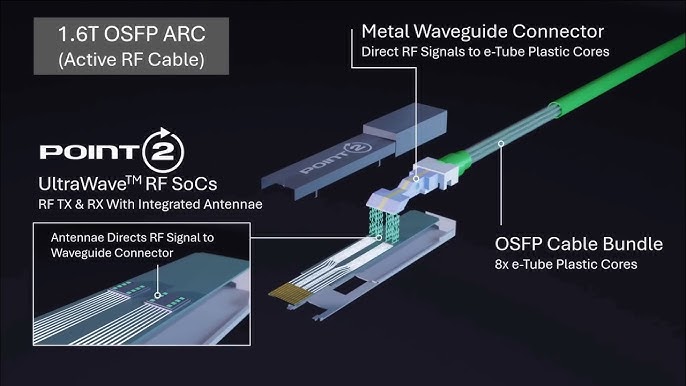
Point2, headquartered in San Jose, develops ultra-low-power, ultra-low-latency RF and mixed-signal interconnect SoCs for AI and accelerated-computing infrastructure. Its flagship e-Tube™ Technology Platform applies a patented RF signaling architecture over plastic waveguide, creating a new product category the company terms “Active RF Cable” (ARC), with a roadmap extending to Near-Packaged e-Tube (NPE) and Co-Packaged e-Tube (CPE) form factors.
Point2’s business spans two segments: a legacy connectivity SoC franchise and an emerging AI-interconnect platform.
The UltraWire™ 56G PAM4 smart retimer, UltraRange™ 25G EDC SoC, C-Tube 400G AEC, and RangeXtender 25G DWDM module comprise Point2’s established data-center and 5G connectivity product line, which we view as having established the company’s early revenue base and customer relationships.
Active RF Cable, a pluggable-cable form factor, is the company’s first commercial e-Tube product, targeting accelerator-to-accelerator compute fabric and rack-scale interconnect. This is the primary near-term deployment of newly raised capital as the company pursues commercialization with systems vendors and hyperscalers.
Near-Packaged e-Tube (NPE) and Co-Packaged e-Tube (CPE) are development-stage products targeting future rack-scale compute systems, intended to further improve bandwidth density and power efficiency through tighter physical integration with the accelerator package.
Core technology — e-Tube RF over Plastic Waveguide: The e-Tube platform is built on what the company describes as a “well-patented” RF signaling architecture that transmits data over plastic waveguide. Per company disclosure, e-Tube delivers 10X the reach, 5X lower weight, and 2X lower cable volume than copper at comparable cost, and 3X lower power, 3X lower cost, and 1,000X lower latency than optics — without the reliability issues associated with failing lasers. These figures are self-reported. Point2’s selection as a 2026 BloombergNEF Pioneers winner, in the “Technologies for Sustainable, Scalable Data Center Infrastructure” category, represents a degree of third-party technology validation beyond company disclosure.
The e-Tube performance figures (10X/5X/2X reach/weight/volume vs. copper; 3X/3X/1000X power/cost/latency vs. optics) are drawn from company press releases and product materials; we have not identified independent third-party benchmarking or verified production data. Headcount estimates also vary by source, ranging from 44 employees (StartupHub) to 60 employees (PitchBook); current staffing levels require direct confirmation.
Point2’s capital-raising trajectory began with accelerator/incubator funding in early 2018, followed by a two-tranche Series A (2018–2019), and a Series B round that first closed in 2022 and has since been extended three separate times, most recently in April and August 2026. The most notable development in our view is the pace of strategic validation in 2026: Series B cumulative proceeds expanded from $76M in April to $136M in August, with NVIDIA (via NVentures) and Arm — two of the highest-profile names in the computing ecosystem — both entering as strategic investors within a four-month window.
Sean Park and Dr. HM Bae founded the company in San Jose. Initial team formation targeted the development of ultra-low-power connectivity SoCs, with early accelerator funding supporting the company’s first product development efforts.
A two-tranche Series A raise funded continued development of the UltraWire and UltraRange connectivity SoC lines and supported early customer acquisition.
Korea-based venture firm GU Equity Partners led a $22M Series B round, with participation from Molex Ventures, Samsung Securities, Shinhan Capital, Tigris Investment, and K2 Investment Partners, reflecting a mix of Korean and U.S. strategic and financial investors.
A $22.6M Series B extension with participation from Bosch Ventures and Molex brought cumulative proceeds to $44.6M. This round marked the beginning of more pronounced strategic interest from large automotive and industrial connectivity corporates.
Semiconductor-focused venture firm Maverick Silicon led this extension round, with participation from NVentures (NVIDIA’s venture arm) and UMC Capital, bringing cumulative Series B proceeds to $76M. In our assessment, direct capital participation from the ecosystem’s largest AI accelerator vendor represents a meaningful signal of strategic alignment for the e-Tube platform. The company also disclosed its 2026 BloombergNEF Pioneers award around this time.
Deal structure: Korea-based LB Investment led this extension, with Arm entering as a new strategic investor and Maverick Silicon continuing its support as an existing investor. Cumulative Series B proceeds expanded from $76M to $136M within approximately four months.
Strategic significance: In our view, Arm’s participation signals alignment across the broader compute stack — from compute to memory to interconnect — and follows NVIDIA’s participation four months earlier, marking back-to-back validation from two of the highest-profile players in computing architecture. We would characterize this as repeated market validation ahead of a commercialization inflection point, though not, on its own, confirmation of design-win traction.
Use of proceeds: Per company disclosure, the capital will bolster engineering, systems, operations, and business teams to accelerate commercialization of the ARC, NPE, and CPE product lines.
• May 2022: $22M — led by GU Equity Partners
• February 2024: +$22.6M — Bosch Ventures & Molex (cumulative $44.6M)
• April 2026: Led by Maverick Silicon; NVentures & UMC Capital join (cumulative $76M)
• August 2026: Led by LB Investment; Arm joins as new investor (cumulative $136M, most recent)
• Other investors: TIMEFOLIO Asset Management, D3 Jubilee Partners, K2 Investment Partners, KAIC TO Ventures, Korea Omega Investment, and more than 20 investors in total
Series A funding amounts (2018–2019) are not disclosed in public sources. Total lifetime capital raised also varies by data provider — PitchBook cites $85.7M (an interval estimate that appears to predate the 2026 rounds), while CB Insights cites $52.9M (a February 2024 snapshot). Neither figure appears to reflect either of the 2026 Series B extensions. We would treat the precise lifetime total, inclusive of undisclosed Series A proceeds, as requiring reconfirmation against the $136M Series B disclosure.
In our assessment, Point2’s competitive positioning rests on a differentiated RF interconnect architecture that bridges the performance/cost gap between copper and optics, a repeated pattern of validation from top-tier computing-ecosystem strategic investors, and a multi-generation form-factor roadmap rather than a single-product bet. Where competitors including Astera Labs, Credo Technology, Celestial AI, and Ayar Labs concentrate on either the optical or electrical technology axis, Point2 differentiates itself through RF signaling as effectively a third technology axis.
Conventional copper cabling faces physical attenuation limits at high data rates, while optical interconnect carries power, cost, and reliability trade-offs tied to laser-based components. Point2’s e-Tube platform transmits RF signals over plastic waveguide, per company disclosure avoiding the downsides of both approaches while offering superior reach relative to copper and superior power, cost, and latency relative to optics. If independently validated, we believe this could position e-Tube as a viable baseline option for next-generation rack-scale interconnect.
NVIDIA’s venture arm, NVentures, participated in April 2026, and Arm joined as a new strategic investor just four months later in August. In our view, sequential investment from the largest AI accelerator vendor and the company that sets computing architecture IP standards is a strategic signal that extends beyond a purely financial bet, potentially foreshadowing reference-design or ecosystem-integration discussions. That said, we flag that strategic equity participation does not, on its own, guarantee commercial design-win outcomes.
Starting from the pluggable Active RF Cable (ARC) now in early commercialization, Point2 has laid out a three-stage roadmap progressing to NPE and CPE, which integrate more tightly with the accelerator package. Relative to competitors dependent on a single product generation, this structure is designed to capture revenue opportunity across multiple phases as AI data-center architecture evolves from rack-scale to package-scale integration.
Selection as a 2026 BloombergNEF Pioneers winner, in the sustainable and scalable data-center infrastructure category, from among more than 600 applicants, represents technology-originality validation beyond company self-disclosure. The e-Tube architecture is described as a “well-patented” RF signaling structure, which we believe forms a partial barrier to entry for later entrants — though the specific scope and strength of the patent portfolio would require separate diligence.
Strategic strength of the founding team composition: Point2’s leadership combines hands-on semiconductor design and founder experience (Park — TeraSquare founder, Marvell director), a dual academic/industry technology leadership track (Bae — KAIST professor and former Finisar/Intersymbol executive), a strategic advisor with a repeated exit track record (Norouzian — four exits), and a newly appointed CFO with Stanford and Harvard credentials (Kitching). In our view, the combination of deep semiconductor operating experience at the founder level and finance leadership capable of closing large institutional rounds is a meaningful execution signal ahead of the company’s commercialization phase.
Point2 has accumulated capital-markets credibility through repeated Series B extensions and sequential participation from top-tier strategic investors, but structural risks typical of an early commercialization-stage company remain. Below is our balanced assessment.
- e-Tube’s headline performance figures (10X reach, 1000X latency improvement, etc.) remain company-disclosed to date, with no independent benchmarking or production-scale validation data publicly available
- Well-capitalized interconnect competitors — Astera Labs, Credo Technology, Celestial AI, Ayar Labs among them — are addressing the same AI data-center bottleneck via distinct optical or electrical technology axes
- Whether NVIDIA’s and Arm’s equity participation translates into actual design wins or volume production agreements requires separate confirmation; strategic investment and commercial adoption typically carry a meaningful time lag
- The business is mid-transition from a legacy connectivity SoC franchise to the e-Tube platform, and recurring revenue scale or specific customer contract details have not been disclosed
- The pattern of four Series B extensions over roughly four years (2022–2026) suggests ongoing capital needs; delayed commercialization could imply further dilution
- Structural tailwind from surging terabit-scale bandwidth demand in AI accelerator clusters, as interconnect increasingly emerges as the system-level bottleneck
- Sequential strategic equity participation from NVIDIA (via NVentures) and Arm — two of the highest-profile players in computing — within a four-month window is, in our view, an uncommon repeated validation signal
- The three-stage ARC → NPE → CPE form-factor roadmap is positioned to capture multiple revenue opportunities as AI infrastructure architecture migrates from rack-scale to package-scale integration
- The 2026 BloombergNEF Pioneers award, selected from more than 600 applicants, functions as an independent third-party validation of technology credibility
- Cumulative Series B proceeds expanded from $76M to $136M within 2026 alone, improving capital access and providing dry powder for commercialization and production-scale investment