
Braveheart Bio
From founding to Nasdaq in nine months — an a16z-backed serial dealmaker’s bet on a next-generation cardiac myosin inhibitor
Braveheart Bio was incorporated in San Francisco in November 2025 and reached a Nasdaq listing just nine months later — a compression of the typical biotech funding-to-IPO cycle that we view as unusual even by the standards of today’s frothy biotech IPO window. In our assessment, the speed itself is the central thesis of the name: this is less a story about a novel molecule than about a repeat dealmaker’s ability to mobilize institutional capital around a de-risked, in-licensed asset.
Following the HI-Bio sale, Murdoch spent roughly a year running Biogen’s West Coast Hub, where he oversaw multiple Phase 3 initiations for felzartamab. We note that his direct superior during that period was Chris Viehbacher — Biogen’s sitting CEO — who now chairs Braveheart’s board. In our view, this is not a conventional investor relationship but a repeat-game dynamic between a founder and the executive who once sat across the table from him in an M&A negotiation, a structure we believe carries implications for how the market should price future strategic-acquirer optionality. Murdoch also previously co-founded Ollin Biosciences, an ophthalmology-focused biotech, making Braveheart his third venture.
M.D., University of Alberta; studied at the University of Oxford. Founder and former CEO of HI-Bio (2021–2024, acquired by Biogen). Co-founder, Ollin Biosciences. Former head of Biogen’s West Coast Hub. We view him as a repeat-playbook operator whose core competency is licensing and building — not discovery.
Sitting CEO of Biogen and Braveheart’s board chairman. Formerly Murdoch’s superior at Biogen and the counterparty on the HI-Bio acquisition, now installed as chairman of Murdoch’s next venture. We read this as evidence of a durable, repeat-transaction trust structure between founder, investors and a plausible future acquirer.
The broader leadership bench includes Michele Anderson as Chief Development Officer — HI-Bio’s former head of regulatory affairs, who drove multiple Phase 3 initiations for felzartamab — alongside a chief scientific lead with prior cardiovascular pharmacology experience at MyoKardia and Edgewise Therapeutics, and a CFO with a prior finance leadership role at Alpine Immune Sciences. We characterize this as a “recycled team” of operators who have each already executed a comparable regulatory and commercialization playbook, which in our view meaningfully compresses execution risk relative to a typical first-time biotech management team.
Braveheart’s entire pipeline rests on a single asset: BHB-1893 (known in China as HRS-1893), an oral small-molecule cardiac myosin inhibitor (CMI). Critically, we flag that this is not an internally discovered molecule — it was originated by Jiangsu Hengrui Pharmaceuticals in China, and Braveheart secured worldwide development, manufacturing and commercialization rights outside Greater China (mainland China, Hong Kong, Macau and Taiwan) via an exclusive license signed in September 2025. We view this structure as a textbook example of the “China-to-West NewCo” model that has proliferated across US biotech over the past two years.
Data-quality flag we consider essential: Every trial completed to date was designed, sponsored and conducted by Hengrui — predominantly in China, with a single Phase 1 study run in Australia — and Braveheart was not involved in the design, conduct or oversight of any of it. We stress that this creates a bridging-study overhang: the company’s future FDA registration strategy will need to demonstrate that efficacy and safety observed in a largely Chinese population translate to a global, and specifically US, patient base.
| Candidate | Indication | Stage | Notes |
|---|---|---|---|
| BHB-1893 | Obstructive HCM (oHCM) | Phase 2 Complete | 42-patient dose-ranging study. Rapid, meaningful reductions in LVOT gradient reported. Data announced March 2026 |
| BHB-1893 | Non-Obstructive HCM (nHCM) | Phase 2 Complete | Randomized, double-blind, placebo-controlled. Improvements across biomarkers, diastolic function, cardiac structure and patient-reported outcomes. Zero approved therapies exist in this indication |
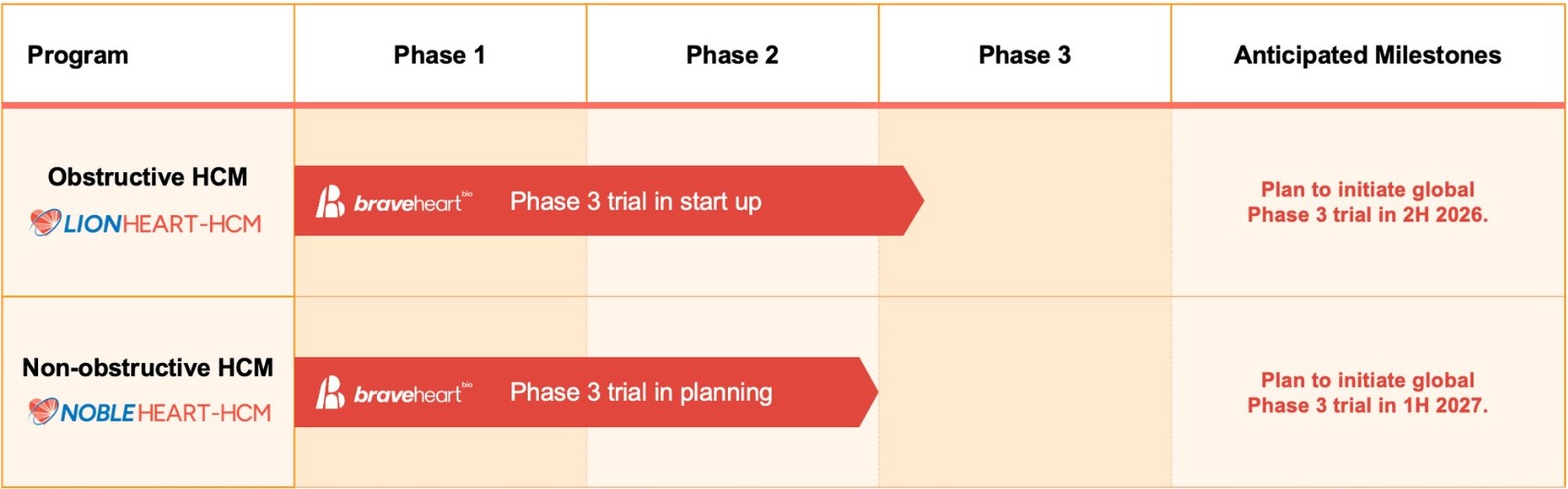
| LIONHEART-HCM | oHCM, global registrational | Phase 3 Planned | Braveheart’s first self-sponsored global Phase 3. Targeted start 2H2026. Primary use of IPO proceeds |
| NOBLEHEART-HCM | nHCM, global registrational | Phase 3 Planned | Targeted start 1H2027. First-in-class potential if approved, given the absence of competing therapies |
| HRS-1893 | HFpEF · Greater China only | Phase 2 Ongoing | Run separately by Hengrui in Greater China. Data expected 2H2027. Outside Braveheart’s licensed territory |
| Study 301 | oHCM · China registrational | Phase 3 Ongoing | Hengrui-run registrational trial in China (NCT07021976), operating independently of Braveheart’s global program |
Braveheart moved from a September 2025 licensing transaction (structured with $65 million in upfront consideration) through a $185 million Series A in November 2025 to a $382.5 million IPO in August 2026 — accumulating more than $600 million in aggregate capital commitments in roughly nine months. We view this pace as unusual even within a hot biotech financing window, and attribute it substantially to the founder’s proven exit history and to cornerstone commitments secured ahead of pricing.
Braveheart secured exclusive worldwide development, manufacturing and commercialization rights to BHB-1893 (HRS-1893) outside Greater China from Jiangsu Hengrui Pharmaceuticals. Consideration comprised $32.5 million in cash plus $32.5 million in non-voting Series A preferred stock (32.5 million shares at $1.00 per share). Hengrui is eligible for up to $23 million in technology-transfer and development milestones, up to $1.0 billion in commercial milestones, and net-sales royalties — implying total potential deal value of roughly $1.09 billion.
Announced simultaneously with the company’s public unveiling. Led by a16z Bio + Health, with participation from Forbion, OrbiMed, Enavate Sciences (a Patient Square Capital platform) and Frazier Life Sciences. Biogen CEO Chris Viehbacher was named board chairman at launch. We read the fact that $185 million was already secured at the moment of public disclosure as evidence this was substantially a pre-coordinated “stealth launch” rather than a conventional fundraise.
Braveheart filed its S-1 with the SEC and applied to list on the Nasdaq Global Market under ticker BRVE. Goldman Sachs, Jefferies, TD Cowen, Stifel and Cantor were named joint bookrunners.
Braveheart set terms for 18.75 million shares at $15–$17 (midpoint $16), targeting a valuation of up to $1.2 billion. Fidelity Management & Research indicated non-binding interest in purchasing up to $75 million of stock — roughly 25% of the deal as originally sized — a cornerstone signal we view as a strong pre-validation of institutional demand.
The offering was upsized to 21.25 million shares and priced at $18 — above the original $15–$17 range — for gross proceeds of $382.5 million, with underwriters granted a 30-day option on an additional 3.19 million shares. Shares closed the August 6 debut at $29.80, up 66%, valuing the company at approximately $2.11 billion. The listing arrived one day after Attovia Therapeutics’ IPO, part of a broader biotech listing wave that has also included Kailera Therapeutics and Parabilis Medicines.
The HCM treatment landscape is presently anchored by BMS’s Camzyos (mavacamten), the first approved cardiac myosin inhibitor, with Cytokinetics’ aficamten advancing as a second-mover competitor. In our view, Braveheart’s differentiation currently rests less on demonstrated molecular superiority — which remains unproven in company-sponsored trials — and more on the capital-formation, founder-credibility and positioning advantages it has already banked ahead of any Phase 3 data.
BHB-1893 is engineered for rapid onset and minimal impact on LVEF, potentially easing the REMS monitoring and titration burden that has constrained Camzyos uptake. Zero LVEF-related discontinuations across the 12-week study is, in our read, an encouraging early safety signal — though one generated exclusively in Hengrui-run Chinese trials.
Camzyos’s April 2026 Phase 3 failure in nHCM leaves that indication with no approved therapy. Success in NOBLEHEART-HCM could confer first-in-class status, though we stress this remains entirely contingent on Braveheart’s own registrational data — not yet in hand.
CEO Murdoch’s HI-Bio sale (up to $1.8 billion in potential value) is, in our assessment, the principal credibility anchor behind both the Series A and IPO demand. We would stress, however, that this premium is not fully separable from underlying clinical risk — the molecule itself remains unproven in Braveheart-sponsored trials.
a16z Bio+Health, OrbiMed, Forbion and Frazier as life-sciences-dedicated backers, plus Fidelity’s $75 million cornerstone commitment and a five-bank Goldman-led underwriting syndicate. Institutional pre-validation was confirmed almost immediately by above-range pricing and a 66% first-day pop.
The Hengrui transaction mirrors the proven out-licensing playbook Hengrui has already run once before, with Kailera Therapeutics’ GLP-1 deal (up to $6 billion in potential value). Braveheart inherited a clinical package with more than 300 patients already dosed, materially compressing the path from founding to Phase 3 relative to de novo discovery.
HCM is a genetic heart condition frequently cited as a leading cause of sudden cardiac death in young athletes, giving it high clinical urgency and public awareness. As long as Camzyos’s REMS burden persists, we see a structural, durable case for unmet demand around a more convenient CMI.
Our view on valuation: The roughly $2.11 billion market capitalization established on debut was set entirely in the absence of any Braveheart-sponsored Phase 3 data. We view a meaningful portion of this valuation as reflecting founder premium and broader sector IPO momentum — following recent listings from Attovia, Kailera and Parabilis — rather than demonstrated molecular superiority, and we would expect valuation volatility to remain structurally elevated until LIONHEART-HCM and NOBLEHEART-HCM deliver their own readouts.
Braveheart remains a pre-revenue, clinical-stage company as of its August 2026 IPO. Full-year 2025 net loss was reported at $66.1 million against net cash used in operating activities of only $2.0 million — a divergence we attribute largely to non-cash consideration issued to Hengrui as part of the license transaction. Headcount stood at just 30 employees as of May 2026, an unusually lean organization for a company now managing two planned global Phase 3 programs.
▲Single-asset concentration — the entire pipeline rests on one molecule with no disclosed backup candidate. ▲Data-transfer risk — all existing clinical data was generated under Hengrui’s sponsorship in a predominantly Chinese population, with Braveheart uninvolved in trial design or conduct, creating bridging uncertainty for FDA registration. ▲Absence of company-sponsored Phase 3 data — both LIONHEART-HCM and NOBLEHEART-HCM remain pre-initiation; a registrational miss would likely trigger a sharp valuation reset. ▲Rich debut valuation — the 66% first-day pop that produced a $2.11 billion market cap leaves limited room for disappointment absent further data momentum. ▲Meaningful milestone and royalty overhang — up to $1.0 billion in commercial milestones plus net-sales royalties owed to Hengrui will structurally compress long-term margins. ▲Competitive intensity — BMS’s commercially established Camzyos and Cytokinetics’ aficamten are both actively contesting the same indication.
On the opportunity side, we would highlight ▲the effectively uncontested nHCM white space opened by Camzyos’s Phase 3 failure; ▲Murdoch’s demonstrated M&A exit capability paired with a board chairman who doubles as a plausible strategic acquirer’s sitting CEO; ▲comprehensive validation from a16z, OrbiMed and Fidelity across the capital-raising sequence; and ▲a relatively de-risked starting clinical package, with over 300 patients already dosed, that in our view lowers — though does not eliminate — binary Phase 3 failure risk, population-bridging concerns notwithstanding. We frame this name as a high-valuation, high-volatility biotech wager led by a proven dealmaker, with the two forthcoming global Phase 3 initiations and Braveheart’s first self-sponsored data readouts over the next 12–18 months standing as the principal catalysts — and the principal risk inflection points — for the stock.