
PaXini Tech
PaXini Sensing Technology (帕西尼感知科技) — how a deep-tech tactile sensor startup collapsed unit pricing from RMB 100,000 to RMB 199 and rode that curve to a RMB 10bn+ valuation
We view PaXini Tech (帕西尼感知科技) as a case where founder pedigree and industrial-capital access materially shaped the early fundraising trajectory. Founded in 2021 and headquartered in Shenzhen, the tactile-sensing company was co-founded by Xu Jincheng, an engineering PhD out of Waseda University’s Sugano Lab — the lab credited with producing the world’s first humanoid robot — alongside Nie Xiangru, a University of Illinois Urbana-Champaign graduate. We read this founder pairing as a classic deep-tech-research-meets-commercial-execution combination, and we flag that it likely carried a meaningful trust premium with early industrial investors.
Co-founder Nie Xiangru has described the company’s earliest days as operating out of a small shared office with two desks, which is consistent with a capital-light initial R&D phase focused on pure technology validation. We view the distance between that starting point and the current RMB 10bn-plus valuation as an unusually rapid re-rating for a hardware deep-tech name, even allowing for the compressed development cycles typical of China’s embodied-AI supply chain.
Engineering PhD, Waseda University, under Professor Sugano Shigeki’s lab — the birthplace of the world’s first humanoid robot. Core R&D contributor to Japan’s national START program (2016–2019); collaborated with Omron, Fanuc, and Epson on joint robotics R&D. Named to 36Kr’s “36 Under 36” China leaders list in 2022.
Master’s degree, University of Illinois Urbana-Champaign. Prior roles at NetEase and PwC; founded an earlier venture that received Y Combinator-affiliated backing before an acquisition. Named a Hurun U30 entrepreneurial leader. Leads commercial execution and large-account operations.
Chief scientific advisor Sugano Shigeki, a Waseda University professor and chairman of Japan’s Automation Promotion Association, also serves as PM on Japan’s flagship Moon-Shot national research program and chairs an international robotics conference committee. We view this advisory structure as reinforcing both the company’s technical credibility and its access to Japanese academic and industrial networks. The broader team draws additional talent from Tsinghua University, UIUC, and Imperial College London, alongside operating veterans from ZTE, Xiaomi, and NetEase.
PaXini’s core technology asset is a Hall-effect-based multi-dimensional tactile sensing platform. According to founder statements, the company evaluated resistive, capacitive, and vision-based tactile approaches before settling on the Hall-effect principle as the only path that could simultaneously satisfy response speed, cost control, and manufacturing consistency requirements. The platform is built around a proprietary Hetero-Array Probing Tactile Architecture (HAPTA) and an in-house Intelligent Tactile Processing Unit (ITPU) chip, which the company states can resolve up to fifteen physical dimensions — including normal force, friction, material composition, and temperature. We have not identified independent third-party benchmark data validating this dimensional-resolution claim and note it should be treated as company-sourced.
| Product / Business Line | Category | Status | Notes |
|---|---|---|---|
| PX-6AX | Multi-axis industrial tactile sensor | Mass Production | Company claims #1 shipment volume in multi-dimensional, multi-core array tactile sensors. Deployed in precision manufacturing and auto production lines |
| PX-3A | Consumer-grade tactile sensor | Mass Production | Flagship product of the RMB 199 pricing strategy, aimed at scaling adoption across price-sensitive segments |
| DexH5 / DexH13 | Four-finger tactile grippers | Commercial Supply | Four-finger rather than five-finger design cuts hardware cost by roughly 20%, on management’s view that ~90% of industrial grasping tasks require only four digits |
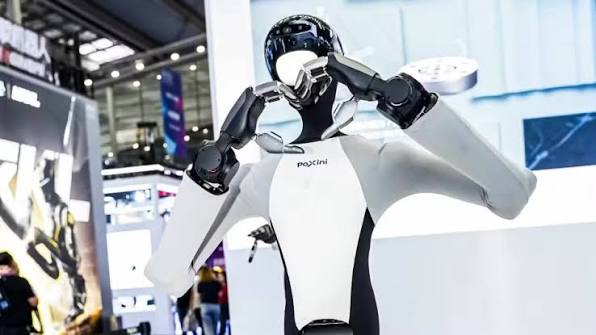
| Tora | Humanoid robot platform | Development / Pilot | Vertical extension of sensor and gripper IP into a full humanoid form factor; pilot references cited in precision manufacturing, healthcare, and logistics |
| OmniVTLA / HyperCosmos | Omni-modal embodied foundation model / world model | R&D Stage | Trained on tactile and multimodal data sourced from super data-collection factories in Tianjin, Suqian, Wuhan, Zigong, and Ganzhou |
Our take: PaXini’s business architecture runs from component sales (sensors, chips) through grippers and humanoid platforms to data infrastructure and foundation models — a full-stack vertical strategy the company itself frames as becoming “the capability base and growth multiplier” for the broader Physical AI industry. We view this breadth of ambition as structurally capital- and R&D-intensive, and note that successive funding rounds appear to be shifting proceeds toward model and infrastructure investment on the implicit assumption that the sensor and component business can fund itself as a cash-generative core.
We frame PaXini’s funding trajectory in three phases: accelerator anchor, industrial-capital mobilization, and state-capital/policy-fund integration. Starting from a single-digit-million-RMB angel round in 2021, the company’s self-reported cumulative funding had reached RMB 3.5bn (roughly USD 490M at our assumed ~7.15 conversion rate) as of August 2026 — a figure the company describes as the largest cumulative raise in the global tactile-sensing category. We flag, however, a material discrepancy between that company-disclosed total and PitchBook’s third-party tracking of cumulative funding at USD 181M (roughly RMB 1.3bn); this gap likely reflects reporting lag or undisclosed rounds, and we treat it as an open information gap rather than a reconciled figure. The investor roster — spanning JD, BYD, BAIC, SAIC, and TCL alongside state platforms and semiconductor firms — skews notably toward strategic industrial partnership rather than pure financial investment.
Led by Miracle Plus (奇绩创坛), the accelerator founded by former Microsoft and Baidu executive Lu Qi. Seed-stage capital deployed against early development of the PX Chip tactile sensor line.
Led by Yingfu Taike (盈富泰克), with Guangyue Capital (光跃投资) participating in a follow-on tranche. Proceeds directed toward product-line expansion and initial commercialization of the tactile sensor range.
Series A led by Xin’ao Capital (新奥资本); Series A1 co-invested by BAIC Industrial Investment (北汽产投), Nanshan Strategic Emerging Industries (南山战新投), and Yingfu Taike. Management characterized the combined round at the time as the largest ever raised by a global tactile-sensor company. Proceeds funded product iteration, volume manufacturing buildout, and commercial expansion.
Press reporting indicates PaXini closed four separate rounds during 2025, with e-commerce major JD, automakers BYD, BAIC, and SAIC, consumer electronics group TCL, semiconductor firms, and state-owned platforms newly appearing as investors. We flag that individual round sizes and valuations from this period were not disclosed and treat this window as a distinct information gap in the capital-raising record.
Co-led by Huangpujiang Capital (黄浦江资本), Kaitai Capital (凯泰资本), and state-backed Xin’an Capital (信安资本). Zhuhai Technology Industry Group (珠海科技产业集团), Shanda Capital (善达资本), and Haichuan Fund (海川基金) co-invested, with listed instrumentation maker Youlide (优利德) among the follow-on participants. Existing shareholder Yida Capital (毅达资本) over-allocated its position. Gengxin Capital China (庚辛资本中国) continued as exclusive financial advisor. Management positioned the company as one of eight embodied-intelligence startups nationally to clear a RMB 10bn valuation.
Co-led by an unnamed party described in press coverage only as a “trillion-RMB-scale global consumer electronics and semiconductor giant,” alongside BOC International Investment (中银国际投资), national big-data fund Kunpeng Fund (鲲鹏基金), and Hexin Fangce (合信方册). CDH Baifu (鼎晖百孚), the Chengdu Jiaozi AI Fund, Jingming Capital, and Jinrong Guosheng participated as follow-on investors. Existing shareholder Zhilai Capital (知来资本) over-allocated. Proceeds are earmarked for data-collection-factory expansion, further development of the OmniVTLA and HyperCosmos models, and overseas footprint buildout across North America, Japan/Korea, and Europe.
The global tactile-sensor market has historically been dominated by overseas brands in the multi-dimensional product category, with China’s import dependence estimated at roughly 95% prior to domestic entrants scaling. We view this structural entry barrier as having created an import-substitution premium that benefited full-stack local players such as PaXini, with competitive advantage visible across three layers: technical design, cost structure, and industrial-capital network access.
Selected the Hall-effect principle after evaluating resistive, capacitive, and vision-based alternatives. The HAPTA architecture and proprietary ITPU chip resolve up to 15 physical dimensions — normal force, friction, material, temperature — with in-house development spanning sensor structure, chip, signal processing, and interpretation algorithms.
States it has cut overseas-brand pricing of roughly RMB 100,000 per unit down to RMB 199. Given that pre-policy market averages reportedly exceeded RMB 1,000 (with driver boards often sold separately), we read this as a direct price-based assault on the category’s historical entry barriers.
Spans sensor hardware, four-finger grippers (DexH series), humanoid platforms (Tora), super data-collection factories, and foundation models (OmniVTLA, HyperCosmos) under one roof — a strategic shift from component vendor toward embodied-intelligence infrastructure provider.
Investor roster spans e-commerce (JD), autos (BYD, BAIC, SAIC), consumer electronics (TCL), state platforms, and semiconductor firms. The strategic-partnership orientation over pure financial investment suggests structurally favorable access to hardware adoption channels.
Founding team traces to Waseda’s Sugano Lab — origin point of the world’s first humanoid robot — combined with early anchor capital via the Lu Qi network. We view this combination as having functioned as an early credibility signal to subsequent institutional investors.
Super data-collection factories across Tianjin, Suqian, Wuhan, Zigong, and Ganzhou give geographic coverage spanning North, East, Central, Southwest, and South China. Management describes this as the world’s largest embodied-intelligence data-collection factory cluster.
Our take: We view PaXini’s competitive position as the product of technical differentiation (Hall-effect sensing) compounding with aggressive cost deflation (the RMB 199 pricing policy) to capture import-substitution demand quickly. That said, the headline claim that PaXini sensors are used in roughly 80% of global humanoid robots is company-sourced, and we have not identified independent third-party verification. We would treat this figure as directional market-positioning color rather than a reliable quantitative input to valuation work.
PaXini remains a private company with no disclosed revenue or profitability figures, which we note is common across this segment but nonetheless material to underwriting. Headline operating metrics — annual chip consumption of roughly 1M units, an estimated 80% share of humanoid-robot adoption — rest entirely on company disclosure, a dependency investors should weight explicitly in any valuation exercise. We also flag as an unresolved information gap the material spread between PitchBook’s tracked cumulative funding (USD 181M) and the company’s self-reported total (RMB 3.5bn, roughly USD 490M).
On the opportunity side, we highlight: ▲ positioning as an upstream critical-component supplier during a broad capital-inflow cycle into humanoid robotics ▲ strategic investment from JD, BYD, BAIC, SAIC, and TCL, which points to potential large-account supply channels ▲ the closing of a follow-on strategic round just five months after Series B, evidencing continued capital-markets access ▲ re-rating optionality if the vertical extension from components into data and foundation models succeeds commercially.
On the risk side, we highlight: ▲ absence of independent verification for headline metrics (market share, chip consumption, revenue scale), with heavy reliance on company disclosure ▲ commercialization-timing uncertainty in the broader humanoid robotics industry — a downstream demand shortfall would flow through directly to an upstream component supplier ▲ unverified durability of margin and competitive defensibility under the RMB 199 disruptive pricing model over a longer horizon ▲ customer-concentration risk should strategic investors such as JD or BYD move toward in-house sensor development ▲ geopolitical and export-control exposure as PaXini expands internationally, given that embodied-intelligence and robotics components sit within a sensitive zone of US-China technology competition ▲ elevated cash-burn signaled by the pace and frequency of large rounds, implying continued dependence on follow-on financing.