
Mariana Minerals
A software-first minerals developer founded by Tesla’s former minerals lead — automating mining and refining end-to-end through MarianaOS
Mariana Minerals is a software-first, vertically integrated critical minerals developer and operator founded in 2024. Founder and CEO Turner Caldwell is a Stanford graduate who spent roughly nine years at Tesla, where he led the company’s minerals and metals team and oversaw construction of its Corpus Christi lithium refinery. In our view, this is not a resume line item so much as a direct operating precedent: the founder has already built and commissioned an industrial mineral-processing asset at scale, which materially de-risks the execution leg of Mariana’s own thesis.
The company launched formally with a Seed round in August 2024 and, within its first year, acquired the idled Lisbon Valley copper mine in Utah — now branded Copper One — giving it an operating physical asset almost immediately. We flag this as a structural departure from the typical “software-first, assets-later” playbook: Mariana is embedding its stack directly into live operating infrastructure from day one, which we view as a meaningful differentiator versus peers in the broader mining-tech category.
Stanford graduate. Spent approximately nine years at Tesla, leading the minerals and metals team and directing construction of the Corpus Christi lithium refinery. Brings hands-on factory design and construction experience directly to bear on Mariana’s autonomy-first mining strategy.
Co-founded the company alongside Caldwell in 2024. Public disclosure on both individuals’ prior track records remains limited in available press materials; we flag this explicitly as an information gap pending further verification.
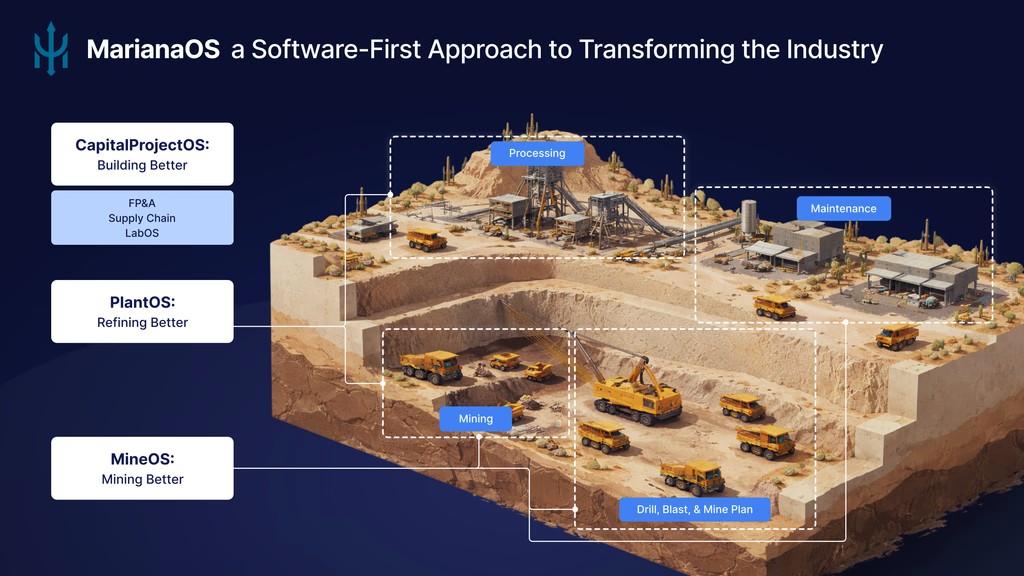
Mariana’s core asset is MarianaOS, an integrated software stack spanning the full mining value chain — capital project delivery (Build), mine operations (Mine), and processing (Refine) — unified into a single data layer with reinforcement-learning (RL) agents operating across it. We view this architecture as a direct answer to an industry-wide coordination failure: geology, planning, equipment, and processing data have historically sat in disconnected silos, reconciled manually through coordination meetings. In our assessment, replacing that human reconciliation loop with software is precisely the kind of structural inefficiency that can justify a valuation premium if execution holds.
| Project | Location / Commodity | Status | Notes |
|---|---|---|---|
| Copper One | Utah · Copper | Operating | Acquired and restarted late 2025 after prior operator (Lisbon Valley Mining Co.) shut down. Deploys autonomous drills, robotic haul trucks, and Boston Dynamics Spot units; Pronto partnership for autonomous haulage. Targeting 50,000 tons of refined copper/year by 2030 |
| Lithium One | East Texas · Lithium | Early operations / build-out | Extracts lithium from oil-and-gas produced water. Billed as the first designed-for-autonomy greenfield lithium refinery globally. On track to come online within 3 years of founding |
| Expansion Pipeline | Aluminum, magnesium, nickel, cobalt, manganese, uranium, rare earths | Exploratory / Planning | Stated target of 10 projects in 10 years. A portion of Series B proceeds is earmarked for additional asset acquisitions |
Business model — the key point: Mariana is not a pure software licensing play. It acquires, develops, and operates mines and refineries directly, then embeds MarianaOS on top of its own assets. We view this as a capital-intensive but data-rich model: it front-loads capital requirements relative to a pure B2B SaaS approach, but in exchange delivers faster proof points and tighter operational validation loops.
Mariana has raised approximately $400 million in cumulative parent and project-level capital across roughly two years, from a Seed round in August 2024 through its Series B in August 2026. What stands out to us is the pace of the re-rating: the Series B closed only about thirteen months after the Series A, and over that window the investor base broadened from pure technology VCs (a16z, Khosla, Breakthrough Energy) to include strategic industrial capital such as BHP Ventures and Mitsubishi Corporation, alongside In-Q-Tel (IQT), a fund with direct ties to the U.S. national-security community. We read this progression as evidence that a supply-chain-security premium is increasingly embedded in the valuation, not just a pure technology multiple.
Backed early by Khosla Ventures and Breakthrough Energy Ventures. The exact Seed round size was not separately disclosed; we derive this estimate by netting the Series A raise ($65M) against the cumulative total disclosed at the Series A announcement ($85M), and flag it as an unverified figure pending primary confirmation.
Led by Andreessen Horowitz (a16z), with continued participation from Seed backers Breakthrough Energy Ventures and Khosla Ventures, plus additional strategic investors across the minerals industry. Marked the company’s first public announcement after operating in stealth.
Led by Khosla Ventures, with continued support from a16z and Breakthrough Energy Ventures, and new participation from Greenoaks, Halo Fund, Pax Ventures, StepStone Group, BHP Ventures, Washington Harbour Partners, Greycroft, General Innovation Capital Partners, Mitsubishi Corporation, In-Q-Tel (IQT), and Earthshot Ventures. Brings cumulative parent-and-project capital to approximately $400M at a post-money valuation of $1.5B.
Information gap flag: As a private company, Mariana does not publish detailed financial statements. Third-party databases such as PitchBook list the company’s headquarters as Houston, Texas, while company disclosures and the majority of press coverage identify San Francisco as the headquarters — we surface this discrepancy directly rather than resolving it, and treat it as an open verification item. The proceeds allocation above is our estimate based on stated strategic priorities, not an audited or company-confirmed breakdown.
Critical minerals mining and refining remains a capital-intensive, historically slow-adopting industry, fragmented between large majors (BHP, Rio Tinto, and peers) and a long tail of regional operators. In our read, Mariana’s structural differentiation plays out across three layers: asset ownership, software embedding, and the composition of its capital base.
Not a pure SaaS vendor — Mariana owns and operates the mines and refineries it deploys MarianaOS onto. The Copper One acquisition-to-restart timeline, compressed from years to months, serves as an operating proof point that we expect to strengthen deal-sourcing leverage in future M&A.
CapitalProjectOS, MineOS, and PlantOS share a single data frame, creating integration synergies that point-solution competitors covering only one stage cannot replicate. The same RL architecture already runs across 7 unit operations, evidence we view as an early proof of generalizability to new commodities and sites.
In-Q-Tel’s (IQT) participation signals direct strategic interest from the U.S. intelligence and defense community. With China controlling an estimated 90% of critical minerals processing globally (rising to roughly 92% for rare-earth magnet manufacturing), Mariana’s positioning aligns squarely with the U.S. policy push to build alternative domestic supply chains.
Has secured commitments from both pure technology VCs (a16z, Khosla) and strategic industrial capital (BHP Ventures, Mitsubishi Corporation) simultaneously. We view this as potential negotiating leverage on two fronts in future rounds: valuation support and offtake partnership formation.
The founder has stated publicly that lithium and copper entry points were chosen deliberately near price troughs. Acquiring an idled asset (the former Lisbon Valley mine) at low cost and restarting it structurally shortens the capital payback period versus a greenfield build.
Within roughly two years of founding, the company has scaled to a 220-person organization operating two live projects while publicly targeting 10 projects in 10 years. We flag whether autonomy technology maturity can keep pace with this expansion cadence as the key variable for future performance.
What the strategic investor mix signals: We interpret the participation of Mitsubishi Corporation and BHP Ventures as more than a financial commitment — it points toward potential offtake agreements or joint ventures with commodity trading houses and major miners. In-Q-Tel’s involvement similarly reads, in our view, as a strategic positioning move ahead of possible government procurement or defense supply-chain integration.
Mariana remains a private company as of its August 2026 Series B, with no publicly disclosed revenue or profitability metrics. We flag this information asymmetry upfront: the assessment below is a qualitative read built on disclosed fundraising history and observable asset-level operating status, not audited financials.
On the opportunity side, we would flag ▲ the founder’s direct execution track record building the Corpus Christi lithium refinery at Tesla ▲ the joint participation of policy-adjacent and industrial capital (In-Q-Tel, Mitsubishi, BHP), which we read as a signal of potential integration into national supply-chain strategy ▲ the simultaneous operation of two live projects (Copper One, Lithium One), which accelerates technology validation ▲ a Series B roughly five times the size of the Series A closed just thirteen months later, indicating strong follow-on investor conviction ▲ alignment with the macro theme of building U.S. alternative supply chains in response to Chinese dominance of minerals processing.
On the risk side, we would flag ▲ the core risk of unproven autonomy technology at commercial scale — if RL-driven mining and refining control fails to deliver expected returns at scale, the entire expansion roadmap would likely require recalibration ▲ the structurally capital-intensive nature of mining, implying ongoing need for additional capital raises ▲ commodity price volatility in copper and lithium directly affecting project-level economics ▲ a potential mismatch between the pace of the “10 projects in 10 years” target and the organization’s execution capacity ▲ limited financial transparency inherent to private-company status, complicating independent verification of the $1.5B valuation ▲ the headquarters discrepancy across sources, which we view as a minor but notable signal about the maturity of the company’s disclosure practices.
The risk factors in this section reflect a qualitative analysis based on publicly available press coverage, investor announcements, and company website disclosures. Because Mariana is a private company, we have not independently verified audited financial statements, project-level unit economics, or contract terms. Valuation and use-of-proceeds figures cited above are estimates and do not represent official, company-confirmed figures. Investors should weigh this information asymmetry carefully in any investment decision. This report does not constitute investment advice.