
Commonwealth Fusion Systems
An MIT fusion spinout building the world’s best-capitalized private fusion company — commercializing grid-scale fusion power through proprietary HTS magnet technology
Commonwealth Fusion Systems (“CFS”) is a US-based commercial fusion energy company spun out of the Massachusetts Institute of Technology’s Plasma Science and Fusion Center (PSFC) in 2018. The company’s headquarters and core R&D/manufacturing campus sit on a 60-acre site in Devens, Massachusetts, having grown from an initial Cambridge office into an organization of more than 1,000 physicists, engineers, and industrial-trade personnel.
A native of Nebraska with a BS in mechanical engineering and engineering physics from the University of Nebraska, Mumgaard went on to earn an MS in nuclear engineering and a PhD in applied plasma physics from MIT. During his doctoral work he contributed to the design of several small superconducting tokamaks using high-temperature superconductors (HTS), and on MIT’s Alcator C-Mod tokamak he developed precision-polarization, robotics, and novel optical instrumentation techniques for measuring magnetic fields inside tokamak plasmas. As an MIT fellow following his PhD, he organized and led a research group (“SPARC Underground”) studying how entrepreneurship and risk-retirement strategies could accelerate fusion’s path from laboratory to market — work that led directly to a formal collaboration model with MIT and the 2018 founding of CFS. As CEO, he continues to lead the company’s strategic direction while also serving as a core technical contributor to the SPARC design process and its interface with business strategy.
As Director of MIT’s PSFC, Whyte provided the early institutional backing that gave the SPARC Underground team its foundation, supervising the student-led magnet designs using high-temperature superconducting (YBCO) tape. He continues to anchor the academic legitimacy and R&D pipeline underpinning CFS’ technology base.
A founding member of CFS serving as Chief Science Officer, Sorbom oversees the core plasma physics and magnet technology roadmap behind SPARC and ARC. Alongside Mumgaard and Brunner, he forms part of CFS’ full-time executive leadership steering the company’s technical strategy.
An MIT PSFC alumnus serving as CTO, Brunner holds overall technical responsibility for HTS magnet manufacturing and tokamak engineering. Together with Mumgaard and Sorbom, he rounds out CFS’ resident executive team.
An MIT professor of nuclear science and engineering and the former deputy director of PSFC, respectively, both co-founded CFS while remaining at MIT — anchoring the exclusive CFS–PSFC R&D partnership that supports ongoing joint research within MIT facilities under a dual-track collaboration structure.
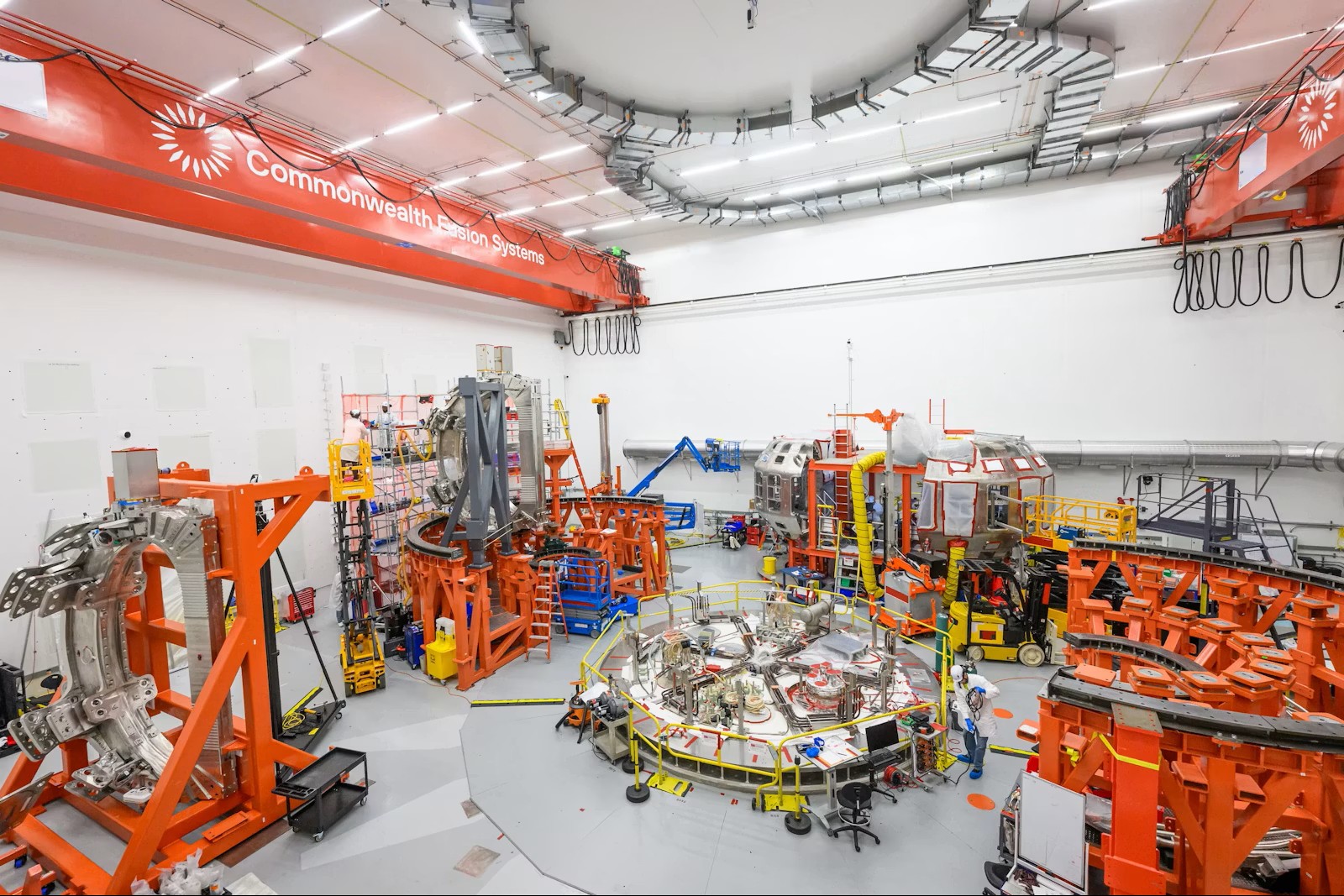
CFS is a commercial fusion energy company built around a compact, high-field tokamak design underpinned by proprietary high-temperature superconducting (HTS) magnet technology. The company operates a vertically integrated model spanning the full value chain — from magnet manufacturing through demonstration-reactor assembly to commercial power plant construction and operation. As of July 2026, management has publicly stated that assembly of its core demonstration device, SPARC, is roughly 80% complete. It should be noted, however, that CFS remains a pre-revenue deep-tech company: capital raised to date has been directed entirely toward demonstration and development rather than commercial operations.
A compact, high-field tokamak using HTS magnets to confine plasma above 100 million°C. The goal is to demonstrate the world’s first commercially relevant net energy production (Q>1) at a fusion gain above 10 and an output of roughly 50–100MW. As of July 2026, management has stated assembly progress at approximately 80% complete; the original 2025 completion target has since slipped to 2027.
The world’s first grid-connected commercial fusion power plant, based on SPARC’s technology. To be built at a 400MW scale near Richmond, Virginia, at a site named the “Fall Line Fusion Power Station,” selected after a two-year evaluation of more than 100 candidate locations. Targeting grid power delivery in the early 2030s, CFS became the first fusion company to file a grid-interconnection application with PJM Interconnection, the largest US wholesale electricity market.
Magnet technology built on yttrium-barium-copper-oxide (YBCO/REBCO) high-temperature superconducting tape, generating magnetic fields on the order of 20 tesla. Because the required operating temperature (roughly 20K) is higher than for conventional low-temperature superconductors, cooling-system complexity and overall device size can be substantially reduced. The company demonstrated its 20-tesla-class magnet in 2021 and a follow-on magnet demonstration in 2024, sequentially clearing core engineering milestones.
Strategic Offtake & Partnership Structure: Despite being pre-commercial, CFS has signed a 200MW power purchase agreement (PPA) with Google and, in September 2025, formalized a collaboration with Google DeepMind using its open-source plasma simulation software, TORAX, to optimize SPARC. In parallel, CFS signed a power agreement with Eni valued at roughly $1 billion, and its Virginia ARC project is advancing grid interconnection and site permitting through a strategic partnership with Dominion Energy. Notably, both Google and Eni are equity investors in CFS as well as offtake partners committed to purchasing more than half of the eventual plant’s output — a dual structure that front-loads commercial demand validation ahead of technical proof.
Industry Positioning: According to Fusion Industry Association figures, roughly 40 private fusion companies were active globally as of mid-2025, and CFS accounts for approximately 30% of cumulative capital raised across the entire private fusion industry — making it the largest and best-capitalized player by a wide margin. Competing technical approaches include inertial confinement (Focused Energy, Marvel Fusion, Xcimer Energy), magnetized target fusion (General Fusion), stellarator designs (Type One Energy, Renaissance Fusion), and UK-based Tokamak Energy, which — like CFS — pursues a compact spherical tokamak with HTS magnets. In the public sector, the internationally backed ITER project in France is targeting experiments around 2035 on a parallel track.
Since its 2018 founding through July 2026, CFS has raised approximately $4.0 billion in cumulative capital — roughly 30% of total cumulative investment across the global private fusion industry, making it the best-capitalized company in the sector. Early rounds were led by an energy major (Eni) and climate-tech-focused venture firms (Breakthrough Energy Ventures, Khosla Ventures); large crossover funds, led by Tiger Global, entered from the 2021 Series B onward; and by 2025–2026 the investor base had further institutionalized to include pension funds, sovereign wealth funds, infrastructure funds, and Big Tech (Google, Nvidia) — a pattern of continuous investor-base institutionalization and diversification.
Italian energy major Eni led the initial seed round, funding the corporate separation from MIT PSFC and early HTS magnet R&D. Financing the company’s commercialization entirely through private capital — rather than relying on traditional government grants — represented an unusual capital strategy even within the fusion industry.
New investors including Breakthrough Energy Ventures (Bill Gates) and Khosla Ventures joined existing backers The Engine and Eni to close this round. The capital funded full-scale demonstration of the HTS magnet technology, and CFS publicly stated an initial roadmap to build SPARC by 2025 and demonstrate net energy production for the first time in history — a timeline since revised to 2027.
Singapore sovereign-linked Temasek entered as new lead investor in this second tranche of the Series A, with Equinor and Devonshire Investors joining as new participants. Cumulative funding reached $200 million at this point. Both A tranches were unusually large for a Series A round, reflecting early conviction from large institutional capital.
A large-scale growth round led by Tiger Global Management with broad participation from institutional and individual investors including Bill Gates, Coatue, DFJ Growth, Google, John Doerr, Marc Benioff’s TIME Ventures, Soros Fund Management, Temasek, and university endowments and pension funds. This round established CFS’ position as the world’s largest private fusion company and funded the buildout of large-scale HTS magnet manufacturing and full-scale SPARC construction.
The largest single deep-tech/energy round since the 2021 Series B, this round brought in Nvidia’s venture arm NVentures, Morgan Stanley’s Counterpoint Global, Google, hedge fund manager Stanley Druckenmiller, Brevan Howard Macro Venture Fund, Galaxy Digital, and a 12-company Japanese consortium led by Mitsui, among others. The investor base notably shifted from pure venture capital toward hedge funds, industrial capital, and international strategic investors; proceeds were directed toward completing SPARC and accelerating ARC development.
Round characteristics: The largest single round among fusion energy companies since the 2021 Series B ($1.8B), this round saw a wave of new institutional capital — pension funds, sovereign wealth funds, infrastructure investors, and industrial partners. The company did not disclose a specific investor list or valuation, citing as the basis for investor confidence: (1) a practical approach grounded in the industry’s collective experience building more than 150 tokamaks to date, (2) an ongoing track record of transparent, consistent execution, and (3) a stated commitment to peer-reviewed science.
Use of proceeds: (1) accelerating completion of SPARC assembly (approximately 80% complete as of July 2026, per management), (2) parallel development of ARC at the Fall Line Fusion Power Station in Virginia, and (3) advancing the PJM Interconnection process and commercial-plant permitting.
Data transparency note: Neither CFS nor its investors disclosed a valuation for this round. Third-party data aggregators have published widely divergent valuation estimates (ranging from roughly $2.4B to $8B), and given this dispersion, no independent valuation estimate is presented in this report. The company-stated reference to “more than 150 tokamaks built to date” should also be treated as a company-reported, industry-wide figure rather than a CFS-specific track record, and is flagged here as such rather than independently verified.
CFS’ competitive position rests on the industry’s largest capital base, an exclusive academic partnership with MIT, a validated track record of HTS magnet engineering milestones, and large offtake agreements secured well ahead of commercialization. That said, fusion remains an industry in which the central technical thesis — net energy production — has yet to be demonstrated, and CFS is no exception to this sector-wide risk.
Cumulative funding of $4 billion is a wide multiple of that raised by peers such as Helion Energy, TAE Technologies, and Tokamak Energy, creating an execution-capacity gap in a capital-intensive deep-tech industry that would be difficult for a later entrant to close quickly. The 2025–2026 broadening of the investor base into pension, sovereign wealth, and infrastructure capital diversifies long-term funding channels and may improve access to project financing for future large-scale commercial plant construction.
Following the 2021 demonstration of a 20-tesla-class HTS magnet and a follow-on magnet demonstration in 2024, CFS has retired a substantial portion of its core technical risk. REBCO-tape-based HTS magnets offer a structural advantage over conventional low-temperature superconducting approaches by simplifying cooling systems and enabling smaller device footprints — underpinning the physical rationale for CFS’ compact tokamak design.
The unique dual-track collaboration structure — with core academic co-founders Whyte, Greenwald, and Hartwig remaining at MIT to continue joint R&D within PSFC facilities — gives CFS both peer-reviewed academic validation of its physics and the rapid execution typical of a startup. This is an asset most competing fusion companies lack.
Agreements with Google (200MW PPA plus a plasma-simulation collaboration with DeepMind), Eni (a power agreement worth roughly $1 billion), and Dominion Energy (Virginia grid interconnection partner) demonstrate that CFS has secured commercial demand signals well before net energy has been demonstrated. Its status as the first US fusion company to file a PJM Interconnection application further suggests a first-mover position in regulatory and permitting engagement.
SPARC has not yet demonstrated net energy production, and its original 2025 target has already slipped once to 2027. The stated assembly progress figure (~80%, per company disclosure) is a self-reported, unverified metric, and the ultimate success of the demonstration — as well as the possibility of further schedule delays — remains the central source of uncertainty.
CFS continues to absorb substantial capital in the absence of commercial revenue, and the July 2026 round disclosed neither investor names nor a valuation, making external valuation estimation difficult. The actual construction cost of the 400MW ARC commercial plant has not been disclosed, and further large-scale capital raises — with associated dilution — cannot be ruled out.
As the world’s first commercial-scale fusion power plant, ARC must navigate new US Nuclear Regulatory Commission and Virginia state-level permitting processes with no established precedent, and the timeline from PJM interconnection application to actual approval and connection remains uncertain — a direct variable against the stated early-2030s commercial operation target.
Competitors pursuing different technical approaches — Helion Energy (magneto-inertial fusion), TAE Technologies (aneutronic fuel), Tokamak Energy (spherical tokamak) — have also raised meaningful capital, and CFS competes over the long term with public-sector efforts such as ITER. A high-profile demonstration failure at any single competitor could also negatively affect investor sentiment toward the sector as a whole.