
Eliyan Corporation
A chiplet interconnect leader for next-generation AI infrastructure — headquartered in Santa Clara, California, with a platform spanning electrical and optical connectivity
In our assessment, Eliyan Corporation is a chiplet-interconnect semiconductor IP company founded in 2021 and headquartered in Santa Clara, California. All three founders bring proven repeat-entrepreneur track records within the semiconductor industry, which we view as a meaningful signal for investment diligence. Core technology development appears to have begun as early as 2016, predating the company’s formal incorporation.
Holds a Ph.D. in Electrical Engineering from Stanford University. An inventor credited with 130-plus granted and pending patents in communications and networking, he led development of two IEEE Ethernet standards and the OCP-adopted Bunch of Wires (BoW) chiplet interconnect standard. He co-founded Velio Communications, which led to a Rambus/LSI Logic acquisition, and subsequently co-founded Aquantia Corp., which he guided through a Nasdaq IPO (NYSE: AQ) and a roughly $450 million acquisition by Marvell Technology. He served as CTO and VP of Networking/Automotive PHYs at Marvell from 2019 to 2021.
Holds an MBA from Purdue University and a B.S. in Mathematics and Physics from UC Santa Barbara and the University of Bristol. He has served as CEO of three early-stage technology companies and previously led business/corporate development and the IP business unit at eSilicon. His prior experience spans marketing, sales, and operations management at Altera, AMD, and TRW, along with seed-stage deep-tech venture investing that produced multiple IPO and M&A outcomes.
Holds an M.S. in Electrical Engineering from Stanford University. He has held VP of Engineering roles at Qualcomm, Nuvia, Ikanos, and PsiQuantum, managing more than 100 engineering teams across systems, chip architecture, design methodology, and packaging. He brings 30 years of semiconductor industry experience and holds 11 patents.
Managing Partner at Seligman Ventures, Padval joined the board in connection with the Series C financing. A veteran technology investor and operator with deep semiconductor-industry experience, his appointment is expected to strengthen governance as the company enters its next scale-up phase.
The board and advisory group also include individuals affiliated with Arm, AMD, Intel, Micron, SK hynix, Samsung, Coherent, Meta, Tiger Global Management, Cerberus Capital Management, and VentureTech Alliance, suggesting a governance structure built around ecosystem partnership rather than purely financial investment.
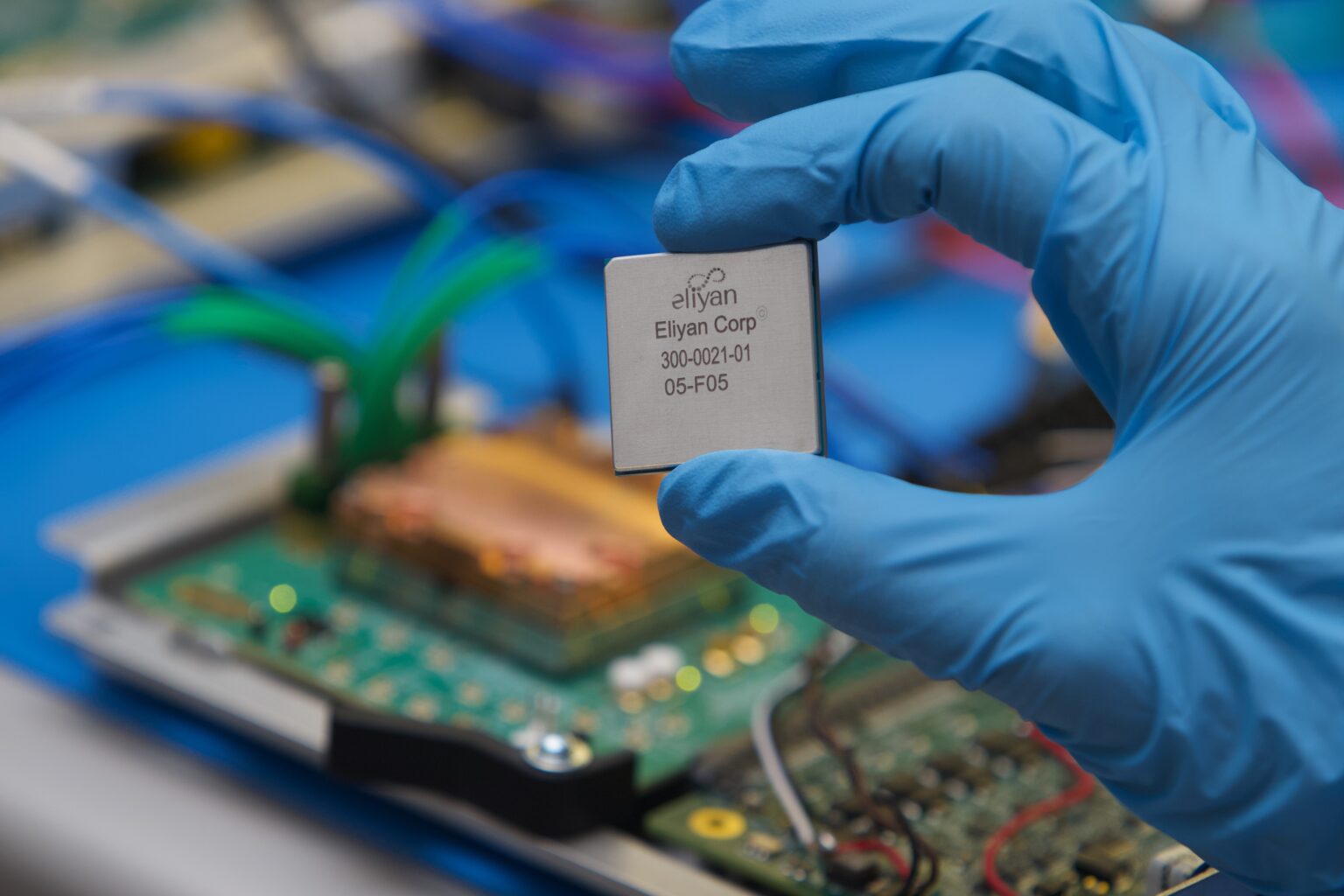
Eliyan positions itself as a foundational connectivity technology company addressing bandwidth and power bottlenecks across the compute, memory, and networking layers of AI, cloud, and HPC systems. Its core product portfolio consists of the NuLink™ PHY IP core family and the NuGear™ chiplet family, and per recent disclosures the company is now extending its scope beyond electrical interconnect into electro-optical architectures.
Eliyan’s operating model is organized around three complementary product and revenue lines.
The company’s core revenue line is die-to-die (D2D) interconnect PHY IP licensed to semiconductor design houses. The architecture is a superset of the UCIe and BoW standards with standardized 128-lane data configurations. Its patent-pending Simultaneous Bidirectional (SBD) signaling scheme is presented as the primary point of differentiation.
NuGear chiplets act as a gateway that converts standard HBM (High Bandwidth Memory) PHY interfaces to NuLink PHY, enabling integration of off-the-shelf HBM parts with GPUs and ASICs on standard organic substrates without a silicon interposer. This has become a distinct product line targeting memory-expansion architectures.
The NuLink-X product family supports longer-reach, PCB-level chip-to-chip (C2C) connections across separate packages, which the company states deliver comparable performance to conventional 112G/224G SerDes at lower power. Following the July 2026 Series C, Eliyan expanded its roadmap to include electro-optical interconnect architectures aimed at rack-to-rack scale-up.
Standards-alignment strategy: NuLink maintains backward compatibility with the UCIe (Universal Chiplet Interconnect Express) standard — originally developed by Intel and subsequently transferred to the UCIe Consortium — as well as the OCP-adopted Bunch of Wires (BoW) standard, while layering in the proprietary, patent-pending SBD signaling scheme. This dual approach is designed to pursue standards compliance and proprietary performance differentiation simultaneously. The company also participates in standards bodies including UCIe and JEDEC.
Customer base: Company disclosures reference a “marquee customer base” spanning hyperscalers, AI accelerator developers, memory suppliers, and optical module providers, though specific customer names and contract values are not disclosed. Notably, the investor base includes AMD, Arm, Intel, Meta, Samsung, SK hynix, Micron, Coherent, Cisco, and Lumentum — companies that also represent Eliyan’s likely customer set — suggesting that strategic investment and commercial/technical validation are occurring in parallel.
Over roughly five years since founding, Eliyan has completed four to five distinct financing events, culminating in unicorn status ($1 billion valuation) with its July 2026 Series C. A notable feature of the investor base is that all three major HBM suppliers — Samsung, SK hynix, and Micron — along with leading chip designers such as Intel, AMD, and Arm, and hyperscaler Meta, have all participated as strategic investors.
Co-founded by Ramin Farjadrad, Patrick Soheili, and Syrus Ziai. Development of NuLink PHY began building on die-to-die interconnect research dating back to 2016.
Led by Tracker Capital Management (the venture arm of Cerberus Capital Management), with participation from Celesta Capital, Intel Capital, and Micron Ventures. The round coincided with the company’s first tape-out on TSMC’s 5nm process, with commercial silicon targeted for the first half of 2023.
Co-led by Samsung Catalyst Fund and Tiger Global Management, with existing investors Intel Capital and SK hynix joined by new participants Cleveland Avenue and Mesh Ventures. The presence of all three major HBM suppliers (Samsung, SK hynix, and Micron) in the cap table by this point is, in our view, a signal of technology fit for generative AI chip architectures. NuLink PHY also completed its TSMC 3nm tape-out around this time.
A VentureTech Alliance investment pushed cumulative funding above $100 million, followed by an additional strategic round of approximately $50 million with participation from AMD Ventures, Arm, Coherent Corp., Meta, Samsung Catalyst Fund, and Intel Capital. This phase brought hyperscaler Meta and optical-components supplier Coherent into the cap table as new strategic investors, broadening the company’s prospective customer base.
Deal structure: An oversubscribed round led by Seligman Ventures, with new strategic investors Cisco Investments and Lumentum joining the cap table. Seligman Ventures Managing Partner Umesh Padval joins the board of directors as part of the financing.
Strategic significance: Management states the proceeds will fund expansion into the electro-optical interconnect market; the participation of Cisco and Lumentum signals an intent to extend into networking-equipment and optical-module ecosystems.
Validation signals: Per the press release, the round drew participation from 12 strategic investors, with a 100-plus patent portfolio and an established marquee customer base cited as the principal underpinnings of the raise.
• Amount raised: $145,000,000 (oversubscribed)
• Post-money valuation: $1,000,000,000
• Lead investor: Seligman Ventures (Managing Partner Umesh Padval)
• New strategic investors: Cisco Investments, Lumentum
• Board change: Umesh Padval appointed as new director
• Stated use of proceeds: Next-generation interconnect product development, ecosystem partnership expansion, manufacturing scale-up
Reported figures for Eliyan’s cumulative funding vary by source. Some outlets cited pre-Series C cumulative totals in the $100–150 million range, while the most recent Series C coverage discloses only the individual round size ($145M), with no single, officially confirmed cumulative total available. Additionally, the strategic investment believed to have occurred between late 2024 and early 2026 (estimated at $50M) is sourced primarily from third-party research (e.g., SemiEngineering) rather than a dedicated company press release, and the precise timing and amount warrant further cross-verification.
In our view, Eliyan’s competitive positioning rests on four pillars: (1) a proven repeat-founder execution track record, (2) a dual strategy combining standards compatibility with proprietary patented technology, (3) a cost structure advantage from eliminating silicon interposers, and (4) a strategic investor base spanning all three major HBM suppliers alongside leading foundry-adjacent and hyperscale customers.
CEO Ramin Farjadrad previously guided Velio Communications to a Rambus/LSI Logic acquisition and co-founded Aquantia Corp., which he took public on Nasdaq before its roughly $450 million acquisition by Marvell. In our assessment, this materially mitigates one of the principal risks facing early-stage deep-tech semiconductor companies: failure to commercialize the underlying technology.
By building NuLink as a backward-compatible superset of the UCIe and BoW standards, Eliyan lowers the adoption barrier — and lock-in concerns — for prospective customers, while its patent-pending SBD signaling scheme preserves a proprietary performance premium relative to the open standards. We view this as a deliberate attempt to reconcile two typically competing objectives: open-ecosystem accessibility and defensible technology differentiation.
The company’s central claim is that it can achieve interposer-class bandwidth, power, and latency performance on standard organic substrates, without the expense of a silicon interposer. If validated at scale, this could offer a meaningful system-cost, yield, and lead-time advantage relative to advanced packaging approaches such as CoWoS. That said, most of the underlying performance figures remain company-reported, with limited independent third-party benchmarking to date.
The cap table includes all three major HBM suppliers (Samsung, SK hynix, Micron), leading chip designers (Intel, AMD, Arm), hyperscaler Meta, and networking/optical suppliers Cisco and Lumentum. We view this as providing both a technology-validation effect across the prospective customer base and a favorable positioning for potential strategic M&A or IPO outcomes down the line.
We believe an investment view on Eliyan should weigh the powerful structural tailwind of AI infrastructure scale-up against the valuation, validation, and competitive risks characteristic of early-stage semiconductor IP companies.
- Valuation step-up riskThe rapid progression from a $60M Series B to a $1B post-money Series C raises the possibility of valuation compression in a subsequent round if growth does not keep pace with the current multiple.
- Reliance on self-reported performance metricsKey bandwidth and power-efficiency figures (e.g., “4x performance, half the power”) are largely company-reported, with limited independent third-party verification currently available.
- Revenue recognition uncertaintyGiven the IP-licensing model, revenue recognition may lag behind customer tape-out and production ramp timing; specific contract sizes and backlog are not disclosed.
- Intensifying competitionLarge incumbent EDA/IP vendors such as Synopsys and Cadence, specialized rivals such as Alphawave Semi, and optical-interconnect entrants such as Ayar Labs are targeting overlapping markets.
- Execution risk in the new electro-optical businessThe electro-optical interconnect segment funded by the Series C proceeds is commercially unproven, carrying higher technical and market uncertainty than the company’s established electrical interconnect business.
- Structural AI infrastructure tailwindAs memory and interconnect bandwidth increasingly constrain AI accelerator performance, we expect structural demand growth across the chiplet interconnect market.
- Diversified strategic backers as a distribution channelWith HBM suppliers, chip designers, and hyperscalers all represented on the cap table, there is a credible path toward commercial partnership conversion and potential strategic M&A outcomes akin to the Aquantia precedent.
- Revenue diversification across multiple product linesNuLink IP licensing, NuGear chiplet sales, and NuLink-X C2C solutions represent three distinct revenue vectors, reducing single-product dependency risk.
- TAM expansion via electro-optical entrySuccessful execution in rack-to-rack scale-up interconnect could extend Eliyan’s addressable market beyond die-to-die connectivity into rack- and cluster-scale networking fabrics.