
ThreatLocker
An Orlando-born Zero Trust platform challenging the EDR paradigm with a “deny by default” architecture — a late-stage growth name that has crossed unicorn status on the strength of its MSP channel
ThreatLocker was founded in 2017 in Florida (initially Maitland, now headquartered in Orlando) as a Zero Trust cybersecurity company, and in our view the origin story itself does much of the work of explaining the investment thesis. Founder Danny Jenkins spent more than two decades — starting in 1997 — defending corporate networks and working across both red-team and blue-team functions, a practitioner background rather than an academic or big-vendor R&D pedigree. We read his founding motivation as coming from a failure he witnessed firsthand as a security consultant, not from a lab hypothesis.
Prior to ThreatLocker, Jenkins had already been through two security-company exits. He co-founded MXSweep, a Dublin-based email and internet security SaaS business that was later sold, and served as CEO of Sirrustec, a white-label email security provider that was sold to Censornet in 2014. We flag this repeat founder-exit pattern as a plausible explanatory factor behind ThreatLocker’s channel-led, MSP-centric go-to-market design.
Two-decade-plus career in corporate network security, penetration testing, and incident response (red/blue team), beginning in 1997. Co-founded and exited MXSweep (Dublin-based email/internet security SaaS); served as CEO of Sirrustec (white-label email security) through its 2014 sale to Censornet — a repeat exit track record. Member of the Forbes Technology Council and a contributor to Harvard Business Review.
Co-founded the company alongside her husband and co-founder Danny Jenkins, and serves as Chief Operating Officer. We view her as the operating lead behind the company’s headcount and organizational scale-up, which now stands at roughly 700 employees, including approximately 600 in Orlando.
The three-person founding team, which also includes co-founder John Carolan, built product-market fit organically after the 2017 founding before raising its first institutional round — a Series A led by Arthur Ventures in 2020. We would flag this extended pre-institutional runway as a likely reason the founding team appears to have preserved comparatively high equity ownership and control through later rounds.
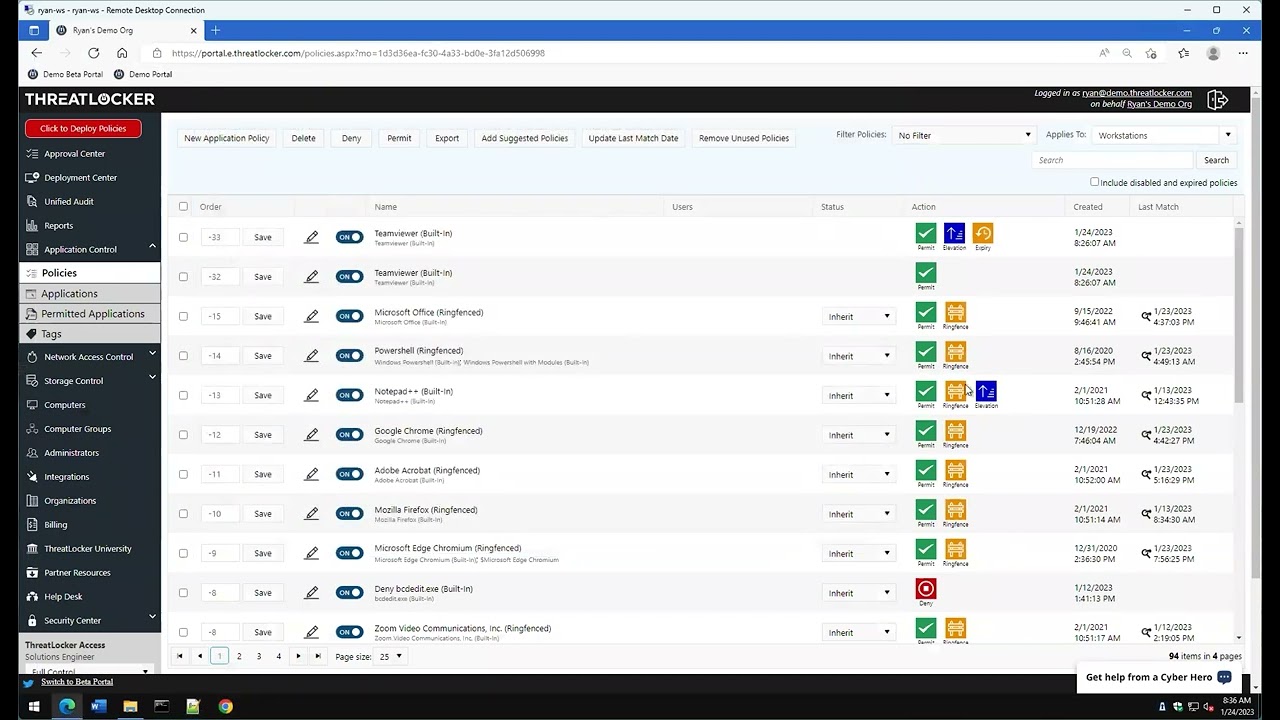
ThreatLocker’s core product philosophy is “deny by default” — block everything that is not explicitly allowed. This is the inverse of the “allow by default, detect malicious activity” model used by most EDR/EPP vendors, and in our view it is the central investment point: the architecture confers a structural defensive edge against unknown threats (zero-days, novel ransomware variants) rather than a reactive one. The flagship module, Allowlisting, blocks execution of any file, script, or library that has not been pre-approved, and is paired with Ringfencing™, which constrains the resources that approved applications and AI agents can access — together forming the platform’s core differentiation axis.
| Module | Function | Positioning | Notes |
|---|---|---|---|
| Allowlisting | Blocks execution of any non-pre-approved executable, script, or library | Core Flagship | Anchors ransomware/zero-day defense; largest revenue contributor |
| Ringfencing™ | Constrains what approved apps/AI agents can access or modify | Differentiated Asset | Most distinctive feature vs. peers; extending into AI security |
| Zero Trust Network / Cloud Access | Extends Zero Trust principles to network and cloud resource access | New Expansion | Core of the single-dashboard platform consolidation strategy |
| PAM / Storage Control | Mitigates privileged-access abuse and external storage device risk | Complementary | Cross-sell asset within the existing installed base |
| Patch Mgmt / EDR / MDR | Patch management, real-time threat detection, managed detection & response | Complementary | Positioned for platform completeness rather than head-on EDR competition |
| Defense Against Configurations (DAC) | Manages attack surface arising from misconfiguration | Recently Launched | Latest pipeline diversification effort |
Distribution strategy — the MSP channel: ThreatLocker has built its core distribution around managed service providers (MSPs/MSSPs), a channel that large EDR vendors tend to cover thinly, giving it differentiated reach into the SMB and mid-market segment. In parallel, the company has secured direct enterprise accounts spanning banks, healthcare organizations, and airlines (including JetBlue Airways), reflecting a dual-track channel-plus-direct model.
ThreatLocker has raised approximately $500M in disclosed cumulative capital across six rounds, from its 2020 Series A through the July 2026 Series F. Two points stand out to us: first, the sequential entry of late-stage growth and crossover capital — General Atlantic, D. E. Shaw, and most recently Koch Disruptive Technologies — reflects a maturing investor base; second, Elephant and Arthur Ventures have participated in every round from the earliest institutional raise through Series F, which we read as a strong continuity signal.
Led by Arthur Ventures, this was the company’s first institutional round, arriving three years after the 2017 founding and following a period of building product-market fit without outside capital — a sequencing we believe minimized early-stage dilution for the founding team.
Led by Elephant VC. We view this round as funding product expansion and the initial sales organization, laying the groundwork for the MSP-centric go-to-market model.
Global growth equity firm General Atlantic joined as lead investor for the first time. At announcement, revenue and headcount had each roughly quadrupled year-over-year, and the company had surpassed 23,000 protected organizations. This round marked the inflection point for meaningful enterprise account penetration across banking, healthcare, and airlines.
General Atlantic returned as lead, joined by new investors StepStone Group and the D. E. Shaw Group. The round coincided with international infrastructure buildout, including a new Sydney data center, and marked a further broadening of the late-stage institutional investor base.
Participants included Arthur Ventures, CR2 Ventures, and Elephant VC, with the round valuing the company at approximately $1.2B and crossing it into unicorn territory. We note the round is widely read in the market as a pre-IPO positioning raise rather than a capital-need-driven one.
Led by Elephant, with continued participation from D. E. Shaw Ventures and Arthur Ventures, and a significant new commitment from Koch Disruptive Technologies (KDT), the venture arm of Koch Industries. The company’s valuation is reported to have stepped up meaningfully from the prior $1.6B mark, though the new post-money figure was not disclosed. BofA Securities served as exclusive placement agent; Latham & Watkins served as legal counsel.
The endpoint and Zero Trust security market includes well-capitalized incumbents such as CrowdStrike and SentinelOne, as well as Microsoft Defender for Endpoint, which benefits from E5 licensing bundling. Even so, we view ThreatLocker as structurally differentiated across three layers: product architecture, distribution model, and market positioning.
Most EDR competitors rely on a “detect after entry” model that is structurally vulnerable to unknown threats. ThreatLocker’s allowlist-based architecture closes this gap at the source, a design-philosophy advantage we believe is difficult for competitors to replicate in the near term.
The company has captured the SMB and mid-market segment through managed service providers — a channel that large enterprise-focused EDR vendors tend to cover thinly. We view this as a structure that carries lower customer acquisition cost relative to direct sales, along with meaningful channel lock-in.
Implementation complexity has long been cited as the primary barrier to Zero Trust adoption despite its theoretical merits. ThreatLocker has positioned deployment, management, and scaling simplicity as its core value proposition, which we believe supports faster real-world market penetration relative to peers.
CEO Danny Jenkins’s two-decade-plus red/blue team background and two prior security-startup exits suggest a product roadmap shaped by field-tested experience rather than theory — a clear case, in our assessment, of founder-product fit.
The Allowlisting/Ringfencing architecture extends naturally into governance of AI agents and AI-generated code without requiring a new product build. Unlike EDR competitors bolting on AI-specific features after the fact, ThreatLocker is structurally positioned to respond ahead of the curve.
The sequential entry of General Atlantic, D. E. Shaw, and Koch Disruptive Technologies — crossover and industrial-capital investors — signals, in our view, that the market is treating ThreatLocker as a late-stage growth name approaching IPO readiness. KDT’s participation also carries potential value in industrial and infrastructure customer channel access.
What General Atlantic’s repeat commitment signals: General Atlantic’s decision to lead both the Series C and Series D rounds reads, in our view, as more than a financial bet — it reflects sustained conviction in the company’s growth trajectory. The subsequent shift of lead status to Elephant in Series F, alongside the large new commitment from Koch Disruptive Technologies, suggests the investor base is transitioning from growth-equity capital toward late-stage, strategic capital.
As of the July 2026 Series F close, ThreatLocker remains a private company. Aside from the CEO’s disclosed reference to roughly $100M in FY2025 revenue, detailed financial statements have not been made public. We view this information asymmetry as a structural feature of late-stage private growth investing generally, and one that constrains independent verification of the current valuation.
Opportunities: ▲Structural demand growth from expanding government and regulatory mandates around Zero Trust adoption; ▲first-mover positioning in the emerging AI agent governance category; ▲continuation of the growth momentum implied by roughly 3,000% three-year revenue growth and consecutive Inc. 5000 / Deloitte Fast 500 rankings; ▲expanded channel and customer access through the Koch Disruptive Technologies industrial-capital partnership; ▲a widening base of crossover investors (General Atlantic, D. E. Shaw) that points toward a potential IPO pathway coming into clearer view.
Risks: ▲Intensifying competition for security budget against better-capitalized incumbents such as CrowdStrike, SentinelOne, and Microsoft (via E5 licensing bundling); ▲channel concentration risk given heavy reliance on the MSP distribution model; ▲limited ability to verify valuation multiples given the absence of disclosed detailed financial statements typical of a private company; ▲execution risk from the pace of international expansion — Dublin, Dubai, Brisbane, and now Reading, U.K. — potentially outstripping organizational management capacity; ▲the valuation premium typical of late-stage private rounds remains exposed to sharp re-rating risk should growth decelerate; ▲uncertainty around the timing and structure (direct listing, M&A exit, or otherwise) of any eventual liquidity event.