
Spectro Cloud, Inc.
A full-stack Kubernetes lifecycle management platform positioning itself as the operating system for production AI infrastructure — founded 2019, headquartered in San Jose, California
Spectro Cloud was co-founded in 2019 in San Jose by three systems-software veterans — Tenry Fu (CEO), Saad Malik (CTO) and Gautam Joshi (VP Engineering). We view the founding team’s shared history at a prior venture, CliQr Technologies, as a meaningful team-risk mitigant: CliQr, a cloud application-deployment automation startup, was acquired by Cisco in 2016, giving the trio a combined track record that spans both a successful exit and multi-year scale-up experience inside a large enterprise (Cisco’s Cloud Platform Solutions Group).
More than two decades in systems software. Co-founded CliQr Technologies in 2010 and served as CTO, pioneering a declarative approach to application modeling for automated cloud deployment; led the company through its 2016 acquisition by Cisco. Subsequently served as Chief Architect for Cisco’s Cloud Platform Solutions Group (2016–2019), directing multi-cloud management, private cloud and container platform initiatives. Earlier held a Staff Engineer/Architect role at VMware (2007–2010). Holds 10+ patents spanning cloud abstraction, declarative modeling and policy-driven automation. Holds an MS in Computer Science from the University of Texas at Arlington and a dual BS in Computer Science and Applied Mathematics from Shanghai Jiao Tong University.
BS in Computer Science, San Jose State University (2003–2006). An engineering leader with a track record at Cisco and CliQr Technologies (later folded into Cisco CloudCenter), where he worked on core platforms including the ACI Multi-Site Orchestrator. Now directs Spectro Cloud’s technology strategy and product direction, with a recent focus on edge AI and large-scale distributed infrastructure operations; regularly presents customer case studies at industry conferences (KubeCon, Edge Computing Expo), which we view as a useful external-credibility signal for the technology.
Holds a bachelor’s degree from Ramarao Adik Institute of Technology (RAIT). Previously Director of Engineering at Cisco and VP Engineering at CliQr Technologies. As the execution-focused member of the founding trio, Joshi oversees Spectro Cloud’s engineering organization and platform scalability — the operational backbone underpinning the reliability of large-scale customer deployments.
Having a CEO, CTO and VP Engineering who all previously worked together at Cisco/CliQr supports organizational and technical cohesion, which we see as a positive for early-stage execution speed. That said, this degree of homogeneity in the founding group also carries a latent blind-spot risk that cannot be fully discounted. We view the gradual strengthening of external governance — notably Goldman Sachs Growth Equity’s Michael Reilly joining the board following the Series C and D rounds — as a constructive offsetting factor.
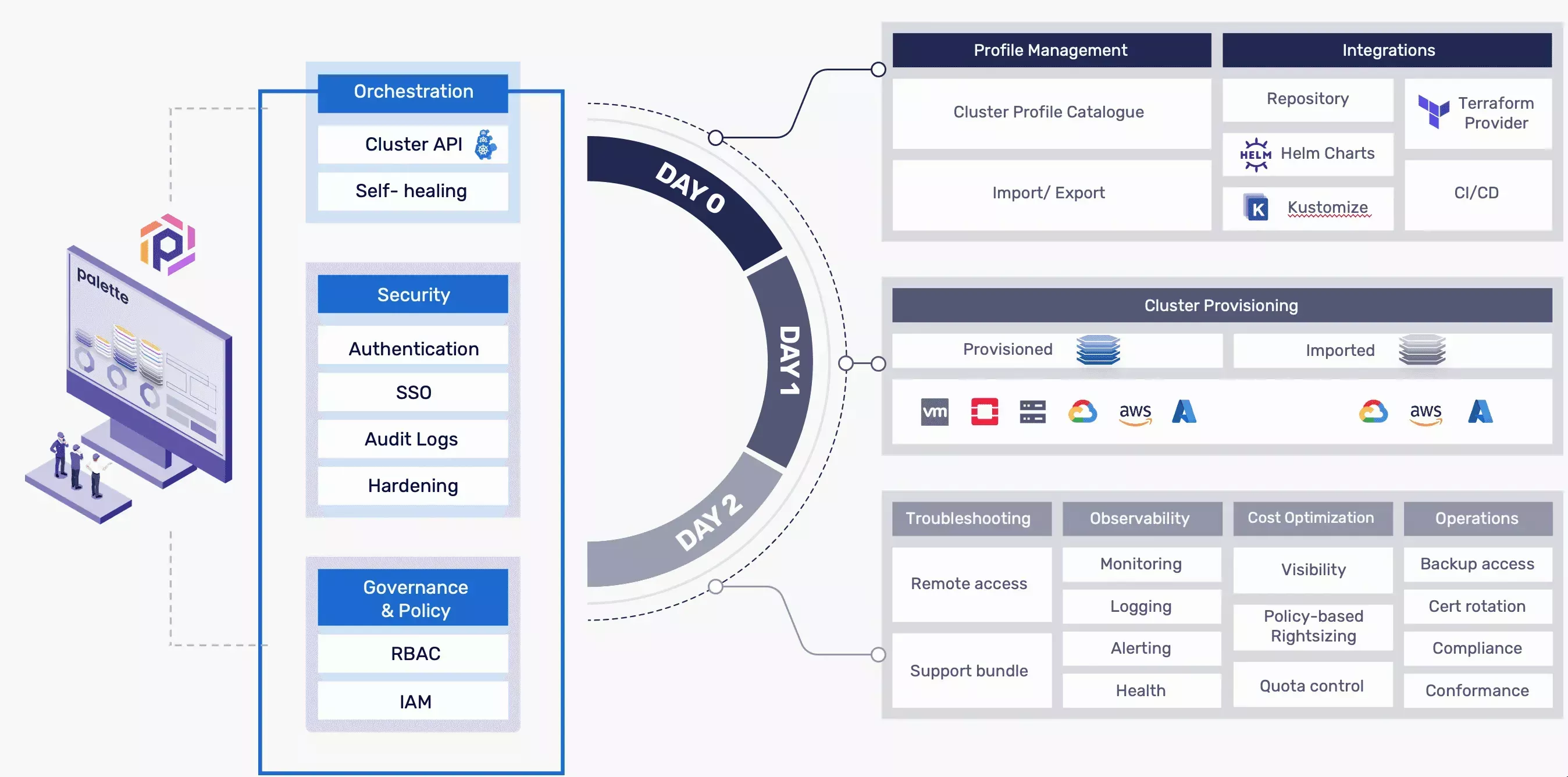
Spectro Cloud’s core offering, Palette, manages the full lifecycle of Kubernetes clusters. With the October 2025 launch of PaletteAI, the company is repositioning from “Kubernetes management” toward a broader “operating system for production AI infrastructure.” In our view, this repositioning is well timed against an industry cycle in which heavy capital spending on AI silicon is increasingly translating into demand for a software governance and cost-control layer.
Spectro Cloud’s product line is segmented by deployment environment and regulatory requirement, a structure we read as an attempt to capture enterprise and public-sector demand that a single SKU could not adequately address.
Manages the full lifecycle — provisioning, upgrades, compliance and health monitoring — of Kubernetes clusters across data centers, public/private cloud, bare metal and edge, using a declarative “cluster profile” model. It also captures VMware-replacement demand by unifying VM and container operations under a single model, including migration projects spanning tens of thousands of VMs.
Launched in October 2025, this newer product enables customers to build, govern and scale GPU clusters, AI factories and distributed inference infrastructure under a single operating model. Its core value proposition is multi-silicon (NVIDIA, AMD, etc.) and multi-model flexibility, with an explicit positioning against vendor lock-in.
A government- and regulated-industry edition addressing FIPS and FedRAMP requirements, serving demand from defense, intelligence and sovereign-cloud customers. Deployment flexibility — self-hosted, SaaS or airgapped — is offered by customer choice.
Reference customer base: T-Mobile, Airbus and the U.S. Air Force use Palette to manage mission-critical infrastructure, while Yum! Brands has deployed it at the edge to support digital experiences today and AI-enabled operations over time. RapidAI, Dentsply Sirona (healthcare) and Tevel (agtech) are also cited as customers, though these references are drawn from company materials and press releases; contract size and revenue contribution are not separately disclosed.
Competitive positioning: Industry research generally classifies Spectro Cloud as a specialist in “bare-metal-to-edge” full-stack management, competing against Rancher (open-source), Platform9 (SaaS-managed alternative), Rafay (policy/governance-focused) and VMware Tanzu (for vSphere-committed customers). Some third-party comparisons, however, flag Palette’s relative configuration complexity and its operations-team-first (rather than developer-experience-first) design as drawbacks — suggesting that differentiating against developer-centric self-service platforms such as Qovery and Northflank, outside the core infrastructure-ops buyer, remains an open question.
Since its 2020 seed round, Spectro Cloud has raised a cumulative $260M across five rounds over roughly six years, with round sizes stepping up sequentially from $7.5M to $20M to $40M to $75M to $100M+ — a fairly classic capital-raising curve for a growth-stage software company. Notably, Growth Equity at Goldman Sachs Alternatives led both the Series C and Series D rounds back to back, which we read as a meaningful signal of the same investor’s follow-on conviction.
Seed round led by Sierra Ventures and Boldstart Ventures. Tenry Fu, Saad Malik and Gautam Joshi founded the company around an early thesis of full-stack Kubernetes management.
Led by New York-based growth investor Stripes, with participation from existing and new backers including Sierra Ventures, Boldstart Ventures, WestWave Capital, Alter Venture Partners and T-Mobile Ventures.
Stripes led again, with TSG joining as a new investor; cumulative funding reached $67.5M. Proceeds were directed toward edge/bare-metal expansion (the Palette Edge edition) and global sales and support build-out. T-Mobile Ventures’ continued participation carries strategic significance from a 5G/edge telecom-partnership standpoint.
Led by Growth Equity at Goldman Sachs Alternatives with participation from existing investors. The company claimed three consecutive years of triple-digit ARR growth, though specific revenue and customer-count figures remain undisclosed. Proceeds were allocated to edge-computing product innovation and expanded customer support.
Deal structure: Growth Equity at Goldman Sachs Alternatives led the round again, joined by new strategic investors AMD Ventures, Ericsson, LG Technology Ventures and Maximus. Cumulative funding raised to date now stands at $260M.
Strategic significance: The participation of silicon, telecom and electronics conglomerates — AMD Ventures, Ericsson and LG Technology Ventures — can reasonably be read as an industry-level endorsement of Spectro Cloud’s multi-silicon, vendor-neutral positioning. That said, strategic-investor participation commonly comes bundled with commercial arrangements (joint go-to-market, technology integration, etc.), so the balance between maintaining genuine vendor neutrality and deepening commercial ties with specific strategic backers is a factor worth monitoring going forward.
Use of proceeds: The company has outlined three strategic priorities for the new capital — (i) advancing PaletteAI capabilities (utilization, token-cost control, governance), (ii) expanding go-to-market in Europe, the Middle East and APJ/APAC, and (iii) deepening partnerships across the silicon, hardware, systems-integrator and distribution ecosystem.
• Round size: $100M+ (oversubscribed)
• Lead investor: Growth Equity at Goldman Sachs Alternatives (second consecutive lead, following Series C)
• Strategic participants: AMD Ventures, Ericsson, LG Technology Ventures, Maximus
• Cumulative capital raised: $260M across five rounds
• Board: Michael Reilly (Managing Director, Goldman Sachs Alternatives) sits on the board
Spectro Cloud has not publicly disclosed its valuation at either the Series C or Series D round. Cumulative-funding figures cited by third-party databases such as PitchBook and Tracxn ($142M–$162.5M) predate the Series D close and therefore differ from the company’s latest official figure of $260M; this report relies on the company’s official press release figures. We also note that the company’s claim of “three consecutive years of triple-digit ARR growth” is self-reported and is not supported by audited financial statements — it should be treated as an unverified metric.
We assess Spectro Cloud’s competitive advantage across four dimensions: (1) a full-stack declarative management architecture, (2) proven capability at scale in edge and bare-metal environments, (3) a natural extension of the business into AI infrastructure, and (4) ecosystem validation via tier-one strategic investors. That said, the Kubernetes management market itself is fragmenting and becoming more competitive, so the durability of these advantages should be understood as conditional rather than assured.
Palette’s “cluster profile” model unifies the operating system, Kubernetes binaries and application layer under a single declarative model. This structurally eliminates configuration drift across fleets spanning thousands of physical servers, and third-party comparisons consistently note that Palette’s management scope is broader than that of Rancher or Platform9. This breadth comes with a trade-off, however: higher configuration complexity, which some organizations prioritizing developer self-service may view as overkill.
Customers such as T-Mobile and Yum! Brands, operating anywhere from thousands to over ten thousand physical sites, have given Spectro Cloud a track record of large-scale edge deployment. Reliable operation in low-connectivity environments constitutes operational know-how that is difficult for later entrants to replicate quickly, and industry research consistently classifies Spectro Cloud as a leader in the edge-specialist category.
PaletteAI extends the company’s existing Kubernetes management capability naturally into GPU clusters, AI factories and distributed inference, with vendor-agnostic silicon and model support as its core differentiator. AMD Ventures’ strategic investment lends some market credibility to this neutrality thesis, but it also introduces a latent conflict-of-interest risk: closer commercial alignment with a specific large strategic backer could over time dilute the “neutrality” positioning.
Palette VerteX’s FIPS and FedRAMP capabilities underpinned the acquisition of customers such as the U.S. Air Force, and we view this as a segment with meaningfully higher barriers to entry than commercial Kubernetes platforms generally. That said, public-sector contracts tend to carry longer procurement cycles and greater budget-driven variability, which can introduce volatility into revenue recognition.
- Well-timed expansion into AI infrastructure, aligned with an industry cycle where silicon capex is translating into software-governance demand
- Ecosystem validation from Goldman Sachs’ back-to-back lead role in Series C and D, plus strategic participation from AMD, Ericsson and LG
- Long-standing, mission-critical reference customers including T-Mobile, Airbus and the U.S. Air Force
- Deployment flexibility (self-hosted, SaaS, airgapped) that positions the company well for regulated industries and sovereign-cloud demand
- Intensifying competition and market fragmentation from Rancher (a free open-source alternative), Platform9, Rafay, OpenShift and developer-centric platforms such as Qovery
- Core financial metrics — revenue, ARR, customer counts — remain undisclosed and self-reported, with no externally verifiable data available
- Absence of a disclosed valuation limits multiple-based relative valuation analysis
- Growing participation of large strategic investors (silicon, telecom) that may, over time, erode the company’s vendor-neutrality positioning
- Macroeconomic sensitivity to the AI infrastructure capex cycle — a slowdown in GPU/data-center investment would directly weigh on PaletteAI demand