
Rokae Robotics
China’s only manufacturer with simultaneous mass production across industrial, collaborative, and embodied-intelligent robotics — a fully self-developed xCore platform underpins a newly listed HKEX Chapter 18C specialist technology company
Rokae was incorporated on December 15, 2014 in Beijing and is now headquartered in Zoucheng, Jining, Shandong Province, under the registered entity Rokae (Shandong) Robotics Group Co., Ltd. The company was founded to address a structural gap in China’s nascent robotics market: at the time, the control system — the “brain” that governs a robot’s motion, positioning, and trajectory — was a technology domain almost entirely monopolized by foreign suppliers.
When operations formally began in May 2015, the team numbered just three people. Market validation arrived faster than expected: in May 2016, a customer visiting from Shenzhen asked to take delivery of the company’s first working prototype before product testing had even concluded; when the founders declined, the customer returned the next day, prototype-collection intent unchanged. The episode is still cited internally as an early proof point of product-market fit. Over the following two years the company scaled from three employees to more than 130, alongside the build-out of a 20,000-square-meter production base in Shandong.
Holds a master’s degree in Electronics and Communications Engineering from Peking University. During graduate study he interned at Motorola Media Lab, IBM, and Sony’s research institute, gaining early exposure to R&D process and technology management. He subsequently joined Fortune 500 telecommunications equipment maker Ericsson, departing in August 2010 to enter the industrial robotics sector, where he held R&D roles at a private enterprise and a state-owned research institute. As of listing, he controls approximately 38.78% of aggregate voting power — including a 13.46% direct stake plus holdings via employee shareholding platforms — making him the controlling shareholder.
A graduate of INSA Rouen in France, Cao Hua co-founded the company alongside Tuo Hua and Han Fengtao in 2014 and now serves as CTO, overseeing the company’s control-system and hardware self-development efforts. Co-founder Han Fengtao (a Zhejiang University graduate), who initially served as co-CTO, departed the company at the end of 2023.
More than 80% of the current R&D headcount holds a master’s degree or higher, drawn from Tsinghua University, Peking University, Beihang University, Zhejiang University, and Huazhong University of Science and Technology, alongside overseas graduates from the University of Tokyo, Tokyo Institute of Technology, Waseda University, Caltech, the University of Washington, and ETH Zurich. The company maintains dedicated R&D centers in Beijing, Shanghai, Shenzhen, and Tokyo, underpinning a globally competitive technical footprint.
Rokae simultaneously mass-produces across three robotics categories — industrial robots, flexible collaborative robots, and embodied intelligent robots — on a common technology base, a combination no other Chinese manufacturer currently offers. According to CIC (China Insights Consultancy), these categories are collectively referred to as multi-joint robots, and by 2024 shipment volume Rokae ranked third among domestic Chinese manufacturers and seventh globally.
| Product Category | Flagship Products / Technology | 2025 Market Position | Notes |
|---|---|---|---|
| Industrial Robots | NB300 series (launched 2025); 4–220kg payload range | #6 domestic | 0.9% revenue share among domestic Chinese suppliers |
| Flexible Collaborative Robots | xMate series; CR35 (launched 2025); 3–25kg payload range | #6 domestic | 4.8% revenue share — the only scaled flexible-cobot supplier among the top six |
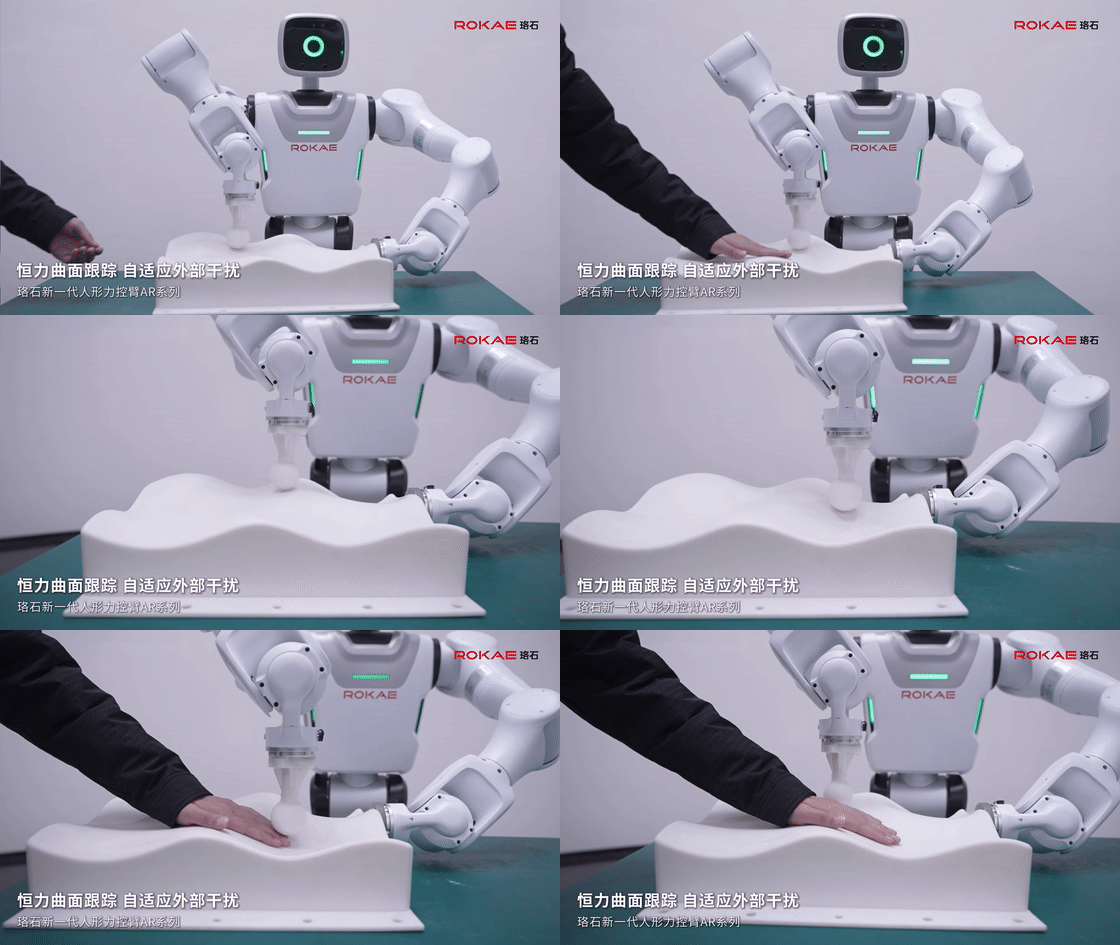
| Embodied Intelligent Robots | Human.X humanoid series (launched 2025); ROKAE Brain model | Top 5 domestic | 6.3% revenue share; per CIC, one of the earliest large-scale commercializations in consumer electronics |
| Core Control Platform | xCore control system · ROKAE+ open ecosystem | Shared foundation | Reused across all three product lines; 185 registered patents (93 invention, 63 utility model, 29 design) |
Customer diversification and overseas expansion: Rokae supplies robots and solutions to more than 1,000 customers across over 40 countries, with roughly 90% of revenue derived from manufacturing customers — automotive, 3C electronics, and general manufacturing. Notable clients include Xiaomi, GoerTek, Valeo, and Foton Cummins. The top five customers accounted for only 21.5% of revenue (with the single largest customer at 5.2%), indicating limited customer-concentration risk. Overseas customers contribute roughly 9% of revenue but at higher gross margins than the domestic business, with Europe and Asia the principal overseas markets.
Rokae raised more than RMB 1.4 billion across ten private funding rounds between 2015 (Angel) and 2024 (Strategic+), before securing an additional HK$875 million (approximately US$112 million) through its July 2026 listing on the Hong Kong Stock Exchange under Chapter 18C, the specialist technology company listing regime. Later-stage participation by a state-backed industrial fund alongside major private conglomerates is a notable feature underpinning capital-market confidence in the name.
Meihua Chuangtou provided the company’s initial outside capital, funding the earliest phase of proprietary control-system development by the three-person founding team.
Led by Qingkong Yinxing with follow-on participation from Delian Capital. The round coincided with the company’s expansion from three to more than 130 employees and the buildout of its 20,000-square-meter Shandong production base.
Led by Shunwei Capital, founded by Lei Jun, with follow-on participation from GSR United Capital and Jinshajiang Capital. The round accompanied the launch of the xMate series, a cabinet-free, integrated-design cobot with torque sensors built into each joint, and financed the expansion of the collaborative robotics business.
Invested by Xianghe Capital, deployed toward commercialization of the industrial and collaborative robot product lines.
Co-led by Shenzhen Capital Group and Yuanyi Investment. Proceeds supported the buildout of simultaneous mass-production capability across all three multi-joint robot categories.
Funded by New Hope Group (listed on the Shenzhen Stock Exchange), a strategic round earmarked for intelligent-manufacturing upgrade scenarios. New Hope affiliate Nanfang Xiwang subsequently remained a key external shareholder, holding approximately 6.96% at listing.
Jointly backed by the National Manufacturing Transformation and Upgrading Fund and the Zoucheng New Kinetic Energy Industry Investment Fund. The largest private round in the company’s history, earmarked for market development, international expansion, product upgrades, and operational refinement. The national-level fund subsequently emerged as Rokae’s largest single external shareholder at listing, holding approximately 9.67%.
China International Capital Corporation (CICC) and Guotai Junan International served as joint sponsors on the issuance of 23,031,900 H shares at an offer price of HK$38.00 (10% allocated to the Hong Kong public offering). Cornerstone investors GF Fund Management, Huatai Capital, Financial Street Capital, Yishao Capital, and All View Fund committed a combined US$35.08 million, representing 31.4% of the offering. Shares opened at HK$38.02 on debut (July 9, 2026) and rose intraday to roughly HK$41.8 (approximately +10%), lifting market capitalization to approximately HK$10.9 billion. Net proceeds of HK$810.5 million were earmarked roughly 40% to R&D, 30% to overseas sales-network expansion, 8% to strategic investment, and 10% to working capital.
China’s robotics market remains led at the high end by global majors Fanuc, ABB, KUKA, and Yaskawa, alongside a large field of domestic manufacturers — including Estun, Siasun, JAKA, and AUBO — competing across the industrial and collaborative robot segments. Within this landscape, Rokae’s differentiation rests on three pillars: breadth of product portfolio, reusable technology architecture, and capital-market validation.
Per CIC, Rokae is the only Chinese manufacturer that mass-produces both industrial and collaborative robots (multi-joint robots) at scale, and it is the only HKEX-listed robotics company to also house embodied-intelligent robots within the same listed entity. Relative to single-product peers, this structure offers a natural revenue-diversification hedge across category-specific downturns.
All three product lines are built on a shared foundation comprising the xCore control platform, the ROKAE Brain embodied-AI training platform, and the ROKAE+ open ecosystem. Because new products iterate on shared infrastructure rather than starting from scratch, the architecture is a structural source of both R&D efficiency and cost competitiveness.
The company holds 185 registered patents, including 93 invention patents, and states it has established technical barriers in joint-force control, integrated force-control joints, and safety control. More than 80% of R&D staff hold a master’s degree or above, with a significant share drawn from Tsinghua, Peking University, and the University of Tokyo, among other leading institutions.
Per CIC, Rokae represents one of the industry’s earliest large-scale commercializations of embodied-intelligent robots within the consumer electronics sector. Shipments of more than 2,000 embodied-intelligent units in a single quarter provide early real-world validation across dynamic factory operations and equipment-maintenance use cases.
Rokae serves more than 1,000 customers across over 40 countries, with its top five customers representing only 21.5% of revenue (the single largest at 5.2%), limiting exposure to any individual customer’s order pattern. A client roster that includes leading consumer electronics and automotive names such as Xiaomi, GoerTek, and Valeo also serves as third-party validation of product quality.
The National Manufacturing Transformation and Upgrading Fund is the largest single external shareholder at listing (approximately 9.67%), while major private and venture investors — New Hope affiliates and Shunwei Capital among them — participated across successive pre-IPO rounds. The dual endorsement of a state-level fund and a diversified cornerstone base (GF Fund, Huatai Capital, and others) underpins market confidence in the technology roadmap and governance structure.
Third-party industry perspective: Shao Tianlan, CEO of rival Mecalmind, has previously observed in press remarks that the market contains both well-engineered products from major foreign players and domestic firms that rely on government subsidies or personal networks to sell, but that Rokae is among the few domestic manufacturers that genuinely understands the underlying technology and invests in real research, with controller performance regarded as domestically leading. The broader shift in Hong Kong’s 2026 robotics-listing wave — away from single-product “hit” narratives and toward platform-scale players with full-stack technical capability — is also a favorable industry backdrop for Rokae’s positioning.
As of its July 2026 HKEX Chapter 18C listing, Rokae is delivering both rapid revenue growth (42.8% CAGR from 2023–2025) and improving gross margin (11.4% to 21.9%), yet the company remains loss-making. Net loss narrowed modestly to RMB 179.3 million in 2025 from RMB 191.8 million a year earlier, while some Chinese-language media have reported cumulative losses of approximately RMB 677 million over the trailing three-and-a-half years.
Opportunities include: ▲ shipments of more than 2,000 embodied-intelligent robots in Q1 2026 alone, suggestive of an inflection point in commercialization; ▲ a confirmed order backlog of RMB 577.3 million as of March 31, 2026, indicating resilient underlying demand; ▲ roughly 70% of net IPO proceeds earmarked for R&D and overseas sales-network expansion, signaling clear intent to scale globally; ▲ the participation of the National Manufacturing Transformation and Upgrading Fund and other state-level capital, consistent with policy tailwinds around manufacturing automation and demographic-driven robotics demand; and ▲ the roughly 10% intraday debut-day gain, which points to healthy investor demand at listing.
Risks include: ▲ continued net losses alongside a structural decline in R&D spending as a share of revenue (22.2% → 16.7% → 12.6%); ▲ a still-modest 0.9% revenue share among domestic Chinese suppliers in the industrial robot segment, reflecting Rokae’s scale disadvantage relative to the broader market; ▲ intensifying multi-front competition from global majors Fanuc, ABB, KUKA, and Yaskawa as well as domestic rivals including Estun, Siasun, and JAKA; ▲ an embodied-intelligent robotics business still at an early commercialization stage with an unproven long-term profitability model; ▲ approximately 90% revenue concentration in manufacturing customers, exposing the business to China’s manufacturing capex cycle; and ▲ a governance structure in which founder Tuo Hua controls approximately 38.78% of aggregate voting power via employee shareholding platforms, warranting attention to minority-shareholder protections.