
VAST (Tripo AI)
China’s 3D-foundation-model unicorn — how a MiniMax co-founder’s bet on “democratizing 3D content” crossed a $1 billion valuation in just three years
VAST (Chinese corporate name: 三启万物) is an AI 3D foundation model company founded in March 2023 in Beijing, operating through a Cayman Islands holding structure that supports international fundraising and global commercial expansion. Core research and development functions are based in Beijing and Hangzhou, and the company has more recently established a San Francisco presence to serve its North American and European client base directly. Its flagship product, Tripo AI, is a family of foundation models that convert text prompts, images, and sketches into fully textured, production-ready 3D meshes within seconds to minutes. Since its public launch in 2024, Tripo has emerged as one of the most closely watched platforms in the global 3D generative AI category.
Song studied Middle Eastern studies, international politics, and economics at Johns Hopkins University, acquiring Hebrew and Arabic along the way and spending an exchange term in Israel. After returning to China in 2019, he joined SenseTime’s CEO office, where he worked alongside CEO Xu Li on multiple AIGC commercialization projects spanning the animation and gaming sectors. In 2021 he became an early co-founder of MiniMax, now one of China’s prominent AI unicorns, before identifying a structural gap in 3D generative AI and founding VAST in March 2023. He was named to the Forbes 30 Under 30 Asia list in 2026.
Su brings deep 3D engineering expertise and leads VAST’s product and production-pipeline strategy. He has been closely involved in designing professional-grade 3D content workflows, including the segmentation, texturing, and rigging capabilities embedded in Tripo Studio, and represents the company’s product-facing co-founder.
Ding holds bachelor’s, master’s, and doctoral degrees from Tsinghua University and has authored more than 50 academic papers with over 100 patents and roughly 10,000 citations. He previously led the general-model function at SenseTime and now directs VAST’s 3D foundation model architecture.
Cao joined VAST from Tencent, where he served as a principal researcher focused on 3D reconstruction. He now leads VAST’s research organization; several of the company’s core papers are co-authored with Tsinghua University researchers, reflecting the technical team’s strong roots in that institution’s talent pool.
VAST has built an end-to-end product ecosystem anchored by its proprietary 3D foundation models, an integrated creation workspace, and an emerging world-model research track. Roughly two and a half years after the launch of Tripo 1.0 in early 2024, the company reached profitability, with annual recurring revenue estimated at approximately $12 million. Founder Simon Song has described the business as currently profitable, noting that inference costs have become efficient while the larger expense now sits in training large-scale 3D foundation models.
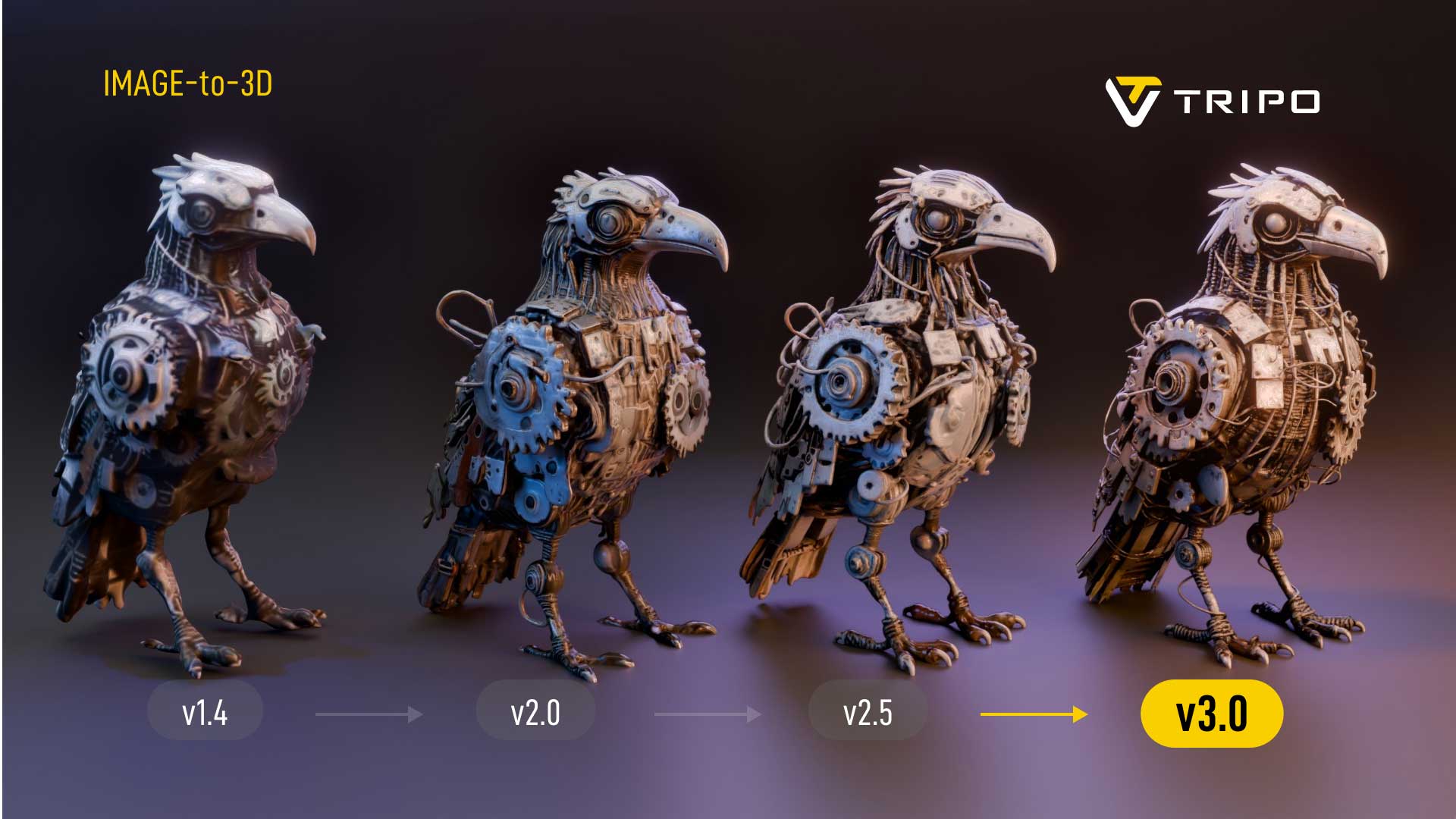
The core generative model lineage has progressed from Tripo 1.0 (2024) through 2.0, 2.5, and 3.0 — a 20-billion-plus-parameter model built on the SparseFlex architecture. In 2026, the company released Tripo H3.1, offering sculpture-grade geometric precision, followed by Tripo P1.0 (Smart Mesh), which outputs production-ready game meshes within seconds, extending VAST’s technical lead.
Tripo Studio consolidates the full 3D production workflow — generation, segmentation, texturing, rigging, and optimization — into a single workspace. Features such as automated part segmentation, an AI texture brush, one-click export to USD/FBX/OBJ/STL, and automated rigging (UniRig) deliver substantial productivity gains over traditional DCC software.
Project Eden adopts a proprietary architecture that natively decouples underlying state simulation from visual rendering. The project aims to move beyond static 3D asset generation toward persistent, explorable, interactive virtual environments, and was formally unveiled in June 2026.
Open-Source Ecosystem Strategy: VAST co-released TripoSR with Stability AI in March 2024 — a model capable of single-image-to-3D conversion in roughly 0.5 seconds — and has since open-sourced a sequence of research outputs including TripoSG, TripoSF, UniRig, and HoloPart. UniRig in particular has become a de facto standard in the open-source 3D auto-rigging space, with multiple outputs integrated into mainstream creative tools such as Blender and ComfyUI. This open strategy secures technical mindshare within the developer community while functioning as a natural on-ramp into VAST’s commercial platform.
Client base: Global enterprises including Tencent, NetEase, ByteDance, Microsoft, Sony, HTC, and Popmart access Tripo’s 3D generation models via API to integrate them into their own product pipelines, alongside a technology partnership with Stability AI. Use cases span game and animation asset production, physical product design for 3D printing (footwear, furniture, figurines), industrial design, and the generation of training data for VR and embodied-AI applications.
Since its founding in 2023, VAST has completed six rounds of financing over roughly three years and four months, raising more than $450 million cumulatively, and crossed a $1 billion valuation in June 2026 to become the first unicorn in China’s 3D generative AI category. Early rounds were led by domestic Chinese venture capital and Tsinghua alumni-affiliated seed funds; from the Series A onward, strategic industrial capital such as Alibaba and SAIC Motor entered; from Series A+ onward, a state-backed insurer-affiliated fund and large crossover investors joined; and the most recent Series A3 drew strategic capital spanning the automotive, gaming, and internet sectors led by Geely Capital — a progressive broadening of the investor base across each successive round.
VAST’s first institutional financing came shortly after founding, led solely by Oasis Capital. The company faced significant early fundraising headwinds amid a broader capital-market slowdown and investor caution toward the then-nascent 3D generative AI category; Song is reported to have paused active fundraising to prioritize team-building and technology development instead.
Fortune Capital and Chun Hua Capital co-led this round, with Innoangel Fund and the Tsinghua Alumni Seed Fund following on. Combined with the angel round, this represented the largest cumulative disclosed financing in China’s 3D foundation model category at the time, and the proceeds were directed toward development of the Tripo 2.0 model.
The Beijing Municipal AI Industry Investment Fund led this round, with Jingya Capital participating. The financing coincided with the official launch of Tripo Studio, the world’s first all-in-one AI 3D workstation, and the start of Tripo 3.0 development, funding the build-out of VAST’s end-to-end “foundation model + ecosystem plugins + native workspace” product architecture.
China’s largest technology company, Alibaba, co-led alongside automaker SAIC Motor, with new participation from Yuanhe Puhua, Baidu Ventures, and Dongfang Jiafu, plus continued investment from existing backers Chun Hua Capital and the Beijing Municipal AI Industry Investment Fund. The combined entry of automotive and big-tech strategic capital signaled market recognition that VAST’s 3D generation technology carries potential well beyond gaming and animation, extending into adjacent industries such as autonomous-driving simulation and industrial design.
INCE Capital co-led alongside a Yangtze River Delta technology fund affiliated with state-backed insurer China Life, with participation from Genesis Capital, Eminence Ventures, and Primavera Venture Partners. The round pushed VAST’s valuation to at least $1 billion, making it the first unicorn in China’s 3D generative AI category; some sources placed the valuation as high as $1.5 billion. The financing was announced alongside the official unveiling of the world-model project Project Eden.
Automaker Geely’s investment arm, Geely Capital, led this round, joined by gaming companies 4399 Network, Tanwan, and Giant Network; a major internet company’s strategic investment arm; and Fosun Capital, Orinno Capital, CoStone Capital, Addor Capital, T-Capital, and Muhua Tech Ventures, spanning the automotive, gaming, internet, and broader technology sectors. Existing shareholders INCE Capital and Genesis Capital also increased their positions, reaffirming continued confidence. The simultaneous participation of strategic capital from both the automotive (intelligent manufacturing and simulation) and gaming (interactive content) sectors suggests that VAST’s 3D foundation model and world-model technology is increasingly recognized as core infrastructure across multiple industries.
• Founding–2025 (Angel–Pre-A+): Led primarily by domestic Chinese VCs and government-affiliated funds; cumulative financing in the hundreds of millions of RMB (tens of millions of USD)
• Series A (Mar 2026): $50M — first entry of big-tech and automotive strategic capital (Alibaba, SAIC)
• Series A+/A++ (Jun 2026): ~$200M — valuation crosses $1B, unicorn status achieved
• Series A3 (Jul 2026): $150M — strategic capital converges across automotive, gaming, and internet sectors
• Total cumulative funding: approximately $450M+ (Mar 2023–Jul 2026, including estimated undisclosed early-round amounts)
VAST’s competitive defensibility rests on four pillars: a 3D foundation model architecture that has matured through successive generations, developer-ecosystem capture through an open-source strategy, strategic capital alignment spanning the automotive, gaming, and internet sectors, and an expansion beyond static 3D asset generation into world models. These pillars have helped VAST maintain a technical and commercial lead even as larger players — including Tencent (with its open-sourced Hunyuan 3D), Alibaba (with its world model Happy Oyster), and Fei-Fei Li’s World Labs — increasingly enter the space.
From Tripo 1.0 through the 20-billion-plus-parameter Tripo 3.0 to P1.0, which generates production-ready meshes for game engines within seconds, VAST has consistently prioritized pipeline-ready output over demo-quality visuals. Resolving the chronic problems that plagued earlier AI-generated 3D content — excessive polygon counts, disorganized topology, and poor UV unwrapping — has been the primary driver of adoption among studios and game developers.
Beginning with the co-released TripoSR with Stability AI, VAST has embedded itself deeply within mainstream creative-tool ecosystems such as Blender and ComfyUI. UniRig, in particular, has become the de facto standard in open-source 3D auto-rigging, forming a natural traffic funnel into the commercial Tripo Studio platform and functioning as a structural advantage.
The simultaneous participation of big-tech and automotive strategic investors (Alibaba, SAIC, Geely) alongside major gaming companies (4399, Tanwan, Giant Network) reflects recognition that VAST’s technology serves as core infrastructure across both content (gaming, animation) and industrial (intelligent manufacturing, simulation) use cases. These strategic investors go beyond capital provision, reinforcing VAST’s commercial moat through real-world adoption within their own pipelines.
Project Eden’s proprietary architecture, which natively decouples underlying state simulation from visual rendering, represents a strategic repositioning of VAST from a 3D asset generation company into a world-model company building explorable virtual environments. As well-capitalized competitors such as World Labs and Alibaba pour resources into similar territory, the data and technology assets VAST has accumulated through its existing 3D asset generation pipeline may provide a structural head start relative to later entrants.
• Intensifying competition: Well-capitalized entrants — Tencent (open-sourcing Hunyuan 3D), Alibaba (world model Happy Oyster), and Fei-Fei Li’s World Labs (which has raised over $1 billion) — are rapidly raising the competitive intensity in the 3D generative AI category.
• Profitability-versus-investment balance: While VAST has reached profitability with ARR of roughly $12 million, training costs for large-scale 3D and world foundation models remain structurally high, which may sustain the need for continued large financing rounds.
• Geopolitical exposure: As a China-based company, VAST is not fully insulated from U.S. export controls on advanced AI semiconductors, and its compute-sourcing strategy could become a variable in its medium-term technical competitiveness.
• Unproven consumer business: The company’s earlier “3D TikTok” concept, the Holy Moly app, achieved limited traction due to production-difficulty constraints, and the viability of a UGC-driven mass-consumer platform remains unproven.