
Joulent
From activist hedge fund to power-infrastructure builder — Engine No. 1’s multi-gigawatt generation platform for the AI era
Joulent, LLC is a technology-driven energy company headquartered in Houston, Texas, which announced its official launch on June 22, 2026. The company’s true origins, however, trace back considerably further. Joulent was quietly developed over roughly three years by investment firm Engine No. 1 in strategic collaboration with GE Vernova — meaning that by the time the company first surfaced publicly, it already possessed substantial capital backing, industrial partnerships, and an executable project pipeline.
Born and raised in the coal-mining town of Harrisburg, Illinois, James earned a B.A. in Economics from Tulane University, where he also chaired the university’s Investment Committee for twelve years. He began his career at JGM Management, later working as an analyst at Ethos Capital (subsequently merged into Moore Capital Management) and serving on the Management Committee of Pequot Capital Management. He co-founded Andor Capital Management and subsequently founded his own hedge fund, Partner Fund Management, where he served as co-managing partner and portfolio manager. Along the way he personally founded several natural-resources companies, including White Oak Resources, Pin Oak Mt. Airy, Pin Oak Corpus Christi (co-founded), and Greenfield Holdings.
Engine No. 1 has since repositioned itself as a holding company centered on U.S. reindustrialization and next-generation infrastructure, led by President and COO Erik Belz and Charlie Penner (formerly of Jana Partners), who heads active engagement. James also serves as founding board chair of Tipping Point Community (a San Francisco-based poverty-fighting organization) and as Vice Chair of the National Fish and Wildlife Foundation, continuing to cultivate an identity as an impact-oriented capitalist. In announcing his role as Joulent’s CEO, James stated that “leadership in the AI era will be determined by who can deliver energy and compute the fastest, most reliably, and at the lowest cost,” framing the company’s purpose around closing the widening gap between America’s innovation-driven demand for power and the pace at which new power infrastructure is actually being built.
Joulent is a technology-driven energy company built to meet the explosive power demand of AI and advanced computing. Its core business model centers on rapidly delivering reliable baseload power to large-load customers such as data center operators. The company draws on generation equipment and operational infrastructure expertise from its core partner GE Vernova (NYSE: GEV), while its collaboration with Chevron (NYSE: CVX) secures the natural-gas fuel supply chain underpinning its projects.
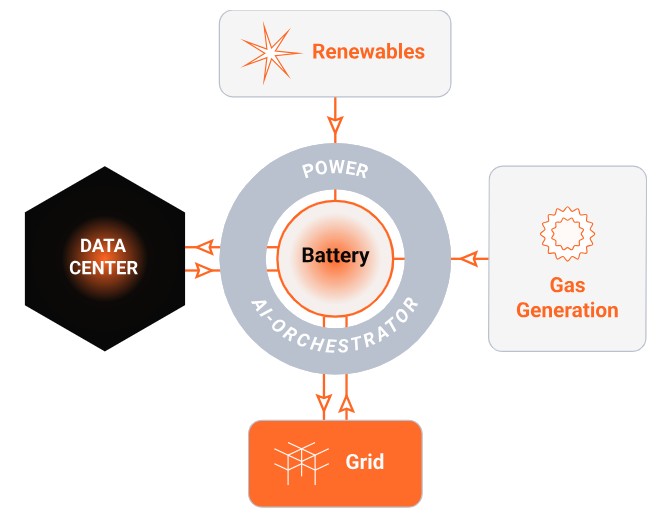
A modular approach that co-locates large-scale new generation directly with customer demand (such as data centers), eventually connecting to the regional grid in phases. This design allows rapid scaling to multi-gigawatt campuses without straining existing grids, while over time creating exportable capacity that can support local power markets.
A roughly 2.67GW natural-gas power project located near Pecos, Texas. Large GE Vernova turbines serve as the primary generation source, with supplemental capacity from Solar Turbines, a Caterpillar subsidiary. Kilby delivers power directly to a Microsoft-operated data center campus under a 20-year PPA. The project is being developed and operated by Chevron subsidiary Energy Forge One, with Joulent holding a 50% ownership stake.
While current operations center on natural-gas baseload generation, the business model is built to incorporate renewable energy sources in phases, beginning with solar. This expansion of clean generation capacity, alongside a broader project pipeline, forms one pillar of the company’s medium- to long-term growth strategy.
Community-conscious design at Kilby: The project is designed to use non-potable, brackish groundwater rather than freshwater for cooling and operations, and Chevron is also exploring the reuse of produced water generated from its oil and gas operations. Chevron’s Final Investment Decision (FID) is expected by the end of 2026, with first power projected for late 2027 to early 2028. Total first-phase investment is estimated at roughly $7 billion to $9 billion.
A strategic partnership network: Joulent operates atop a three-way partnership structure — GE Vernova for equipment and engineering, Chevron for fuel supply and project development (through its Energy Forge subsidiary), and National Grid for capital and grid operations expertise — anchored by a long-term customer relationship with Microsoft, which has committed to a 20-year contract. The simultaneous presence of capital, equipment, fuel, and demand at the company’s outset is a structural hallmark that distinguishes Joulent from typical power-infrastructure startups.
Rather than following a conventional venture capital fundraising path, Joulent has drawn on a distinctive combination of Engine No. 1’s own development capital and strategic equity investment from industrial partners. After roughly three years of quiet, private development, the company unveiled its first commercial contract (the Microsoft PPA) at its official launch in June 2026, and just nine days later, on July 1, secured a $1.75 billion strategic minority investment from National Grid — formalizing the capital markets’ confidence in the platform.
Engine No. 1 began developing multi-gigawatt power infrastructure in strategic collaboration with GE Vernova. During roughly three years of development away from public view, the firm worked alongside Chevron to shape what would later become the West Texas power project known as “Project Kilby.”
Joulent formally announced its launch as a technology-driven energy company on the same day that Chevron subsidiary Energy Forge One and Microsoft revealed a 20-year power purchase agreement for the 2.67GW Project Kilby. This coordinated dual announcement meant Joulent debuted to the market already backed by a validated anchor project and anchor customer, with large GE Vernova turbines adopted as the primary generation equipment.
Deal structure: UK-based utility major National Grid, through its investment arm National Grid Ventures, made a $1.75 billion strategic minority investment in Joulent. The capital strengthens Joulent’s ability to execute its current multi-gigawatt project, advance its broader project pipeline, and scale organizational capabilities. The investment coincided with the formal confirmation of Joulent’s 50% ownership stake in Project Kilby.
Strategic significance: National Grid CEO Zoë Yujnovich characterized the investment as “partner-led capital directed at contracted, critical infrastructure supporting the AI-driven large-load economy,” emphasizing that it diversifies the company’s U.S. geographic exposure while offering long-term contracted cash flows and attractive risk-adjusted returns. National Grid brings deep expertise in high-voltage transmission, system integration, and project execution, along with critical supply-chain capabilities, to the partnership.
A market-confidence signal: GE Vernova Chief Commercial Operating Officer Pablo Koziner described National Grid as a key customer across the U.S. and Europe, calling the investment a signal of confidence in Joulent and of the strength of the collaboration among the partners.
• Investment size: $1,750,000,000 (strategic minority stake, via National Grid Ventures)
• Kilby project stake: Joulent holds a formalized 50% interest (co-developed with Chevron subsidiary Energy Forge and GE Vernova)
• Kilby generation capacity: Approximately 2.67GW, underpinned by a 20-year Microsoft PPA
• Kilby estimated investment: Approximately $7B–$9B (Phase 1) · FID expected end of 2026 · First power expected late 2027–early 2028
• Core partnerships: GE Vernova (equipment) · Chevron (fuel, development) · National Grid (capital, grid operations) · Microsoft (anchor customer)
Joulent’s competitive moat rests on a founding team with a demonstrated track record of executing large-scale infrastructure initiatives, a layered set of strategic partnerships spanning generation equipment, fuel supply, and capital, an already-secured anchor customer and anchor project, and a business model deliberately engineered to minimize strain on existing power grids. As competition intensifies to supply power for AI infrastructure, Joulent’s ability to line up capital, equipment, fuel, and demand simultaneously at launch gives it a structurally favorable starting position relative to later entrants.
Chris James and Engine No. 1 have already demonstrated the ability to exert real influence over the governance of a major energy incumbent, through the symbolic victory of reshaping ExxonMobil’s board. The firm’s evolution from external pressure-based activism to directly building infrastructure — including three years of quiet project development — suggests a capacity to methodically prepare capital-intensive, large-scale projects rather than chase short-term outcomes.
Joulent has simultaneously secured partnerships with top-tier players in each critical domain: GE Vernova for turbines and equipment, Chevron for natural-gas fuel supply and project development, and National Grid for capital and high-voltage transmission expertise. This is a resource combination that a typical early-stage power-infrastructure company would struggle to assemble independently, providing an advantage in both execution speed and credibility relative to competitors.
Securing a 2.67GW, 20-year PPA with Microsoft — a top-tier hyperscaler — at the moment of its official launch represents an unusually early form of validation for a power-infrastructure startup. The cash-flow visibility that comes from a long-term fixed contract underpins confidence for follow-on capital raises and the expansion of its future project pipeline.
By co-locating new generation directly with the point of demand, Joulent’s model minimizes the strain and rate-pressure that surging AI data-center power demand can place on existing regional grids — a design that directly addresses community and regulatory concerns. Its modular structure enables rapid scaling to multi-gigawatt capacity while ultimately allowing surplus capacity to be exported into local markets.
What the National Grid partnership signals: The fact that a major utility chose to go beyond a purely financial investment and directly contribute high-voltage transmission operating expertise and supply-chain capabilities suggests a belief that Joulent’s business model can function as “contracted infrastructure” generating stable long-term returns, not merely a power-plant development play. This makes Joulent one of the few AI-power-infrastructure ventures to have earned simultaneous confidence from a utility, an oil major, an equipment manufacturer, and a hyperscaler.
As a privately held LLC, Joulent does not publicly disclose its financial results, and formal disclosure of its valuation and revenue structure remains limited. Its flagship project, Kilby, also remains contingent on Chevron’s Final Investment Decision (FID), expected by the end of 2026 — meaning the project has not yet been finalized, and permitting, environmental review, and construction risks still lie ahead before actual groundbreaking and commercial operation.
Opportunities include ▲ a structural demand backdrop in which global AI capital expenditure is estimated at roughly $725 billion in 2026, with power supply identified as one of three critical bottlenecks alongside memory and optical bandwidth; ▲ simultaneous validation from top-tier players in each relevant domain — Microsoft, GE Vernova, Chevron, and National Grid; ▲ the community and political goodwill implied by Kilby’s projected tax contribution (over $10 billion) and job creation (roughly 2,000 positions); and ▲ the potential to expand a follow-on project pipeline through the modular, scalable design of the Across-the-Meter™ model.
Risks include ▲ execution uncertainty around Project Kilby itself, given that Chevron’s FID has not yet been finalized; ▲ the fact that generation announced to date is natural-gas-centric, which may draw mixed market reaction given Engine No. 1’s prior positioning as a climate-focused activist investor; ▲ customer concentration, with the first project anchored entirely around a single customer, Microsoft, making future customer diversification an important task; ▲ limited financial transparency stemming from its private company structure; ▲ supply-chain, labor, and permitting-delay risks inherent to large-scale gas-generation infrastructure construction; and ▲ intensifying competition from other hyperscalers’ in-house generation projects and emerging power-infrastructure entrants all vying to supply data-center power.