
Bending Spoons S.p.A.
The Milan-based “acquire, rebuild, operate” model behind the revival of AOL, Evernote, Vimeo, and WeTransfer — thirteen years after founding, the company debuted on Nasdaq at an ~$18.4B valuation in one of Europe’s largest tech IPOs to date
Bending Spoons S.p.A. was co-founded in 2013 in Copenhagen, Denmark by a team of five — four Italian engineers and one Polish co-founder — before relocating its headquarters to Milan, Italy the following year. The company launched with roughly $40,000 in personal capital and, over the following decade, built a distinctive strategy of acquiring, rebuilding, and operating digital businesses. That model has since carried the company to a valuation of approximately $18.4 billion at the time of its Nasdaq listing in July 2026, making it one of the largest private-to-public technology companies to emerge from Europe.
Raised on a farm in a small town of roughly 900 residents in northeastern Italy, Ferrari earned a bachelor’s degree in information engineering and a master’s in electrical and electronics engineering from the Università degli Studi di Padova before being selected for a scholarship-funded dual-degree program in telecommunications engineering at the Technical University of Denmark, which brought him to Copenhagen. It was during this exchange program that he met the colleagues who would become his co-founders, and he also spent a brief period as a consultant at McKinsey & Company. His first venture, an automated journaling app called Evertale, failed to find product-market fit and was wound down in 2013; the roughly $40,000 in remaining capital became the seed funding for Bending Spoons, founded that same year. The company’s name is drawn from the scene in *The Matrix* in which a boy bends a spoon through willpower alone — a fitting symbol for a business built on reshaping underperforming digital assets into higher-value ones. As Chairman and CEO, Ferrari oversees the company’s overall acquisition and operating strategy, and is reported to maintain an internal governance practice of soliciting an annual anonymous survey from his direct reports and institutional investor partners on whether he remains the right person to lead the company.
A fellow co-founder from Padua, Patarnello leads deal sourcing, valuation, and execution as the company’s head of acquisitions. He is also known for winning a charity-auction business lunch with Riccardo Zacconi, founder of Candy Crush developer King, and is credited with actively leveraging industry relationships to build the company’s acquisition pipeline.
Danieli and Querella, from Vicenza and Turin respectively, along with Greber — a Polish national and the only non-Italian member of the founding team — rounded out the original group. Following the company’s $11 billion valuation round in October 2025, all four Italian co-founders became billionaires; the Bloomberg Billionaires Index has since estimated each of their net worths at more than $2 billion following the IPO.
Ferrari’s precise hometown within the Veneto region, along with the individual equity stakes and net-worth estimates attributed to the five co-founders, vary across media sources and have not been directly disclosed by the company. The founder background in this report reflects a cross-check of multiple secondary sources, including Forbes, Bloomberg, and Grokipedia; investors should refer to the management biography section of the original SEC F-1/424B4 registration statement for authoritative detail.
Bending Spoons describes itself not as a traditional software developer but as an “acquirer, transformer, and operator of digital businesses.” The model breaks down into three repeating steps: (1) acquiring digital assets that have stalled or are underperforming in the market; (2) applying its proprietary “Platform” — a deliberately selective workforce (internally called “Spooners”), purpose-built technology spanning data infrastructure, experimentation tools, and AI-driven systems, and proprietary data accumulated across the portfolio — to fundamentally redesign each asset’s product, marketing, and monetization; and (3) reinvesting the resulting profits into the next acquisition. The company states it has not divested a material business since its founding, a discipline the market has come to interpret as a “hold forever” strategy distinct from the buy-and-sell logic of a typical private equity rollup.
Core Portfolio Assets:
A legacy internet brand acquired from Apollo Global Management, now operated as an integrated email, news, and search business. This was the company’s largest transaction to date, financed through a $2.8 billion debt facility.
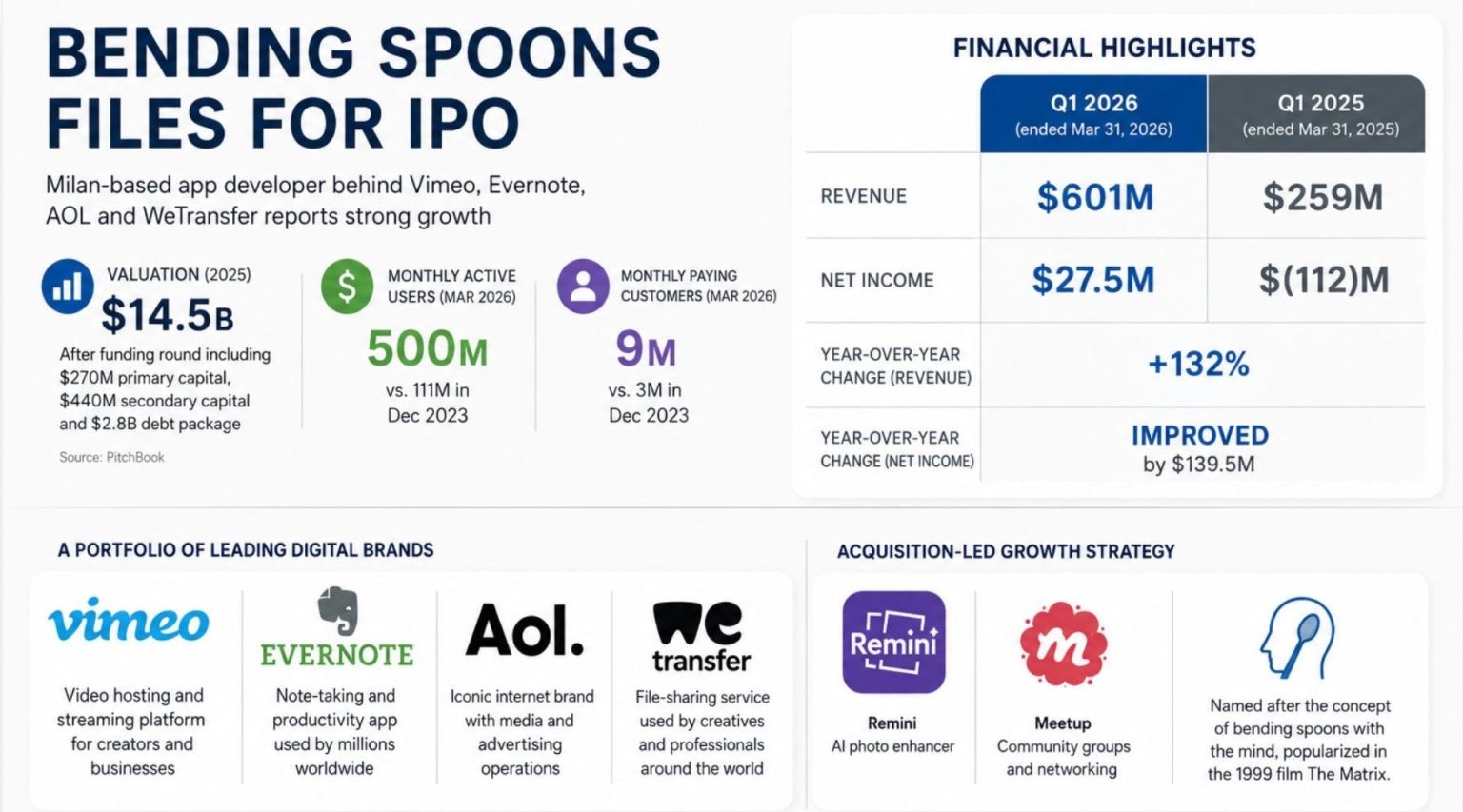
Vimeo, formerly Nasdaq-listed, was taken private for $1.38 billion, while video platform Brightcove was acquired in an all-cash deal for $233 million, extending the portfolio’s reach in video hosting and streaming.
Evernote, once a Silicon Valley unicorn productivity app (acquired 2023), and file-transfer service WeTransfer (acquired 2024) were both rebuilt through subscription repricing and tighter free-tier limits designed to lift paid conversion.
An event creation and ticketing platform added to the portfolio in a recent acquisition, broadening the company’s exposure to both consumer and business event markets.
AI-powered photo and video enhancement app Remini and live-streaming/recording tool StreamYard (formerly Hopin) give the company a foothold in AI consumer products and creator tools.
Outdoor navigation app komoot and time-tracking SaaS platform Harvest give the company a balanced mix of consumer and B2B subscription assets.
Financial Performance (per SEC Form 424B4 registration statement): Annual revenue grew from $387 million in 2023 to $671 million in 2024 and $1.31 billion in 2025 — an 84% three-year CAGR — while Q1 2026 revenue rose 132% year-over-year to $601.3 million. Fiscal-year 2025 gross profit was $857.3 million and operating income was $277.9 million, though net income remained near breakeven at a loss of $0.2 million. In Q1 2026, the company reported net income of $27.5 million, swinging from a net loss of $112.2 million in the prior-year quarter.
Some media coverage from July 2026 cites full-year 2025 revenue of $2.6 billion and net income of $500 million — figures that differ materially from the official numbers in the SEC-filed 424B4 registration statement (revenue of $1.31 billion, near-breakeven net income of $(0.2) million). This report treats the SEC filing as the primary source and includes the media figures only as an unverified reference point. Investors should consult the original financial statements on SEC EDGAR directly.
Operating Metrics and AI Utilization: As of March 2026, 65% of revenue was generated in North America and 21% in Europe, with subscription revenue accounting for 84% of the total (advertising 12%, other 4%). Company-wide net revenue retention (NRR) stood at 94%, with meaningful variance by asset — AOL at 95%, Evernote at 99%, and StreamYard at 91% — while Remini trailed at a comparatively lower 87%. Revenue-weighted average subscriber tenure reached 8.0 years, and 48% of subscription revenue came from customers with five or more years of tenure. Notably, 83% of new-customer revenue was generated through organic channels rather than paid marketing. On the engineering side, more than 90% of code pull requests in Q1 2026 were AI-authored or AI-assisted (with roughly 70% authored by AI alone) — a factor cited as central to lifting revenue per employee to roughly $2.6 million.
Bending Spoons operated as an effectively fully bootstrapped company through 2021, growing solely through the reinvestment of its own profits. Following its first institutional round in 2022, the company’s capital structure evolved rapidly through 2025 — from small-scale equity investments to a mix of large-scale debt and equity financing — before culminating in a Nasdaq listing in July 2026, thirteen years after founding. Notably, in the second half of 2025, the debt financing behind the AOL acquisition ($2.8 billion) and a $710 million equity round were announced within 48 hours of each other, propelling the company into the ranks of Europe’s largest “decacorns” (companies valued above $10 billion).
Founded in Copenhagen in 2013, with headquarters relocated to Milan in 2014. Beginning with its first acquisition — a keyboard-customization app for $10,000 — the company expanded its app portfolio purely through profit reinvestment, without outside institutional capital. In 2020 it developed and provided “Immuni,” a COVID-19 contact-tracing app, to the Italian government, and in 2021 it was ranked 79th on the Financial Times FT1000 list of Europe’s fastest-growing companies.
The company’s first major institutional round, with participation from leading Italian banks Banco BPM and Intesa Sanpaolo alongside Creator Capital Partners. The proceeds funded the Evernote acquisition (roughly $200 million), agreed in 2022 and completed in early 2023. Global and Italian investors including Baillie Gifford, Cox Enterprises, Durable Capital Partners, NB Renaissance, Nuo Capital, and Tamburi Investment Partners joined in subsequent closings through March 2023.
A new $155 million round valued the company at $2.55 billion, making it the second company from Italy’s startup ecosystem to reach unicorn status. Around this period, the company sequentially acquired Meetup (early 2024), Mosaic Group, and StreamYard (formerly Hopin).
The company acquired Meetup, Mosaic Group, and StreamYard in the first half of 2024, followed by WeTransfer and Issuu in the second half. In November, it acquired video platform Brightcove — a former Nasdaq-listed company — in an all-cash take-private transaction valued at $233 million. The company’s valuation was assessed at approximately $2.8 billion during this period.
In March 2025, the company secured a $600 million direct-lending facility with participation from Silver Point Capital and others; in August, it drew a €500 million venture-debt facility from a global banking syndicate comprising JPMorgan, BNP Paribas, Crédit Agricole, Banco BPM, BofA, Goldman Sachs, HSBC, Intesa Sanpaolo, Mizuho, Société Générale, and Wells Fargo. This capital underpinned the major acquisitions that followed — Vimeo, komoot, Tractive, and AOL.
Just two days after financing its acquisition of AOL from Apollo Global Management with $2.8 billion in debt, the company announced a $710 million equity round led by T. Rowe Price Investment Management, with participation from Baillie Gifford, Cox Enterprises, Durable Capital Partners, Fidelity Management & Research, Foxhaven Asset Management, and Radcliff. Of the total, $270 million was primary (new share issuance) and $440 million was secondary (existing shareholder sales), with the round valuing the company at an $11 billion pre-money valuation — roughly four times its 2024 level of $2.8 billion. This round pushed all four Italian co-founders into billionaire status and made the company one of the small number of European “decacorns” — companies valued above $10 billion.
Institutional bookbuilding opened on June 15, 2026, and following SEC registration effectiveness on June 30, the IPO priced at $29.00 per share — above the marketed range of $26 to $28. A total of 57,971,015 ordinary shares were offered, comprising 34,398,640 primary shares from the company and 23,572,375 shares from selling shareholders, for total gross proceeds of approximately $1.68 billion (some earlier press reports cited a figure closer to $1.7 billion). The company plans to direct roughly $933 million in net proceeds toward general operations and future acquisitions. Shares opened for trading roughly 7% above the IPO price on debut day and traded intraday in a range extending from the high-$30s into the $40s. Goldman Sachs International, J.P. Morgan, and Allen & Company served as joint lead book-running managers, with Wells Fargo, BofA, Jefferies, Evercore ISI, BNP Paribas, Mizuho, Société Générale, Crédit Agricole CIB, Intesa Sanpaolo, UniCredit, and Banca Akros participating as joint bookrunners.
Intraday trading figures from July 1, 2026 (price movement, high/low) reflect a real-time snapshot at the time this report was prepared and may differ from the final closing price. Separately, some pre-IPO analyses reference a reported “material weakness” in the company’s internal controls over financial reporting, though the specifics have not been independently verified. The precise equity stakes and voting-rights percentages underlying the founders’ reported dual-class structure (five votes per share) should be confirmed directly against the “Principal Shareholders” and “Description of Share Capital” sections of the original SEC registration statement.
Bending Spoons’ competitive defensibility rests on an unusually selective talent base, AI-driven operating automation, a shared proprietary technology infrastructure spanning its entire portfolio, and a compounding growth structure that reinvests cash flow into new acquisitions without the exit-driven asset sales typical of private equity. Together these form a hybrid moat that does not map cleanly onto either a traditional software company or a conventional PE rollup.
The company runs an extraordinarily selective hiring process (internally, the “Spooner” model), hiring just 286 people out of roughly 800,000 applications in 2025. This is less a cost-cutting measure than a deliberate structure for concentrating the capability density needed for a small, elite workforce to rebuild multiple acquired businesses simultaneously — an efficiency reflected in revenue per employee of roughly $2.6 million, which doubled as of Q1 2026.
As of Q1 2026, more than 90% of code pull requests were AI-authored or AI-assisted (roughly 70% authored by AI alone), dramatically accelerating the modernization of acquired legacy codebases, centralization of server costs, and elimination of duplicated infrastructure. This level of automation is difficult for rival PE firms or standalone software companies to replicate in the near term, and is a central driver in compressing the full cycle time from target selection to rebuild.
The company has not divested a material asset since its founding, fundamentally distinguishing it from the typical buyout fund’s acquire-then-sell structure. Its practice of continuously reinvesting the free cash flow generated by acquired assets into the next deal has drawn comparisons to Canadian software rollup Constellation Software as a long-duration compounding story — and is cited in the market as a basis for premium valuation.
Assets such as AOL, Evernote, Vimeo, and WeTransfer are monetized primarily by defending and repricing an already-established base of long-tenured paying customers, rather than through new-user acquisition. A revenue-weighted average subscriber tenure of 8.0 years, with 48% of subscription revenue coming from customers of five years or longer, points to a high-inertia, low-churn customer base that new entrants cannot easily replicate in a short period. The fact that 83% of new-customer revenue comes through organic channels further underscores a revenue structure with limited reliance on paid marketing.
Next Growth Driver — A ~$400 Billion Reinvestable Market: The company has internally identified more than 1,000 potential acquisition targets with combined annual revenue of approximately $400 billion, and Ferrari has stated an intention to continue pursuing three to five major acquisitions per year. The roughly $933 million in net proceeds raised through the IPO is expected to fund this acquisition pipeline, suggesting the “acquire → rebuild → reinvest” compounding model that defined the company pre-IPO should remain structurally intact as a public company.
Multiple media reports indicate that Bending Spoons’ acquire-and-rebuild model typically involves substantial headcount reductions (in some cases reportedly up to 70% or more of an acquired company’s existing staff) and subscription price increases — for example, Evernote’s annual plan reportedly rose from $100 to $249 following the acquisition. Fiscal-year 2025 financial statements disclosed approximately $78.6 million in reorganization-related expenses. This practice has drawn public criticism from stakeholders, including a WeTransfer co-founder, and investors should separately weigh the potential for brand-reputation and customer-attrition risk at acquired assets.