
Xunlong Sci-Tech (鲟龙科技)
Hong Kong’s first caviar stock, twenty-three years and four failed bids in the making — the “Caviar King” behind the KALUGA QUEEN brand now commands 36% of the global caviar market
Hangzhou Qiandaohu Xunlong Sci-Tech Co., Ltd. (“Xunlong” or the “Company”) was incorporated in April 2003 in Chun’an, Hangzhou, Zhejiang Province, as a sturgeon aquaculture and caviar processing enterprise. The Company converted to a Sino-foreign joint venture in 2005 and was restructured as a joint-stock company in July 2010 in preparation for capital markets access. Its origin traces back to an unusual decision by a rising research-institute official to abandon a stable government career for a high-risk venture in aquaculture.
Wang Bin drew on his former research-institute network to raise approximately RMB 6.6 million in founding capital. The bet carried significant structural risk: female sturgeon require a minimum of seven years — and in some species up to twenty — to reach reproductive maturity, meaning the business would generate no caviar revenue for years while absorbing substantial ongoing costs. In 2003, judging water quality to be a critical determinant of caviar flavor, Wang relocated the entire farming operation from Beijing to Qiandao Lake (Thousand Island Lake) in Zhejiang. Shortly after the move, the region experienced its hottest summer in six decades, and more than half of the Company’s sturgeon stock died. Wang and the founding team reportedly spent several months collecting and disposing of dead fish each day while debating whether to continue the business at all.
Having weathered this near-failure, the Company produced its first internationally compliant batch of caviar — roughly 500 kilograms — in 2006 and launched its proprietary brand, KALUGA QUEEN. That same year, Wang personally carried 400 kilograms of product to France to seek validation from the president of the World Caviar Association, who declined to purchase any of it and offered only suggestions for improvement. A return visit roughly six months later proved more successful: the Chinese caviar was accepted for sale at the same individual’s boutiques inside the Galeries Lafayette and on the Champs-Élysées. The Company’s product later placed among the top finishers in a blind tasting of 25 caviars from around the world organized by Lufthansa, leading to a subsequent round of evaluation and, ultimately, an exclusive first-class supply agreement with the airline in the following decade — a milestone that established the Company’s foothold in premium global distribution channels.
Served as deputy director of the development department at the Chinese Academy of Fishery Sciences in 1996, reportedly the youngest division-level official in the Ministry of Agriculture system at the time. Resigned in 1998 to found a sturgeon farming venture; pivoted the business to caviar in the early 2000s and led the relocation to Qiandao Lake. Previously chaired the Sturgeon Committee of the China Wildlife Conservation Association’s Aquatic Wildlife Protection Branch. Holds 6.36% of shares directly and an additional 28.28% indirectly through employee shareholding platforms (Chun’an Kaluga Ren, Hangzhou Kaluga Ren, and Hangzhou Xunlong Ren), for combined voting rights of 34.64% as the Company’s largest shareholder.
Acquired an 11.89% stake from existing corporate shareholder Ningbo Xingxun in May 2025, later increasing the holding to 12.67% to become the largest external shareholder. Some media reports have referred to Chen as the Company’s de facto controller; the Company itself states it has no single controlling shareholder under a dispersed ownership structure. This relatively diffuse voting structure was flagged as a governance-stability concern during prior A-share listing reviews.
The management team is staffed largely by professionals from China’s national fisheries research system. Executive Deputy General Manager Xia Yongtao and Deputy General Manager Han Lei both came from the Sturgeon Breeding Center under the Chinese Academy of Fishery Sciences, and both have been with the Company since the 2003 crisis period as early colleagues of Wang Bin. This combination of operational expertise and research-institute technical pedigree is viewed as a positive factor in governance and technology-credibility assessments within the Hong Kong capital market context.
Xunlong operates a fully vertically integrated value chain spanning sturgeon genetics and breeding, ecological aquaculture, caviar processing, and sales and brand marketing. According to Frost & Sullivan data cited in the Company’s filings, Xunlong has ranked first globally in caviar sales volume for eleven consecutive years from 2015 through 2025, with a 2025 market share of 36.1% — more than four times that of the second-largest player. Market share has exceeded 30% in every year from 2021 to 2024.
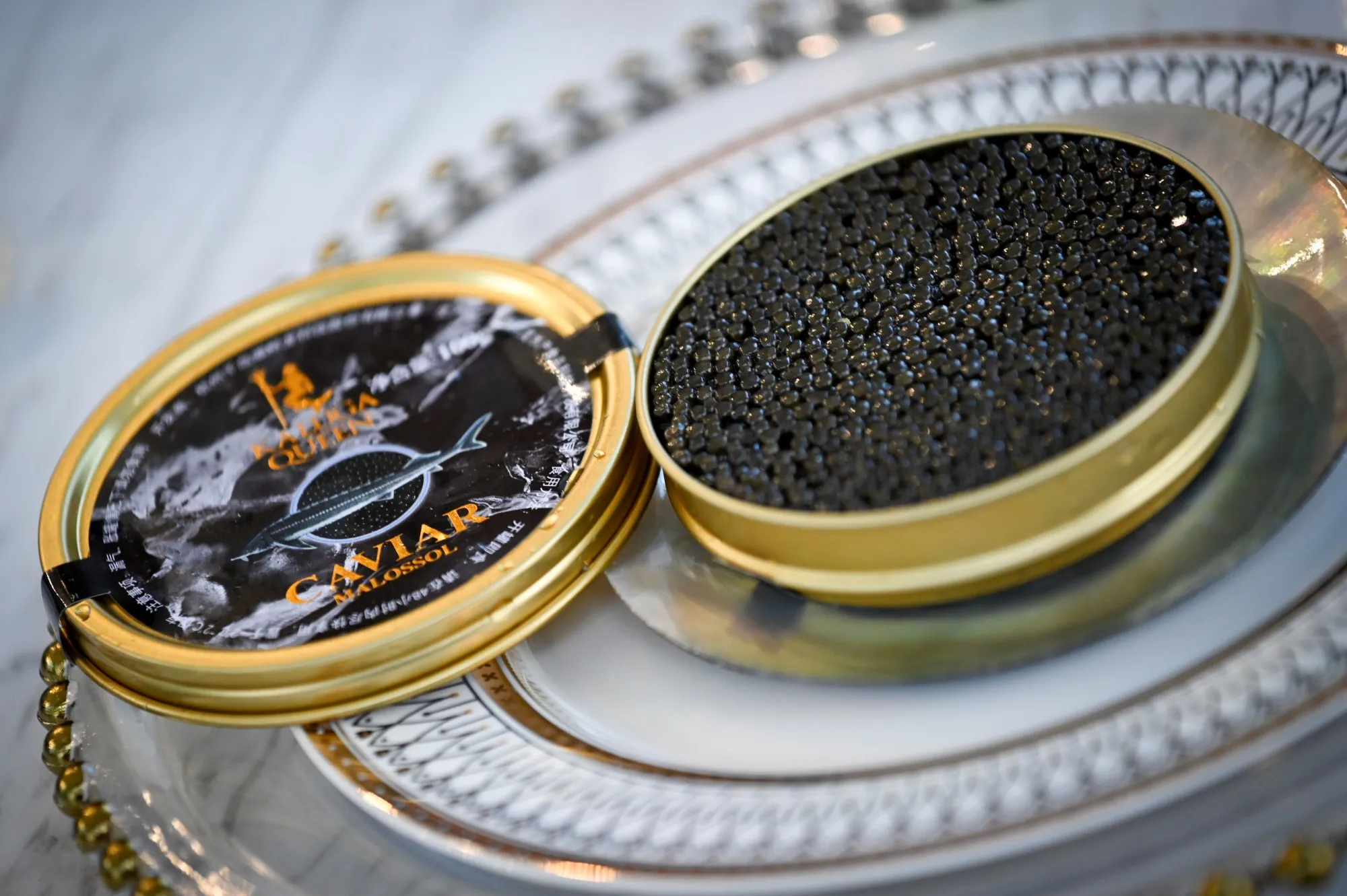
Core Product — Caviar: The Company’s flagship brand, KALUGA QUEEN, produces caviar from six sturgeon species — Siberian sturgeon, Russian sturgeon, the Company’s proprietary hybrid “Xunlong No. 1,” Kaluga sturgeon, beluga, and Amur sturgeon — giving it what management describes as the broadest product range in the industry. Caviar accounts for more than 90% of total revenue. The Company maintains a balanced age cohort of sturgeon stock spanning one to fifteen years, supporting a stable and predictable harvest cycle.
Revenue Mix — Overseas Concentration and the Brand-Versus-OEM Trade-off: Overseas sales accounted for between 76.7% and 80.9% of total revenue from 2022 through the first half of 2025. Within that overseas revenue, however, the Company’s own KALUGA QUEEN brand represented only 31% to 39%, with the remaining 61% to 69% sold under third-party brands (OEM/private-label arrangements) belonging to established overseas distributors with local consumer trust and existing distribution infrastructure. Management has characterized this structure as a deliberate strategy to accelerate market penetration by leveraging partners’ local credibility and operational reach.
| Product Line | Brand | Key Channels | Notes |
|---|---|---|---|
| Caviar (6 species) | KALUGA QUEEN | Airline first class, Michelin restaurants, department stores, gala events | 90%+ of revenue. Global #1; 36.1% market share in 2025 |
| Sturgeon meat & byproducts | Qiandao Xunlong | Hot pot & restaurant chains (incl. Haidilao), supermarkets | Steak, fish head, marinated fillet, bone soup, canned product, smoked fillet |
| Caviar-derived consumer products | KALUGA QUEEN | Domestic e-commerce (Tmall, JD, Douyin) | “Caviar+” lifestyle line — ice cream, chocolate, mooncakes, cakes |
Technology and Certification Base: The Company holds national-level certification as a premium sturgeon breeding farm and participated directly in drafting China’s national caviar industry standard. It has developed proprietary AI-based technology for automated sturgeon inventory counting and sex identification to improve aquaculture efficiency, and operates a HACCP-certified processing facility in Quzhou that combines traditional Russian and Iranian hand-processing techniques with modern low-temperature methods. A significant share of the Company’s research personnel originate from the Chinese Academy of Fishery Sciences, sustaining an ongoing technical advisory relationship.
Unlike a typical venture-backed company, Xunlong’s capital-raising history is not a sequence of private financing rounds but a fifteen-year record of repeated IPO attempts and setbacks dating back to 2011. Accounting uncertainty inherent to biological-asset valuation, combined with a dispersed shareholder base, contributed to three consecutive rejections in the A-share market. Following a voluntary delisting from the National Equities Exchange and Quotations (NEEQ) system in 2025, the Company redirected its listing ambitions to the Hong Kong Stock Exchange — its fifth attempt at going public.
The Company converted to a joint-stock structure in July 2010 to begin preparing for capital markets access. Later that year, shareholder Zixing Liangmei acquired roughly a 5% stake at RMB 3.90 per share. Regulators subsequently raised concerns that the scale of the Company’s purchases from this related party represented an outsized share of revenue and profit, contributing to the rejection of its October 2011 ChiNext listing application in August 2012.
The Company refiled its ChiNext application in September 2014 and was accepted for review. During the review period, Zixing Liangmei — in an unrelated sales-contract dispute — testified in court that a January 2012 inventory count record had reportedly been prepared to satisfy regulatory inspection requirements rather than to reflect actual data, an allegation that was not conclusively substantiated in subsequent legal proceedings but that nonetheless created reputational overhang. In 2018, the listing review committee ultimately rejected the application, citing concerns over the authenticity of overseas sales, the reasonableness of a roughly 70% gross margin, the verifiability of sturgeon inventory counts, and governance stability given the absence of a single controlling shareholder.
Shenzhen-listed Tewoo Group (002124.SZ), the parent of an animal-feed business, announced plans to acquire a 23.80% stake from existing shareholder William Houston for RMB 115 million, which would have made it Xunlong’s largest shareholder. The transaction was rejected at Xunlong’s shareholder meeting and did not proceed. Notably, a Tewoo-affiliated feed supplier, Ningbo Tewoo Feed, has continued to serve as one of Xunlong’s principal feed suppliers.
The Company filed for a Shenzhen Stock Exchange Main Board listing with the China Securities Regulatory Commission (CSRC) but never received formal acceptance notice. Reported areas of regulatory concern included the Company’s reliance on distributors for more than 77% of overseas sales — raising questions about end-market sales control and revenue recognition accuracy — and continued governance concerns linked to the absence of a controlling shareholder.
The Company completed listing guidance registration with the Beijing Stock Exchange in February 2024 and was admitted to the NEEQ (新三板) the following month. It voluntarily delisted roughly eighteen months later, in August 2025, citing “adjustments to its own strategic development” — widely interpreted as preparatory positioning ahead of a Hong Kong listing push.
The Company filed a Hong Kong Stock Exchange Main Board listing application with CITIC Securities and CITIC Securities International serving as joint sponsors. Management cited the exchange’s international capital markets access, diversified funding channels, and suitability for overseas business expansion as the rationale for the venue change. On December 26, 2025, the CSRC requested supplementary disclosure regarding whether use of proceeds involved overseas investment and whether related approval or filing procedures had been completed.
The Company cleared its Hong Kong Stock Exchange listing hearing on May 22, 2026. Shares were priced at HK$75.50 each, with the final offering of 16.33 million new shares raising net proceeds of approximately HK$1.15 billion (roughly $147 million). The retail tranche was oversubscribed 2,134 times and the international institutional tranche 19 times. Eight cornerstone investors — including BlackRock, which committed $30 million, and Barings — together purchased approximately 49.9% of the shares on offer. Shares opened 36.4% above the offer price on the June 30, 2026 trading debut and closed up 51% at HK$114.00.
Publicly available reporting reflects differing reference periods for the Company’s revenue and profit figures. Per the listing application filed in October 2025, revenue rose from RMB 491 million (2022) to RMB 577 million (2023) to RMB 669 million (2024), a 16.7% CAGR, while net profit rose from RMB 234 million to RMB 273 million to RMB 324 million over the same period, an 17.8% CAGR. Separately, media coverage following the June 2026 listing reported “the prior year’s” (2025) revenue at RMB 769 million (up 14.9% year-over-year) and net profit at RMB 363 million (up 17.8% year-over-year). The two figure sets do not reconcile precisely in terms of reference period or growth calculation. This report presents both for transparency and recommends that investors verify figures against the Company’s final annual report.
The caviar industry is defined by an extreme capital-intensive production cycle — female sturgeon require seven to twenty years to reach reproductive maturity — which creates a structurally difficult barrier to entry for new competitors. Xunlong has converted more than two decades of accumulated biological-asset investment and global distribution relationships into a dominant market position that would be exceptionally difficult to replicate.
The Company maintains a complete age-cohort breeding system spanning ages one through fifteen, supporting roughly 14,000 tons of live sturgeon inventory. New entrants face a minimum seven-year period with no caviar revenue, making this already-established, full-cohort inventory a structural barrier that cannot be replicated in the short term.
Xunlong has held the top position in global caviar sales volume every year since 2015, with a 2025 market share of 36.1% — more than four times that of the second-largest competitor. This reflects not merely scale economics but the cumulative effect of long-tenured farming expertise, buyer relationships, and quality reputation.
Exclusive first-class supply relationships with Lufthansa, Singapore Airlines, and Cathay Pacific, alongside placement at 27 Michelin three-star restaurants across Paris and New York and an appearance at the Academy Awards dinner, represent relationships that typically take years to establish — a brand-trust asset new entrants would struggle to acquire quickly.
National-level certification as a premium sturgeon breeding farm, a proprietary hybrid breed (“Xunlong No. 1”), and AI-based inventory counting and sex-identification technology together with direct participation in drafting China’s national caviar industry standard position the Company as a technical and regulatory standard-setter within the sector.
In-house control over breeding, farming, processing, branding, and distribution supports both quality assurance and cost control. Eight farming bases and two HACCP-certified processing facilities maintain traceability and consistent quality across the entire supply chain.
A growing line of caviar-derived consumer products — ice cream, chocolate, mooncakes, and cakes — extends the brand beyond traditional fine-dining contexts and is helping introduce caviar culture to younger Chinese consumers. With domestic revenue still representing roughly 20% of the total, management sees meaningful runway for further growth.
What BlackRock and Barings’ Cornerstone Participation Signals: The participation of BlackRock, the world’s largest asset manager, with a $30 million commitment — alongside long-only investor Barings — in an IPO of this relatively modest market capitalization is notable, given that offerings of this size typically fall below the minimum deployment threshold for many foreign long-only funds. This is broadly interpreted as a vote of confidence from international capital markets in the Company’s scarce sector positioning and long track record of profitability.
Xunlong is already a profitable, cash-generative business with a net margin of 58.3% in the first half of 2025 — a level that exceeded the comparable net margin of roughly 52.6% reported by Kweichow Moutai over the same period. Beneath this headline profitability, however, lies a set of accounting volatility and structural dependency risks characteristic of the agriculture and aquaculture sector.
As of year-end 2025, biological assets — sturgeon fry, immature and mature female sturgeon, and male sturgeon — carried a book value of approximately RMB 1.75 billion, representing 83.1% of total net assets. These assets are measured using Level 3 fair-value inputs based on unobservable assumptions, including estimated market prices and discount rates, which cannot be independently verified by outside investors through simple physical inspection. In 2024, a subsidiary in Liaoning suffered summer flood damage that reduced biological-asset fair value by approximately RMB 24.9 million, contributing to a gross margin of -2.9% (a gross loss) once fair-value changes were included — compared with a gross margin of 65% to 71% when fair-value changes are excluded. Investors should note the substantial divergence between these two measures.
Opportunities include: ▲ structural supply constraints stemming from the depletion of wild sturgeon stocks globally and the seven-to-twenty-year aquaculture cycle, which together create a high barrier to new entry; ▲ meaningful growth runway in the domestic Chinese market, which still represents only around 20% of total revenue, supported by mass-market crossover trends such as hot-pot and dessert collaborations; ▲ validation from international capital markets, evidenced by cornerstone participation from long-term investors such as BlackRock and Barings; and ▲ enhanced brand credibility from the Hong Kong listing, along with potential access to capital for future overseas M&A or strategic investment.
Risks include: ▲ the inherent subjectivity of biological-asset fair-value accounting and its exposure to natural disasters such as floods and heat waves; ▲ heavy reliance on overseas markets, which accounted for 80.9% of revenue in the first half of 2025, exposing the Company to geopolitical and trade-policy risk concentrated in the U.S. and Europe; ▲ the fact that more than 60% of overseas revenue is generated through third-party brand arrangements, limiting the Company’s direct control over end-consumer relationships and brand equity; ▲ supplier concentration, with the top five suppliers — primarily feed and sturgeon-stock providers — accounting for 60% to 69% of purchases; ▲ a governance reputation overhang stemming from three failed A-share listing attempts in 2011, 2014, and 2022, along with unresolved allegations raised in past related-party litigation; ▲ a dispersed shareholding structure with no single controlling shareholder; and ▲ approximately RMB 359 million in cumulative cash dividends paid to controlling shareholders between 2022 and the first half of 2025, concentrated in the period immediately preceding the IPO, which has drawn some market scrutiny.