
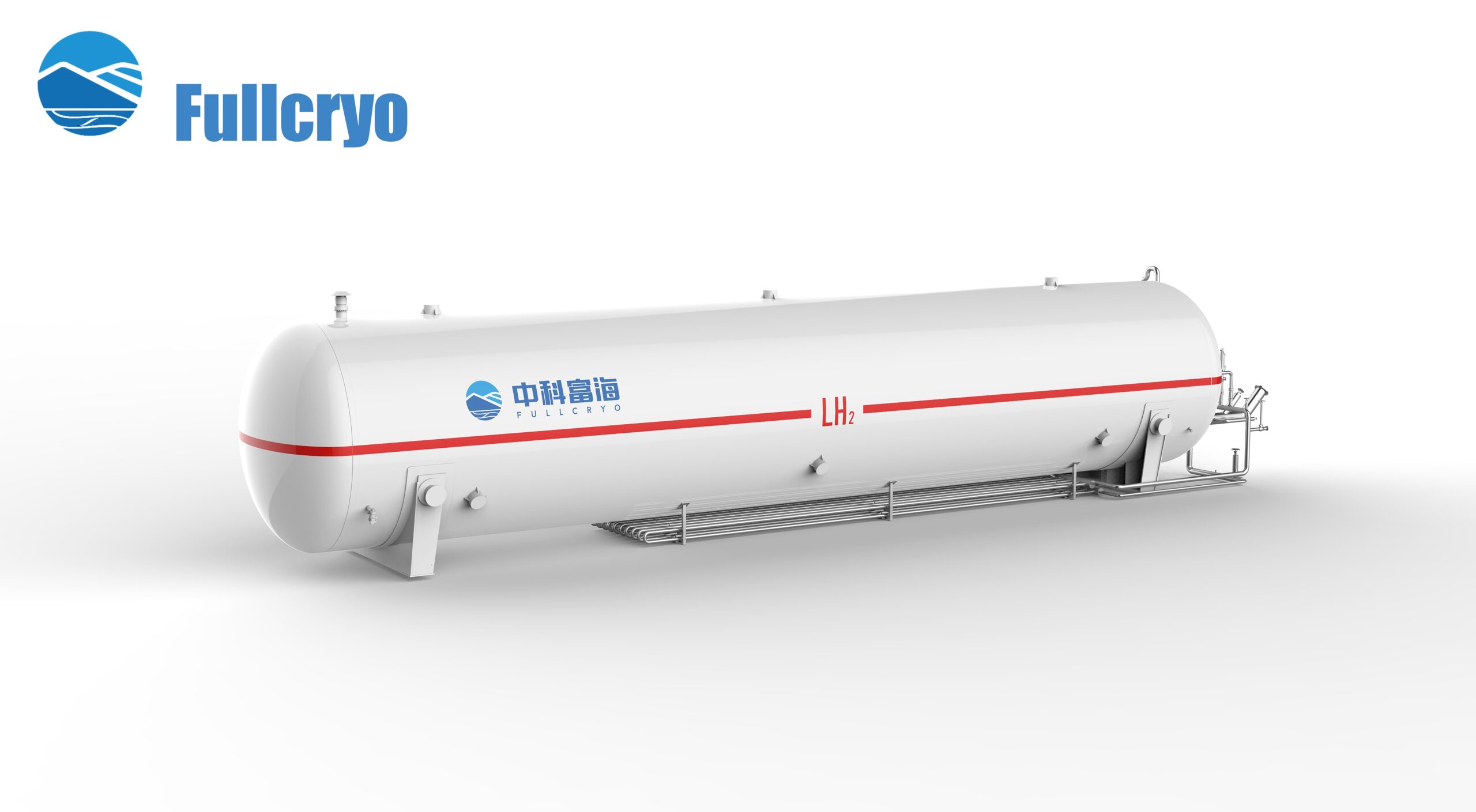
Fullcryo
A national-champion cryogenic equipment platform built on decades of cryogenic engineering research from the Chinese Academy of Sciences — China’s first, and the world’s third, fully self-IP large-scale cryogenic solutions provider spanning fusion energy, quantum technology, semiconductors and hydrogen energy
Fullcryo (formally Zhongke Fuhai Technology Co., Ltd., 中科富海科技股份有限公司) is an advanced equipment manufacturer founded in Beijing in August 2016, built on decades of large-scale cryogenic engineering achievements accumulated at the Technical Institute of Physics and Chemistry (TIPC) of the Chinese Academy of Sciences (CAS). Core cryogenic cooling technology spanning the liquid hydrogen and liquid helium temperature ranges was developed under two phases of a national major scientific instrumentation program commissioned by China’s Ministry of Finance to TIPC in 2010 and 2014 (cumulative funding of RMB 360 million). This technology base, combined with capital from the Beijing municipal and Haidian district governments together with social capital, gave rise to the company.
Holds a Ph.D. in Science. Previously served as Director of the Planning Department at TIPC, where he was responsible for long-term technology transfer and commercialization. In the company’s earliest days, he personally visited 40–50 investment institutions over roughly a year, most of whom praised the technology but declined to invest, citing uncertain commercial returns. He subsequently designed a multi-round, state-capital-anchored fundraising strategy that propelled the company to unicorn status.
A cryogenics specialist and operating executive with extensive prior experience at leading global cryogenic technology companies before joining Fullcryo. He oversees the industrialization strategy across the company’s four business segments — large-scale cryogenic equipment, strategic helium resources, industrial gas equipment, and domestic hydrogen-energy substitution — and has led academic-industry partnerships including with Xi’an Jiaotong University.
An undergraduate classmate of Gao Jinlin and a recognized international authority in cryogenics. He led the full development cycle of core components such as turbo-expanders, from theoretical design through to mass production. In his 50s, he reportedly spent three consecutive months sleeping on the factory floor alongside younger engineers to complete prototype validation — an episode that has become emblematic of the company’s engineering rigor.
Holds a Ph.D. and is a co-inventor (3rd contributor) on a Ministry of Education science and technology achievement, the “helium gas tangential-hole bearing turbo-expander,” and won third prize in the 2002 Jiangsu Province Science and Technology Progress Award. Designated a CAS “Key Technical Talent” in 2013, he is a career engineer in helium turbomachinery and oversees the company’s proprietary core component technology.
TIPC, an institute of the Chinese Academy of Sciences, holds a controlling interest in Fullcryo. The company’s four-party founding structure — combining the research institute, government, the founding team, and social capital — underpins both its continued participation in national large-scale science facility programs (e.g., heavy-ion accelerators, spallation neutron sources, the “artificial sun” fusion reactor) and its access to a steady pipeline of state-capital-backed follow-on financing.
Fullcryo holds fully proprietary core technology in the 20K–2K (−253.15°C to −271.15°C) temperature range — the only Chinese company to do so, and the third company globally with fully self-owned IP for large-scale cryogenic cooling equipment and systems solutions, after Germany’s Linde Group and France’s Air Liquide. The company has built a three-tier technology stack spanning industrial temperature ranges, liquid helium / superfluid helium temperature ranges, and ultra-low-temperature / quantum temperature ranges, positioning it as one of a small handful of platform-level innovators in China able to deliver complete cryogenic solutions from industrial applications through to the quantum regime.
Four Core Business Lines — Vertically Integrated From Basic Science to Hydrogen Energy:
Supplies sub-20K large-scale cryogenic cooling systems for national-level major science facilities — heavy-ion accelerators, spallation neutron sources, tokamak (“artificial sun”) fusion experiments — as well as ground-based aerospace testing. Its 850W@4.5K helium refrigerator has logged over 10,000 hours of stable operation at the Southern Advanced Light Source research platform.
Pioneered China’s first industrial-scale demonstration of helium extraction from natural-gas boil-off gas (BOG), producing helium at 99.9999% purity. Operates a BOG-to-helium demonstration plant in Ordos, Inner Mongolia, building a domestically self-sufficient supply chain for this strategically scarce gas.
Operates a domestically built 1.5 tonne/day liquid hydrogen facility in Fuyang, Anhui Province, producing 99.9999%-purity liquid hydrogen that has been successfully exported overseas. A large-scale cryogenic storage and transport equipment manufacturing base in Kaiping, Guangdong, representing an investment of over RMB 1.5 billion, is under construction, alongside a rare-gas (helium, neon, krypton, xenon) separation and purification business serving the semiconductor and electronics sectors.
The “Two-Legged” Strategy — Concurrent Technology Breakthroughs and Market Development: Rather than following the conventional lab-to-pilot-to-industrialization technology transfer sequence, Fullcryo adopted a parallel model of “researching while commercializing simultaneously.” The company invests an average of over RMB 50 million annually in R&D while deliberately avoiding reliance on government subsidy programs, instead reinvesting engineering and industrialization revenue back into R&D in a self-sustaining loop. This reflects Chairman Zhang Yanqi’s stated operating philosophy that “serving national strategy is our duty; realizing commercial value is our instinct.”
Geographic Expansion — Four National Regional Hubs: Fullcryo has established over 25 subsidiaries and production bases across four core regions: Ordos in Inner Mongolia (helium extraction), the Beijing-Tianjin-Hebei region (R&D and headquarters), the Yangtze River Delta (gas engineering), and the Guangdong-Hong Kong-Macao Greater Bay Area (cryogenic and hydrogen storage/transport equipment manufacturing). The company has also expanded overseas, completing air-separation EPCC and EPS projects in Malaysia and the United States respectively, validating the international competitiveness of its proprietary technology.
Since its 2016 seed round through the Pre-IPO round completed in June 2026, Fullcryo has raised capital across seven rounds, with state-owned and state-affiliated capital (“guozi”) playing a defining role as lead investor in nearly every round. Sinopec Capital and the CAS-affiliated Guoke Capital, among others, have led successive rounds, contributing not only capital but broader industrial-ecosystem resources beyond pure financial investment. Following its 2023 Series C, the company was valued at approximately RMB 7.8 billion and was named to China’s 2023 list of hydrogen-energy unicorns; it completed conversion to joint-stock company status in October 2024 and registered for STAR Market (Shanghai Science and Technology Innovation Board) listing guidance in October 2025.
The Beijing municipal and Haidian district governments stepped in with public investment to address a market failure in funding the technology’s commercialization. TIPC (Chinese Academy of Sciences), the Beijing municipal government, social capital (including Fuhui Venture Capital), and the founding team jointly capitalized the company, then named Beijing Zhongke Fuhai Cryogenic Technology Co., Ltd.
Secured angel investment through the Haidian Park Entrepreneurship Center, providing funding for early-stage R&D and prototype validation.
CICC Capital’s infrastructure fund led the company’s first large-scale institutional financing round. Shenzhen Capital Group, Zhongguancun Science City, and Fu Tu were among 12 co-investing institutions, providing the capital base needed for the company’s transition into full-scale industrialization.
Sinopec Capital, the investment arm of China Petroleum & Chemical Corporation (Sinopec Group), led this round via the Beijing Equity Exchange. Eight new strategic investors participated, including a Sinochem Capital-affiliated Shandong new-kinetic-energy fund, an Agricultural Bank of China-affiliated Beijing green fund, a Wuchan Zhongda-affiliated Hangzhou vehicle, a Zhike Chanetou-affiliated Xinyu hydrogen energy fund, and a CAS Star (Casstar)-affiliated Beijing hard-tech fund, alongside six existing shareholders including Shenzhen Capital Group and a TIPC-affiliated Chongqing fund. This influx of energy-sector capital became a key catalyst for industrializing the company’s hydrogen-energy business.
China Tongheng Group’s mixed-ownership reform fund and CCB Trust co-led this RMB 800 million round, the single largest hydrogen-energy financing in China for 2023. New investors China Reform State-Owned Capital, ICBC Investment, and Yuexiu Industrial Fund participated alongside follow-on investment from existing shareholders Xingye Guoxin, a TIPC-affiliated venture fund, and Casstar. The round resulted in the company’s inclusion on China’s official 2023 list of hydrogen-energy unicorns in September of that year.
Completed formal conversion from a limited liability company to a joint-stock company, establishing the corporate governance structure required for a public listing. Given uncertainty around STAR Market listing timing, the company also evaluated a Hong Kong listing as a parallel option.
Completed listing guidance registration with the Beijing bureau of the China Securities Regulatory Commission, marking the substantive first step toward a STAR Market (Shanghai Science and Technology Innovation Board) listing. Zhongtai Securities serves as lead underwriter, with Beijing Tongshang and Tianzhi International as legal and accounting advisors respectively; the guidance period runs from October 2025 to April 2026.
Guoke Capital, the investment platform affiliated with the Chinese Academy of Sciences, led this RMB 1 billion Pre-IPO round. A broad coalition of central and local state-owned enterprises, bank-affiliated investment institutions, and regional industrial capital participated, reinforcing the stable development of China’s domestic ultra-low-temperature equipment industry. The round was framed as a capital build-up to meet rising demand for cryogenic infrastructure across strategic emerging industries — fusion energy, quantum information, AI computing cooling infrastructure, hydrogen energy, aerospace testing, semiconductors, and advanced medical equipment — and represents the final combined private/state-capital raise ahead of the planned listing.
• Round Size: RMB 1.0 billion
• Lead Investor: Guoke Capital — investment platform affiliated with the Chinese Academy of Sciences
• Investor Composition: Central/state-owned enterprises, bank-affiliated investment institutions, regional industrial capital
• Strategic Significance: Final-stage capital infusion conducted in parallel with the A-share STAR Market listing guidance process initiated in October 2025
• Use of Proceeds: Scaling up mass production and industrialization of cryogenic equipment for fusion energy, quantum information, AI computing, and hydrogen energy applications
Fullcryo’s competitive moat rests on four pillars: foundational research assets accumulated across two generations of Chinese Academy of Sciences scientists; the technical scarcity of being one of only a handful of global players with proprietary IP in the sub-20K temperature range; a stable capital and demand base anchored in state-owned capital; and a vertically integrated business portfolio spanning basic science to industrial gases. Globally, the company competes against multinational industrial-gas conglomerates such as Germany’s Linde Group and France’s Air Liquide — companies with market capitalizations many times Fullcryo’s scale — but it has effectively secured a dominant position within the domestic Chinese market.
Fullcryo is the only company in China with fully proprietary IP for large-scale cryogenic equipment below 20K (−253°C to −271°C), and the third company globally, after Linde Group and Air Liquide. It is the only company able to simultaneously custom-build, lease, and operate 4.2K and 20K large-scale cryogenic equipment on a non-standard basis, and holds over 80% share of new cryogenic project awards within China.
TIPC’s controlling-shareholder position translates directly into preferential access to national-level major science facility programs — fusion experimental reactors, heavy-ion accelerators, spallation neutron sources — a trust asset that ordinary commercial equipment makers cannot quickly replicate, and the foundation enabling multi-round, state-capital-backed follow-on financing.
The same core cryogenic technology stack is applied simultaneously across major science facility equipment, strategic helium extraction, hydrogen liquefaction/storage/transport, and rare-gas purification for semiconductors. Concentrating a single R&D investment across multiple strategic emerging industries diversifies exposure to any single industry cycle while maximizing the leverage of market expansion.
For more than seven years, the company has sustained over RMB 50 million in average annual R&D reinvestment funded by engineering and industrialization revenue rather than government subsidies. Combined with RMB 740 million in 2024 revenue and seven rounds of cumulative capital raised, this has created a virtuous cycle in which technology leadership and financial discipline reinforce one another.
Next-Generation Growth Drivers — Expansion into Fusion, Quantum, and AI Computing Infrastructure: Fullcryo’s three-tier technology stack (industrial / liquid-helium / ultra-low-temperature and quantum temperature ranges) is rapidly extending beyond its traditional core customer base of major science facilities and hydrogen energy into emerging strategic industries — commercial fusion energy, quantum computing infrastructure, and superconducting cooling demand for large-scale AI compute. This expanding multi-sector demand profile is widely viewed as the central investment thesis behind the 2026 Pre-IPO round.